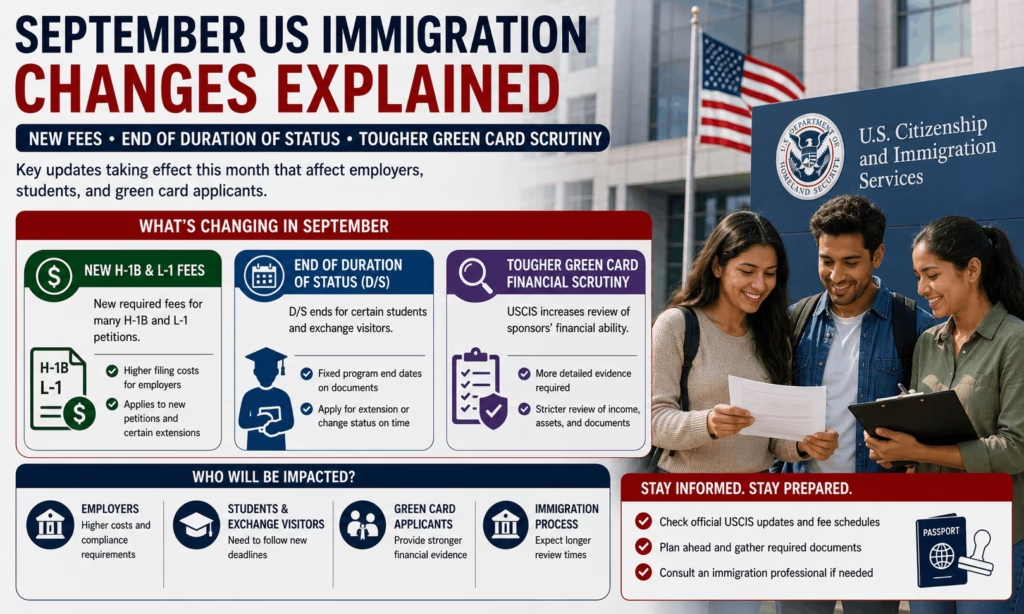
September US Immigration Changes: Five separate federal immigration rules take effect within a single 17-day window this month, and the timing is deliberately compressed rather than coincidental. Starting September 9, 2026, certain U.S. employers filing H-1B and L-1 extension petitions face a new $4,000 to $4,500 fee that didn’t previously apply to extensions with the same employer, and by September 18, green card applicants filing Form I-485 will be evaluated under a substantially broader financial scrutiny standard than the one that’s governed adjustment-of-status cases since 2022. For Indian nationals specifically, who represent the largest single nationality group in the U.S. H-1B program and one of the largest international student populations, this month’s changes carry outsized weight.
The September US immigration changes aren’t limited to one category of applicant either. F-1 students and J-1 exchange visitors lose a three-decade-old admission framework on September 15, the same day USCIS stops accepting older editions of two forms central to status extensions and work authorization. Taken together, these five changes touch nearly every stage of the employment-based and student immigration pipeline, from a new hire’s first work visa extension to a long-term resident’s final green card interview. We’ll be updating this article monthly as new immigration rule changes are confirmed.
Latest Update: The September 2026 Immigration Changes
| Change | Effective Date | Who It Affects |
|---|---|---|
| New H-1B/L-1 extension fee ($4,000 / $4,500) | September 9, 2026 | Employers with 50+ U.S. employees, majority in H-1B/L-1 status |
| End of Duration of Status (D/S) for F-1 and J-1 | September 15, 2026 | F-1 students, J-1 exchange visitors and scholars |
| New editions of Form I-539 and Form I-765 required | September 15, 2026 | Status extension and work authorization applicants |
| Revised public charge rule for green card applicants | September 18, 2026 | Adjustment of status (Form I-485) applicants |
| Mandatory revised Form I-485 | September 18, 2026 | All new green card adjustment filings |
| Maximum new fixed admission period for students | 4 years (2 years for English-language programs) | F-1 students under the new fixed I-94 system |
Change 1: H-1B and L-1 Extensions Get More Expensive
The most immediately costly change for employers takes effect September 9, 2026, when certain companies filing H-1B and L-1 extension-of-status petitions must pay the existing 9-11 Response and Biometric Entry-Exit Fee, previously applied mainly to new petitions, now extended to cover extensions with the same employer as well. The fee runs $4,000 for H-1B petitions and $4,500 for L-1 petitions.
Not every employer is affected. The fee specifically applies to companies with at least 50 U.S. employees where more than half the workforce holds H-1B, L-1A, or L-1B status, a threshold clearly targeted at large IT staffing and outsourcing firms rather than smaller individual sponsors. Amended petitions that don’t request an extension of the worker’s current status remain exempt from the new charge. For Indian IT and consulting companies, which sponsor a substantial share of the H-1B workforce, this represents a direct increase in the cost of simply retaining existing employees already working in the U.S., not just hiring new ones.
Change 2: The End of “Duration of Status” for F-1 and J-1 Visa Holders
Effective September 15, 2026, the Department of Homeland Security eliminates Duration of Status (D/S), the nearly 30-year-old system that let F-1 students and J-1 exchange visitors remain in the U.S. for as long as they stayed enrolled and maintained an active SEVIS record, with no fixed expiration date printed on their I-94.
In its place, students and scholars will receive a fixed “Admit Until” date tied directly to their program end date as listed on their Form I-20 or DS-2019, capped at a maximum of four years, or two years for English-language training programs. Crucially, this change applies retroactively to students already in the country, not only to new arrivals, meaning current F-1 and J-1 holders need to check their program’s actual end date against this new four-year ceiling. Anyone whose program runs longer than that window, common in some PhD and extended research programs, will need to file a formal Extension of Stay with USCIS rather than relying on continued enrollment alone. The grace period allowed after a program ends has also been shortened under the new framework, adding urgency for students whose programs are wrapping up around this transition.
Change 3: New USCIS Form Editions Become Mandatory
Also landing on September 15, 2026, USCIS will stop accepting older editions of two forms central to the immigration process for students, exchange visitors, and other nonimmigrants: Form I-539, used to extend or change certain nonimmigrant statuses, and Form I-765, used to apply for employment authorization, including standard OPT and STEM OPT work permits.
Applications filed on or after this date using outdated form editions face rejection, not just delay, meaning applicants need to confirm they’re using the current version before submitting anything close to this deadline. This detail is easy to overlook amid the bigger D/S policy change happening the same day, but a rejected filing due to an outdated form can cost weeks of processing time that many students, particularly those on a tight OPT timeline, genuinely cannot afford to lose.
10 New Canada Immigration Changes And Updates In September 2026
H-1B Spouse Work Permit at Risk: How Trump’s Latest Move Could Cut Family Incomes in Half
80% to 100% VA Disability: Why the Final Jump Is the Hardest One Veterans Face
Change 4: Green Card Applicants Face Broader Financial Scrutiny
The most consequential change for prospective permanent residents arrives September 18, 2026, when a revised public charge rule takes effect for adjustment-of-status applications. Under the new framework, immigration officers gain considerably more discretion to evaluate an applicant’s entire circumstances holistically, moving away from the narrower, more mechanical framework that has governed public charge determinations since 2022.
Factors officers can now weigh include an applicant’s age, health, family circumstances, financial position, education, and skills, alongside consideration of certain means-tested public benefits the applicant may have used. This shift mirrors the broader trend seen in USCIS’s separate May 2026 policy memorandum reframing Adjustment of Status itself as a discretionary benefit rather than a routine step, reinforcing that green card officers now have meaningfully wider latitude to weigh an applicant’s full financial and personal picture rather than checking eligibility boxes alone. The revised standard applies to relevant adjustment-of-status applications filed on or after September 18, meaning applicants with cases already pending under the prior framework aren’t automatically subject to the new criteria, though this distinction is worth confirming directly with an immigration attorney given how quickly related USCIS discretionary guidance has been evolving throughout 2026.
Change 5: A Mandatory New Form I-485 Edition
Tied directly to the public charge revision, September 18, 2026 also marks the date a revised Form I-485, Application to Register Permanent Residence or Adjust Status, becomes mandatory for all new filings. Applicants preparing a green card application around this date need to confirm they’re using the correct, current edition, since USCIS has shown a consistent pattern this year of rejecting outdated form versions outright rather than simply flagging them for correction.
For Indian applicants specifically, who face some of the longest employment-based green card backlogs of any nationality due to per-country visa caps, maintaining thoroughly organized financial and employment records has become considerably more important under this broader discretionary standard than it was even a year ago.
Why These Five Changes Are Landing Together This Month
It’s worth understanding why September specifically became the effective date for such a concentrated cluster of rules. Federal agencies frequently set new fee structures, form editions, and regulatory changes to take effect at the start of a new fiscal quarter or shortly after a rule’s mandatory public comment and implementation period concludes, and several of 2026’s most significant immigration policy shifts, including the May Adjustment of Status memo and ongoing TPS litigation, trace back to policy directions set earlier in the year that are only now reaching their scheduled implementation dates. The compressed timing means employers, students, and green card applicants dealing with multiple different processes simultaneously face an unusually dense stretch of deadlines rather than changes spread evenly across the calendar.
How to Prepare: Practical Steps for Each Affected Group
Given how many separate deadlines fall within the same two-and-a-half-week window, here’s a practical breakdown by category.
For H-1B and L-1 Employers
- Identify affected petitions by checking whether your company meets the 50-employee, majority-H-1B/L-1 workforce threshold.
- Budget for the new fee ($4,000 for H-1B, $4,500 for L-1) on any extension petition filed on or after September 9, 2026, for a worker remaining with the same employer.
- Review whether a filing qualifies as an amendment rather than an extension, since amended petitions not seeking a status extension remain exempt.
For F-1 and J-1 Students and Scholars
- Check your I-20 or DS-2019 program end date against the new four-year maximum admission period (two years for English-language programs).
- File for an Extension of Stay with USCIS proactively if your program will run past that fixed date, rather than waiting until close to the deadline.
- Confirm you’re using the current Form I-539 or I-765 edition for any application filed on or after September 15, 2026.
- Review your post-program grace period, since this window has been shortened under the new framework.
For Green Card (Adjustment of Status) Applicants
- Organize financial, employment, and educational records thoroughly ahead of filing, given the broader discretionary review now in effect.
- Confirm you’re using the revised Form I-485 for any application filed on or after September 18, 2026.
- Consult an immigration attorney about whether your specific case timing falls under the prior or revised public charge framework.
Processing Time for These Applications
None of these five changes come with a published, accelerated processing timeline; if anything, applicants should expect the opposite in the near term. Rejected filings due to outdated form editions restart the processing clock entirely, and the broader discretionary review now applied to green card cases may extend adjudication time for applications requiring officers to evaluate a fuller financial and personal picture rather than a narrower checklist. USCIS’s separate FY2026-2030 Agency Strategic Plan does set a goal of reducing overall wait times agency-wide, but that goal applies to disability-adjacent claims metrics rather than these specific student and employment categories.
What This Means for Fees and Payment Obligations
Beyond the new $4,000/$4,500 H-1B and L-1 extension fee, none of the other four changes introduce a new standalone government fee; the cost impact instead comes from the risk of a rejected filing under an outdated form edition, which forces applicants to refile and, in some cases, repay standard filing fees a second time. Employers budgeting for H-1B and L-1 renewals this fall should treat the new fee as a direct, unavoidable cost added specifically to same-employer extensions, distinct from the separate H-1B fees introduced earlier in 2026 for new petitions.
How This Fits Into 2026’s Broader Immigration Pattern
These five September changes don’t exist in isolation, they’re the latest entries in a year that has already reshaped several major areas of U.S. immigration policy. Earlier in 2026, a separate presidential proclamation restricted entry for certain H-1B workers, and USCIS introduced its own distinct new fee structure for H-1B cap-subject petitions, changes that applied specifically to new hiring rather than the extension-focused fee taking effect this September. The Adjustment of Status policy memorandum from May 2026, which reframed green card approval as a discretionary benefit rather than a routine step, laid much of the groundwork for the broader public charge scrutiny now formally taking effect this month, meaning the two policies work together rather than as isolated, unrelated changes.
International students have faced their own separate wave of scrutiny throughout the year as well, including increased federal attention on foreign student employment compliance at U.S. colleges and universities, alongside the significant increase in the Canada study permit financial requirement to $23,448 that took effect September 1, 2026, a reminder that this kind of tightening isn’t limited to U.S. policy alone but reflects a broader pattern across major English-speaking study destinations this year. For applicants and employers trying to track cumulative risk across an entire immigration case, rather than reacting to each announcement individually, understanding how these pieces connect matters more than treating any single September deadline as an isolated event.
What Happens If You Miss One of These September Deadlines
Given how compressed this month’s timeline is, it’s worth being direct about the consequences of missing a specific date rather than assuming a grace period will apply universally. Filing an H-1B or L-1 extension petition after September 9 without accounting for the new fee typically results in a Request for Evidence or outright rejection for insufficient payment, adding weeks to an already time-sensitive process for workers whose current status may be nearing expiration. F-1 and J-1 holders who don’t confirm their new fixed admission date under the end of Duration of Status risk falling out of status without realizing it, since the shift from an open-ended framework to a fixed end date changes what “maintaining status” actually requires going forward. Green card applicants who file using an outdated Form I-485 after September 18 face a straightforward rejection, losing any priority date advantages tied to timely filing and potentially affecting family-based or employment-based case timing that depends on when a complete application is properly received. In every one of these scenarios, the safest response is confirming current requirements directly through official USCIS channels before submitting anything, rather than relying on a form or fee schedule saved from even a few months earlier.
SSA Ticket to Work Program: How Disability Beneficiaries Can Return to Work Without Losing Benefits
SSA Strategic Plan FY2026-2030: New Goals, Wait Times & Service Targets
SSI Address Change Service Enhancements: SSA’s New Fast-Track Process Explained
IRS Confirms Payments of Up to $8,231: Who Qualifies for the EITC in 2026
Official Resources for September 2026 Immigration Changes
Always confirm the latest form editions, fees, and eligibility rules directly through these official government channels.
| Resource | Purpose | Official Link |
|---|---|---|
| USCIS Forms page | Confirm current editions of Form I-539, I-765, and I-485 | uscis.gov/forms |
| USCIS H-1B program page | Extension rules, fees, and petition requirements | uscis.gov/working-in-the-united-states/h-1b-specialty-occupations |
| USCIS L-1 visa program page | L-1A/L-1B extension rules and fee information | uscis.gov/working-in-the-united-states/l-1a-l-1b |
| SEVP / Study in the States | Official guidance on the end of Duration of Status | studyinthestates.dhs.gov |
| USCIS Adjustment of Status | Public charge rule and Form I-485 filing guidance | uscis.gov/green-card/green-card-processes-and-procedures/adjustment-of-status |
| myUSCIS online account (login) | Track filings and case status | my.uscis.gov |
| Federal Register | Official published text of each rule change | federalregister.gov |
Conclusion
The September US immigration changes landing across a tight 17-day window this month, from the new H-1B and L-1 extension fee on September 9, to the end of Duration of Status and mandatory new form editions on September 15, to the revised public charge standard and Form I-485 edition on September 18, together mark one of the most concentrated stretches of immigration policy implementation of the year. For employers, students, and green card applicants alike, the practical response is the same regardless of category: confirm the exact date your specific filing falls under, use the current form edition without exception, and treat the broader discretionary standards now shaping both student status and green card review as reasons to prepare documentation more thoroughly than the prior framework ever required.
FAQs About September US Immigration Changes
What is the new H-1B and L-1 extension fee effective September 2026?
Starting September 9, 2026, employers with at least 50 U.S. employees where more than half hold H-1B, L-1A, or L-1B status must pay $4,000 for H-1B extension petitions and $4,500 for L-1 extension petitions, even when the worker is continuing with the same employer.
What happens to F-1 students under the end of Duration of Status?
Starting September 15, 2026, F-1 students no longer receive open-ended admission tied to enrollment status. Instead, they receive a fixed “Admit Until” date tied to their program end date, capped at four years, or two years for English-language programs, requiring a formal Extension of Stay filing if more time is needed.
Does the end of Duration of Status apply to students already in the U.S.?
Yes. The change applies retroactively to students and exchange visitors already present in the country, not only to new arrivals starting programs after September 15, 2026.
What is changing with the green card public charge rule in September 2026?
Starting September 18, 2026, immigration officers gain broader discretion to evaluate a green card applicant’s overall circumstances, including age, health, family situation, financial position, education, and skills, moving away from the narrower 2022 public charge framework.
Do I need to use a new Form I-485 for my green card application?
Yes. A revised Form I-485 becomes mandatory for adjustment-of-status filings submitted on or after September 18, 2026. Applications filed using the outdated edition after that date risk rejection.
Will using an old Form I-539 or I-765 after September 15 get my application rejected?
Yes. USCIS will reject, not simply flag for correction, applications filed on or after September 15, 2026 using outdated editions of Form I-539 or Form I-765.
Are these changes specific to Indian applicants, or do they affect everyone?
These rules apply to all nationalities equally, but Indian nationals face outsized practical impact given their large share of the H-1B workforce and international student population, along with some of the longest employment-based green card backlogs due to per-country visa caps.
Where can I check my current visa or student status details?
F-1 and J-1 holders should check their I-20 or DS-2019 directly for their program end date, while all applicants can verify current form editions and filing requirements through the official USCIS website before submitting any application.
IRCC Tightens Citizenship by Descent: What the New 1,095-Day Presence Test Rules Mean for Applicants
September 2026 Refund Payments: All the Real Deposits You Could Actually Get This Month
Social Security Proposals in Congress: What Changes Could Affect Your SSI and SSDI Benefits