Canada Study Permit Proof of Funds Increase: International students planning to study in Canada have a new number to remember, and it is a bigger one than before. Starting September 1, Immigration, Refugees and Citizenship Canada (IRCC) has raised the minimum proof of funds that a single applicant must show before a study permit can be approved. The amount has moved from 22,895 dollars to 23,448 dollars for a single applicant, an increase of 553 dollars, and the numbers go up further for students bringing a spouse or children. This is not a small paperwork update. For thousands of applicants from India, Nigeria, the Philippines, Vietnam and other major source countries, this single figure can decide whether a study permit application is approved or refused. We’ll be updating this article monthly as IRCC releases further clarifications, so bookmark this page if you are applying in the coming months.
The timing matters just as much as the number. Anyone who submits a complete study permit application before September 1 is assessed against the older, lower threshold. Anyone submitting on or after that date must meet the new figure, regardless of when they were accepted by their college or university. Immigration lawyers are already warning that this single date could catch out families who assumed their bank balance from a few months ago would still be enough. Coming on top of a national cap on study permits, tighter co-op work rules and a shrinking list of programs eligible for a post-graduation work permit, this financial change adds one more layer of pressure on a system that international students already describe as far stricter than it was even two years ago.
Why Canada Is Raising the Proof of Funds Requirement Again
Canada does not set this number randomly. The financial requirement is tied to Statistics Canada’s Low Income Cut Off, commonly known as LICO, which measures the income a household needs to avoid financial hardship in a Canadian city. IRCC has confirmed that the study permit financial requirement reflects roughly 75 percent of this LICO benchmark, and the figure is reviewed and adjusted every year on September 1. Because LICO moves with inflation and the real cost of rent, groceries and transport, the proof of funds number for students has climbed every year since a major overhaul in 2024.
Before 2024, the requirement had stayed frozen at 10,000 dollars for more than two decades, a figure that no longer reflected the actual cost of living in cities like Toronto, Vancouver or Montreal. IRCC more than doubled it to 20,635 dollars from January 2024, then raised it to 22,895 dollars in September 2025, and now to 23,448 dollars from September 2026. The government’s stated goal is straightforward: to stop students from arriving in Canada with too little money, which has historically pushed some international students into unsafe housing, exploitative jobs, or serious financial distress within weeks of landing.
New Proof of Funds Amount 2026
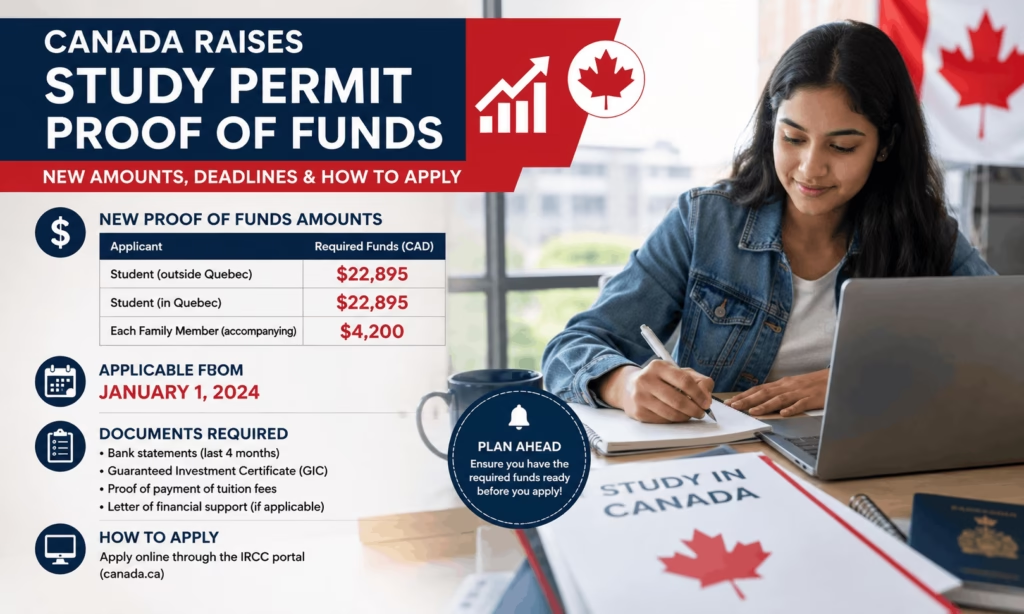
The table below sets out the confirmed figures for study permit applications submitted on or after September 1, alongside the amount that applied before the change. These figures apply to all provinces and territories except Quebec, which runs its own financial assessment through the Quebec Acceptance Certificate process.
| Applicant Category | Amount Before September 1 | New Amount From September 1 | Increase |
|---|---|---|---|
| Single applicant (student only) | 22,895 dollars | 23,448 dollars | 553 dollars |
| Applicant with two accompanying family members (family of three) | 35,040 dollars | 35,888 dollars | 848 dollars |
| Applicant with additional family members | Increases per family size | Increases per family size | Ranges up to 1,465 dollars for larger families |
A few points make this table easy to misread if you rush through it. First, family size includes the applicant, their spouse or common-law partner, and every dependent child, whether or not those family members are actually travelling to Canada. Second, this amount covers living expenses only. It does not include tuition fees or the cost of a return ticket. A student must separately show proof of first-year tuition, proof of the new living expense amount, and proof of funds for transportation to and from Canada. For a single applicant facing an average tuition bill of 18,000 to 20,000 dollars plus airfare, the real total requirement is often well above 40,000 dollars, not the 23,448 dollars figure that headlines tend to highlight.
IRCC’s own public page on financial support had not fully updated its family-size table by the time this rule took effect, so students should always cross-check the exact figure for their family size directly on the official IRCC website before submitting documents, since institutional guidance can occasionally run slightly ahead of the government’s own published tables.
SSA Ticket to Work Program: How Disability Beneficiaries Can Return to Work Without Losing Benefits
SSA Strategic Plan FY2026-2030: New Goals, Wait Times & Service Targets
SSI Address Change Service Enhancements: SSA’s New Fast-Track Process Explained
IRS Confirms Payments of Up to $8,231: Who Qualifies for the EITC in 2026
What Documents Count as Valid Proof of Funds
IRCC does not accept vague assurances of financial support. Every document submitted has to show that the money is real, accessible, and legally the applicant’s own, not borrowed at the last minute or simply promised by a relative. The accepted categories include:
A Guaranteed Investment Certificate of at least the new required amount from a participating Canadian financial institution. This remains the most commonly recommended option for first-time applicants because it is issued directly in the student’s name and is easy for a visa officer to verify.
Proof of a student or education loan from a recognised bank or lending institution, showing the sanctioned amount and disbursement schedule.
Bank statements covering at least the last four to six months, showing a stable balance history and a clearly traceable source of funds rather than a single large deposit appearing just before the application.
A bank draft that can be converted into Canadian dollars.
Receipts confirming that tuition and residence fees for the first year have already been paid.
A signed letter of financial support from a sponsor, accompanied by that sponsor’s own bank statements, salary slips, or business records, since a letter on its own carries very little weight with a visa officer.
Officers frequently flag a few recurring problems: a large unexplained deposit shortly before the application date, funds held by a third party with no supporting sponsor documentation, and no visible financial plan for the second or third year of a multi-year program. Applicants relying on the old figures from before September 1 are another common and entirely avoidable reason for refusal this year.
How the Proof of Funds Rule Fits Into Canada’s Wider Study Permit Overhaul
This financial change does not exist in isolation. It lands in the middle of one of the most significant tightening cycles Canada’s international education sector has seen in years. Canada plans to issue up to 408,000 study permits in the current year, made up of roughly 155,000 new arrivals and 253,000 extensions. That national target is around 7 percent lower than the previous year and 16 percent lower than two years earlier, meaning competition for a limited number of capped spots is only getting sharper.
Most post-secondary applicants still need a Provincial or Territorial Attestation Letter, commonly called a PAL or TAL, before IRCC will even process their study permit application. There is one meaningful exception worth knowing about: from January 1, master’s and doctoral students applying to public designated learning institutions are exempt from both the national cap and the attestation letter requirement altogether, removing a paperwork step and, in many cases, a deposit that used to add extra cost and delay.
Post-Graduation Work Permit rules have also shifted. Students at private colleges that simply license a public college’s curriculum remain ineligible for a PGWP, a rule that was reinforced in 2025 and continues to trip up applicants who choose cheaper private pathways without checking eligibility first. On a more positive note for graduate students, those completing a master’s degree can now receive a three-year PGWP even if their program runs for less than two years, provided it lasted at least eight months and was completed at a designated learning institution.
Spousal work permits have narrowed considerably too. Open work permits for spouses are now generally restricted to partners of students enrolled in master’s, doctoral, or select professional degree programs, and dependent children of international students are no longer eligible for open work permits at all. Meanwhile, from April 1, post-secondary international students no longer need a separate work permit to complete co-op placements, internships, or practicums that are a mandatory part of their program, which is one of the few genuine simplifications in an otherwise stricter system. Students taking short prerequisite courses before starting a longer program are also now issued shorter study permits, typically valid for only 90 days beyond the length of the prerequisite course, rather than the older formula of the course length plus a full year.
How to Apply Under the New Financial Requirement
Applying for a Canada study permit under the updated rule follows the same overall process as before, but the financial documentation stage now needs extra care.
Start by confirming your letter of acceptance from a designated learning institution, since this document is required before any study permit application can move forward. Next, gather your proof of funds evidence based on your exact family size, making sure every figure matches the table effective from September 1 rather than an older number pulled from a college brochure or a friend’s application from last year. Pay your tuition deposit or first-year fees and keep the official receipt, since this can offset part of what you need to demonstrate separately as living expenses. Complete your biometrics if required, and submit your application along with a clear financial plan for every year of your program, not just the first one. Applicants studying in Quebec follow a separate track and must first obtain a Quebec Acceptance Certificate before applying for the study permit itself.
Study Permit Processing Time in the Current Cycle
Processing times have lengthened this year because of a combination of high application volumes, tighter provincial caps, and country-specific backlogs. Study permit processing generally continues to take several weeks once an application is complete, though it varies heavily by country of application and time of year, with peak intake months typically seeing longer queues. Work permit extensions linked to student pathways are currently averaging around 15 months in some categories, a sharp reminder that students planning to extend their stay should start the renewal process well ahead of their permit’s expiry date rather than waiting until the final weeks. Because processing benchmarks shift frequently, applicants should always check the live processing time tool on the official IRCC website closer to their submission date rather than relying on a number quoted in any single article.
Payment Schedule: What You Actually Need to Pay and When
Understanding the payment schedule alongside the proof of funds requirement avoids a lot of last-minute panic. The study permit application fee itself is paid to IRCC at the time of submission. Separately, most designated learning institutions require a tuition deposit, often the first semester or first year’s fees, to be paid before they issue the final letter of acceptance that IRCC needs to see. Living expense funds, unlike tuition, generally do not need to be transferred to Canada before arrival. They need to be demonstrated as available, whether sitting in a GIC, a home-country bank account, or a sponsor’s account with supporting documents. Return transportation costs should also be budgeted for separately, since IRCC treats this as its own category rather than folding it into the living expense figure. Students should also factor in the biometrics fee where applicable and, for many provinces, mandatory health insurance premiums that are billed separately once classes begin.
IRCC Tightens Citizenship by Descent: What the New 1,095-Day Presence Test Rules Mean for Applicants
September 2026 Refund Payments: All the Real Deposits You Could Actually Get This Month
Social Security Proposals in Congress: What Changes Could Affect Your SSI and SSDI Benefits
Official Canada Study Permit Resources
Always rely on government sources rather than third-party estimates when finalising an application. The table below lists the official links most students will need.
| Purpose | Official Link |
|---|---|
| Study permit application and eligibility | canada.ca/en/immigration-refugees-citizenship/services/study-canada/study-permit.html |
| Proof of financial support requirements | canada.ca/en/immigration-refugees-citizenship/services/study-canada/study-permit/get-documents/financial-support.html |
| Check application status | canada.ca/en/immigration-refugees-citizenship/services/application/account.html |
| Processing times tool | canada.ca/en/immigration-refugees-citizenship/services/application/check-processing-times.html |
| List of designated learning institutions | edu-canada.ca or the province’s official DLI list linked from IRCC |
| Quebec Acceptance Certificate (CAQ) | quebec.ca (Immigration, Francisation et Intégration section) |
Canada Study Permit Proof of Funds Increase Key Dates & Highlights
| Date or Detail | What It Means |
|---|---|
| September 1 | New proof of funds amount of 23,448 dollars for a single applicant comes into effect |
| Applications before September 1 | Assessed against the older 22,895 dollar threshold |
| January 1 | Master’s and PhD applicants at public institutions exempted from the national cap and PAL/TAL requirement |
| April 1 | Post-secondary students no longer need a separate work permit for mandatory co-op or internship placements |
| Annual review, every September 1 | IRCC revises the proof of funds figure based on Statistics Canada’s LICO data |
| National target for the year | Up to 408,000 study permits, including about 155,000 new permits and 253,000 extensions |
What This Means for Indian and Other International Students
India has historically sent the largest single group of international students to Canada, and this population has been the most exposed to every round of tightening since 2024. Study permit holders in Canada fell from more than one million at the start of that year to around 725,000 within roughly a year and a half, driven by the national cap, stricter attestation rules, and a general cooling in demand as the process became costlier and less predictable. For families in India, Nigeria, the Philippines and Vietnam, the new proof of funds figure adds pressure at exactly the stage where many applications already fail: demonstrating a believable, well-documented financial picture rather than a hurried, unverifiable one. Education consultants are now advising students to lock in their financial documents at least two to three months before their intended application date, so they are not caught mid-process by the September revision or a future one.
TPS Terminations 2026: Complete Tracker for Somalia, Ethiopia, South Sudan, Syria, Haiti, and Yemen
USCIS Ukraine TPS EAD Extension: Work Permits Automatically Extended Through October 19, 2026
BC PNP Entrepreneur Immigration Draw Invites 16 Business Candidates in Latest Round
FAQs About Canada Study Permit Proof of Funds Increase 2026
What is the new Canada study permit proof of funds amount?
For applications submitted on or after September 1, a single applicant must show 23,448 dollars in living expenses, up from 22,895 dollars, for all provinces except Quebec.
Does the proof of funds amount include tuition fees?
No. The figure covers living expenses only. Tuition and return transportation must be shown as separate amounts on top of this number.
What happens if I already submitted my application before September 1?
Your application continues to be assessed under the previous, lower threshold that was in effect on the date you submitted a complete application.
Do current students on a valid study permit need to show the new amount?
No, not immediately. However, if you apply to extend or renew your study permit on or after September 1, your renewal will be assessed against the new figure.
Is the requirement different for students going to Quebec?
Yes. Quebec assesses financial capacity separately through the Quebec Acceptance Certificate process rather than IRCC’s national table.
Can I use a sponsor’s bank account instead of my own?
Yes, but a sponsor letter alone is not enough. You must also submit the sponsor’s own financial documents, such as bank statements or salary proof, showing they genuinely have the funds available.
How often does Canada change the proof of funds requirement?
IRCC reviews and typically adjusts this figure every year on September 1, based on Statistics Canada’s Low Income Cut-Off data.
Will study permit processing take longer because of this change?
The financial rule itself does not directly slow processing, but it sits alongside high application volumes and provincial caps that have already extended waiting periods this year.
Conclusion
The jump from 22,895 dollars to 23,448 dollars might look modest on paper, but for a system already squeezed by national caps, attestation letters, narrower spousal work permit rules and a shrinking PGWP eligibility list, it is one more test that international students must clear before they can even book a flight to Canada. The safest approach for anyone applying in the coming months is simple: check the exact figure for your family size directly on IRCC’s website, gather documents that clearly show where your money came from, and build in tuition and travel costs on top of the living expense number rather than treating it as the full picture. Canada remains a major destination for higher education, but getting the paperwork right on the first attempt now matters more than ever.
H-1B Spouse Work Permit at Risk: How Trump’s Latest Move Could Cut Family Incomes in Half
80% to 100% VA Disability: Why the Final Jump Is the Hardest One Veterans Face
FY2027 Government Shutdown Risk: Congress Races the September 30 Funding Cliff
Florida Minimum Wage Reaches $15/Hour: The Final Step of a Six-Year Countdown Arrives September 30
IRS Seize Bank Accounts, Vehicles and Property From Taxpayers Who Ignore This Final Notice
Manitoba EIA Payment and CDB Exemption: What Changes and What Stays Protected in 2026