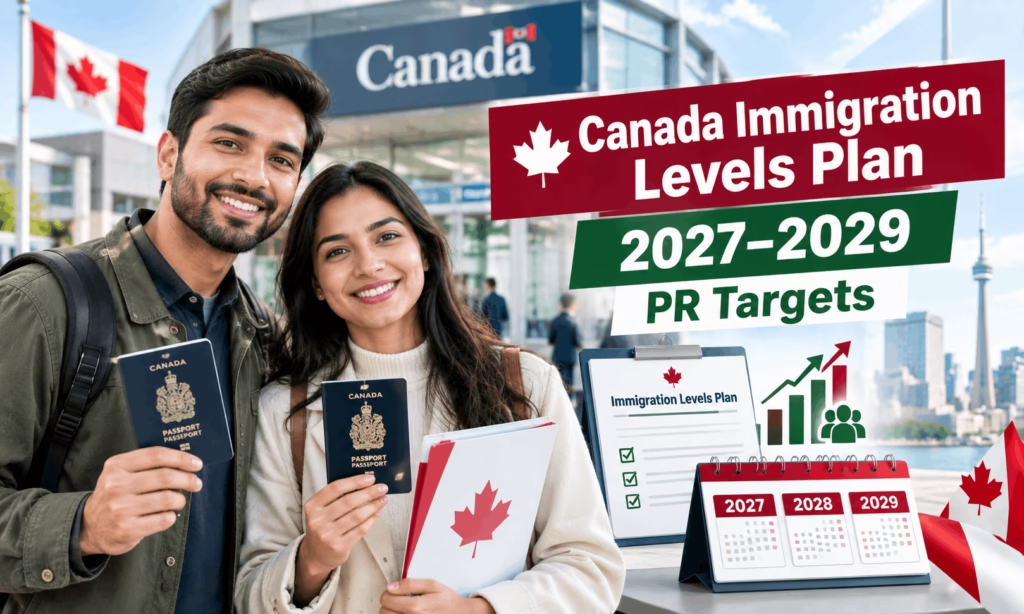
Canada Immigration Levels Plan 2027-2029: Canada’s next Immigration Levels Plan 2027-2029 is now in its final drafting stage inside Immigration, Refugees and Citizenship Canada, with the federal government legally required to table the document in Parliament by November 1, 2026. The plan will set the exact number of permanent residents Canada admits each year through 2029, decide how many spots go to Express Entry, the Provincial Nominee Program, family sponsorship and refugees, and confirm whether Ottawa continues shrinking the temporary resident population toward its stated goal of under 5 percent of the total population by the end of 2027. Until the new numbers are tabled, the current 2026-2028 Immigration Levels Plan remains the official baseline, holding permanent resident admissions at 380,000 per year and temporary resident arrivals at 385,000 for 2026, dropping to 370,000 in both 2027 and 2028. We’ll be updating this article monthly as new details, consultation findings and the final tabled numbers become available.
The stakes behind this plan are unusually high. Canada’s immigration system went through its sharpest correction in decades between 2024 and 2026, after years of record-high arrivals collided with a housing shortage and a strained rental market. The government responded by cutting overall permanent resident targets from a planned 500,000 down to 395,000 and then to 380,000, while simultaneously capping international student permits and tightening work permit eligibility. The 2027-2029 Immigration Levels Plan will show whether that correction is now considered complete, whether targets hold steady, or whether further reductions are coming. For prospective immigrants, international students, employers relying on foreign labour, and families waiting on sponsorship applications, this single document will shape Express Entry draw sizes, Provincial Nominee Program allocations and processing speed for the next three years.
What Is the Immigration Levels Plan and Why the 2027-2029 Version Matters?
Under the Immigration and Refugee Protection Act, Canada’s immigration minister must table an annual report to Parliament that includes a multi-year Immigration Levels Plan, covering the current year plus the following two years. This report sets numerical targets for permanent resident admissions by category, and since the 2025-2027 plan, it also sets targets for new temporary resident arrivals, including international students and foreign workers. The plan does not decide who gets approved; it sets the ceiling and floor for how many people across each program can be admitted, which in turn drives how many Express Entry invitations go out, how large each province’s nominee allocation is, and how quickly family sponsorship and refugee files move.
The 2027-2029 edition matters more than most because it lands at the point where several of the government’s stated policy commitments come due. Ottawa has promised to bring the temporary resident share of the population below 5 percent by the end of 2027 and to stabilize permanent resident admissions under 1 percent of the population after that point. Both targets converge in this plan, making it the first release that will show concretely whether the multi-year immigration reduction strategy launched in 2024 is being extended, held flat, or reversed.
USCIS Addis Ababa Field Office: New International Office Opens September 9
Is It Hard to Refinance Student Loan, and What Are the Pros and Cons of Doing It?
Tax Filing Season 2027: IRS Start Date, Deadlines and Refund Schedule
When Will Canada Release the Immigration Levels Plan 2027-2029?
IRCC opened its public input window for the plan on May 12, 2026, and after an initial deadline of June 14 was extended, the consultation closed on June 30, 2026. The department is now reviewing the responses alongside economic forecasts, labour market data, Parliamentary Budget Officer projections and input from provinces and territories before finalizing the numbers for Cabinet approval.
| Milestone | Date | Status |
|---|---|---|
| Public consultation opens | May 12, 2026 | Completed |
| Consultation deadline (extended) | June 30, 2026 | Completed |
| IRCC reviews responses and economic data | Summer through early fall 2026 | In progress |
| Final consultation report expected | October 2026 | Estimated |
| Statutory deadline to table plan in Parliament | November 1, 2026 | Confirmed by law |
| New levels take effect | January 2027 | Confirmed |
The November 1 date is a legal deadline under the Immigration and Refugee Protection Act, not a suggestion, though the government can table the report within 30 sitting days if Parliament is not in session on that date. Last year’s 2026-2028 plan was released shortly after the usual deadline, so a short slip into November is not unusual.
Canada’s 2026-2028 Immigration Levels Plan
Because the 2027-2029 numbers are not yet public, every projection has to start from the plan currently in force. Released in November 2025, the 2026-2028 plan holds permanent resident admissions flat at 380,000 per year across all three years, a marked pullback from the 500,000 target once planned for 2025 before the mid-decade correction.
| Category | 2026 Target | 2027 Target | 2028 Target |
|---|---|---|---|
| Total permanent resident admissions | 380,000 | 380,000 | 380,000 |
| Express Entry (economic federal) | approximately 109,000 | approximately 111,000 | approximately 111,000 |
| Family class (spouses, partners, parents) | 84,000 | 81,000 | 81,000 |
| Refugees and protected persons | 49,300 | 49,300 | 49,300 |
| Temporary resident arrivals (new students and workers) | 385,000 | 370,000 | 370,000 |
The plan’s temporary resident targets, introduced for the first time in the 2025-2027 cycle, apply only to new arrivals rather than the total temporary resident population already in Canada. This distinction matters because the government’s headline commitment, keeping temporary residents under 5 percent of Canada’s population, is measured against the total stock of non-permanent residents in the country, not just new arrivals in a given year.
Three Government Commitments Shaping the 2027-2029 Plan
IRCC’s own consultation materials point to three specific benchmarks that will anchor the next plan rather than a single top-line admissions number.
The first is reducing the temporary resident share of Canada’s population to below 5 percent by the end of 2027, down from a peak of roughly 7.3 percent recorded in 2024. The second is stabilizing permanent resident admissions under 1 percent of the total population once that 2027 threshold is reached, which at Canada’s current population of roughly 41 million implies a rough ceiling in the range of 400,000, though the government could just as easily hold admissions flat or below the current 380,000 figure. The third is raising Francophone immigration outside Quebec to 10.5 percent of total admissions by 2028 and 12 percent by 2029, a long-standing policy goal tied to preserving French-language communities across the country.
Unlike previous consultation cycles that asked Canadians to react to specific numerical options, the 2027-2029 survey used open-ended questions instead, asking respondents how recent reductions have affected their community or sector, what regional and demographic trends should guide future targets, and what barriers make settlement harder. That shift suggests the government is treating the broad direction of lower admissions as settled and is now focused on fine-tuning category-by-category allocations rather than revisiting the overall ceiling.
UPS Tariff Refund: Who Is Eligible to Get One and How Can You Apply?
What Analysts Expect the 2027-2029 Plan to Change?
While IRCC has not confirmed specific figures for 2029, several patterns from the consultation process and recent policy signals point to where the plan is likely headed.
- Express Entry is widely expected to remain the largest single admissions category and the one stream analysts expect to hold steady or grow slightly, with projections in the 110,000 to 115,000 range for 2027 through 2029, continuing a shift toward category-based draws targeting healthcare, skilled trades, STEM and French-language candidates over broad, general draws.
- Provincial Nominee Program allocations are expected to stay closely tied to provincial housing and labour market capacity, meaning fast-growing provinces with tighter housing markets could see smaller per-capita allocations than in previous cycles.
- Family class sponsorship, already reduced to 81,000 for 2027 and 2028 under the current plan, is not expected to see a significant increase, keeping spousal and parental sponsorship processing times a persistent point of frustration for applicants.
- International student permit caps, introduced in 2024 and tightened further through 2026, are expected to remain in place or tighten modestly, since the temporary resident population reduction commitment applies directly to new study permit volume.
- Refugee and protected person admissions have held near 49,300 for several years and are expected to stay close to that level, since this category is driven more by international humanitarian commitments than by domestic labour market considerations.
How to Apply Under Canada’s Immigration System?
The Immigration Levels Plan itself is not something a person applies for; it sets the number of spots available across existing programs. Anyone hoping to immigrate to Canada during the 2027-2029 period still applies through one of the established federal or provincial pathways.
- Create an Express Entry profile through the IRCC secure account, which ranks candidates using the Comprehensive Ranking System and issues Invitations to Apply to the highest scorers in regular draws.
- Apply to a Provincial Nominee Program directly through the province or territory that matches your occupation, education or connection, either as a standalone stream or one linked to Express Entry.
- Sponsor a spouse, partner, parent or grandparent through the family class sponsorship stream, which requires the sponsor to meet income and eligibility requirements before the sponsored person can apply.
- Apply for refugee or protected person status through the appropriate humanitarian pathway if fleeing persecution or conflict.
- Apply for a study permit or work permit as a temporary resident pathway, which for many applicants later becomes a stepping stone toward permanent residence through the Canadian Experience Class.
Every application stream requires an IRCC secure account for submission and status tracking, along with biometrics, medical examinations where applicable, and supporting documents specific to the program.
IRCC Processing Times Heading Into 2027
Processing speed is one of the clearest ways the levels plan affects real applicants, since higher targets generally allow IRCC to move more files through the system each month.
| Application Type | Typical Processing Time (2026) | Service Standard |
|---|---|---|
| Express Entry (Federal Skilled Worker, Canadian Experience Class) | 6 to 7 months | 6 months |
| Provincial Nominee Program via Express Entry | 6 to 8 months | 6 months |
| Provincial Nominee Program, paper-based | 12 to 18 months | 11 months |
| Spousal sponsorship (inland) | 10 to 13 months | 12 months |
| Parents and Grandparents Program | 24 to 36 months | 24 months |
| Study permit application | 4 to 12 weeks | 60 days for eligible countries |
| Post-Graduation Work Permit | 80 to 120 days | 120 days |
These figures reflect current 2026 conditions and typically shift once a new levels plan takes effect each January, since a higher or lower annual ceiling changes how many decisions IRCC can issue in a given month without breaching its own service standards.
SSDI Pay Chart: The Least Amount You Can Get Per Month and the Most Common Disabilities
Application Fees and Payment Schedule 2027
IRCC raised most permanent residence and citizenship application fees effective April 30, 2026, and further inflation-linked adjustments are expected to apply again in 2027 under the department’s standard annual indexing schedule.
| Fee Type | Current Fee (CAD, from April 2026) |
|---|---|
| Express Entry principal applicant processing fee | $990 |
| Express Entry spouse or common-law partner | $990 |
| Express Entry dependent child | $270 |
| Right of Permanent Residence Fee | $600 |
| Family sponsorship, spouse or partner (principal applicant) | $660 |
| Family sponsorship, dependent child | $180 |
| Biometrics fee | $85 |
| Provincial Nominee Program application fee | varies by province, typically $250 to $1,500 |
Fees are paid online through the IRCC secure portal at the time of application submission, and applicants should always confirm the current fee schedule before paying, since receipts generated before an official fee change date may not remain valid after it takes effect.
Official IRCC Resources and Status Check Links
What This Means for Students, Workers and Families?
International students applying for the 2027 academic year should expect study permit volumes to remain tightly capped, since reducing new temporary resident arrivals is central to the government’s 5 percent population target. Students already in Canada working toward permanent residence through the Canadian Experience Class should watch Express Entry allocation numbers closely, since this pathway is one of the few categories analysts expect to hold steady or grow slightly.
Temporary foreign workers, particularly in healthcare, skilled trades and other designated priority occupations, are likely to see continued preferential treatment through category-based Express Entry draws, even if overall admission numbers stay flat.
Families waiting on spousal or parental sponsorship should not expect faster movement under the 2027-2029 plan, since family class targets have already been trimmed and show no indication of returning to earlier, higher levels in the near term.
FAQs
When will the Canada Immigration Levels Plan 2027-2029 be officially released?
The federal government is legally required to table the plan in Parliament by November 1, 2026, though final numbers could arrive slightly later if Parliament is not sitting on that exact date.
How many immigrants will Canada accept in 2027, 2028 and 2029?
The exact figures have not been confirmed. Under the current 2026-2028 plan still in effect, permanent resident admissions are set at 380,000 per year, and many analysts expect the 2027-2029 plan to hold close to this level rather than increase it significantly.
Will Canada increase or decrease immigration under the new plan?
IRCC’s consultation approach suggests the broad target of roughly 380,000 permanent residents per year is likely to continue, with the plan focused more on adjusting which categories receive priority rather than changing the overall ceiling.
What is the 5 percent temporary resident target?
It refers to the government’s commitment to reduce the total number of non-permanent residents, including international students and temporary foreign workers, to below 5 percent of Canada’s total population by the end of 2027.
Does the Immigration Levels Plan affect Express Entry draw sizes?
Yes. The annual target set for the Express Entry category directly determines how many Invitations to Apply IRCC issues across the year, which in turn affects Comprehensive Ranking System score cutoffs in each draw.
How can I give feedback on the Immigration Levels Plan?
The formal public consultation for the 2027-2029 plan closed on June 30, 2026. Future levels plans typically open a new consultation window each spring, usually announced on the IRCC website and through provincial and territorial partners.
Will Provincial Nominee Program allocations change in 2027?
Individual provincial allocations are expected to be announced alongside or shortly after the federal levels plan is tabled, and are likely to reflect each province’s current housing and labour market capacity rather than a uniform increase across the country.
Conclusion
The Canada Immigration Levels Plan 2027-2029 will be one of the most closely watched federal announcements of late 2026, arriving at the exact moment the government’s temporary resident reduction target comes due and setting the framework for permanent resident admissions through the end of the decade. Until the plan is formally tabled by the November 1 statutory deadline, the current 2026-2028 targets of 380,000 permanent residents and declining temporary resident arrivals remain the operative numbers for anyone planning an Express Entry profile, a Provincial Nominee application, or a family sponsorship this year. Prospective immigrants, students and employers should treat the coming weeks as the critical window to watch, since the category-by-category breakdown released this fall will shape processing speed, draw sizes and program eligibility for the next three admission cycles.
IRS Identity Protection PIN: How to Get One and Stop Tax Fraud
Express Entry Labour Shortage Categories 2027: What Canada May Tighten?