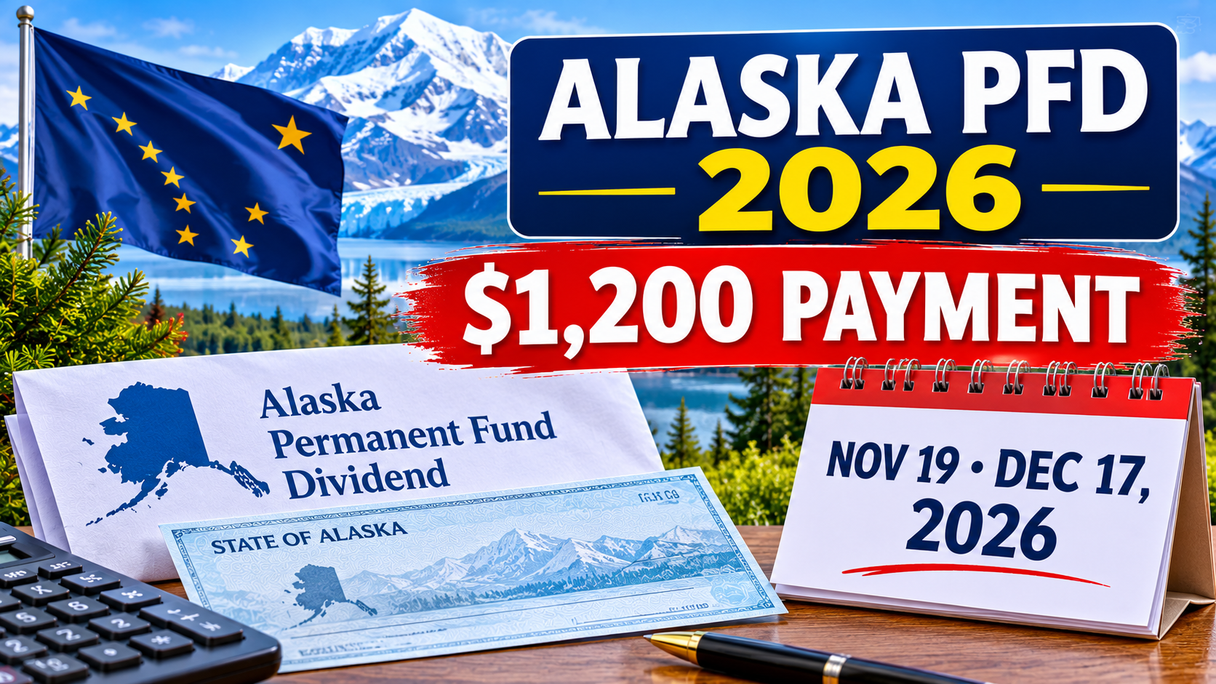
Alaska Permanent Fund Dividend: If you live in Alaska, you already know the rhythm of the year. Apply in the winter, wait through the summer, and watch your bank account in the fall. For most Alaskans the 2026 Permanent Fund Dividend is already in the bank. Some people are still waiting, and plenty of others are asking whether next year’s check will look anything like this one. Here’s where things stand as of November 19, 2026.
Alaska Permanent Fund Dividend $1,200
Starting October 1, nearly 600,000 Alaskans began receiving a 2026 PFD of $1,000, plus an additional $200 energy relief payment. The state’s own tax page puts the total at $1,200, including the energy relief payment. The number came out of the Legislature, not a formula. The amount was set in House Bill 263. The $200 bonus wasn’t a given, either. It was included because oil prices reached a threshold needed to trigger it, and both the Legislature and the Department of Revenue labeled it an energy relief payment.
The budget bill ties that extra money to state revenue. If fiscal year 2026 unrestricted revenue came in over $6.3 billion, money would flow to the dividend fund and to school grants. Higher oil prices made it happen this year. The total bill is substantial. The state is spending more than $800 million on this year’s dividends.
How lawmakers landed on $1,000 plus $200
The path to that figure was rocky, as usual. Early in the session, Gov. Mike Dunleavy had asked for much more. His proposed budget included a full statutory dividend of $3,650 per Alaskan. The Legislature had other ideas. Over the spring, the Senate Finance Committee proposed a $1,000 dividend plus a $150 energy relief payment. The House had pushed toward a bigger check. The final deal landed roughly between the Senate’s restrained plan and the House’s push for about $1,500.
The math explains why the Senate won out. A $1,000 PFD costs the state an estimated $674 million, while a $1,500 PFD runs about $992 million and a $3,650 dividend about $2.4 billion. Lawmakers also had a thin cushion to work with. The compromise budget had an estimated $40 million surplus, and the Senate Finance co-chair said a higher dividend was impractical given that.
The budget cleared the Legislature right at the end of the session. It passed the House 21-19 on a caucus-line vote and the Senate 17-3 shortly before adjournment. Dunleavy signed the fiscal year 2027 budget on June 24, with the $1,000 PFD and $200 energy relief rebate intact.
One more piece of context matters for the checks themselves. The $1,000 base dividend equals last year’s, which was the lowest ever when adjusted for inflation. So while $1,200 sounds fine on paper, it’s thin compared with what the dividend used to deliver.
Why the check isn’t “formula” money anymore
If you’re newer to Alaska or just never followed the politics, here’s the short version. For years the PFD was calculated from a formula in state law. That stopped working as designed a decade ago. Since 2016, legislators have adopted a “surplus dividend” approach, paying the dividend with what’s left after services are covered. A court ruling cemented the change. A 2017 Alaska Supreme Court decision changed how the PFD is appropriated, and lawmakers have determined each year’s amount through the appropriation process since then. The last formula-driven dividend was paid in 2015.
That’s why you hear two numbers every year: what the law’s formula would produce, and what the Legislature actually votes to pay. This year the statutory amount would have been over $3,800. The gap between those figures is the fight that comes back every session.
Who is eligible
Eligibility is the part people most often get wrong, so it’s worth slowing down. Being in Alaska isn’t enough on its own. The state’s own immigration guidance says physical presence in Alaska is not, by itself, sufficient to establish residency, and that applicants must have taken at least one step beyond presence before January 1 of the qualifying year.
For the 2026 dividend, the qualifying year is 2025. In practical terms, you need to have:
- Been an Alaska resident for the entire 2025 calendar year.
- Intended, when you applied, to stay in Alaska indefinitely. That’s another core requirement.
- Shown proof of that intent. The state’s guidance on residency evidence includes things like registering to vote in Alaska or obtaining an Alaska driver’s license.
Age doesn’t matter, and neither does income. Kids get a dividend too, with a parent or guardian filing for them.
Absences
Plenty of Alaskans travel, work seasonally outside, or spend winters elsewhere. The rules here are specific. The state’s FAQ says that if you haven’t taken any action inconsistent with an intent to return, absences of 180 days or less allow you to retain eligibility. The absence guidelines add a reporting wrinkle: you must report all absences over 90 days in a calendar year, even if the absence is allowable under the program. They also spell out how days are counted. The day you return counts as a day absent, but the day you left doesn’t.
Some absences can run longer than 180 days. Longer absences may be permitted for military service, full-time education, medical treatment and some government employment. Even then, people claiming allowable absences must have been physically present in Alaska for at least 72 consecutive hours at some point during the two years before the current dividend year. There’s also a cap if you stack reasons: additional days beyond allowable absences are limited to 45 days.
Immigration status and convictions
Two other categories trip people up. On immigration, the state’s appeal decisions show how this plays out. In one case, an applicant who held only parole status was denied because he lacked indefinite immigration status and didn’t meet the residency requirements.
On convictions, the Department of Revenue posted a notice on its homepage about a PFD process change effective September 16 involving vacated or dismissed convictions. If that applies to you, check the notice on the division’s site. The state also withholds dividends from certain incarcerated individuals. The tax page lists $9,056,100 that would have been paid to ineligible individuals, redirected to corrections health care, behavioral health grants and the Crime Victim Compensation Fund.
A caution on all of this: the rules are written into statute and regulation, and exceptions are narrow. If your situation is anything but straightforward, read the division’s FAQ and absence guidelines, or call them, before you assume you’re covered.
Payment dates, and what “Eligible-Not Paid” means
The division split the 2026 payout into rounds. The first disbursement went out October 1 to eligible applicants who filed online and chose direct deposit. The second, on October 22, covered paper applications and people who selected a paper check. The cutoffs were tied to your status on a given date. Online, direct-deposit applications in “Eligible-Not Paid” status as of September 18 were paid October 1, and applications in that status as of October 12 were paid October 22.
If neither round caught you, you’re not necessarily out of luck. The division says monthly disbursements will continue as applications are put into an eligible-for-payment status. The division’s website puts it plainly for late approvals: if your dividend is determined eligible after the cutoff dates, it will be distributed in the next monthly distribution.
I couldn’t confirm an exact payment date for the November round from the division’s own pages, so I won’t guess one. Check the current schedule at pfd.alaska.gov or log into myPFD. The division recommends checking your application status there and making sure your address is current. If you e-signed your application, you can update your address online, or you can file an address change form with a division office.
A few practical tips. If you’re still waiting, the usual culprits are an incomplete application, a pending review of your absences, or an address problem. Don’t assume it’s lost. Look at your status first, then call. And be wary of random texts or emails promising to “release” or “expedite” your dividend. Those are the kind of thing scammers lean on this time of year. The division communicates through its own site and your myPFD account.
Is it taxable?
Yes. The state publishes a federal tax reporting page for exactly this reason, and it states that the 2026 PFD amount is $1,200 and that the figure includes the energy relief payment. Treat the full $1,200 as the amount to report on your federal return. Alaska has no state income tax, but the IRS still wants its share, so if you’re budgeting around the check, remember that what lands in your account isn’t the same as what stays there after April.
Applying for next year
If you missed this year’s window, mark your calendar now. The pattern is consistent. The division’s filing period runs January 1 through March 31 each year. The division’s own homepage described the last cycle’s deadline this way: the online application was available through 11:59 PM on March 31. Assuming the same schedule holds for 2027, the application for next year’s dividend should open January 1, 2027. Confirm that on the division’s site as the date approaches.
Practically speaking, get your documents together early. Collect dates for any time you were outside Alaska in 2026, since you’ll need to report them. If you’ve moved, changed your name, or had a change in status, handle it before you start the form. And apply online if you can, since the first payment round goes to online filers who choose direct deposit.
What comes next
Here’s where it gets interesting. The 2026 dividend is settled, but the politics around it aren’t.
A new governor
The most immediate change is at the top. Democrat Jonathan Kreiss-Tomkins will be Alaska’s next governor after the Associated Press called the race on Friday, November 13. He’s the first Democratic governor of Alaska since 1998. The state still has to certify the results. The Division of Elections isn’t scheduled to certify until November 25. He’s expected to take office on December 7.
For PFD watchers, that matters because the governor holds a veto over the dividend appropriation, a point the 2017 court ruling made permanent. A new governor means a new budget proposal, and the incoming administration’s fiscal choices will shape the amount that goes into the dividend. I haven’t seen a firm statement from the governor-elect on a specific 2027 dividend figure, so I won’t speculate on one here.
The big fiscal fights
Outgoing Gov. Dunleavy tried to put a long-term answer on the table this year. His fiscal plan included a statewide sales tax, a “50-50” PFD plan where half of spendable earnings go to dividends, a cap on state spending increases, and a higher oil tax floor. The sales tax would have taken effect July 1, 2027. That package didn’t become law, but the ideas will linger.
The broader question of how to protect and cap spending from the Permanent Fund is still very much alive. Back in September, three of the four gubernatorial candidates voiced support for a plan to restructure the Permanent Fund to permanently cap the amount that can be spent from it. Doing that is hard. Merging the accounts would require a constitutional amendment, with two-thirds of both the House and Senate plus a majority of voters in a statewide general election.
Some candidates floated more radical ideas during the campaign, too. Former Gov. Bill Walker proposed ending the dividend entirely with a one-time $10,000 payment, which he suggested putting before voters as a question on the 2027 application. It was a campaign proposal, and Walker didn’t win, so treat it as part of the debate, not a plan on the table.
The 2027 session
The practical next step is the Legislature. Lawmakers will reconvene in January and start on the budget that includes the 2027 dividend. The governor has a statutory deadline for submitting a first-draft budget (the prior cycle’s was December 15), and the incoming administration can adjust it.
What will the amount be? Honestly, nobody knows yet. Several things will push on it:
- Oil prices. They drove this year’s $200 bonus and will matter again. The Legislature’s chief fiscal analyst warned in spring that whether the money materializes depends on actual revenue.
- The size of the surplus. This year’s budget had only a thin margin, which limited how generous lawmakers could be.
- The politics of a new governor and a divided Legislature. The House and Senate differed sharply on the amount this year, and a new governor adds another voice.
- Whether any permanent fix gets traction. A constitutional amendment on how the Permanent Fund is spent would take years, not months.
A reasonable planning assumption for 2027 is something in the neighborhood of this year’s base amount, perhaps with or without an energy component, but that’s a guess, not a forecast. Don’t budget your life around a number that hasn’t been voted on.
Overview
The 2026 Permanent Fund Dividend is $1,200: a $1,000 base payment plus a $200 energy relief add-on. Most Alaskans have been paid, and monthly rounds continue for people whose applications cleared later. If you’re waiting, check myPFD, confirm your address, and look at the schedule on the division’s site.
If you’re thinking ahead, the application window for the 2027 dividend should open January 1, 2027, and the amount that comes with it will depend on a new governor, an oil market no one controls, and a Legislature that has never found this fight easy. I’d also keep one habit year-round: keep your records. Travel dates, proof of residency, and mail from the division all matter if your application is ever questioned.