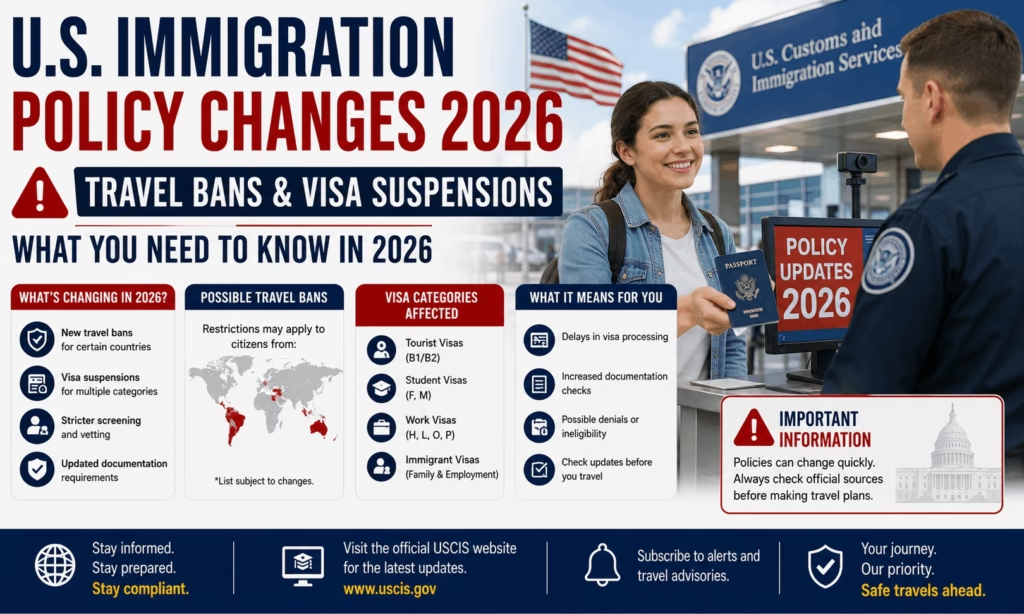
US Immigrant Visa Pause: Immigrant visa applicants around the world are still stuck waiting, but two countries just jumped the line. Reuters reported on September 8, 2026 that President Trump’s administration quietly resumed processing immigrant visa applications from Hungary and Poland the previous week, even as the broader global pause on immigrant visa appointments remains firmly in place everywhere else. Four people familiar with the matter said the directive to prioritize these two countries came directly from the White House, not from career State Department officials, and no public explanation has been offered for why these specific nations were chosen while millions of other applicants worldwide continue to have their appointments canceled or delayed indefinitely.
The timing and selection raise obvious questions, since Trump has publicly embraced far-right political figures in both countries, including former Hungarian Prime Minister Viktor Orban and Poland’s nationalist President Karol Nawrocki, whose election has put him at odds with the centrist government of Prime Minister Donald Tusk. This comes on top of an already turbulent year for U.S. immigrant visa policy, which began with a blanket suspension covering 75 countries in January, was struck down by a federal judge in August, and then immediately replaced with a new global pause tied to training on public charge rules. We’ll be updating this article monthly as the visa pause status, litigation, and any further country-specific exceptions develop.

What Is Actually Happening Right Now With US Immigrant Visas
To understand the Hungary and Poland exception, it helps to separate two different, overlapping policies that have confused applicants throughout 2026.
| Policy | Status | Countries Affected |
|---|---|---|
| Original 75-country immigrant visa suspension | Struck down by federal court, no longer in effect | Nations across Africa, Latin America, the Caribbean, Eastern Europe, Southeast Asia, and the Middle East |
| Worldwide public charge training pause | Currently in effect, resumed selectively for Hungary and Poland | All countries except Hungary and Poland, where processing has resumed |
| Hungary and Poland resumption | Active as of the first week of September 2026 | Hungary, Poland only |
The Full Timeline: How the US Immigrant Visa Pause Unfolded in 2026
This has been one of the most legally contested immigration policy episodes of the year, moving through multiple court rulings before landing at today’s selective, two-country exception.
| Date | Event |
|---|---|
| January 14, 2026 | Secretary of State Marco Rubio issues a directive titled Pausing Immigrant Visa Issuances for Nationalities at High Risk of Public Charge |
| January 21, 2026 | The 75-country immigrant visa suspension takes effect, covering nearly 40 percent of the world’s countries |
| July 31, 2026 | U.S. District Judge Amit Mehta rules in De Moura Gomes v. Rubio that the blanket policy violates the Immigration and Nationality Act, though the order initially provides direct relief only to the plaintiff |
| August 21, 2026 | U.S. District Judge Jeannette Vargas issues a 61-page ruling in CLINIC et al. v. Rubio, vacating the 75-country policy nationwide as contrary to law and in excess of the Secretary of State’s authority |
| August 28, 2026 | State Department confirms the 75-country suspension is no longer in effect following the court’s ruling |
| Days before August 31, 2026 | State Department separately pauses immigrant visa appointments at all global missions worldwide, citing the need to train consular officers on new public charge guidance |
| Late August into early September 2026 | Hungary and Poland receive a White House-directed exception to resume immigrant visa processing while the worldwide pause continues elsewhere |
| September 8, 2026 | Reuters breaks the story revealing the selective resumption for Hungary and Poland |
Canada 50% Tariff 2026: 700 US Goods Hit With Tariffs Up to 50% From September 8
USCIS Addis Ababa Field Office: New International Office Opens September 9
Is It Hard to Refinance Student Loan, and What Are the Pros and Cons of Doing It?
Tax Filing Season 2027: IRS Start Date, Deadlines and Refund Schedule
SNAP Maximum Benefits FY2027 Confirmed: Family of Four Gets Up to $1,023 (Effective Oct 1, 2026)
Why the Original 75-Country Ban Was Struck Down
Understanding the legal reasoning behind the court rulings matters for anyone trying to predict what happens next, since the same legal vulnerability could affect future country-specific decisions.
- U.S. District Judge Jeannette Vargas found the policy was contrary to law and issued in excess of Secretary Rubio’s statutory authority under the Immigration and Nationality Act
- Federal immigration law generally prohibits nationality-based discrimination in immigrant visa issuance, requiring consular officers to conduct an individualized assessment of each applicant rather than a blanket nationality-based refusal
- The court’s ruling directed the government to reconsider immigrant visa applications that had been denied or refused solely because of the 75-country policy
- The ruling affected both employment-based and family-based immigrant visa applicants across the affected countries, spanning regions including Africa, Latin America, the Caribbean, Eastern Europe, Southeast Asia, and the Middle East
Why the Pause Immediately Returned in a Different Form
The court victory for immigrant visa applicants was short-lived in practical terms, since the State Department pivoted almost immediately to a new, worldwide justification for continuing to slow down processing.
- Just days after confirming the 75-country policy was no longer in effect, the State Department paused immigrant visa appointments at all of its global missions, citing a need to train consular officers on new public charge guidance
- This training-related pause was described as temporary, with the agency initially indicating it would expire around August 31, 2026
- Immigration attorneys have noted this effectively replaced one pause with another, meaning applicants who celebrated the court ruling quickly found their appointments frozen again under a different justification
- Unlike the original 75-country policy, this new pause applies globally rather than to a specific list of nations, which is precisely why the Hungary and Poland exception stands out as unusual
Why Hungary and Poland Specifically
This is the detail generating the most public scrutiny, since no official government explanation has been provided.
- Four sources familiar with the matter confirmed the directive to prioritize Hungary and Poland came from the White House itself rather than through normal State Department channels
- Trump has publicly supported former Hungarian Prime Minister Viktor Orban, who was defeated in an April election, and has voiced support for Poland’s nationalist President Karol Nawrocki, whose positions have put him in conflict with Poland’s centrist government led by Prime Minister Donald Tusk
- In May 2026, Reuters separately reported that Deputy Secretary of State Christopher Landau instructed senior officials to facilitate a U.S. visa for a fugitive former Polish cabinet minister who had taken refuge in Hungary from corruption charges in his home country
- A State Department spokesperson, speaking on condition of anonymity, said appointments were being adjusted to accommodate processing needs, but did not explain why Hungary and Poland specifically were chosen for the exception
- The White House referred all requests for comment to the State Department, and the State Department itself declined to explain the rationale behind the selective resumption
How This Affects Applicants Around the World
For the vast majority of immigrant visa applicants who are not from Hungary or Poland, the practical reality has not improved despite the court victory over the original 75-country ban.
| Applicant Group | Current Status |
|---|---|
| Applicants from Hungary or Poland | Immigrant visa processing has resumed as of early September 2026 |
| Applicants from the original 75 listed countries, excluding Hungary and Poland | Still subject to the worldwide public charge training pause, despite the court striking down the original nationality-based ban |
| Applicants from countries never on the original 75-country list | Also subject to the same worldwide pause, since the current freeze applies globally rather than by nationality |
| Applicants previously denied solely due to the vacated 75-country policy | Entitled to renewed consideration of their case under the court’s ruling, though still affected by the separate, ongoing global pause |
Online forums have reflected the frustration directly, with applicants from countries including Peru, the United Kingdom, and India reporting canceled visa appointments extending through September, with one applicant describing being at the finish line only to face another delay.
What This Means for Family-Based and Employment-Based Applicants
The distinction between visa categories matters less than it might seem here, since both major immigrant visa pathways have been swept up in the same policy turbulence.
- Family-based immigrant visa applicants, including spouses, parents, and children of U.S. citizens and lawful permanent residents, have faced the same appointment cancellations as employment-based applicants under the worldwide pause
- Employment-based immigrant visa applicants, including those in employer-sponsored green card categories, were also directly affected by both the original 75-country ban and the subsequent worldwide training pause
- Applicants in either category from Hungary or Poland now have a practical advantage over similarly situated applicants from any other country, purely based on their nationality rather than any difference in visa category or case merits
IRS Identity Protection PIN: How to Get One and Stop Tax Fraud
Express Entry Labour Shortage Categories 2027: What Canada May Tighten?
CPP/EI Max Earnings 2027: New Rate Cut and Contribution Limits Explained
How to Apply and Check Your Immigrant Visa Status
Given how quickly this policy has shifted over the past several months, applicants need to rely on current, official channels rather than outdated guidance.
- Check your case status directly through the Consular Electronic Application Center, which reflects real-time updates on scheduled interviews and case processing
- Contact the specific U.S. embassy or consulate handling your case for the most accurate, location-specific update on when appointments are expected to resume in your country
- If your immigrant visa was previously denied solely due to the now-vacated 75-country policy, you may be entitled to have your case reconsidered, and should contact your consular post or immigration attorney to request this review
- Applicants from Hungary or Poland should confirm directly with their local U.S. embassy or consulate that their specific case has been rescheduled under the resumed processing
- Monitor official State Department travel and visa announcements directly, since policy in this area has changed multiple times within a matter of weeks
Processing Time: What to Expect Given the Current Pause
Processing time estimates that applied earlier in the year are no longer reliable, given the sequence of policy reversals throughout 2026.
| Stage | Current Status |
|---|---|
| Interview scheduling | Paused globally except for Hungary and Poland, where scheduling has resumed |
| Case review following the 75-country policy’s reversal | Cases previously denied solely on nationality grounds are eligible for renewed review, though timing for this review has not been publicly detailed |
| Training-related pause originally expected to end | Around August 31, 2026, though the pause has continued past that date for most countries outside Hungary and Poland |
| Backlog impact | Applicants can expect delays beyond normal processing times due to the cumulative effect of two separate suspensions within the same year |
Payment Schedule: Visa Fees and Refund Considerations
Immigrant visa processing involves fees paid at multiple stages, and the ongoing pause raises practical questions for applicants who have already paid but face delayed appointments.
- Immigrant visa application fees paid through the National Visa Center or at the time of interview scheduling are generally non-refundable, regardless of processing delays caused by the pause
- Applicants whose interviews were canceled due to the pause should confirm with their specific consular post whether previously paid fees remain valid for a rescheduled appointment, since fee validity periods can vary
- Medical examination fees, which are typically valid for a limited window before an interview, may need to be repeated if a rescheduled appointment falls outside that validity period, adding additional unplanned cost for delayed applicants
- Applicants should retain all fee payment receipts and confirmation numbers, since these records will be necessary when engaging with consular staff about rescheduling once processing resumes in their country
UPS Tariff Refund: Who Is Eligible to Get One and How Can You Apply?
Ontario Minimum Wage Rises to $17.95 on Oct 1, 2026
SNAP Income Limits FY2027 Confirmed: Single Applicants Capped at $1,729, Family of Four at $3,575
Official Resources for Checking Your Immigrant Visa Status
Given how quickly this policy has shifted, applicants should rely only on official government channels rather than secondhand reports or social media threads.
| Resource | Purpose | Official Link |
|---|---|---|
| Consular Electronic Application Center | Check immigrant visa case status and interview scheduling | ceac.state.gov |
| Travel.State.Gov, Immigrant Visa Process | Official step-by-step immigrant visa process and current announcements | travel.state.gov/content/travel/en/us-visas/immigrate.html |
| US Embassy and Consulate directory | Find country-specific contact details and local announcements | usembassy.gov |
| National Visa Center | Fee payment, document submission, and case inquiries before interview scheduling | travel.state.gov/content/travel/en/us-visas/immigrate/national-visa-center.html |
| State Department press releases | Official policy announcements on visa pauses and resumptions | state.gov/press-releases |
| USCIS case status tool | Track the immigrant petition stage that precedes consular visa processing | egov.uscis.gov/casestatus |
FAQs About US Immigrant Visa Pause
Why did the US resume immigrant visa processing for Hungary and Poland but not other countries?
The White House directed the selective resumption for Hungary and Poland, but no official public explanation has been given for why these two countries were chosen while the worldwide pause continues elsewhere.
Is the original 75-country immigrant visa ban still in effect?
No. A federal judge vacated that policy on August 21, 2026, and the State Department confirmed on August 28, 2026 that the 75-country suspension is no longer in effect.
If the 75-country ban was struck down, why are visas still paused for most countries?
Days after the 75-country policy ended, the State Department imposed a separate, worldwide pause on immigrant visa appointments, citing a need to train consular officers on new public charge guidance, and this global pause remains active for most countries.
What is the public charge rule affecting immigrant visa processing?
The public charge ground of inadmissibility allows the government to deny a visa to an applicant likely to become dependent on U.S. government assistance, and the current pause is officially tied to training consular officers on updated guidance for applying this rule.
Can I get my case reconsidered if I was denied under the 75-country policy?
Yes. Applicants whose immigrant visas were denied or refused solely because of the vacated 75-country policy are entitled to renewed consideration of their case under the court’s ruling.
Which countries were originally covered by the 75-country immigrant visa ban?
The list spanned nearly 40 percent of the world’s countries, including nations across Africa, Latin America, the Caribbean, Eastern Europe, Southeast Asia, and the Middle East, such as Egypt, Afghanistan, Somalia, Haiti, Iran, Brazil, and Russia.
Does the Hungary and Poland exception apply to both family-based and employment-based visas?
Yes. The resumption applies broadly to immigrant visa processing for Hungary and Poland, covering both family-based and employment-based categories, without a public distinction between the two.
How long is the worldwide immigrant visa pause expected to last?
The State Department originally indicated the training-related pause would expire around August 31, 2026, but it has continued past that date for most countries, with no new public end date confirmed.
Who ordered the immigrant visa resumption for Hungary and Poland?
Sources familiar with the matter said the directive came from the White House rather than through standard State Department channels.
Can the State Department appeal the court ruling that struck down the 75-country ban?
Yes, the agency retains the option to appeal Judge Vargas’s ruling, though as of the State Department’s confirmation on August 28, 2026, it is complying with the order and no longer applying the vacated policy.
Conclusion
The US immigrant visa pause saga in 2026 has moved through a blanket 75-country ban, a decisive court defeat for that policy, an immediate replacement pause justified by officer training, and now a selective, White House-directed exception for exactly two countries with no public explanation. For the overwhelming majority of immigrant visa applicants worldwide, the practical outcome of winning in court has been replaced by a different form of the same delay, while Hungary and Poland move ahead under circumstances that have drawn scrutiny given Trump’s public alignment with political figures in both nations. Applicants should track their case status directly through official consular channels rather than assuming general news about the pause applies uniformly to their specific country or situation. As litigation continues and the scope of the worldwide pause evolves, check back here, since this article is reviewed and updated with the latest confirmed information each month.
SSDI Pay Chart: The Least Amount You Can Get Per Month and the Most Common Disabilities
Ohio SNAP Sugary Beverage Ban Delayed: What Happened and Why
Missouri Minimum Wage Amendment Could Return to the Ballot on November 3, 2026