H-1B Fraud Investigation Texas: A state-level crackdown on H-1B visa sponsorship that started with just three North Texas companies in January has grown into one of the broadest visa fraud investigations any state attorney general has launched in recent memory. Texas Attorney General Ken Paxton confirmed on April 30, 2026 that his office had issued Civil Investigative Demands to nearly 30 North Texas businesses, accusing them of operating so-called ghost offices, addresses that exist mainly on paper, to falsely justify sponsoring foreign workers on H-1B visas. The expansion turns what began as a narrow inquiry sparked by viral social media videos into a sweeping statewide probe with implications for employers and visa holders far beyond the handful of companies originally named.
The investigation centers on a specific and increasingly familiar pattern investigators say they have uncovered repeatedly. Companies allegedly listed residential homes, unfinished buildings, or largely inactive commercial addresses as their official places of business while claiming to operate as functioning enterprises with real products, services, and revenue. Some of these entities reportedly maintained websites advertising offerings that, according to the Attorney General’s office, were never actually available to consumers. Paxton has framed the effort in blunt terms, stating publicly that he will not allow the H-1B program to be used as a loophole for what he described as bad actors seeking to bring foreign nationals into Texas under false pretenses. We’ll be updating this article monthly as the investigation develops and as any enforcement actions or legal proceedings move forward.
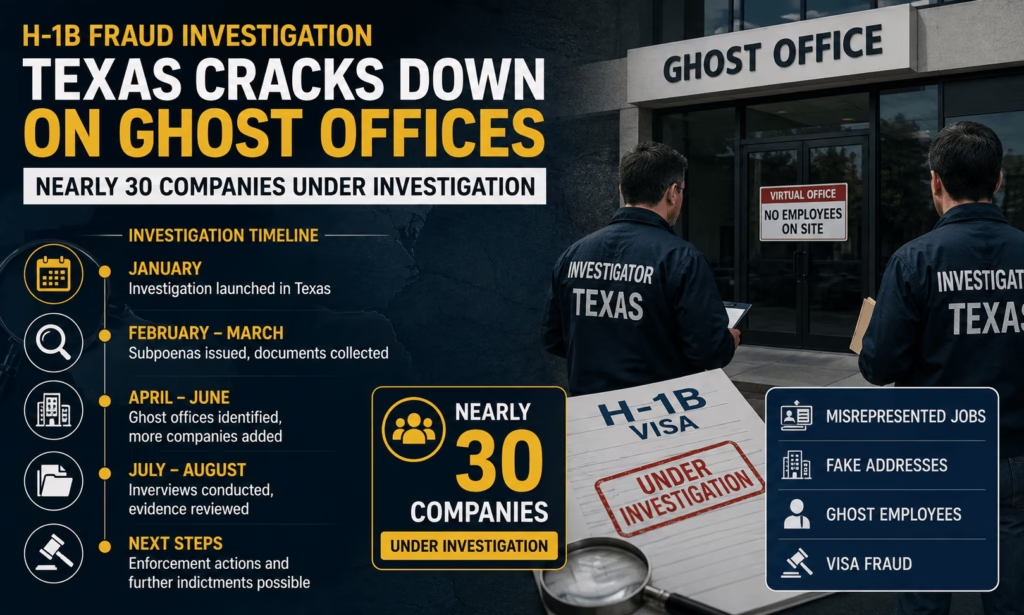
Timeline of the Texas H-1B Fraud Investigation
| Date | Development |
|---|---|
| January 28, 2026 | Paxton announces initial investigation, issues Civil Investigative Demands to three North Texas companies |
| Early 2026 | Governor Greg Abbott orders state agencies and public universities to freeze new H-1B visa petitions |
| April 20, 2026 | Two Indian nationals plead guilty in a separate H-1B visa fraud case |
| April 30, 2026 | Paxton expands the investigation, issuing CIDs to nearly 30 North Texas businesses |
| Ongoing | Investigation remains active, with the Attorney General’s office signaling further enforcement action is possible |
How the Investigation Started?
The probe traces back to a series of widely circulated online videos and social media posts, including reporting from conservative commentator Sara Gonzales, alleging that multiple IT consulting and software development contracting companies in North Texas were fraudulently sponsoring H-1B visas. One video that drew particular attention showed a business operating out of what appeared to be a food truck, with the person featured in the video alleged to be working in the United States on an H-1B visa despite the business being formally registered under a different name.
Acting on these public complaints, Paxton’s office issued its first round of Civil Investigative Demands on January 28, 2026, targeting three North Texas companies. Investigators alleged these businesses had set up sham operations, complete with functioning websites advertising products or services that were never actually offered to consumers, specifically to create the appearance of legitimate business activity needed to sponsor H-1B workers. In one case cited by investigators, a company listed a single-family residence, described as empty and unfinished, as its corporate office address.
Student Loans and FAFSA 2026: Urgent changes every student needs to know
ACA Subsidy Cliff 2026: What Is It, Who Is Affected and Why Health Insurance Costs Are Rising
2027 HSA Contribution Limits Announced: IRS Confirms $4,500 and $9,000 Caps
What the April Expansion Actually Covers
Three months after the investigation began, Paxton’s office announced on April 30, 2026 that the inquiry had grown substantially, now encompassing nearly 30 North Texas businesses. The Attorney General’s office publicly named several of the newly targeted companies, including Tekpro IT LLC, Fame PBX LLC, 1st Ranking Technologies LLC, Qubitz Tech Systems LLC, Blooming Clouds LLC, Virat Solutions Inc., Oak Technologies Inc., Techpath Inc., and Techquency LLC. It is worth noting explicitly that being named in a Civil Investigative Demand is not the same as being formally charged or found liable, and none of the companies identified have been convicted of wrongdoing as part of this specific investigation.
As part of the expanded probe, investigators are demanding detailed documentation from each company, including complete employee rosters, records describing the specific products or services the business claims to provide, financial statements, and internal communications tied to the company’s operations. The goal, according to the Attorney General’s office, is to determine whether these businesses are functioning as legitimate operating entities or exist primarily as vehicles to fraudulently sponsor foreign worker visas.
What Counts as a Ghost Office Under This Investigation
The central allegation running through nearly every company named in this investigation involves what officials are calling a ghost office scheme. This refers to a business address used to project the appearance of a legitimate, active commercial operation, when in reality the location may be a residential home, an unfinished or vacant commercial building, or a virtual office with little to no actual business activity taking place there. Investigators say these addresses are used specifically to satisfy the paperwork requirements tied to sponsoring an H-1B worker, including labor condition applications that require employers to specify a genuine worksite.
| Ghost Office Red Flag | What Investigators Are Looking For |
|---|---|
| Residential address listed as corporate office | Homes used to represent a functioning business location |
| Unfinished or vacant commercial buildings | Properties with no active business operations occurring on site |
| Websites advertising nonexistent products or services | Online presence created to simulate legitimate commercial activity |
| Lack of verifiable revenue or client contracts | Financial records that do not support claimed business operations |
| Virtual office or shared mailbox addresses | Locations used only for mail forwarding rather than actual work |
Broader Political and Policy Context in Texas
This state-level investigation is unfolding alongside a series of other actions targeting the H-1B program in Texas and at the federal level. Earlier in 2026, Governor Greg Abbott directed state agencies and public universities to freeze all new H-1B visa petitions, citing concerns that the program was displacing job opportunities for Texans. At the federal level, the Trump administration implemented a 100,000 dollar fee on new H-1B petitions filed for workers located outside the United States, effective September 2025, and shifted the H-1B selection process from a random lottery to a wage and skills weighted system favoring higher paid, higher skilled applicants, a change that took effect in February 2026.
Congress has also seen proposed legislation reflecting this same wave of scrutiny. The End H-1B Visa Abuse Act of 2026, introduced in Washington, proposes a three year pause on new H-1B visas, a halving of the annual visa cap, and a 200,000 dollar minimum salary threshold for sponsored positions. The bill would also eliminate Optional Practical Training extensions tied to the program, bar dependents of H-1B holders in certain circumstances, and restrict status adjustment pathways. Immigration policy analysts caution that while the bill represents a sweeping proposal, it remains far from becoming law and could change significantly as it moves through Congress.
What This Means for H-1B Employers and Workers in Texas
For legitimate employers sponsoring H-1B workers in Texas, the immediate practical impact of this investigation is heightened scrutiny on worksite documentation and address verification, even for companies with no connection to the specific businesses named. Immigration attorneys generally advise employers to ensure their labor condition applications accurately reflect a genuine, verifiable worksite, and to maintain documentation demonstrating real business operations, actual client relationships, and legitimate revenue, since Civil Investigative Demands of this kind can extend to any business the Attorney General’s office believes warrants further examination.
For H-1B workers themselves, particularly the more than 70 percent of H-1B holders who come from India, the investigation introduces a layer of uncertainty that extends beyond any individual company under scrutiny. Workers sponsored by a company later found to have misrepresented its operations could face complications with their visa status through no fault of their own, a concern immigration advocates have raised as the investigation has widened. The Texas probe is also unfolding against a backdrop of broader local tension in some North Texas communities, including Frisco, where rapid demographic shifts tied to the tech sector’s growth have fueled public debate that extends well beyond the specific fraud allegations at the center of Paxton’s investigation.
FTC Refund 2026: Millions of Americans May Be Owed Money and Most Don’t Know It
Official Resources for H-1B Employers and Workers
| Resource | Purpose | Link |
|---|---|---|
| Texas Office of the Attorney General, Press Releases | Official updates on the H-1B fraud investigation | https://www.texasattorneygeneral.gov/news/releases |
| U.S. Citizenship and Immigration Services, H-1B Program | Federal H-1B eligibility, petition, and compliance information | https://www.uscis.gov/working-in-the-united-states/h-1b-specialty-occupations |
| U.S. Department of Labor, Office of Foreign Labor Certification | Labor condition application requirements and worksite rules | https://www.dol.gov/agencies/eta/foreign-labor |
| Texas Workforce Commission | State-level workforce and employer compliance resources | https://www.twc.texas.gov |
FAQs
How many companies are under investigation in the Texas H-1B fraud probe?
As of the April 30, 2026 expansion, nearly 30 North Texas businesses are under investigation by the Texas Attorney General’s office, up from the three companies originally targeted when the probe began in January 2026.
What is a ghost office in the context of H-1B visa fraud allegations?
A ghost office refers to a business address, such as a residential home, an unfinished building, or a largely inactive commercial space, that a company allegedly lists as its official worksite to create the appearance of legitimate operations while sponsoring H-1B visa workers.
Has any company in the Texas investigation been found guilty of H-1B fraud?
No company named in this specific Texas Attorney General investigation has been formally charged or found liable as of this writing. A Civil Investigative Demand requires companies to produce documentation for review and does not itself constitute a finding of wrongdoing.
What triggered the original Texas H-1B fraud investigation?
The investigation began after public complaints and widely circulated online videos, including content from conservative commentator Sara Gonzales, alleged that several North Texas IT consulting and software development companies were fraudulently sponsoring H-1B visas through sham business operations.
Is this Texas investigation connected to federal H-1B policy changes?
The state investigation is running alongside, though separately from, federal changes including a 100,000 dollar fee on certain new H-1B petitions effective September 2025 and a shift to a wage and skills weighted selection process effective February 2026, both part of a broader wave of scrutiny on the H-1B program.
What happens to H-1B workers if their sponsoring company is found to have committed fraud?
Workers sponsored by a company later found to have misrepresented its operations could face complications with their visa status, though outcomes depend on the specific findings of any investigation and the individual worker’s circumstances. Affected workers are generally advised to consult an immigration attorney promptly if their employer comes under investigation.
Does Governor Abbott’s H-1B freeze apply to private Texas employers?
No. Governor Abbott’s directive freezing new H-1B visa petitions applies specifically to Texas state agencies and public universities, not to private employers operating in the state, though it reflects the same broader political scrutiny driving the Attorney General’s investigation.
Conclusion
What began as a narrow inquiry into three North Texas companies has grown into a sweeping investigation covering nearly 30 businesses, placing Texas at the center of one of the most aggressive state-level efforts to police H-1B visa sponsorship fraud in the country. With Civil Investigative Demands actively compelling companies to turn over detailed financial and operational records, and with the Attorney General’s office signaling the probe remains far from finished, both employers and visa holders connected to the North Texas tech and IT consulting sector should expect continued scrutiny in the months ahead. Whether this state-level enforcement effort leads to formal charges, civil penalties, or broader policy changes remains to be seen. We’ll be updating this article monthly as Paxton’s office releases further findings and as any related federal action develops.
Canada 50% Tariff 2026: Full List of Products That Could See Price Hikes
Why Is SNAP Enrollment Falling in 2026? Key Reasons Behind the Decline in SNAP Participation
Social Security Compassionate Allowances List: 14 Conditions Added