IRS Form 4547: The rollout of Trump Accounts has moved faster than almost anyone predicted just months ago. According to the latest Treasury figures, more than 6.5 million children have now been signed up nationwide through IRS Form 4547, though only about 1.4 million of those accounts are confirmed eligible to actually receive the government’s $1,000 pilot contribution, meaning a majority of eligible families still have not completed the steps needed to unlock the deposit. More than 500,000 children have already received their first $1,000 payment since deposits began in early July 2026, and employers including Franklin Templeton have started matching the federal contribution dollar for dollar for eligible newborns.
If you have a child born between January 1, 2025 and December 31, 2028, IRS Form 4547 is the document that opens the door to this money, and getting the paperwork right matters more than most parents realize, since the $1,000 deposit is not automatic even for children who qualify. Filing the wrong section, missing a Social Security number, or assuming the account opens itself can leave real money sitting unclaimed. This guide walks through exactly how IRS Form 4547 works, who qualifies for the Trump Account program, and how to actually get the $1,000 contribution into your child’s account. This article will be updated monthly as Treasury releases new enrollment figures and processing updates.
What Is IRS Form 4547 and Why It Exists?
IRS Form 4547, officially titled Trump Account Election(s), is the form the IRS created to let parents, guardians, and certain other family members open a Trump Account for an eligible child and, separately, request the one-time $1,000 federal pilot program contribution from the U.S. Treasury. The form does two distinct jobs, and it is important to understand that they are not the same thing. Part II of the form elects to establish the account itself for any child under 18 with a valid Social Security number, regardless of income or citizenship status. Part III is a separate election specifically for the $1,000 pilot program contribution, and checking that box is required to receive the deposit even if the underlying account already exists.
Trump Accounts themselves, legally known as 530A savings accounts, were created under the One Big Beautiful Bill Act, signed into law on July 4, 2025. The program functions somewhat like a restricted individual retirement account for minors, with contributions locked in low-cost index funds during the child’s growth period and the account automatically converting into a traditional IRA once the child turns 18.
Trump Account and Form 4547 Key Highlights
| Detail | Current Information |
|---|---|
| Program name | Trump Accounts, legally 530A savings accounts |
| Created by | One Big Beautiful Bill Act, signed July 4, 2025 |
| Official launch date | July 4, 2026 |
| Administered by | U.S. Department of the Treasury with IRS and SSA support |
| Federal seed deposit | $1,000 one time, per eligible child |
| Eligible birth window | January 1, 2025 through December 31, 2028 |
| Total accounts opened as of mid-2026 | Approximately 6.5 million |
| Children confirmed eligible for the $1,000 deposit | Approximately 1.4 million |
| Children who received the first deposit | Over 500,000 as of early July 2026 |
| Annual private contribution cap | $5,000 per child, combined from all non-exempt sources |
| Employer contribution sub-limit | Up to $2,500 per year, tax free |
| Account conversion age | Automatically becomes a traditional IRA at age 18 |
| Official website | trumpaccounts.gov |
SSDI Pay Chart: The Least Amount You Can Get Per Month and the Most Common Disabilities
IRS Identity Protection PIN: How to Get One and Stop Tax Fraud
Who Can File Form 4547 to Open an Account?
Eligibility to simply open a Trump Account is broader than most people expect. Any child under 18 at the end of the tax year with a valid Social Security number can have an account established on their behalf, and there is no income limit or citizenship requirement for the account itself. If you are not seeking the $1,000 pilot contribution, you can file Form 4547 as long as you are the child’s legal guardian, parent, adult sibling, or grandparent.
The rules tighten considerably if you want the $1,000 federal deposit. To claim that specific benefit, you must be someone who expects to claim the child as a qualifying dependent on your tax return for the relevant year, and you do not need to have already filed that return, your intention to claim the child is sufficient at the time you submit Form 4547. By signing the form, you are certifying under penalty of perjury that you are authorized to make these elections, so the form should not be filed casually or on behalf of a child you do not actually support.
Who Qualifies for the $1,000 Pilot Program Contribution?
The $1,000 pilot program contribution has a narrower set of requirements than the account itself. For a child to qualify for the federal deposit, they must be a U.S. citizen, have a valid Social Security number on file, be anticipated to be claimed as a qualifying child by the person filing on their behalf, live with the filer claiming them as a dependent, and be born on or after January 1, 2025 and before January 1, 2029. A child who has already received a pilot program contribution cannot receive a second one, and children born before 2025 can still have a Trump Account opened for them, they simply will not receive the government seed money.
This birth window matters enormously for families planning ahead. A child born in December 2028 still qualifies for the full $1,000, while a child born in January 2029 would miss the pilot program entirely under the current rules, even though both children would otherwise be eligible to open a standard Trump Account.
How to Apply Using IRS Form 4547?
Filing correctly is straightforward once you understand the sequence, but skipping a step is the most common reason families end up with an open account and no deposit.
- First, confirm your child has a valid Social Security number, since no pilot program election will be processed and no $1,000 contribution will be made without one listed on the form.
- Second, complete Part II of Form 4547 with the child’s information to formally elect to establish the initial Trump Account, since this step is required regardless of whether you are also requesting the $1,000 deposit.
- Third, if your child was born between January 1, 2025 and December 31, 2028 and meets the citizenship and dependency requirements, complete Part III and check the box on Line 7 to elect the pilot program contribution, since this box does not get checked automatically just because the child qualifies.
- Fourth, file the completed form either alongside your federal tax return, the most common route for the 2025 tax year filed by April 15, 2026, or submit it separately, since the form can also be mailed on its own or filed electronically outside of tax season.
- Fifth, as an alternative to the paper or e-filed form, register directly through the online portal at trumpaccounts.gov, which Treasury has confirmed is now live and updated with full account funding capabilities.
- Sixth, once submitted, watch for an activation confirmation email from Treasury’s official Trump Accounts system, since Treasury has said it sends account activation and confirmation messages from an official Treasury email address once processing is complete.
Processing Time for Form 4547 and the $1,000 Deposit
Processing has moved unevenly since the program’s July 2025 legal creation. Treasury published its first proposed regulations on March 9, 2026, and did not begin sending account activation information until closer to May 2026, with the first actual $1,000 government contributions arriving only after the program’s official July 4, 2026 launch date. Even now, the gap between accounts opened and deposits confirmed remains wide, with roughly 6.5 million accounts opened against only about 1.4 million children confirmed eligible for the deposit and just over 500,000 who had actually received their $1,000 as of early July 2026. Families who filed Form 4547 early with their 2025 tax return generally saw their elections processed alongside normal IRS return processing timelines, while those filing the standalone form outside of tax season have reported waiting several weeks for confirmation as Treasury continues building out the verification system tied to Social Security number matching.
Express Entry Draw Update: CEC Cut-Off Falls To 521, Physicians Round Drops To 198 CRS
Canada Counter-Tariffs Worker Support Package: $7.5 Billion in Relief Confirmed
StayNJ Income Cap Drops From $500,000 to $200,000: Why Your Check Already Got Smaller
New York POWER Rebate Checks: $100 to $200 Payments Begin Landing in Mailboxes This Fall
Payment Schedule: When and How the $1,000 Actually Arrives
The $1,000 pilot program contribution is a single, one-time federal deposit rather than an installment payment, and it does not count against the child’s separate $5,000 annual private contribution limit. Once Treasury confirms a child’s eligibility, including a valid Social Security number match and confirmed citizenship status, the deposit is sent directly into the child’s Trump Account rather than to the parent or guardian, and the funds are immediately subject to the program’s investment rules during the growth period, meaning they cannot simply be withdrawn as cash. Treasury has been clear that the deposit is not automatic even for eligible children, since the pilot program election on Line 7 of Form 4547 must be affirmatively made, and no contribution is processed without it. Families who filed before the July 4, 2026 launch date had their elections queued and processed as accounts came online, while later filers are being processed on a rolling basis as Treasury and the Social Security Administration work through the current backlog of roughly 5 million accounts still awaiting eligibility confirmation.
Annual Contribution Limits Beyond the $1,000 Deposit
Once the account is open, families are not limited to the government’s initial deposit. Total contributions from parents, relatives, and friends combined are generally capped at $5,000 per year for 2026 and 2027, with the limit indexed for inflation in future years. Employers can separately contribute up to $2,500 per year, and in many cases this can be structured as a pre-tax benefit through a workplace cafeteria plan, meaning it is excluded from the employee’s taxable income entirely. Contributions from qualified tax-exempt organizations and government or charitable programs generally do not count against the standard $5,000 cap, which is the same treatment given to the initial $1,000 pilot deposit itself.
During the child’s growth period, contributions can only be invested in a narrow set of eligible investments, generally limited to low-cost mutual funds or exchange traded funds tracking a broad U.S. index, with expense ratios capped to keep fees minimal. That restriction lifts once the child turns 18 and the account automatically converts into a standard traditional IRA, at which point ordinary IRA contribution limits, investment choices, and distribution rules apply going forward.
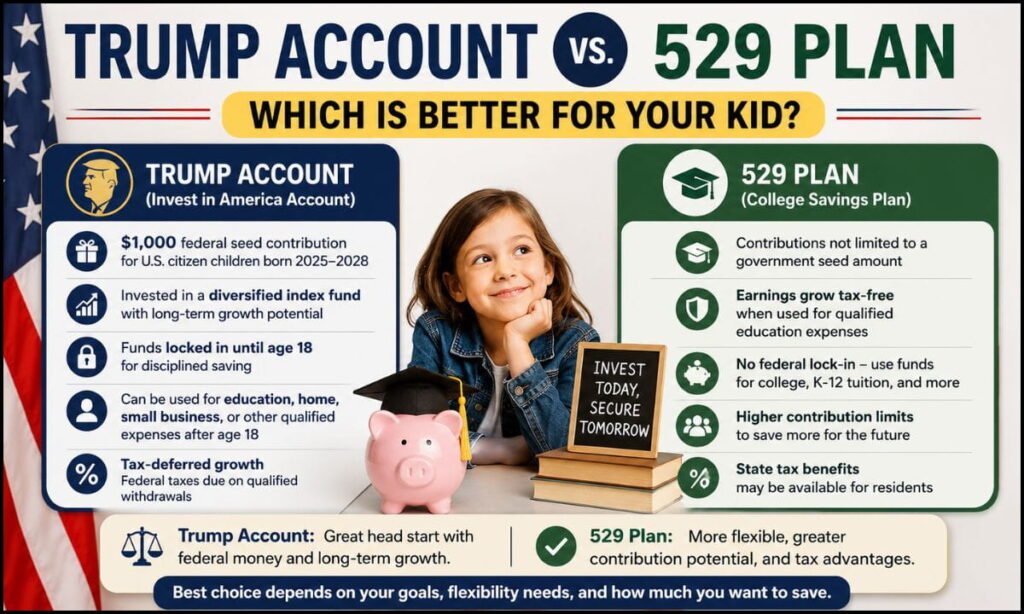
How Trump Accounts Compare to a 529 College Savings Plan?
Families already saving through a 529 plan often want to know how a Trump Account fits alongside it, and the two programs serve genuinely different purposes. A 529 plan has no federal contribution cap, though many states set lifetime limits in the range of 400,000 to 550,000 dollars, and funds are meant primarily for qualified education expenses. A Trump Account carries a federal contribution limit of $5,000 per year, includes the one-time $1,000 government seed deposit unavailable through any 529 plan, and functions more like a retirement account than an education fund, since it converts into a traditional IRA at age 18 rather than being restricted to tuition and related costs. Families are not required to choose one over the other, and many financial advisors are now recommending both accounts be used together depending on a family’s savings goals.
Tax Treatment of Contributions and Withdrawals
Contributions made by parents, relatives, or friends into a Trump Account are made with after-tax dollars and are not deductible under the standard individual retirement account contribution rules, though they do create basis in the account. The $1,000 federal pilot deposit, along with employer contributions made through a qualifying cafeteria plan and qualified government or charitable contributions, do not create basis, since that money was never taxed to the family to begin with. Because the account converts into a traditional IRA at 18, the tax treatment of withdrawals after that point generally follows standard IRA distribution rules, meaning early withdrawal penalties and ordinary income tax can apply depending on when and how the funds are eventually taken out.
New Canada Prescription Drug Rules October 2026: What Every Patient and Pharmacy Needs to Know
October 15 Tax Deadline Is Final — What Happens If You Still Don’t File
VA Benefits Lawyer: For Which Claims Do You Need One, and How Much Can They Cost?
Green Card Sponsors Face New Scrutiny: USCIS Can Now Pull Your Credit Report
Official Resources and Application Links
| Resource | Purpose | Official Website |
|---|---|---|
| IRS About Form 4547 | Current form, instructions, and recent developments | irs.gov |
| Instructions for Form 4547 | Full step-by-step filing instructions | irs.gov |
| Trump Accounts official portal | Online enrollment, funding, and account management | trumpaccounts.gov |
| U.S. Treasury employer contribution inquiries | Information for businesses offering matching contributions | TrumpAccounts@treasury.gov |
| Federal Register, Trump Accounts Contribution Pilot Program | Full text of the proposed regulations | federalregister.gov |
FAQs About IRS Form 4547
What is IRS Form 4547 used for?
IRS Form 4547 is used to open a Trump Account for an eligible child and, separately, to elect the one-time $1,000 federal pilot program contribution from the U.S. Treasury for children who meet the citizenship, Social Security number, and birth date requirements.
Is the $1,000 Trump Account deposit automatic?
No. Even for children who meet every eligibility requirement, the box on Line 7 of Form 4547 must be actively checked to request the pilot program contribution, and the deposit will not be processed without that election.
Which children qualify for the $1,000 federal contribution?
Children must be U.S. citizens with a valid Social Security number, born between January 1, 2025 and December 31, 2028, and expected to be claimed as a qualifying dependent by the person filing the election.
Can a child born before 2025 still get a Trump Account?
Yes, a Trump Account can be opened for any child under 18 with a Social Security number regardless of birth year, but only children born in the 2025 through 2028 window qualify for the $1,000 government seed deposit.
How do I file Form 4547?
You can file Form 4547 along with your federal tax return, submit it separately by mail or electronically, or register directly through the official portal at trumpaccounts.gov.
How much can I contribute to a Trump Account each year?
Total private contributions from parents, relatives, and friends combined are generally capped at $5,000 per year for 2026 and 2027, with employers allowed to contribute up to an additional $2,500 per year on top of that limit.
What happens to a Trump Account when the child turns 18?
The account automatically converts into a traditional individual retirement account once the child turns 18, and from that point forward it follows standard IRA contribution and distribution rules.
How many children have actually received the $1,000 deposit so far?
As of early July 2026, more than 500,000 children had received their first $1,000 deposit, while roughly 6.5 million accounts had been opened in total and about 1.4 million children were confirmed eligible for the payment.
Conclusion
IRS Form 4547 is the gateway to one of the largest new federal savings programs launched in years, but the gap between accounts opened and deposits actually received shows how easy it is to miss a step. Filing the form is only half the process, since the $1,000 pilot program contribution requires its own specific election and depends on a clean Social Security number match before Treasury releases the funds. Families with a child born between 2025 and 2028 who have not yet filed should treat this as unfinished business rather than a completed task, since millions of eligible children are technically enrolled but still waiting on money that will not arrive without the correct paperwork on file.
Trump Accounts Dell $250 Grant: Did Deposits Actually Start Monday? Here’s Who’s Actually Been Paid
2027 Social Security COLA Forecast: Latest 3.6% Estimate and How Much Retirees Could Get
$2000 Stimulus Payment September 2026 Fact-Check: Is It Really Coming?