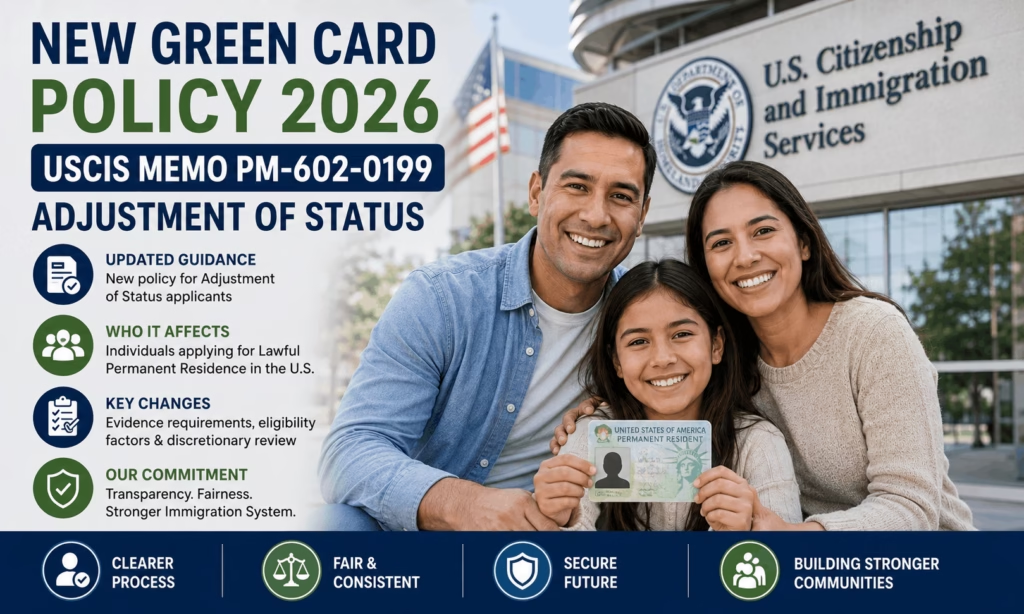
New Green Card Policy 2026: The United States Citizenship and Immigration Services (USCIS) fundamentally altered how federal immigration officers evaluate Form I-485 applications by formally issuing Policy Memorandum PM-602-0199. Officially titled “Adjustment of Status is a Matter of Discretion and Administrative Grace, and an Extraordinary Relief that Permits Applicants to Dispense with the Ordinary Consular Visa Process,” this landmark directive reframes the adjustment of status process for noncitizens seeking lawful permanent residence inside the U.S. Under this new Green Card policy 2026, satisfying baseline legal eligibility requirements is no longer a guaranteed ticket to approval. USCIS officers are instructed to treat domestic green card applications as discretionary acts of grace rather than routine administrative outcomes, reinforcing overseas consular processing as the baseline default pathway for immigrant visas. Applicants must now affirmatively establish that their positive equities outweigh any potential adverse factors to obtain a green card without leaving the country. We’ll be updating this article monthly.
This strategic policy shift impacts millions of immigrants, employers, and family sponsors navigating Section 245(a) of the Immigration and Nationality Act (INA). While the core statutory eligibility rules passed by Congress remain unchanged, the practical standard for USCIS I-485 adjudication has become far more rigorous. Adjudicators are explicitly directed to conduct comprehensive case-by-case balancing tests, weighing factors such as U.S. family ties, economic contributions, and long-standing tax compliance against negative discretionary elements. Negative factors may include prior immigration status violations, unauthorized employment, or nonimmigrant intent shifts. For noncitizens residing in the U.S. on dual-intent status or temporary nonimmigrant visas, navigating this discretionary standard is crucial to preventing unexpected application denials.
Key Highlights of USCIS Policy Memo PM-602-0199
| Policy Parameter | Official Specifications & Key Directives |
| Document Number | Policy Memorandum PM-602-0199 |
| Issuing Agency | U.S. Citizenship and Immigration Services (USCIS) |
| Core Directive | Characterizes adjustment of status as an act of administrative grace and extraordinary relief |
| Primary Target Pathway | Form I-485 filings under INA Section 245(a) |
| Default Immigrant Pathway | Consular processing through U.S. embassies and consulates abroad |
| Standard of Proof | Discretionary balancing of positive equities against adverse factors |
| Statutory Law Changes | None (Eligibility criteria under INA § 245 remain legally unchanged) |
| Written Notice Requirement | Denials based on discretion must include a detailed written explanation |
Understanding Policy Memo PM-602-0199: The Strategic Shift in Green Card Adjudication
For decades, noncitizens legally residing in the United States who qualified for an immigrant visa category viewed filing Form I-485 Adjustment of Status as a predictable secondary step. If an applicant met the statutory criteria (such as an approved immigrant petition, an immediately available visa number, and a lawful entry), approval of permanent residence was largely treated as the standard outcome unless serious criminal or security bars applied.
Under USCIS Policy Memo PM-602-0199, that assumption has been retired. USCIS leadership has instructed its field adjudicators that adjusting status inside the U.S. is an “extraordinary relief” designed to bypass the traditional consular visa process. By invoking long-standing administrative case law, including Board of Immigration Appeals (BIA) precedents like Matter of Marin, USCIS emphasizes that every I-485 application requires a separate, favorable exercise of administrative discretion.
This means an applicant can meet every technical statutory requirement and still face a discretionary denial if the adjudicating officer concludes that negative factors in the record outweigh the positive equities presented.
PPTC-153 and US Entry Without a Visa: What It Really Means
Student Loan Changes 2026: New RAP Plan & Repayment Rules
$2400 Working Families Refund: Eligibility, Income Limits & Status
25 States Sue Trump Administration Over New Tariffs on Trading Partners
Discretionary Factor Analysis: Positive Equities vs. Adverse Factors
USCIS adjudicators are trained to weigh positive and negative factors in a totality-of-the-circumstances test. Under the new Green Card policy 2026, applicants are strongly encouraged to submit robust affirmative evidence of their positive equities at the time of initial filing.
Positive Equities Strengthened in I-485 Filings
- Family Ties in the United States: Having immediate family members who are U.S. citizens or lawful permanent residents.
- Length of Lawful Residence: Maintaining a continuous, unbroken history of lawful nonimmigrant status in the U.S.
- Economic and Professional Contributions: Earning high wages relative to regional standards, paying federal and state taxes consistently, or occupying critical roles in healthcare, STEM fields, or specialized employment.
- Community and Humanitarian Record: Documented volunteer work, military service, civic engagement, or caregiving obligations.
- Property Ownership and Financial Stability: Ownership of home assets, commercial investments, or significant financial ties within the United States.
Adverse Discretionary Factors Subject to Heavy Scrutiny
- History of Status Violations: Prior periods of unlawful presence or technical status gaps, even if forgiven by statute under INA § 245(k).
- Unauthorized Employment: Engaging in unpermitted work activities, regardless of duration.
- Misrepresentation or Inconsistent Intent: Evidence suggesting that an applicant entered the U.S. on a short-term nonimmigrant visa (such as a B-1/B-2 tourist visa or F-1 student visa) with a preconceived intent to permanently adjust status.
- Tax Non-Compliance or Financial Delinquency: Unpaid taxes, tax filing errors, or unresolved government debts.
- Minor Criminal or Conduct Records: Arrests or traffic infractions that do not rise to the level of statutory inadmissibility but reflect poorly on moral character.
Impact on Key Applicant Categories
The implementation of USCIS Policy Memo PM-602-0199 creates varying degrees of risk across different immigrant visa classifications.
1. Dual-Intent Visa Holders (H-1B, L-1, O-1)
Holders of dual-intent nonimmigrant statuses, such as H-1B specialty occupation workers and L-1 intracompany transferees, remain legally permitted to seek permanent residence while maintaining nonimmigrant status. However, PM-602-0199 explicitly notes that holding dual-intent status alone is not sufficient to automatically guarantee a favorable exercise of discretion. Employment-based applicants should build thorough documentary evidence showing their ongoing contributions to U.S. economic productivity and professional achievements.
2. Nonimmigrant Students and Exchange Visitors (F-1, J-1, M-1)
Single-intent visa holders face heightened scrutiny regarding preconceived intent. If an F-1 student or J-1 visitor files an I-485 shortly after arrival or status renewal, officers may closely examine whether the applicant misrepresented their original nonimmigrant intent. Applicants transitioning from single-intent visas must provide clear explanations regarding when and why their permanent residence plans developed.
3. Immediate Relatives of U.S. Citizens
Spouses, parents, and unmarried children under 21 of U.S. citizens enjoy strong statutory protections under federal law, including exemptions from overstay and unauthorized work bars. However, the discretionary mandate of PM-602-0199 still applies. While immediate relatives generally present high family-based positive equities, applications containing severe negative factors, such as fraud or prior immigration enforcement actions, will face intense review.
4. Employment-Based and EB-5 Investor Applicants
Employment-based (EB-1, EB-2, EB-3) and EB-5 investor applicants who rely on Section 245(k) or Section 245(n) provisions to forgive minor status gaps must be cautious. Even if a technical overstay is protected by statute, the officer can still consider that overstay as an adverse discretionary factor when weighing the overall application.
Which Categories Are Exempt From the Discretionary Memo?
It is important to highlight that PM-602-0199 primarily targets Section 245(a) adjustment of status adjudications. The memo does not apply to humanitarian pathways where Congress established distinct statutory relief mechanisms:
- Refugees adjusting status under INA § 209
- Asylees adjusting status under INA § 209
- Special Immigrant Juveniles (SIJS)
- U Visa Holders (Victims of Qualifying Crimes)
- T Visa Holders (Victims of Human Trafficking)
- VAWA Self-Petitioners (Violence Against Women Act)
Strategic Advice for Green Card Applicants Filing Form I-485
Given the stricter discretionary framework enforced by USCIS Policy Memo PM-602-0199, applicants and legal representatives should adapt their filing strategies:
- Include a Discretionary Cover Letter: Do not rely on basic forms alone. Include a formal cover letter detailing how the applicant satisfies statutory eligibility and why they deserve a favorable exercise of administrative discretion.
- Submit Comprehensive Evidence of Equities: Front-load your application with tax returns, employment verification letters, proof of community involvement, home deeds, or proof of family relationships in the U.S.
- Address Minor Infractions Upfront: If your history includes technical status gaps, address them directly in an affidavit explaining the mitigating circumstances rather than waiting for a Request for Evidence (RFE).
- Evaluate Consular Processing as an Alternative: If an applicant has significant negative discretionary factors that cannot be mitigated, consular processing at a U.S. embassy abroad may offer a more straightforward, non-discretionary statutory pathway.
Official USCIS Portals & External Resources
| Resource Description | Official Government Link |
| USCIS Official Homepage | USCIS Official Website |
| Form I-485 Filing Instructions & Updates | USCIS Form I-485 Overview |
| USCIS Policy Manual Online | USCIS Policy Manual Access |
| USCIS Case Status Online Tracker | USCIS My Case Status Portal |
| Department of State Visa Bulletin | U.S. Department of State Visa Bulletin |
FAQs
Does USCIS Policy Memo PM-602-0199 eliminate the Adjustment of Status process?
No. The policy memo does not eliminate adjustment of status or alter the statutory eligibility rules enacted by Congress. It directs USCIS officers to exercise greater discretionary scrutiny when approving I-485 applications.
Will my pending I-485 green card application be denied because of this memo?
Pending applications are not automatically denied. However, adjudicators reviewing pending files will evaluate them under the discretionary standards outlined in the memo. Applicants may receive Requests for Evidence (RFEs) asking for documentation of positive equities.
Can USCIS deny an I-485 if I meet all the legal requirements?
Yes. Because adjustment of status is legally defined as a discretionary form of relief, USCIS has the administrative authority to deny an application if adverse discretionary factors outweigh the positive equities, even if statutory requirements are met.
Does the new policy affect H-1B or L-1 visa holders applying for Green Cards?
Dual-intent visa holders remain eligible for green cards. However, holding an H-1B or L-1 visa alone is no longer treated as a sufficient positive factor on its own. Applicants must provide documented evidence of their work contributions, economic stability, and U.S. community ties.
Can I appeal a discretionary I-485 denial in court?
Discretionary denials by USCIS generally face strict judicial review limits under federal court precedents such as Patel v. Garland. While administrative motions to reopen or reconsider can be filed with USCIS, challenging a purely discretionary denial in federal court is extremely difficult.
Conclusion
USCIS Policy Memo PM-602-0199 marks an important evolution in U.S. immigration enforcement and administration. By explicitly framing adjustment of status as an act of administrative grace and extraordinary relief, federal authorities have raised the bar for domestic green card applicants. While statutory eligibility rules under INA § 245 remain in full force, applicants must now take a proactive approach to demonstrating their positive equities. Proper legal preparation, thorough documentation, and a clear presentation of personal and professional ties are essential tools for securing Green Card approval under the new Green Card policy 2026.
Trump Accounts Dell $250 Grant: Check State & ZIP Code Eligibility
PPTC-153 and US Entry Without a Visa: What It Really Means
Alaska PFD Payment 2026: It’s Actually $1,200, Not Just $1,000 – Here’s the Truth
Social Security Changes August 2026: SSA Announces Major Update for Retirees and Beneficiaries