25 States Sue Trump Administration Over New Tariffs: A coalition of 25 states sued the Trump administration on Monday, August 3, 2026, alleging that President Donald Trump’s latest round of tariffs on dozens of U.S. trading partners is illegal. The lawsuit, filed in the U.S. Court of International Trade, argues that the new Section 301 tariffs exceed the president’s legal authority and were designed as a workaround after the Supreme Court struck down his earlier tariff regime. This marks the third time this multi-state coalition has taken the Trump administration to court over its tariff policy, and legal experts say the outcome could reshape how much American consumers and businesses pay for imported goods for years to come.
The new tariffs, which took effect on July 24, 2026, impose duties of 10% to 12.5% on goods coming from 59 countries and the European Union, together accounting for roughly 99.4% of all U.S. imports. California Attorney General Rob Bonta, one of the lead officials behind the suit, said the administration “is so intent on raising the cost of living for Americans that he is willing to break law after law after law to do so.” New York Attorney General Letitia James added that this is the administration’s third attempt to “illegally impose tariffs that would make life more expensive for American families and small businesses.” We’ll be updating this article monthly as new developments emerge in this fast-moving legal battle.
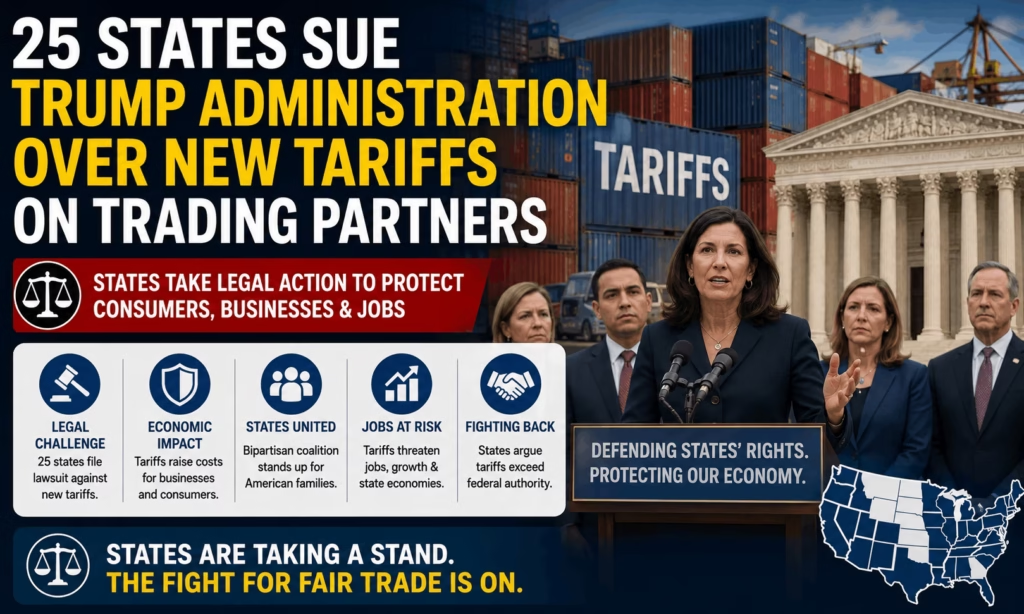
25 States vs Trump Tariffs Lawsuit Key Highlights
| Detail | Information |
|---|---|
| Lawsuit filed on | Monday, August 3, 2026 |
| Number of states involved | 25 (Democratic-led coalition) |
| Court | U.S. Court of International Trade (CIT) |
| Tariff authority cited by administration | Section 301 of the Trade Act of 1974 |
| Tariff rate | 10% to 12.5% |
| Countries affected | 59 countries plus the European Union (about 60 trading partners) |
| Share of total U.S. imports covered | 99.4% |
| Tariffs took effect | July 24, 2026 |
| Lead states | Arizona, California, Oregon, New York |
| Named defendants | President Donald Trump, USTR Jamieson Greer, CBP Commissioner Rodney S. Scott |
| Stated reason for tariffs | Alleged failure of trading partners to stop forced-labor imports |
| This is the coalition’s | 3rd lawsuit against Trump tariff policy since April 2025 |
What Is the New Tariffs Lawsuit About?
The lawsuit alleges that the Trump administration’s newest tariffs are not genuinely about forced labor, the justification the White House gave when it announced them, but are instead a pretext to resurrect a broader tariff regime that courts had already ruled unlawful. According to the complaint, the administration directed the Office of the U.S. Trade Representative to investigate around 80 countries and ultimately imposed duties on 59 nations and the EU, timed to take effect just as the previous temporary tariffs were set to expire.
The states argue this violates the Administrative Procedure Act, the federal law that governs how agencies must create rules, because the investigation behind the tariffs was, in their view, rushed and did not properly establish that each targeted economy actually failed to curb forced-labor imports. The lawsuit asks the court to declare the tariffs unlawful, halt their collection, and order refunds of duties already paid by the states and their residents.
Which States Are Suing the Trump Administration?
The coalition suing over the new tariffs includes attorneys general and governors from the following 25 states:
Arizona, California, Colorado, Connecticut, Delaware, Hawaii, Illinois, Kentucky, Maine, Maryland, Massachusetts, Michigan, Minnesota, Nevada, New Jersey, New Mexico, New York, North Carolina, Oregon, Pennsylvania, Rhode Island, Vermont, Virginia, Washington, and Wisconsin.
New York Attorney General Letitia James and Governor Kathy Hochul jointly announced the filing, while Arizona, California, and Oregon co-led the legal effort. All of the participating states currently have Democratic attorneys general or governors.
The Full Tariff Timeline
Understanding this lawsuit requires looking back at the year-long legal fight over Trump’s tariff policy. Here is how the dispute unfolded:
| Date | Event |
|---|---|
| April 2025 | States file their first lawsuit challenging tariffs imposed under the International Emergency Economic Powers Act (IEEPA) |
| February 2026 | U.S. Supreme Court rules that IEEPA does not give the president authority to impose sweeping tariffs |
| Late February 2026 | Administration pivots to Section 122 of the Trade Act of 1974, imposing temporary 10% tariffs on most imports |
| May 2026 | U.S. Court of International Trade rules the Section 122 tariffs unlawful (ruling paused pending appeal) |
| July 23, 2026 | Administration announces new Section 301 tariffs of 10-12.5% on goods from 59 countries and the EU |
| July 24, 2026 | New tariffs take effect, just as the temporary 10% worldwide tariffs expire |
| August 3, 2026 | Coalition of 25 states files its third lawsuit, challenging the Section 301 tariffs |
After the Supreme Court’s February ruling against the IEEPA tariffs, the administration was forced to refund duties already collected from importers. Eager to avoid a repeat revenue loss, officials say the administration turned first to Section 122, and then, after that too was struck down, to Section 301 — a law that has historically been used for narrower, country-specific trade actions rather than a blanket global tariff.
Why Section 301 Tariffs Are Controversial
Section 301 of the Trade Act of 1974 authorizes the president to impose tariffs and other trade sanctions on countries found to engage in unfair trade practices. Historically, this provision has been used for targeted disputes, such as the tariffs imposed on Chinese goods during Trump’s first term. This time, however, the administration cited forced-labor concerns as the basis for tariffs on dozens of countries simultaneously.
The states argue this is an unprecedented and improper use of the law. Their complaint states that the administration didn’t adequately prove, on a country-by-country basis, that each nation had failed to curb forced-labor imports, nor did it explain how the new tariffs would actually fix the alleged problem, both of which are legal requirements under Section 301. Notably, this state lawsuit is not the only challenge; two separate lawsuits by small businesses were already filed in the Court of International Trade in July 2026 raising similar objections.
What the White House Is Saying
The Trump administration has firmly defended the legality of the new tariffs. White House spokesman Kush Desai said in a statement that “the United States is using its lawful authority to obtain the elimination of unreasonable acts, policies and practices that burden U.S. commerce.” He added that a foreign country’s failure to stop forced-labor imports “is unreasonable and burdens U.S. commerce, including American workers, and must be addressed,” and argued that Section 301 tariffs have proven to be a legally durable tool since Trump’s first term.
U.S. Trade Representative Jamieson Greer and CBP Commissioner Rodney S. Scott are both named as defendants in the lawsuit, alongside President Trump himself.
COVID Tax Refunds: Who Might Still Qualify, What The Kwong Ruling Means, And Your Options Now
Canada Asylum Rules 2026: What Changed, What’s Next?
Canada’s High-Wage Occupation Proposal: Who Could Benefit Most
How the New Tariffs Could Affect Consumers and Businesses
Because the tariffs cover trading partners responsible for 99.4% of total U.S. imports, the financial impact is expected to be widespread. The states’ lawsuit specifically warns that the added costs of these import tariffs will ultimately be passed on to everyday American consumers through higher prices on everyday goods, from electronics and clothing to household staples. Small businesses that rely on imported materials or finished products are also expected to feel a direct hit to their margins, a concern echoed by the separate small-business lawsuits already filed against the Section 301 duties.
Economists and trade groups have pointed out that repeated rounds of restructured tariffs, first under IEEPA, then Section 122, and now Section 301, have created significant uncertainty for supply chains, making it difficult for importers to plan pricing and inventory months in advance.
What Happens Next in the Tariff Lawsuit?
The case now heads to the U.S. Court of International Trade, the same court that previously ruled against the administration’s Section 122 tariffs. Given the pattern from the earlier IEEPA and Section 122 disputes, most legal observers expect this case to move relatively quickly through the CIT before likely facing an appeal, regardless of which side wins at the trial court level. If the states succeed, the administration could once again be required to refund duties collected under the new tariffs, echoing the refunds ordered after the Supreme Court’s February 2026 IEEPA ruling.
Official Government and Legal Resources
| Resource | Purpose | Official Link |
|---|---|---|
| U.S. Court of International Trade | Case filings and court updates | https://www.cit.uscourts.gov |
| Office of the U.S. Trade Representative (USTR) | Section 301 tariff actions and investigations | https://ustr.gov |
| U.S. Customs and Border Protection (CBP) | Tariff rates, duty collection, and import guidance | https://www.cbp.gov |
| California Department of Justice (Attorney General) | Lawsuit statements and press releases | https://oag.ca.gov |
| New York Attorney General’s Office | Lawsuit statements and press releases | https://ag.ny.gov |
| The White House | Official administration statements | https://www.whitehouse.gov |
FAQs 25 States Sue Trump Administration Over New Tariffs
How many states are suing Trump over the new tariffs?
A coalition of 25 states, led by Arizona, California, Oregon, and New York, filed the lawsuit against the new tariffs on August 3, 2026.
What law is the Trump administration using to impose the new tariffs?
The administration is using Section 301 of the Trade Act of 1974, citing trading partners’ alleged failure to prevent forced-labor imports.
Which countries are affected by the new tariffs?
The tariffs apply to 59 countries and the European Union, roughly 60 trading partners, which together account for about 99.4% of total U.S. imports.
What tariff rate is being charged under the new rules?
The new tariffs range from 10% to 12.5%, depending on the country.
Why did the Supreme Court strike down Trump’s earlier tariffs?
In February 2026, the U.S. Supreme Court ruled that the International Emergency Economic Powers Act (IEEPA) does not give the president authority to impose broad tariffs, forcing the administration to refund previously collected duties.
Is this the first time states have sued over Trump’s tariffs?
No. This is the third lawsuit filed by this multi-state coalition, following an April 2025 case over IEEPA tariffs and a mid-2026 case over Section 122 tariffs.
Will these tariffs affect prices for regular consumers?
Yes. The states’ lawsuit argues that the cost of the tariffs will largely be passed on to American consumers through higher prices on imported goods.
Where can I check the status of the tariff lawsuit?.
Case updates are published on the U.S. Court of International Trade website and through official statements from participating state attorneys general
Conclusion
The 25-state lawsuit against the Trump administration’s new tariffs represents the latest chapter in an ongoing, high-stakes legal battle over presidential trade authority. With Section 301 tariffs now covering nearly all U.S. trading partners and affecting the vast majority of American imports, the outcome of this case could have far-reaching consequences for consumer prices, small businesses, and the broader U.S. economy. As the case moves through the Court of International Trade, millions of Americans and businesses will be watching closely to see whether history repeats itself, with the courts once again ruling against the administration’s tariff strategy, or whether Section 301 proves to be the durable legal tool the White House claims it is. This article will continue to be updated monthly as new developments unfold in this evolving case.
Missouri SNAP Food Ban Delayed: What’s Banned & Latest Status
Hawaii SNAP Soda Ban Delayed to 2027: What Will Be Banned & Status
Florida SNAP Junk Food Ban 2026: What’s Banned, Court Update, EBT Rules & Latest Status
Nevada SNAP Food Ban: What’s Banned & Start Date Explained