
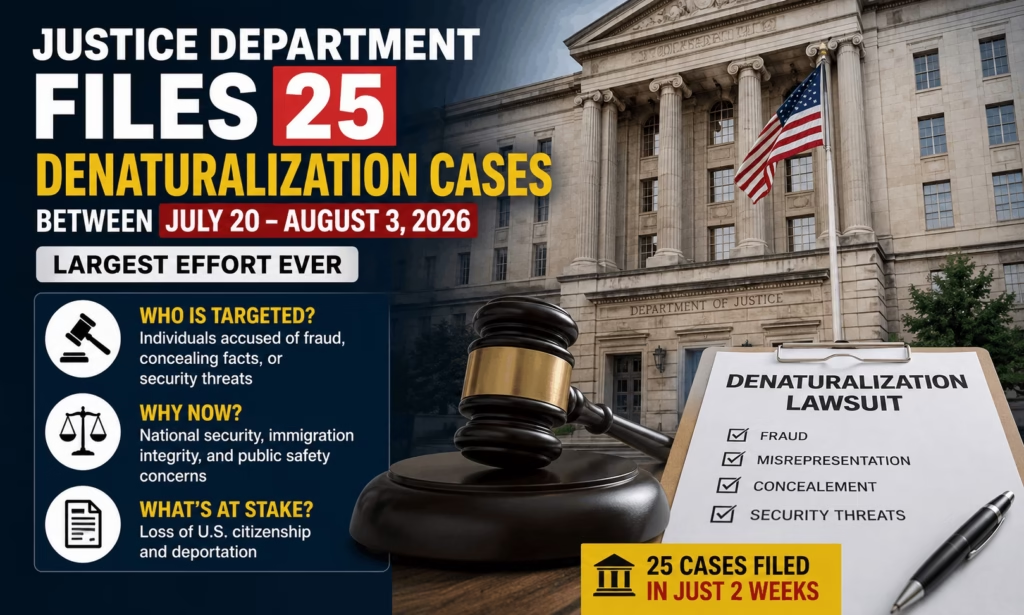
Denaturalization Cases: The Department of Justice has launched what it is calling the largest coordinated denaturalization effort in its history, filing 25 civil denaturalization cases against naturalized US citizens in federal district courts across the country between July 20 and August 3, 2026. Working in partnership with US Citizenship and Immigration Services, the Justice Department targeted individuals accused of serious crimes ranging from attempted first-degree murder and assault with a deadly weapon to aggravated sexual assault of a child, spousal abuse, and financial fraud, all allegedly concealed or misrepresented at the time they applied for citizenship. Acting Attorney General Todd Blanche framed the filings as a milestone in an accelerating campaign, stating plainly that US citizenship must be obtained lawfully and honestly.
The scale of this push becomes clearer against the broader numbers. Since January 20, 2025, the Justice Department has filed 123 civil denaturalization complaints, the most in recorded history for any comparable period, and officials have signaled the pace is not slowing down. For naturalized citizens, immigration attorneys, and families following this story, the wave of denaturalization cases raises real questions about who is actually at risk and what legal standards the government must meet before a court can strip someone of citizenship they have already lawfully held for years. We’ll be updating this article monthly as additional denaturalization complaints are filed and as these cases move through the federal courts.
Latest Update On The Denaturalization Cases
As of this month, the 25 complaints filed between July 20 and August 3, 2026 represent the single largest concentrated batch of denaturalization filings the Justice Department has ever brought at one time, according to the department’s own August 3 announcement. The complaints were filed in multiple federal district courts nationwide, targeting individuals whose alleged underlying conduct spans attempted murder, aggravated sexual assault of a child, assault and battery of a high and aggravated nature, money laundering, and use of a fraudulent identity to gain admission to the United States in the first place.
This latest batch builds directly on a June 2026 wave in which the department moved against 17 individuals from 13 different countries over allegations including child sexual abuse, narcotics trafficking, and large-scale financial fraud, meaning the August filing nearly doubled the size of that earlier action within just a few months. Assistant Attorney General Brett Shumate, who leads the Civil Division overseeing these cases, along with Blanche, has described the current wave of filings as a down payment rather than a final effort, signaling additional denaturalization complaints are expected in the coming months.
Why Denaturalization Cases Are Accelerating Now
The current surge traces back to a June 2025 memorandum that directed the Justice Department’s Civil Division to pursue denaturalization cases more aggressively than in prior years. That memo specifically identified terrorism, gang activity, national security threats, and undisclosed felony conduct as top enforcement priorities, giving federal prosecutors a clearer mandate to pursue cases that may have previously moved more slowly through the referral pipeline. Earlier this year, the administration also reassigned USCIS attorneys to work directly with the Justice Department, a bureaucratic shift specifically aimed at building the department’s capacity to investigate and litigate denaturalization cases at a larger scale, and officials say that added capacity is now producing the visible acceleration seen in this year’s filing numbers.
By comparison, denaturalization complaints during the Biden administration averaged fewer than four cases per year, according to data compiled by researchers tracking federal court filings, making the current pace of well over 100 complaints in roughly a year and a half a dramatic departure from recent historical norms.
Backdoor Roth IRA 2027: What’s Actually Changing For High Earners As Two Separate Rules Collide
Denaturalization Cases Key Highlights
| Detail | Information |
|---|---|
| Cases filed in this batch | 25 |
| Filing window | July 20 through August 3, 2026 |
| Total complaints since Jan. 20, 2025 | 123 |
| Prior comparable period, Biden administration | Fewer than 4 denaturalization cases per year on average |
| Lead agencies | Department of Justice Civil Division, in partnership with USCIS |
| Legal basis | Immigration and Nationality Act, illegally procured naturalization or concealment/misrepresentation |
| Civil case burden of proof | Clear, convincing, and unequivocal evidence |
| Criminal case burden of proof | Beyond a reasonable doubt |
| Prior batch, June 2026 | 17 individuals from 13 countries |
| Driving policy memo | June 2025 Civil Division denaturalization enforcement memo |
| Stated enforcement priorities | Terrorism, gang activity, national security threats, undisclosed felony conduct |
What Denaturalization Actually Means Under US Law
Denaturalization is the legal process of revoking a naturalized US citizen’s citizenship and canceling their certificate of naturalization. Under the Immigration and Nationality Act, this can happen when the government proves that a person’s naturalization was illegally procured, meaning the person did not actually meet the legal requirements for citizenship at the time it was granted, or was procured by concealment of a material fact or willful misrepresentation during the naturalization process, meaning the person lied about or hid something significant that would have affected the outcome of their application.
There are two separate legal paths to denaturalization, and the burden of proof differs sharply between them. Civil denaturalization, which is the pathway used in all 25 of these recent cases, requires the government to present clear, convincing and unequivocal evidence that does not leave the issue in doubt, a demanding standard but lower than the criminal standard. Criminal denaturalization, which occurs as part of a criminal prosecution rather than a separate civil lawsuit, requires proof beyond a reasonable doubt, the same standard used in any other federal criminal case.
Who Is Actually Being Targeted In These Cases
According to the official case details released by the Justice Department, the individuals named in this latest batch of complaints represent a range of alleged conduct, all tied either to crimes committed after naturalization that were concealed during the process, or to fraud committed at the time citizenship was originally obtained. Case examples released publicly include a 67-year-old man from El Salvador accused of concealing disqualifying conduct before becoming a citizen, a 65-year-old man from India accused of using a fraudulent identity to gain admission to the United States in the first place, and a 46-year-old woman originally from Moldova accused of involvement in distributing child sexual abuse material years after her 2010 naturalization.
Attorneys who work directly with naturalized clients caution that the alarming headlines around this surge can be misunderstood. The cases the department has publicized involve specific, serious allegations, including violent crimes, child exploitation offenses, and deliberate identity fraud, rather than routine paperwork errors or minor omissions on a naturalization application. Legal commentary following the announcement has emphasized that the government’s high burden of proof in civil cases, requiring clear and convincing evidence, means these filings are not simple administrative actions but full federal lawsuits the government must actually win in court.
Canada FMCSP Study Permit: 2,970 Spots Open August 26, See Eligibility, PR Pathway & How to Apply?
The Denaturalization Legal Process Step By Step
A denaturalization case begins when USCIS identifies potential grounds for revocation, often through a review of an individual’s original naturalization file, new criminal conduct, or evidence surfacing through separate law enforcement investigations. If USCIS determines there is sufficient evidence, the agency refers the case to the Department of Justice’s Civil Division, which then decides whether to file a civil complaint in the appropriate US district court. From that point, the case proceeds like any other federal civil lawsuit, with the defendant entitled to respond, present evidence, and contest the government’s claims before a judge, who ultimately decides whether the government has met its burden of clear and convincing evidence.
If a court rules in the government’s favor, the defendant’s citizenship is revoked, their certificate of naturalization is canceled, and they are typically ordered to surrender any documents proving citizenship, effectively reverting the individual to their prior immigration status, which in many cases can then expose them to separate removal proceedings.
What This Means For Naturalized Citizens Broadly
The vast majority of the roughly 25 million naturalized US citizens have no connection to the specific fraud, concealment, or serious criminal conduct these cases target, and immigration attorneys have stressed that a lawful, accurately completed naturalization application from years ago is not retroactively at risk simply because the government is filing more of these cases overall. That said, individuals with a history of undisclosed criminal conduct predating their naturalization, or who are aware of specific misrepresentations made during their application process, are the population most directly implicated by this enforcement priority shift, and attorneys are encouraging anyone with genuine concerns about their own naturalization history to consult an immigration attorney rather than wait to see if their case surfaces in a future filing.
Official Sources
| Resource | Link |
|---|---|
| DOJ official denaturalization case announcement | justice.gov/opa/pr |
| USCIS official press release on the 25 cases | uscis.gov/newsroom/news-releases |
| USCIS denaturalization overview | uscis.gov/policy-manual |
| Check naturalization case status | egov.uscis.gov/casestatus |
| DOJ Civil Division, Office of Immigration Litigation | justice.gov/civil/office-immigration-litigation |
FAQs About Denaturalization Cases
How many denaturalization cases has the DOJ filed in 2026?
The Justice Department filed 25 civil denaturalization complaints between July 20 and August 3, 2026 alone, bringing the total since January 20, 2025 to 123 complaints.
What crimes are the people in these denaturalization cases accused of?
The complaints allege offenses including attempted first-degree murder, assault with a deadly weapon, aggravated sexual assault of a child, spousal abuse, money laundering, and use of a fraudulent identity to obtain citizenship.
What legal standard does the government have to meet to denaturalize someone?
In civil denaturalization cases, the government must present clear, convincing, and unequivocal evidence that does not leave the issue in doubt. Criminal denaturalization requires proof beyond a reasonable doubt.
Can any naturalized citizen be denaturalized at any time?
No. Denaturalization requires the government to prove in court that citizenship was illegally procured or obtained through concealment of a material fact or willful misrepresentation, not simply that someone is a naturalized citizen.
Why is the number of denaturalization cases increasing so sharply in 2026?
A June 2025 Justice Department memo directed more aggressive pursuit of denaturalization cases involving terrorism, gang activity, national security threats and undisclosed felony conduct, and USCIS attorneys were reassigned to help build the department’s litigation capacity.
What happens if someone loses a denaturalization case?
Their US citizenship is revoked, their certificate of naturalization is canceled, and they are typically ordered to surrender citizenship documents, which can also expose them to separate immigration removal proceedings.
People Also Ask
What is the difference between civil and criminal denaturalization? Civil denaturalization is a federal lawsuit requiring clear and convincing evidence, while criminal denaturalization occurs as part of a criminal prosecution and requires proof beyond a reasonable doubt.
Who decides whether to file a denaturalization case? USCIS reviews naturalization files and refers cases with sufficient evidence to the Department of Justice’s Civil Division, which then decides whether to file a complaint in federal court.
Is denaturalization common for naturalized US citizens? No. Denaturalization historically has been rare, though filings have increased sharply since January 2025 compared to prior years, when complaints averaged fewer than four per year.
Can a denaturalized person be deported? Yes. Once citizenship is revoked, an individual reverts to their prior immigration status, which can make them subject to separate removal proceedings depending on their circumstances.
Conclusion
The Justice Department’s filing of 25 denaturalization cases in just two weeks marks the largest coordinated action of its kind in the department’s history, part of a broader surge that has already produced 123 total complaints since January 2025. While the pace of these filings is unprecedented, the underlying legal process, and the government’s demanding burden of proof, remain unchanged, meaning these cases target specific, serious allegations of fraud or concealment rather than reopening naturalization broadly for the millions of citizens who obtained it lawfully. Anyone with genuine questions or concerns about their own naturalization history should consult an immigration attorney directly rather than relying on general news coverage to assess their individual risk.
2027 Social Security COLA: 3.6% Estimate Beats Medicare Hike
2027 HSA Contribution Limits Announced: IRS Confirms $4,500 and $9,000 Caps