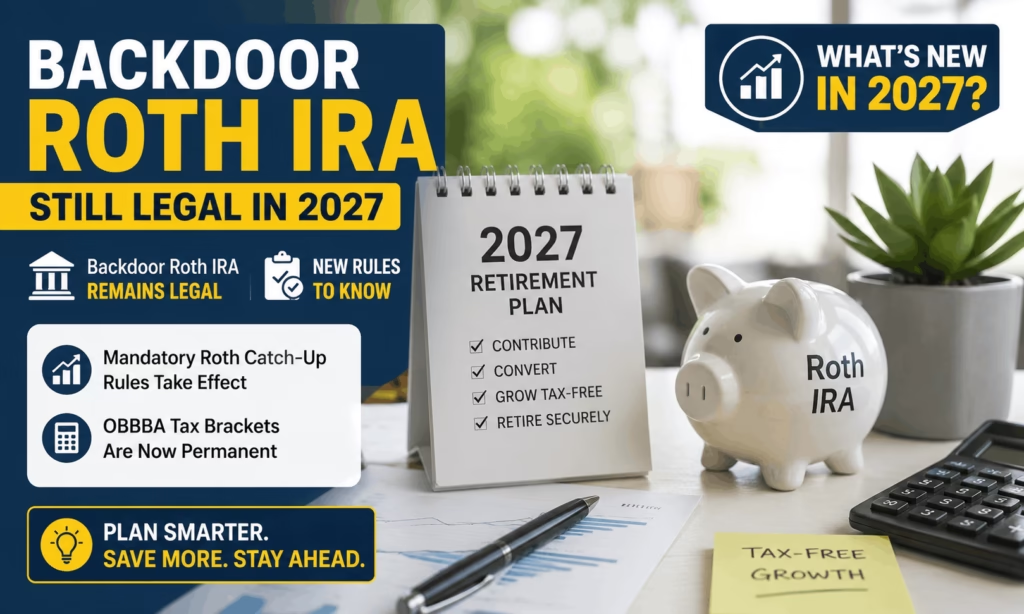
Backdoor Roth IRA 2027: High-income savers who rely on the backdoor Roth IRA strategy are heading into a genuinely different planning environment in 2027, even though the core loophole itself remains completely legal. Two separate pieces of federal policy are converging on the same tax year. The One Big Beautiful Bill Act, signed into law July 4, 2025, made the 2017 Tax Cuts and Jobs Act individual tax brackets permanent instead of letting them expire, locking in the lower rates that have made Roth conversions attractive for years. At the same time, a completely different law, SECURE 2.0, will move past its temporary good-faith compliance period and fully enforce a mandatory Roth catch-up rule starting January 1, 2027, forcing many of the same high earners who use backdoor Roth conversions to also route their 401(k) catch-up contributions into Roth accounts automatically.
Confusion between these two rules has spread quickly online, with some coverage incorrectly describing the mandatory Roth catch-up requirement as an OBBBA provision. It is not. The backdoor Roth IRA strategy itself was never banned by either law, and an earlier 2021 proposal that would have eliminated backdoor conversions entirely never became law in the first place. What has changed is the surrounding tax landscape these conversions now sit inside, and understanding exactly which rule comes from which law matters for anyone trying to plan a conversion correctly heading into 2027. We’ll be updating this article monthly as the IRS finalizes further guidance ahead of the 2027 enforcement deadline.
Latest Update On Backdoor Roth IRA Rules Heading Into 2027
As of this month, the backdoor Roth IRA and mega backdoor Roth strategies remain fully legal, with no legislative action from either OBBBA or any other recent law restricting the two-step contribute-and-convert process that high earners use to fund a Roth IRA despite exceeding the direct income limits. For 2026, those direct Roth IRA contribution limits phase out between $153,000 and $168,000 for single filers, meaning anyone above that range must continue relying on the backdoor method if they want Roth IRA assets at all.
The more significant development for 2027 involves the mandatory Roth catch-up contribution rule under SECURE 2.0. The IRS and Treasury finalized regulations requiring employees age 50 and older who earned more than $145,000 in FICA wages from their employer in the prior year, a threshold indexed annually and set at $150,000 based on 2025 wages, to make their 401(k) catch-up contributions exclusively on a Roth, after-tax basis. The rule technically became mandatory for calendar-year plans starting January 1, 2026, but the IRS granted 2026 as a good-faith compliance gap year, meaning stricter enforcement and the fully binding final regulations do not take hold until January 1, 2027.
Backdoor Roth IRA: The Strategy Itself Remains Untouched
A backdoor Roth IRA is not a special account type. It is a two-step strategy that lets high-income earners fund Roth IRA assets despite exceeding the income limits that block direct contributions. The process involves contributing after-tax dollars to a traditional IRA, which carries no income restriction, and then converting that traditional IRA balance into a Roth IRA shortly afterward. Because the contribution itself was already taxed and nondeductible, the conversion typically triggers little to no additional tax, aside from any investment growth that occurred between the contribution and the conversion.
Reports that OBBBA repealed or restricted this strategy are inaccurate. The law made no changes to IRA contribution rules, conversion rules, or income eligibility for backdoor conversions. The only legislative attempt to eliminate backdoor Roth conversions came from the 2021 Build Back Better proposal, which would have banned the strategy starting in 2022, but that bill never passed Congress, and neither OBBBA nor any subsequent law has revived that proposal.
Direct Express Card Transition to Fifth Third Bank: What 3.6 Million Cardholders Need to Know
Federal Fuel Excise Tax Suspension: Ford Pushes Carney to Extend Relief Past Labour Day
FTC Refund 2026: Millions of Americans May Be Owed Money and Most Don’t Know It
Backdoor Roth IRA 2027 Key Highlights
| Detail | Information |
|---|---|
| Backdoor Roth IRA legal status | Fully legal, unchanged by OBBBA |
| OBBBA signed | July 4, 2025 |
| OBBBA’s relevant effect | Made 2017 TCJA individual tax brackets permanent |
| Mandatory Roth catch-up rule origin | SECURE 2.0, not OBBBA |
| Roth catch-up income threshold | Prior-year FICA wages over $145,000, indexed to $150,000 for 2025 wages |
| Roth catch-up good-faith compliance period | Calendar year 2026 |
| Roth catch-up full enforcement | Begins January 1, 2027 |
| 2026 IRA contribution limit | $7,500 under age 50, $8,600 age 50 and older |
| 2026 Roth IRA direct contribution phase-out, single filers | $153,000 to $168,000 |
| Key risk in any backdoor conversion | The pro-rata rule |
What OBBBA Actually Changed For Roth Planning
While OBBBA left the backdoor Roth mechanics untouched, it reshaped the broader tax environment these conversions are planned around. By making the 2017 Tax Cuts and Jobs Act’s lower individual tax brackets permanent instead of letting them sunset after 2025 as originally scheduled, OBBBA removed a deadline that had previously pushed many savers to accelerate Roth conversions before rates were expected to rise. With current marginal brackets, the higher standard deduction, and the 20 percent qualified business income deduction under Section 199A now locked in rather than temporary, financial advisors say the urgency to convert quickly has shifted toward a longer-term, multi-year planning decision rather than a race against an expiring law.
This matters directly for backdoor Roth strategy because the timing of a conversion, and how much of a traditional IRA balance to convert in a given year, is typically modeled around expected future tax rates. With brackets now stable for the foreseeable future, advisors can build multi-year conversion plans with more confidence, spreading conversions across several years to manage tax bracket thresholds, Medicare IRMAA surcharges and other income-based phaseouts without racing an artificial deadline.
The Mandatory Roth Catch-Up Rule Explained
Separately from OBBBA, the SECURE 2.0 mandatory Roth catch-up provision represents the single biggest procedural change high earners will feel starting in 2027. Under current law, employees age 50 and older can make additional catch-up contributions to their 401(k) or similar workplace plan beyond the standard annual deferral limit, and these have traditionally been allowed on either a pre-tax or Roth basis, depending on the plan and the participant’s choice. Starting with the full enforcement date of January 1, 2027, employees who earned more than the indexed threshold, currently $150,000 based on 2025 FICA wages from the plan-sponsoring employer, in FICA wages the prior year must make 100 percent of their catch-up contributions on a Roth, after-tax basis. Regular contributions below the standard deferral limit remain unaffected and can still be made pre-tax or Roth at the employee’s choice.
This determination is made annually based on the prior year’s wages from the specific employer sponsoring the plan, meaning an employee whose wages drop below the threshold in a given year can revert to pre-tax catch-up contributions the following year if eligible. Self-employed individuals without W-2 FICA wages are exempt from this requirement regardless of their net self-employment earnings, and the rule applies specifically to 401(k), 403(b) and governmental 457(b) plans, not to IRAs directly.
Why The Mandatory Roth Catch-Up Rule Matters For Backdoor Roth Users
For years, high earners locked out of direct Roth IRA contributions have relied on the backdoor Roth strategy specifically because it required extra steps, careful paperwork, and precise execution to access Roth-style tax-free growth. The mandatory Roth catch-up rule effectively creates a second, automatic pathway into Roth savings directly through an employer’s 401(k) plan, without any backdoor maneuvering required for that specific portion of retirement savings.
This does not eliminate the need for a backdoor Roth strategy for IRA contributions specifically, since the mandatory catch-up rule only touches employer-sponsored plan catch-up contributions, not IRA contributions. But for high earners who were previously making pre-tax catch-up contributions to reduce their current taxable income, the shift to mandatory Roth catch-ups means less flexibility to choose pre-tax savings for that portion of their retirement contributions, a change financial advisors describe as effectively forcing more retirement savings into Roth accounts regardless of an individual’s preferred tax strategy.
ICE Detained Military Families: AP Finds 50+ Spouses and Parents Held
Watch Out For The Pro-Rata Rule
Regardless of how the surrounding tax law has shifted, the single most common mistake in executing a backdoor Roth IRA conversion has not changed. The pro-rata rule states that when any portion of IRA money is converted to a Roth IRA, the conversion is treated as a proportional mix of all pre-tax and after-tax dollars across every traditional, SEP and SIMPLE IRA an individual owns, not just the specific account being converted. This means that if a saver has pre-tax IRA balances anywhere else in their name on December 31 of the conversion year, even if the contribution and conversion happened cleanly in January, a significant portion of the conversion could become unexpectedly taxable.
Financial professionals consistently advise anyone planning a backdoor Roth conversion to first roll any existing pre-tax IRA balances into a workplace 401(k) plan, if the plan accepts incoming rollovers, before executing the nondeductible contribution and conversion, since 401(k) balances are not counted in the pro-rata calculation the way IRA balances are.
How A Backdoor Roth IRA Conversion Works
The process itself remains straightforward and has not changed under either OBBBA or the new catch-up rules. A saver first contributes to a traditional IRA, taking no tax deduction on the contribution since their income exceeds the deductibility limits, up to the 2026 contribution limit of $7,500 for those under 50 or $8,600 for those 50 and older. The account is then converted to a Roth IRA, typically through a short form the brokerage provides, with any tax owed limited to investment growth that occurred between the contribution and the conversion, assuming no other pre-tax IRA balances exist elsewhere. The conversion must be reported on Form 8606 for the tax year in which the conversion actually occurs, which can create a filing quirk when a contribution made in early 2027 for the 2026 tax year is converted after the calendar flips, splitting the transaction across two separate Form 8606 filings.
Official Sources
| Resource | Link |
|---|---|
| IRS retirement plan and IRA contribution limits | irs.gov/retirement-plans |
| IRS Form 8606, Nondeductible IRAs | irs.gov/forms-pubs/about-form-8606 |
| IRS guidance on Roth catch-up contributions, SECURE 2.0 | irs.gov/retirement-plans/secure-2-0-act |
| Treasury Department, final Roth catch-up regulations | treasury.gov |
| Text of the One Big Beautiful Bill Act | congress.gov |
FAQs About Backdoor Roth IRA 2027
Did OBBBA ban or restrict the backdoor Roth IRA strategy?
No. The One Big Beautiful Bill Act made no changes to IRA contribution or conversion rules. The backdoor Roth IRA strategy remains fully legal.
What did OBBBA actually change that affects Roth planning?
OBBBA made the 2017 Tax Cuts and Jobs Act’s lower individual tax brackets permanent instead of letting them expire, which removed the deadline pressure that previously drove many savers to rush Roth conversions before rates were expected to rise.
Is the mandatory Roth catch-up rule part of OBBBA?
No. It is a provision of SECURE 2.0, a separate law, and becomes fully enforced starting January 1, 2027 after a good-faith compliance period in 2026.
Who is affected by the mandatory Roth catch-up rule in 2027?
Employees age 50 or older who earned more than the indexed threshold, currently $150,000 based on 2025 FICA wages, from the employer sponsoring their 401(k) plan the prior year.
Does the mandatory Roth catch-up rule apply to IRA contributions?
No. It applies specifically to catch-up contributions in employer-sponsored 401(k), 403(b) and governmental 457(b) plans, not to traditional or Roth IRA contributions.
What is the biggest mistake people make with a backdoor Roth conversion?
Failing to account for the pro-rata rule, which taxes a conversion as a proportional mix of all pre-tax and after-tax IRA dollars a person owns, not just the specific account being converted.
People Also Ask
Is the backdoor Roth IRA still legal in 2027? Yes. Neither OBBBA nor any other recent law has repealed or restricted the backdoor Roth IRA strategy, and it remains a fully legal method for high earners to fund Roth IRA assets.
What is the difference between a backdoor Roth and a mega backdoor Roth? A standard backdoor Roth converts a traditional IRA to a Roth IRA, while a mega backdoor Roth uses after-tax contributions inside a 401(k) plan, offering significantly higher contribution room for those whose plans support the feature.
How much can I contribute to a backdoor Roth IRA in 2026? The 2026 IRA contribution limit is $7,500 for those under age 50 and $8,600 for those age 50 and older, which includes the $1,100 catch-up amount.
What happens if my plan doesn’t support Roth catch-up contributions? Under the final regulations, if a plan does not offer a Roth contribution feature, affected high earners may be barred from making any catch-up contributions at all until the plan is amended to add that option.
Conclusion
The backdoor Roth IRA strategy heads into 2027 fully intact, but the planning environment around it has shifted in two distinct ways that are easy to conflate. OBBBA’s permanent extension of the 2017 tax brackets has removed the urgency that once drove rushed conversions, giving savers more room to plan multi-year strategies with confidence, while SECURE 2.0’s fully enforced mandatory Roth catch-up rule will push many of the same high earners into automatic Roth treatment for their 401(k) catch-up contributions starting January 1, 2027. Anyone relying on backdoor Roth conversions should keep these two separate rules straight, watch carefully for the pro-rata trap, and consult a qualified tax professional before executing a conversion, since the mechanics remain unchanged but the surrounding tax strategy now has more moving parts than it did just a year ago.
2027 Social Security COLA: 3.6% Estimate Beats Medicare Hike
2027 HSA Contribution Limits Announced: IRS Confirms $4,500 and $9,000 Caps