Social Security COLA 2027: Social Security recipients finally have the number they were waiting for. On Wednesday, October 14, 2026, the Social Security Administration confirmed a 3.6 percent Social Security COLA for 2027. That lifts a $1,500 monthly check to $1,554, a $2,000 check to $2,072 and a $3,000 check to $3,108, before Medicare deductions. The raise starts with January 2027 benefits and reaches nearly 72 million Social Security beneficiaries. Counting people who receive Supplemental Security Income, about 76 million Americans will see a bigger payment. The agency says the average retired worker will gain roughly $75 a month, and it is the largest increase since the 8.7 percent jump in 2023. You do not need to apply or file anything. Still, the amount that lands in your bank account may grow by less than the headline suggests, mainly because Medicare costs are rising too. We’ll be updating this article monthly.
The adjustment is tied to inflation measured from July through September, using a government index known as the CPI-W. Prices stayed stubbornly high through 2026, which is why the number came in above last year’s 2.8 percent. Outside forecasters had been guessing between 3.3 and 3.6 percent in recent weeks, and The Senior Citizens League had pointed to 3.5 percent in September. The final 3.6 percent landed at the top of that range. Two other figures moved on the same day. The maximum amount of earnings subject to Social Security payroll tax rises to $192,300 from $184,500. And the standard Medicare Part B premium is projected at $209.50, up $6.60 from $202.90. Below, you will find exact dollar amounts for common check sizes, what you may actually keep after Medicare, the January payment calendar, and a free calculator.
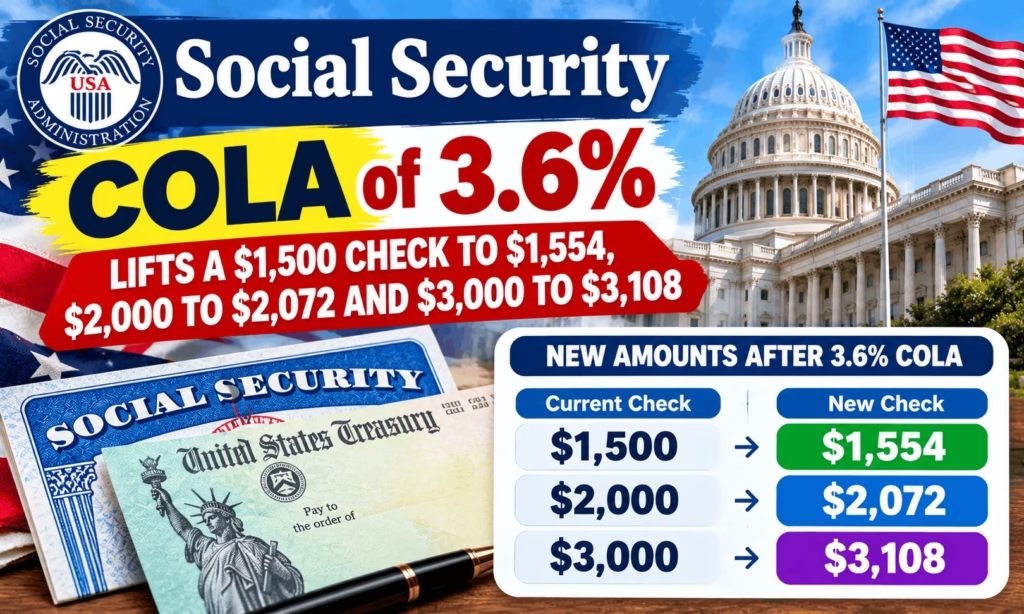
Social Security COLA 2027: How Much a $1,500, $2,000 and $3,000 Check Will Grow
A 3.6 percent increase multiplies your current monthly benefit by 1.036. The table shows the new gross amount, which is the figure before any Medicare premiums, taxes or other deductions.
| Current monthly check | New monthly check in 2027 | Monthly increase | Yearly increase |
|---|---|---|---|
| $1,000 | $1,036 | $36 | $432 |
| $1,250 | $1,295 | $45 | $540 |
| $1,500 | $1,554 | $54 | $648 |
| $2,000 | $2,072 | $72 | $864 |
| $2,500 | $2,590 | $90 | $1,080 |
| $3,000 | $3,108 | $108 | $1,296 |
| $4,000 | $4,144 | $144 | $1,728 |
Your own number may differ by a dollar or so. Social Security rounds benefits down to the next lower dollar after applying the adjustment, and your check may already include small deductions or withholding. The agency will show your exact new amount in your notice. A useful rule of thumb: every $100 of monthly benefit grows by $3.60. If your check is $1,800, you can estimate an increase of about $65. If you receive $2,700, expect about $97.
What You Will Really Take Home After Medicare Part B
Most retirees pay for outpatient Medicare through a deduction from their Social Security check. That deduction is going up, so the gain in your deposit is smaller than the gain in your benefit. The 2026 Medicare Trustees Report, released June 24, projected the standard 2027 Part B premium at $209.50. The 2026 premium is $202.90. CMS had not published the final 2027 figure when SSA made its announcement, and it typically arrives between late October and early November. Using the projected premium, here is what the three most searched check sizes look like for someone who pays the standard Part B rate.
| Item | $1,500 check | $2,000 check | $3,000 check |
|---|---|---|---|
| New gross benefit | $1,554 | $2,072 | $3,108 |
| Projected Part B premium | $209.50 | $209.50 | $209.50 |
| Deposit after Part B in 2027 | $1,344.50 | $1,862.50 | $2,898.50 |
| Deposit after Part B in 2026 | $1,297.10 | $1,797.10 | $2,797.10 |
| Net monthly gain | $47.40 | $65.40 | $101.40 |
| Net yearly gain | $568.80 | $784.80 | $1,216.80 |
| Share of raise used by Part B increase | about 12 percent | about 9 percent | about 6 percent |
The lesson is that lower benefit checks lose a bigger share of the raise. The Part B increase of $6.60 is the same dollar amount for everyone, so it eats a larger piece of a $54 raise than a $108 raise. Higher earners may also owe an income related surcharge on Part B and Part D, which can reduce deposits further. Some beneficiaries with low incomes have protections that keep their Part B increase from shrinking their check, so if you are unsure, the notice from SSA will show the actual premium.
Latest Update: What Social Security Announced on October 14
The agency released its figures after the Bureau of Labor Statistics published September inflation data. Here is what is new and confirmed.
The Social Security COLA for 2027 is 3.6 percent. The average retired worker benefit rises by about $75 a month. About 72 million Social Security beneficiaries and 76 million people overall, counting SSI recipients, are covered. The taxable maximum climbs to $192,300. Beneficiaries with a personal my Social Security account can view their COLA notice online starting in late November, and everyone else will receive a mailed notice in December.
Several outlets noted that 2027 is the fifth largest adjustment in about 35 years, behind 2023 at 8.7 percent, 2022 at 5.9 percent, 2009 at 5.8 percent and 2006 at 4.1 percent. For comparison, last year’s raise was 2.8 percent and the one before it was 2.5 percent. In dollar terms, people have lived with the effects of high prices for years, and advocates argue that the cumulative squeeze matters more than any single year’s percentage. One more point from the announcement: SSA reminded the public that the COLA is automatic. No form, no phone call and no visit to an office is needed.
VA Pay Dates: Next Deposit Is October 30, Plus the Full 2026 Schedule and a Free Calculator
New York POWER Rebate Checks: $100 to $200 Payments Begin Landing in Mailboxes This Fall
When Will the 2027 COLA Show Up in Your Bank Account?
The increase applies to benefits for December 2026 onward in the sense that it starts with the payments you receive in January 2027. Social Security benefits are paid a month behind, so the January deposit is for December in some cases, and the agency’s wording is that the raise begins in January. What matters for planning is the day your deposit hits. SSA pays on set days based on when you started benefits and when your birthday falls.
| Group | Usual payment day | January 2027 date |
|---|---|---|
| Birthday on the 1st to 10th | Second Wednesday | January 13, 2027 |
| Birthday on the 11th to 20th | Third Wednesday | January 20, 2027 |
| Birthday on the 21st to 31st | Fourth Wednesday | January 27, 2027 |
| Started benefits before May 1997, or receive both Social Security and SSI | The 3rd of the month | Likely moved earlier because January 3 is a Sunday and January 1 is a holiday |
| SSI recipients | The 1st of the month | Likely paid on Thursday, December 31, 2026, because January 1 is a federal holiday |
Because the 3rd and 1st dates collide with a weekend and a holiday, confirm the exact deposit day on your SSA payment calendar. SSA moves payments to the previous business day when the regular day is a weekend or holiday.
How the Social Security COLA Is Calculated?
The Social Security Act ties the adjustment to the CPI-W, the Consumer Price Index for Urban Wage Earners and Clerical Workers. SSA takes the average CPI-W for July, August and September of the current year and compares it with the average for the same three months in the last year a COLA took effect. The percentage difference, rounded to the nearest tenth, becomes the COLA. If prices do not rise, there is no increase, and benefits stay the same.
Congress added the automatic COLA in the 1972 Social Security Amendments, and the first automatic adjustment arrived in 1975. Critics, including some seniors’ groups, argue that the CPI-W does not capture what older people spend on, since healthcare and housing weigh more heavily in their budgets. Supporters say the measure is transparent and has worked consistently for decades. Whichever side you are on, the formula is fixed by law, which is why the number is predictable by late summer.
How to Apply for Social Security Benefits?
If you are not yet receiving benefits, the process is simpler than most people expect. Follow these steps.
- Check your eligibility. Most workers need 40 credits, roughly 10 years of work, to qualify for retirement benefits. You can claim as early as 62, but your monthly amount is permanently reduced. Waiting until full retirement age, or up to 70, increases it.
- Create a my Social Security account. Go to the SSA website and sign up with a Login.gov or ID.me account. This lets you review your earnings record and estimates.
- Review your earnings. Mistakes in your record can cut your benefit. Fix anything missing before you apply.
- Apply online, by phone or in person. The online application takes about 30 minutes for retirement. You can also call 1-800-772-1213 or visit a local office.
- Choose direct deposit. It is the fastest and safest way to get paid.
- Keep your confirmation. You will need it to check your status.
If you plan to apply for disability or SSI, expect to provide medical records, work history and details about your income and resources.
Social Security Processing Time: How Long Until Your First Check
Retirement claims are often decided within a few weeks, especially when you apply online and have clean records. Complex cases, such as those involving work overseas or disputed earnings, take longer. Disability claims take much longer, and the initial decision can run for several months, with appeals adding more time. SSA posts its own average processing times on its website, and these change from month to month, so use the agency’s page for the current figure.
After approval, your first payment generally arrives the month after your first month of entitlement, because of the month behind rule. If you are eligible for past due benefits, they are paid separately. Once you are on the roll, the 3.6 percent increase is applied automatically in January.
How to Check Your Social Security COLA Notice and Payment Status
You have two ways to find your new amount. First, sign in to your personal my Social Security account and open the Message Center. SSA says COLA notices start appearing in late November for account holders. You can ask for text or email alerts so you know the moment yours posts. Second, if you do not have an online account, watch your mailbox in December for a paper notice with your new gross benefit, the Medicare premium taken out and your net payment.
To check an application, sign in and select the status tool, or call the national number. Keep a note of the date you applied, since a representative will ask for it. If your notice looks wrong, such as a Part B amount that seems too high, contact SSA before January so any correction can be made quickly.
Will Taxes Shrink Your COLA?
For some retirees, yes. Social Security benefits can become taxable when your combined income passes certain thresholds. Combined income is your adjusted gross income, plus nontaxable interest, plus half of your Social Security benefits. For single filers, benefits may be taxed once combined income passes $25,000. For married couples filing jointly, the figure is $32,000. These limits are not adjusted for inflation, so every COLA pushes more people over them.
Up to 50 percent of your benefits can be taxable at the first tier, and up to 85 percent at higher incomes, generally above $34,000 for single filers and $44,000 for joint filers. You never pay tax on more than 85 percent of the benefit. A raise of $72 a month, or $864 a year, can nudge a retiree into a higher tier, particularly one who also takes withdrawals from a retirement account. The IRS website has worksheets, and you can choose to have federal tax withheld from your check by filing a form with SSA. State rules vary, and most states do not tax Social Security at all.
Higher Earners and the New $192,300 Taxable Maximum
The taxable maximum is the cap on wages subject to the Social Security payroll tax. It rises from $184,500 to $192,300 in 2027. Workers earning above the cap do not pay the 6.2 percent employee share of the tax on the excess, though they keep paying the Medicare tax. A worker earning at least $192,300 will pay about $484 more in Social Security tax next year than in 2026, since the cap rose by $7,800. Employers match that amount. The higher cap also feeds into the benefit formula for future retirees, because more of their earnings count toward their record.
SSI and SSDI Recipients: Does the 3.6 Percent Apply to You?
Yes. SSA’s announcement covers retirement, survivors and disability benefits as well as SSI. The agency estimated that disabled workers receiving SSDI will see an average rise of roughly $59 a month, according to a published breakdown of benefit categories. SSI payments rise by the same percentage, and the federal rate for an individual and a couple both go up. If you receive both Social Security and SSI, the increase in your Social Security check may slightly reduce your SSI, since the program counts other income. That is normal, and your notice explains the change.
For veterans, the same 3.6 percent figure is the basis for the VA compensation increase, which requires a separate act of Congress. Survivors and spouses who rely on these benefits should read each notice carefully.
Social Security Changes October 2026: SSA Announces Major Update for Retirees and Beneficiaries
Why a Bigger Check Can Still Feel Smaller
A few forces eat into the raise. Medicare Part B is the biggest. The 2026 premium rose by $17.90, and the projected 2027 premium rises by $6.60. The annual Part B deductible is projected to climb from $283 to about $292. Part D prescription plans are also changing. KFF reports that about 28 percent of Part D enrollees without low income subsidies, roughly 4 million people, paid no monthly premium in 2026, and some of them may start paying in 2027. One independent analyst said her own plan’s premium would rise from zero to more than $19 a month.
Over this decade, Part B premiums have grown by about 5.3 percent a year on average, while COLAs have averaged about 3.1 percent. That gap explains why many retirees feel they run in place even in years with a large COLA. The 2027 raise is one of the few recent years in which the COLA should outpace the Part B increase on a percentage basis.
Smart Moves Before the January Raise Arrives
Open your my Social Security account now so your notice reaches you quickly. Update your address and direct deposit details to avoid delays. When the final Part B premium is published, compare it with the projection in this article. If you buy Medicare Advantage or Part D coverage, use open enrollment, which runs from October 15 to December 7, to compare plans, since premiums are changing. Review your tax withholding, especially if your combined income is near a threshold. And rebuild your budget using your net deposit rather than your gross benefit.
Social Security COLA Calculator
The calculator below lets you enter any monthly benefit and see the new amount, the dollar increase, the yearly change and an estimate after the projected Part B premium. It starts with $2,000 and has quick buttons for $1,500 and $3,000.
Social Security COLA Calculator
Estimate only. Part B figures are $202.90 for 2026 and a projected $209.50 for 2027, which CMS has not finalized. SSA rounds benefits down to the next lower dollar. Check your official notice at ssa.gov.
Social Security COLA Key Highlights
| Item | Latest information |
|---|---|
| 2027 COLA | 3.6 percent, announced October 14, 2026 |
| 2026 COLA | 2.8 percent |
| Average retirement increase | About $75 per month |
| People affected | Nearly 72 million Social Security beneficiaries and about 76 million including SSI |
| When it starts | January 2027 benefits |
| Taxable maximum | $192,300, up from $184,500 |
| Projected 2027 Part B premium | $209.50, up $6.60 from $202.90 |
| Projected Part B deductible | About $292, up from $283 |
| COLA notices online | Late November for my Social Security account holders |
| COLA notices by mail | December |
| Action needed | None, the increase is automatic |
Official Social Security and Medicare Resources
| Resource | What it is for | Link |
|---|---|---|
| Social Security COLA page | Official COLA details and history | https://www.ssa.gov/cola/ |
| my Social Security login | Sign in, view notices and payment history | https://www.ssa.gov/myaccount/ |
| Apply for benefits | Retirement, disability and survivor applications | https://www.ssa.gov/apply |
| Retirement benefits | Eligibility and claiming age information | https://www.ssa.gov/benefits/retirement/ |
| Supplemental Security Income | SSI rules and payment amounts | https://www.ssa.gov/ssi/ |
| Medicare | Premiums, plans and open enrollment | https://www.medicare.gov |
| CMS newsroom | Final Part B premium announcement | https://www.cms.gov/newsroom |
| IRS | Taxes on Social Security benefits | https://www.irs.gov |
Trump Super Intelligence Force: Who Is on the Team and What the 120-Day Deadline Means
FAQs About the Social Security COLA
How much is the Social Security COLA for 2027?
It is 3.6 percent, announced on October 14, 2026. It begins with January 2027 benefits.
What will a $1,500 Social Security check be after the COLA?
It becomes $1,554, an increase of $54 a month, before Medicare and other deductions.
What will a $2,000 check be after the COLA?
It rises to $2,072, a gain of $72 a month or $864 a year, before deductions.
What will a $3,000 check be after the COLA?
It grows to $3,108, which is $108 more each month and $1,296 more each year.
Do I have to apply for the COLA?
No. SSA applies it automatically, and you will receive a notice.
When can I see my new benefit amount?
Online account holders can see their notice starting in late November. Mailed notices go out in December.
Will the Part B premium reduce my raise?
For most people paying the standard rate, yes. The projected increase is $6.60 a month, which takes a slice of the raise.
Is the 2027 Part B premium final?
Not yet. The $209.50 figure is a projection from the Medicare Trustees Report, and CMS usually confirms the final number in late October or early November.
Will Social Security increase in January 2027?
Yes. Benefits rise by 3.6 percent beginning with the January 2027 payments.
What is the average Social Security increase in 2027?
SSA estimates about $75 more per month for the average retired worker.
How much is the Social Security taxable maximum in 2027?
It is $192,300, up from $184,500.
Is Social Security COLA taxable?
The increase is part of your benefit, so it can raise your taxable amount if your combined income passes $25,000 for singles or $32,000 for joint filers.
Does SSI also get the 3.6 percent increase?
Yes. SSI payments rise by the same percentage, covering about 76 million people with Social Security.
Conclusion
The new Social Security COLA is good news, with limits. A 3.6 percent raise turns $1,500 into $1,554, $2,000 into $2,072 and $3,000 into $3,108, which adds hundreds of dollars a year. After the projected Part B increase, the net gain is closer to $47, $65 and $101 a month for those three check sizes. Taxes and Medicare surcharges can trim it further for some households. The sensible approach is simple: watch for your notice, confirm the final Part B premium when CMS announces it, shop for drug and health plans before December 7, and plan your budget around your net deposit. We’ll keep this page current as new Medicare and SSA numbers arrive.
USCIS Fee Increase Takes Effect Today: New Asylum, Parole, Work Permit and TPS Fees
Georgia Tax Rebate Status: HB 1000 pays $250, $375 or $500 Check Refund Status and Dates