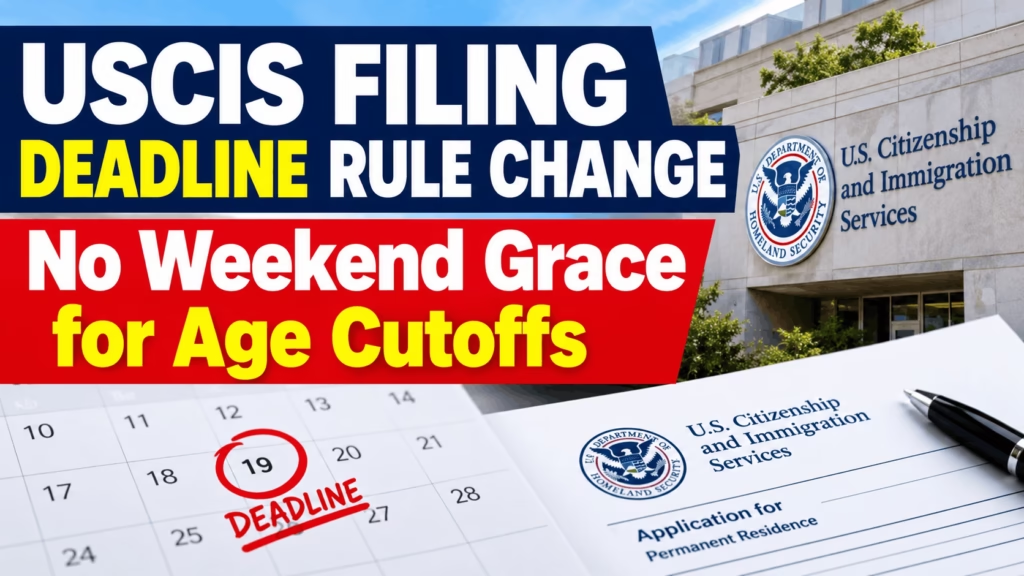
The USCIS filing deadline rule change is now in force. As of Friday, October 23, 2026, a paper application tied to an age or birthday cutoff no longer gets an extra business day when that cutoff lands on a Saturday, Sunday or federal holiday. The new guidance, Policy Alert PA-2026-15, covers paper filings that U.S. Citizenship and Immigration Services receives on or after that date. For a young person whose 21st birthday falls on a weekend, the practical message is blunt: the filing has to be in the agency’s hands before the birthday arrives, not on the Monday after it. The USCIS next business day rule has not disappeared, though. It has been cut back to the kind of deadline it was always written for. We’ll be updating this article monthly.
The change matters most to families and lawyers who plan around a calendar date. The alert, titled “Definition of Day for Purposes of Filing Deadlines,” was issued on September 23, 2026 and gave the public a month of notice. It reverses guidance the agency issued in March 2023, which had stretched the weekend and holiday cushion to some age-based filing deadlines and other eligibility cutoffs. Deadlines counted in days, such as a 30-day window to answer a request for evidence, still roll to the next business day on paper. Online filings never rolled at all. Below you will find the key dates, a plain-language breakdown of who is affected, a step-by-step filing checklist, official links and a free deadline calculator you can use today.
USCIS Filing Deadline Rule Change Key Highlights
| Item | Detail |
|---|---|
| Policy alert | PA-2026-15, “Definition of Day for Purposes of Filing Deadlines” |
| Issued | September 23, 2026 |
| Effective date | October 23, 2026 (Friday) |
| Applies to | Paper filings USCIS receives on or after October 23, 2026 |
| What changed | No next-business-day extension for deadlines set by age, birthday or another eligibility requirement |
| What did not change | Paper deadlines stated as a number of days can still roll to the next business day |
| Online filings | Treated as received the moment they are submitted, so no weekend or holiday extension |
| Guidance replaced | PA-2023-10, issued March 29, 2023 |
| Policy Manual location | Volume 1, Part B, Chapter 6 |
| Most exposed group | Applicants who must file before turning 21, including Special Immigrant Juvenile petitioners |
What Is USCIS Policy Alert PA-2026-15 and What Changed?
Federal immigration regulations include a definition of the word “day.” Under 8 CFR 1.2, weekends and legal holidays count when you tally a period expressed in days, but if the period ends on one of those days, it runs through the end of the next business day. For decades the agency applied that text to filing windows and response periods that were literally measured in days.
In March 2023, USCIS widened its approach. A paper filing that was due on a Saturday, Sunday or federal holiday, including one due the day before a birthday, could be treated as timely if it arrived by the end of the next business day. PA-2026-15 undoes that expansion. The agency now says the regulatory definition of “day” applies only when a statute, regulation or form instruction sets a deadline in a stated number of days. Anything built on a different trigger, such as reaching a certain age, is outside the definition and gets no automatic rollover.
One detail is easy to miss. The cutoff is tied to receipt, not to the postmark and not to the day a package is dropped off with a courier. If your envelope reaches a USCIS location on October 22, the old approach is not in play for that filing. If it arrives on October 23 or later, the new guidance governs. The agency has said it is returning to its long-standing reading of the rule, which is why many immigration practitioners describe this as a reset rather than a brand-new restriction.
Social Security Changes October 2026: SSA Announces Major Update for Retirees and Beneficiaries
USCIS Next Business Day Rule: Which Deadlines Still Roll Over?
The easiest way to understand the USCIS next business day rule after October 23 is to sort your deadline into one of three buckets.
| Type of deadline | Filing method | Rule after October 23, 2026 |
|---|---|---|
| Period stated in days (for example, 30 or 60 days from a notice) | Paper | If the last day is a Saturday, Sunday or federal holiday, a filing received by the end of the next business day may still be timely |
| Age, birthday or other eligibility requirement (for example, file before turning 21) | Paper | No automatic extension; the filing must be received while the person still meets the requirement |
| Any deadline | Online | Counted as received when submitted; no weekend or holiday extension |
A quick illustration shows the difference. Imagine a notice that gives you 60 days to respond, and day 60 lands on Sunday, November 29, 2026. A paper response that reaches USCIS on Monday, November 30 can still count. Now imagine a petition that must be filed before a teenager turns 21, and the birthday is Sunday, November 29. The paper package has to land earlier, in practice by Friday, November 27, and since mail and courier delays are real, earlier still is wiser.
Age-Based Filing Deadlines: Why Turning 21 on a Weekend Now Matters
Birthdays do not care about business hours. About two of every seven birthdays fall on a weekend, and a handful each year land on a federal holiday. Under the 2023 approach, a family could sometimes treat the following Monday as a safety net. That net is gone for paper filings received on or after October 23.
Age-based cutoffs show up in more places than most people realize. The best known is the Special Immigrant Juvenile classification, where the young person must be under 21 when the petition is filed. Other benefits also depend on a person’s age at a specific moment, and each one has its own rules. If you are close to a cutoff, treat the calendar date itself as the deadline and work backward from it, accounting for delivery time, the weekend and any holiday closure.
The Child Status Protection Act can protect some children from aging out of certain family and employment categories, and it has been law since August 6, 2002. But its math depends on the details of each case, including when a petition was filed, when a visa became available and how the child’s age is calculated. It does not turn a missed filing cutoff into a timely filing, and it does not create an extra weekend day. Families should not assume it applies without a lawyer running the numbers.
Special Immigrant Juvenile Petitions and Matter of Borges Borsoi
The rule change arrived alongside a precedent decision that sharpens the same point. On September 23, 2026, USCIS designated Matter of Borges Borsoi, 30 I&N Dec. 67 (AAO 2026), Interim Decision #4248, as binding precedent. The decision holds that a Special Immigrant Juvenile petition on Form I-360 must be filed before the day the applicant turns 21. Filing on the birthday itself does not satisfy the age requirement, even if the package arrives early that morning.
Put the two developments together and the planning window gets tighter. For a young person born on a Saturday, Sunday or holiday, the last safe moment is not the birthday and it is not the following Monday. It is a business day before the birthday, with enough cushion that a delivery problem does not wreck the case.
Some protections still exist. Congress added age-out protection for SIJ petitioners in 2008, which generally prevents a denial based on age when the person was under 21 on the filing date. That protection is only useful if the filing was truly on time, which is exactly what the new guidance tests. Advocates who work with immigrant youth are advising clients to file as early as the state court findings and supporting documents allow, rather than treating the birthday as a target.
USCIS Paper Filing vs Online Filing: Which Is Safer Now?
For a deadline that depends on age, the safest option is usually the one with the clearest timestamp. An online submission through a USCIS account is treated as received immediately, so the receipt moment is the moment you click submit. That is a double-edged fact. It means no weekend extension, but it also means you can file at 11 p.m. on a Thursday and know the date is locked in, without depending on a courier.
Paper filings carry extra risk. Mail centers do not accept deliveries on weekends or federal holidays. Delivery tracking tells you when a package reached the building, but the agency’s own receipt notice is the document that fixes the receipt date. If the form is not available for online filing, or if your situation requires paper, build in a larger buffer than you think you need.
| Factor | Paper filing | Online filing |
|---|---|---|
| Receipt date | Date USCIS receives the package | Date and time of submission |
| Weekend or holiday rollover | Only for deadlines stated in days | None |
| Delivery risk | Yes, mail or courier delays | No |
| Availability | All forms | Only forms offered online |
| Best for age-based cutoffs | Only with a large safety margin | Preferred when the form is available |
Who Is Affected by the New USCIS Deadline Rules?
Anyone filing on paper whose eligibility depends on a calendar event should read this section twice.
Special Immigrant Juvenile petitioners and their lawyers are the clearest group, since the age cutoff is written into the benefit itself. Families of young adults approaching 21 in other categories should also check whether any filing in their case depends on age at the time of filing.
Temporary workers whose authorized stay ends on a weekend are another group to watch. Several law firm bulletins this month warn that an H-1B worker should not assume that filing on the next business day will protect status when the I-94 expires on a Saturday or Sunday. The outcome can depend on the circumstances, so these cases call for an attorney’s review rather than a guess. Students and employers who track status expiration dates should apply the same caution.
Who is largely unaffected? People responding to a request for evidence or a notice of intent to deny that gives a set number of days, and who respond on paper, can still rely on the next-business-day extension if the last day falls on a weekend or holiday. Still, anyone with a deadline close to a weekend should consider filing early and online if possible.
USCIS Deadline Calculator
USCIS Filing Deadline Calculator
Planning aid based on USCIS Policy Alert PA-2026-15 (effective October 23, 2026). Not legal advice.
Treat the result as a planning aid, not legal advice. It cannot read your file, your state court order or the instructions for your specific form. Anyone close to a cutoff should confirm the date with a licensed immigration attorney or an accredited representative.
How to Apply and File Before an Age-Based Deadline: Step by Step
If you or a family member is near an age cutoff, here is a practical order of operations.
- Confirm the exact trigger. Read the form instructions and the governing rule to see whether the deadline is a number of days or an age or eligibility event. Only the first kind gets the paper rollover.
- Write down the birthday and the day of the week it falls on. If it is a Saturday, Sunday or federal holiday, treat the previous business day as the outer limit, and plan to file earlier.
- Decide on paper or online. If the form is offered online, create or sign in to your USCIS account and file there so the timestamp is clear.
- Gather the required evidence, signatures and fee payment before you start. An incomplete package can be rejected, and a rejected package does not preserve its original receipt date.
- If you must file on paper, use a trackable service, send it well ahead of the cutoff and keep the delivery confirmation.
- Save the receipt notice when it arrives and check that the receipt date matches what you expect.
- If the date looks wrong or the filing is rejected, speak to an attorney immediately, since the next steps depend on the facts.
USCIS Processing Time After You File
Processing time is separate from the filing deadline, and it is where many families get confused. The deadline decides whether your request counts as timely. The processing time only describes how long the agency takes to decide it. A petition filed on time stays timely however long the review takes, which is why a late decision does not usually undo an on-time filing.
Processing times vary by form, category and service center, and they change often. Check the official processing times tool on the USCIS website, choose your form and office, and treat the result as a moving estimate rather than a promise. After you file, expect a receipt notice first, which is the document that records your receipt date. Later notices, such as biometrics appointments or requests for evidence, follow depending on the case. If a request for evidence arrives, read the response deadline closely, because that one is typically counted in days and may follow the next-business-day rule on paper.
USCIS Filing Fees and Payment Schedule
| Stage | What to do about payment |
|---|---|
| Before filing | Check the current fee for your form on the official USCIS fee schedule, since amounts and rules change |
| Paper filing | Include the correct fee with the package; a wrong or missing payment can lead to a rejection |
| Online filing | Pay during the submission process so the filing is complete when you submit |
| After filing | Keep your payment confirmation or cleared payment record with your receipt notice |
| If rejected | The original receipt date is not preserved, so correct the issue and refile right away |
Some forms have fee waivers or reduced-fee options for qualifying people, and some humanitarian filings, including certain juvenile petitions, may have no filing fee at all. Always confirm against the current form page rather than relying on a summary.
Australia’s Utilities Allowance 2026: Real Payment Dates, Current Rate and Who Is Covered?
Official USCIS Links: Login, Registration, Case Status and Policy Pages
| Resource | What it is for | Link |
|---|---|---|
| USCIS official website | Forms, news and policy alerts | https://www.uscis.gov |
| USCIS online account sign in | Log in to file online and manage cases | https://my.uscis.gov |
| Create a USCIS online account | New account registration | https://myaccount.uscis.gov/create-account |
| Case status check | Track a case with your receipt number | https://egov.uscis.gov |
| Processing times | Estimated processing by form and office | https://egov.uscis.gov/processing-times/ |
| Policy Manual, Volume 1, Part B, Chapter 6 | Where the submitting-requests guidance lives | https://www.uscis.gov/policy-manual/volume-1-part-b-chapter-6 |
| USCIS newsroom alerts | Policy alerts including PA-2026-15 | https://www.uscis.gov/newsroom/alerts |
| Form I-360 page | Special Immigrant Juvenile and related petitions | https://www.uscis.gov/i-360 |
| USCIS fee schedule (Form G-1055) | Current filing fees | https://www.uscis.gov/g-1055 |
| 8 CFR 1.2 (definition of day) | The regulation behind the rule | https://www.ecfr.gov/current/title-8/chapter-I/subchapter-A/part-1/section-1.2 |
Key Dates to Remember
| Date | Event |
|---|---|
| March 29, 2023 | USCIS issues PA-2023-10 and extends next-business-day treatment to some age-based paper filings |
| September 23, 2026 | USCIS issues PA-2026-15; Matter of Borges Borsoi is designated as precedent |
| October 23, 2026 | New guidance takes effect for paper filings received on or after this date |
| November 11, 2026 | Veterans Day, a federal holiday with no paper deliveries |
| November 26, 2026 | Thanksgiving Day, a federal holiday |
| December 25, 2026 | Christmas Day, a federal holiday |
| January 1, 2027 | New Year’s Day, a federal holiday |
USCIS Filing Deadline Rule Change FAQs
What is the USCIS filing deadline rule change?
It is a policy shift announced in Policy Alert PA-2026-15. For paper filings received on or after October 23, 2026, USCIS no longer treats a weekend or federal holiday as extending a deadline that is set by age, birthday or another eligibility requirement. Deadlines counted in days can still roll to the next business day on paper.
When did the new USCIS deadline rule take effect?
It took effect on Friday, October 23, 2026. The alert itself was issued on September 23, 2026.
Does the next-business-day rule still exist at USCIS?
Yes, in a narrower form. It still applies to paper filings and responses where a statute, regulation or form instruction sets the deadline in a number of days and the last day falls on a Saturday, Sunday or federal holiday.
Does the rule apply to online filings?
Online filings never got a weekend extension because they are treated as received at the moment of submission. The new alert does not change that.
What if my 21st birthday falls on a weekend?
For a filing that must be made before you turn 21, the package must be received before the birthday, not on the following Monday. In practice that means a business day before the weekend, with extra time for delivery.
Is the effective date based on the mailing date or the receipt date?
Receipt. The guidance covers paper filings that USCIS receives on or after October 23, 2026, so the date a package was sent does not decide which rule applies.
Does this affect Special Immigrant Juvenile petitions?
Yes. These petitions are the clearest example, since the applicant must be under 21 when filing. A separate precedent decision, Matter of Borges Borsoi, holds that filing must happen before the 21st birthday and that filing on the birthday is not enough.
Can the Child Status Protection Act help me?
It can protect some children from aging out in certain family and employment cases, but the protection depends on the facts and does not create an extra filing day. Speak to an attorney before relying on it.
What about H-1B workers whose I-94 ends on a weekend?
Law firm guidance this month says not to assume that filing on the next business day preserves status. The result can depend on the circumstances, so ask an immigration lawyer before the date arrives.
Where can I read the official policy?
The policy alert and the Policy Manual are on the USCIS website. See the official links table above.
Does USCIS accept applications on weekends?
USCIS does not accept paper deliveries on Saturdays, Sundays or federal holidays. Online applications can be submitted any day and are recorded when sent.
What happens if a USCIS deadline falls on a Sunday?
If the deadline is stated in days and you file on paper, it can roll to the end of the next business day. If it is tied to an age or eligibility event, it does not roll.
Is a USCIS filing timely if it is postmarked on the deadline?
Timeliness is generally judged by when USCIS receives the filing, so a postmark alone is not a safe plan. Send paper filings with a wide margin.
Can I file an I-360 online?
Form availability changes, so check the Form I-360 page on the USCIS website to see whether online filing is offered for your category.
What is the best way to avoid a missed USCIS deadline?
Identify the exact trigger, work backward from it, file online when possible, include the correct fee and evidence, and keep proof of every step.
How do I check my USCIS case status?
Use the case status tool on the USCIS website with the receipt number printed on your notice, or sign in to your USCIS online account.
Conclusion
The USCIS filing deadline rule change is narrow in text but sharp in effect. Paper deadlines counted in days still get the next-business-day cushion. Age cutoffs, birthdays and other eligibility triggers do not, and online filings never did. For families watching a 21st birthday, the right response is to treat the calendar date as the real deadline, subtract the weekend, the holidays and the delivery time, and file with room to spare. Use the calculator, read the official policy, and speak to a licensed immigration attorney if your date is close. We’ll be updating this article monthly as USCIS adds the guidance to its Policy Manual and as practitioners report how the rule works in real cases.
Canada’s Federal Benefit Payments 2026: Latest Dates, Amounts and What’s Rolling Out This Week