Federal Employee RIF Rules 2026: The Office of Personnel Management finalized sweeping changes to how federal reductions in force are conducted and appealed, publishing four final rules in the Federal Register on August 3, 2026, that take effect September 2, 2026. The most consequential shift moves the power to decide RIF appeals away from the independent Merit Systems Protection Board and places it directly inside OPM itself, a change that drew opposition from 99 percent of public commenters during the rulemaking process. For the roughly two million people employed across the federal civil service, these regulations rewrite both how agencies decide who stays during a layoff and where an employee can turn if they believe that decision was unfair. We’ll be updating this article monthly as new workforce data and regulatory developments are released.
The regulatory overhaul lands after more than a year of steady federal workforce reduction that began with a February 2025 executive order directing agencies to plan for large-scale staffing cuts. OPM has not been exempt from its own policy: a Government Accountability Office report released July 20, 2026 found that OPM’s own headcount fell 35 percent, a loss of 1,052 employees, between December 2024 and March 2026, with more than half of those who left having 11 or more years of federal service. That combination, an agency simultaneously shrinking its own staff while taking on new adjudicatory responsibilities for RIF appeals governmentwide, has become the central point of concern among federal employee unions and workforce policy experts watching the rollout.
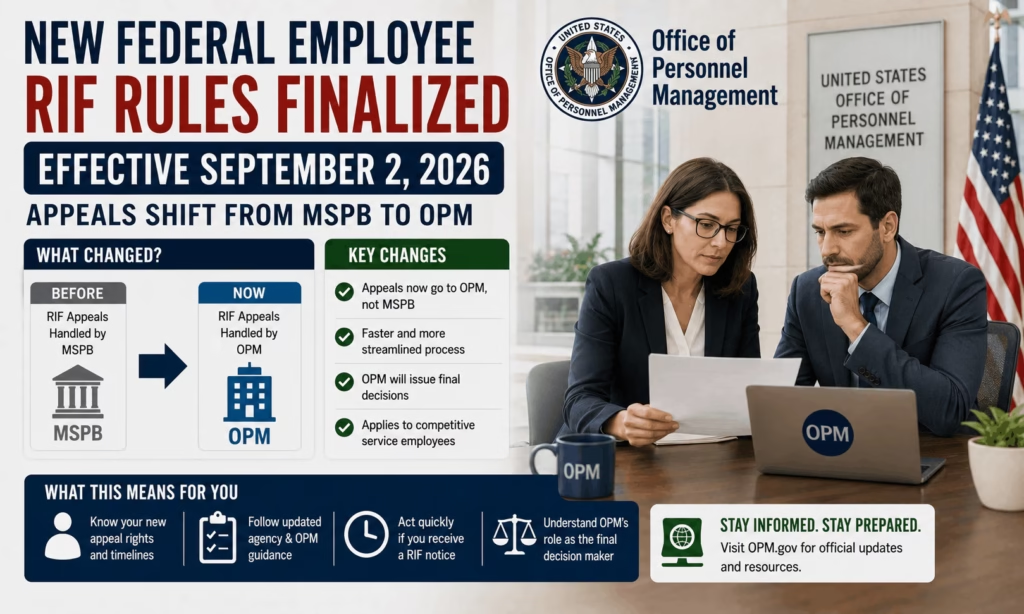
What OPM’s New RIF Rules Actually Change
The Federal Register published two closely related rules on August 3, 2026 that reshape the reduction in force process from two different angles. The first, titled simply Reduction in Force, revises the substantive criteria agencies use to decide which employees are retained when positions are eliminated. Historically, RIF retention order weighed four factors together: tenure of employment, veterans preference, length of service, and performance ratings. The new rule shifts that balance meaningfully, prioritizing recent performance ratings over tenure and length of service when agencies determine who keeps their job during a workforce reduction. The rule also changes which categories of employees are excluded from RIF competition entirely, and updates related programs including the reemployment priority list, the career transition assistance program, and the interagency career transition assistance program.
The second rule, Reduction in Force Appeals, is the more legally significant of the two. It replaces the Merit Systems Protection Board as the forum for employees appealing a RIF-related separation, demotion, or a furlough lasting more than 30 days, and hands that adjudicatory authority to OPM’s own Merit System Accountability and Compliance office instead. A separate but related change also shifts suitability-related adverse action appeals to a different OPM office known as the Suitability Executive Agent. Both changes apply only to RIF notices issued on or after the September 2, 2026 effective date; any RIF notice issued before that date continues to be processed under the regulations that were in effect at the time it was issued.
Federal RIF Rule Changes Key Highlights
| Detail | Information |
|---|---|
| Final rules published | August 3, 2026, Federal Register |
| Effective date | September 2, 2026 |
| Rule 1 | Reduction in Force, RIN 3206-AO86 |
| Rule 2 | Reduction in Force Appeals, RIN 3206-AO99 |
| Prior RIF appeals forum | Merit Systems Protection Board |
| New RIF appeals forum | OPM Merit System Accountability and Compliance office |
| Suitability appeals forum | OPM Suitability Executive Agent |
| Public comment opposition to appeals shift | 99 percent of commenters |
| Retention factor priority shift | Performance ratings weighted above tenure and length of service |
| OPM headcount decline, Dec 2024 to Mar 2026 | 35 percent, 1,052 employees |
| MSAC office staffing decline, FY2024 to FY2026 | 41 percent |
| OPM employees aged 60 and older, decline | 49 percent |
| Share of separated employees under 30 who left during probation | 60 percent |
| Share of OPM separations via deferred resignation program | 59 percent |
| Share of OPM separations via RIF specifically | 10 percent |
| GAO report on OPM workforce changes | GAO-26-108916, published July 20, 2026 |
SSDI Fast-Track Approval 2026: Compassionate Allowances, QDD
Quebec Experience Program 2026: PEQ Reopening Dates, Eligibility
$5000 CRA Data Breach Settlement 2026: Who Qualifies and How to Claim
H-1B 60-Day Grace Period Elimination: What US Visa Workers Should Know
Why the Appeals Change Is So Controversial
Moving RIF appeal authority from the Merit Systems Protection Board to OPM has generated the sharpest pushback of any element in this regulatory package. The Merit Systems Protection Board was structured specifically as an independent, quasi-judicial body separate from the personnel offices whose decisions it reviews, a design meant to give federal employees a genuinely neutral forum when challenging an adverse action. Federal employee unions, former MSPB officials, and workforce policy experts have argued that folding this function into OPM, an agency that also sets federal personnel policy and, in this case, has been the entity directing much of the underlying workforce reduction, creates a structural conflict of interest. Critics describe the risk as OPM effectively serving as both the policymaker setting the rules for RIFs and the adjudicator ruling on whether those same RIFs were conducted fairly.
OPM’s own response in the final rule defends the shift on different grounds, arguing that Congress historically distinguished RIF actions, which affect positions rather than target individuals, from other adverse personnel actions that have traditionally carried stronger procedural protections. OPM has characterized the change as promoting efficiency and reducing costs for agencies carrying out RIF actions, whether for eliminating duplicative functions, adapting to new technology, or responding to budget constraints. The 99 percent commenter opposition figure, drawn directly from the rulemaking record, reflects how one-sided the public feedback was during the formal comment period, even as OPM proceeded with the rule largely as proposed.
OPM Is Shrinking While Taking On More Work
Perhaps the most striking element of this rollout is that OPM is expanding its adjudicatory responsibilities at the same time its own capacity to handle that work has sharply contracted. The Government Accountability Office’s July 20, 2026 report found OPM’s total headcount fell by 35 percent, or 1,052 positions, between December 31, 2024 and March 31, 2026, reversing a 17 percent increase the agency had seen between 2019 and 2024. More than half of the employees who departed had at least 11 years of federal service, a loss GAO explicitly described as reducing institutional knowledge and operational capacity.
The office specifically taking on new RIF and probationary appeal work, the Merit System Accountability and Compliance division, has been hit even harder, with a staffing decline exceeding 40 percent between fiscal 2024 and fiscal 2026 according to GAO’s analysis. OPM’s own Office of Inspector General identified this workforce reduction as a top management challenge heading into 2026, specifically citing immediate gaps in operational capacity. In its fiscal year 2027 congressional budget justification, OPM stated it plans to rely on artificial intelligence tools and modernized IT systems to help offices with reduced staffing manage their expanded workloads, though workforce experts have questioned whether MSAC staff, most of whom lack prior adjudicatory experience handling firings and adverse actions, can absorb this new function effectively even with technology support.
Notably, GAO reported that it requested additional documentation from OPM about its reorganization efforts and the reasoning behind closing or consolidating specific offices, but that OPM officials did not provide the requested materials, meet with GAO staff, or respond to written questions before the report’s release, though the agency did provide some additional information afterward.
Who Was Affected by OPM’s Own Workforce Reduction
The demographic pattern of who left OPM during this period adds further context to the capacity concerns. Employees aged 60 and older saw the sharpest decline of any age group, dropping 49 percent between December 2024 and March 2026. Among younger employees under 30 who separated during this window, 60 percent left specifically during their probationary period, a group with fewer job protections and a faster separation process than tenured staff. In terms of how these departures happened, 59 percent of all OPM separations during the period came through the Deferred Resignation Program, a voluntary buyout-style mechanism, while only 10 percent were the result of a formal reduction in force action, indicating that most of the reduction was achieved through incentivized voluntary departures rather than involuntary layoffs at OPM specifically.
What This Means If You Are Facing a RIF
For federal employees currently facing or anticipating a reduction in force, the timing of an agency’s RIF notice matters significantly under the new rules. Anyone who receives a formal RIF notice under 5 CFR 351.802 before September 2, 2026 will have their case processed under the prior regulations, including the previous four-factor retention formula and the option to appeal to the Merit Systems Protection Board. Anyone who receives a RIF notice on or after that date falls under the new performance-weighted retention criteria and must pursue any appeal through OPM’s Merit System Accountability and Compliance office rather than MSPB.
Employees should also be aware that a RIF, under both the old and new regulatory framework, remains defined as a position-based workforce restructuring action tied to specific causes such as lack of work, shortage of funds, insufficient personnel ceiling, reorganization, or the exercise of reemployment or restoration rights. It is explicitly not meant to function as a disciplinary or conduct-based removal tool, and OPM’s final rule reiterates that using performance ratings within a RIF does not license arbitrary action or targeting specific individuals under the guise of a broader reorganization.
Canada Set to Finalize LNG Agreement With Germany’s SEFE for Ksi Lisims LNG Project
New UK Immigration Rules 2026: What Changes for Visa Applicants?
450,000 Borrowers Student Debt Erased: How to Check If You Qualify?
Official OPM and Federal Workforce Resources
| Resource | Purpose | Official Link |
|---|---|---|
| OPM Reduction in Force Information | Official RIF regulations and guidance portal | opm.gov/policy-data-oversight/workforce-restructuring/reductions-in-force |
| Federal Register RIF Final Rule | Full text of the revised RIF regulations | federalregister.gov, RIN 3206-AO86 |
| Federal Register RIF Appeals Final Rule | Full text of the appeals process change | federalregister.gov, RIN 3206-AO99 |
| OPM Federal Workforce Data Explorer | Governmentwide workforce statistics and trends | data.opm.gov |
| Merit Systems Protection Board | Current MSPB jurisdiction and case information | mspb.gov |
| GAO Report on OPM Workforce Changes | Full GAO-26-108916 report and findings | gao.gov/products/gao-26-108916 |
FAQs
When do the new federal RIF rules take effect?
The new rules take effect September 2, 2026. Any RIF notice issued before that date is processed under the prior regulations, while notices issued on or after that date follow the new rules.
Where do federal employees appeal a RIF decision now?
Under the new rules, RIF appeals for notices issued on or after September 2, 2026 go through OPM’s Merit System Accountability and Compliance office instead of the Merit Systems Protection Board.
What is the biggest change to how RIF retention decisions are made?
The new rule prioritizes recent performance ratings over tenure and length of service when agencies decide which employees are retained during a reduction in force, a shift from the traditional four-factor balancing approach.
Can an agency use a RIF to fire someone for performance or conduct reasons?
No. A RIF remains defined as a position-based workforce restructuring action tied to causes like lack of work, budget shortfalls, or reorganization, not a disciplinary tool, even though performance ratings now factor more heavily into retention order.
Why is the shift of RIF appeals to OPM controversial?
Critics argue it creates a conflict of interest since OPM both sets federal personnel policy and would now adjudicate appeals of RIF decisions, undermining the independent review the Merit Systems Protection Board previously provided. During the rulemaking process, 99 percent of public commenters opposed the change.
Has OPM itself gone through workforce cuts?
Yes. A Government Accountability Office report found OPM’s headcount fell 35 percent between December 2024 and March 2026, with the office newly responsible for RIF appeals seeing an even steeper 41 percent staffing decline.
What happens to suitability-related appeals under the new rules?
Appeals related to suitability-based adverse actions move to a separate OPM office, the Suitability Executive Agent, distinct from the Merit System Accountability and Compliance office handling RIF and probationary appeals.
People Also Ask
What is a reduction in force in the federal government? A reduction in force, or RIF, is a position-based workforce restructuring action federal agencies use to eliminate positions due to causes like lack of work, budget shortfalls, insufficient staffing ceilings, or reorganization, governed by regulations in Title 5 of the Code of Federal Regulations.
How do federal employees appeal a layoff decision? Starting September 2, 2026, RIF-related appeals for new notices go through OPM’s Merit System Accountability and Compliance office rather than the previously used Merit Systems Protection Board.
What factors determine who gets laid off in a federal RIF? Under the new rules effective September 2, 2026, agencies weigh recent performance ratings more heavily than tenure and length of service, alongside veterans preference, when determining which employees are retained during a reduction in force.
Is OPM cutting its own staff while managing federal layoffs? Yes. A July 2026 Government Accountability Office report found OPM’s own headcount dropped 35 percent between December 2024 and March 2026, even as the agency takes on new responsibility for adjudicating RIF and other appeals governmentwide.
Conclusion
The new OPM regulations taking effect September 2, 2026 mark one of the most significant structural changes to federal reduction in force procedures in decades, shifting both the criteria used to decide who stays during a layoff and the forum where employees can challenge that decision. With OPM absorbing new adjudicatory authority at the exact moment its own staffing, and specifically the office handling this new caseload, has contracted sharply, questions about the agency’s practical capacity to manage this expanded role remain unresolved heading into the fall. Federal employees facing a potential RIF should pay close attention to the exact date any notice is issued, since that single detail determines which set of rules, and which appeals forum, applies to their case.
Alberta AAIP Eligibility Assessment Tool: Check Your Immigration Chances Online
Social Security $200 Monthly Increase 2027: Which Seniors Qualify for the Biggest Raise?