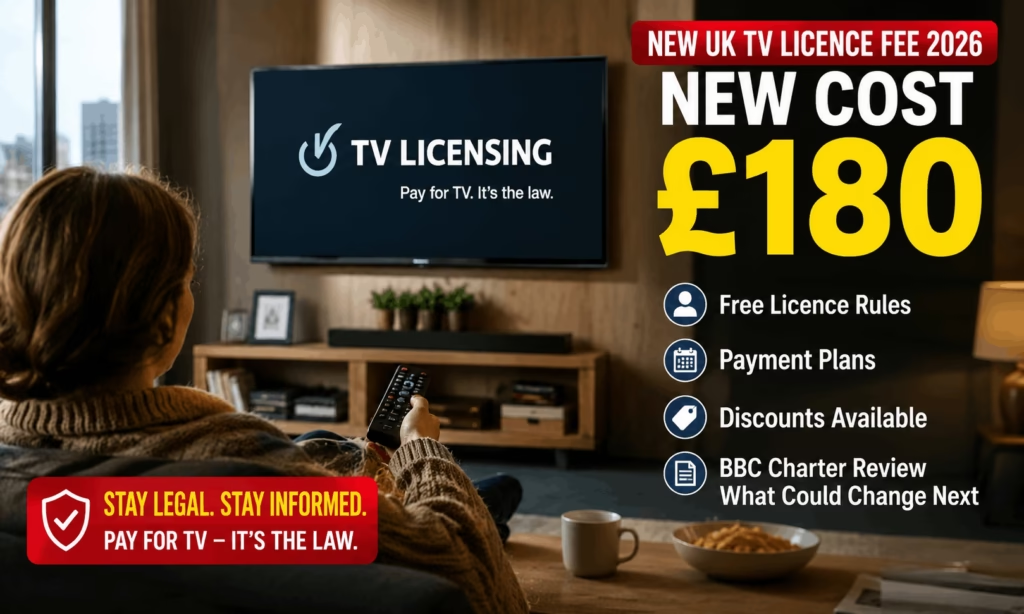
New UK TV Licence Fee 2026: The standard UK TV Licence fee 2026 has settled at £180 a year following the 3.15 percent increase that took effect on 1 April, but the bigger story for licence payers is what happens after this Charter period ends. Culture Secretary Lisa Nandy’s department confirmed in December 2025 that the entire funding model, not just the price, is now under formal review, with a White Paper expected later this year setting out how the BBC will actually be paid for from 2028 onwards. For millions of households who assume the annual renewal notice is simply a routine price update, this is the year that decision starts taking real shape.
The government’s own figures give this review added urgency. According to the House of Commons Library, the proportion of households that need a licence but do not hold one has climbed to more than 12 percent, up from around 6 percent in 2015, a shift officials partly attribute to the criminal penalty attached to non-payment and partly to changing viewing habits that make the traditional TV set feel increasingly outdated. This guide covers the confirmed 2026 fee, who still qualifies for a free or discounted licence, how the payment plans work, and where the Charter Review could take the system next. We’ll be updating this article monthly as new details from the review and any fee changes are confirmed.
What the TV Licence Costs?
The Government confirmed the new rate in February 2026, applying a 3.15 percent rise in line with annual Consumer Price Index inflation, under the funding formula agreed as part of the 2022 Licence Fee Settlement.
| Licence Type | New Rate (from 1 April 2026) | Previous Rate |
|---|---|---|
| Standard colour TV licence | £180.00 | £174.50 |
| Black and white TV licence | £60.50 | £58.50 |
| Blind or severely sight impaired discount (colour) | £90.00 | £87.25 |
| Blind or severely sight impaired discount (black and white) | £30.25 | £29.25 |
This is the second-to-last CPI-linked increase scheduled under the current arrangement. A further rise is planned for April 2027, the final year of the present settlement, before the next Charter period and its funding model take over from 2028.
When You Actually Pay the New Rate
Timing matters more than most people realise, since not every household moves to the new price on the same day. If a licence renewal falls on or before 31 March 2026, that renewal is billed at the old £174.50 rate for the coming year. Anyone renewing on or after 1 April 2026 pays the new £180 rate instead. A licence can only be renewed from the first day of the month in which it expires, so there is limited scope to lock in the lower price by renewing early outside that window.
Households paying monthly or quarterly through direct debit, or weekly and fortnightly through a payment card, continue making instalments toward their current total until that licence next comes up for renewal. The higher rate only applies from the following renewal date, not immediately when the new price is announced.
Who Still Gets a Free TV Licence in 2026
The blanket free licence for everyone aged 75 and over ended on 1 August 2020. Since that date, the concession has been tied specifically to Pension Credit rather than age alone.
To qualify for a free licence in 2026, a household needs one resident aged 75 or over who receives Pension Credit, either the Guarantee Credit or Savings Credit element. The free licence is not issued automatically. It must be applied for directly through TV Licensing, and once granted it covers everyone living at the main address, regardless of their own age. Only one free licence is permitted per household, even where more than one resident happens to qualify individually.
Anyone who is not currently receiving Pension Credit but suspects they might be eligible is worth checking, since Pension Credit remains significantly underclaimed nationally, meaning some households are paying full price for a licence they could be getting for free simply because they have not applied for the underlying benefit.
2027 HSA Contribution Limits Announced: IRS Confirms $4,500 and $9,000 Caps
USCIS Restored Power To Deny Without RFE: Here Is What Policy Alert PA-2026-05 Actually Changes
IEEPA Tariff Refund Process: How Businesses Are Claiming Their Share of $166 Billion
50% US Tariffs on Canadian Goods: Full List and What Changes
Discounts and Concessions Beyond the Over-75 Rule
Free eligibility is not the only concession built into the system. Several other groups qualify for reduced rates.
| Concession | Who Qualifies | Discount |
|---|---|---|
| Blind or severely sight impaired | Registered blind or severely sight impaired individuals | 50% off the standard rate |
| Care home residents | Residents in qualifying Accommodation for Residential Care | Reduced rate, as low as £7.50 per room in some schemes |
| Students in halls | Depends on whether the accommodation holds a blanket licence | Varies, check with accommodation provider |
| Short-term absence | Licence holders temporarily away from a licensed address | No separate licence needed if the address remains licensed |
Care home operators apply for an Accommodation for Residential Care licence rather than a standard household licence, and this can be structured to cover multiple residents at a substantially reduced per-room cost. Students are a common source of confusion, since there is no blanket student exemption. Anyone in private rented accommodation who watches live television or BBC iPlayer needs their own licence unless the property already holds one, while students in halls should check directly with their accommodation provider rather than assume they are automatically covered.
The Simple Payment Plan Explained
For households struggling to manage the full annual cost in one go, TV Licensing runs a Simple Payment Plan, which spreads the £180 annual fee into smaller fortnightly or monthly instalments at no extra cost. The government confirmed an expansion of this scheme, extending eligibility on a case-by-case basis to thousands more households facing financial difficulty. Uptake of the plan has grown steadily, reflecting rising demand for more manageable payment structures as the cost of living continues to squeeze household budgets. Anyone concerned about affording the licence in a single payment should contact TV Licensing directly to check current eligibility for the plan rather than falling behind on payments.
Enforcement, Prosecution, and the Decriminalisation Debate
Watching or recording live television, or using BBC iPlayer, without a valid licence remains a criminal offence in the UK, punishable by a fine of up to £1,000 plus court costs and a victim surcharge, with cases typically heard in magistrates’ courts. Non-payment prosecutions remain among the most common offences processed through the magistrates’ court system each year.
This criminal sanction has been politically contentious for years. A previous government consultation concluded that the penalty was “increasingly unfair and disproportionate” for many cases, particularly involving vulnerable people, yet ultimately shelved any move to decriminalise non-payment, citing the potential loss of licence fee income that would follow if enforcement lost its criminal teeth. That question has resurfaced inside the current Charter Review, with the government’s own research noting concerns about the stress the criminal sanction causes for vulnerable licence evaders, alongside a documented gender disparity in who actually gets prosecuted. A firm decision on decriminalisation has still not been made, and it now sits among the issues expected to be addressed in the White Paper due later in 2026.
The BBC Charter Review: What Could Change After 2027
This is the part of the story that most coverage of the annual fee increase misses entirely. The BBC’s current Royal Charter runs from 1 January 2017 to 31 December 2027, and the government formally launched its review of what comes next on 16 December 2025. Alongside the review, the Department for Culture, Media and Sport published a Green Paper, titled Britain’s Story: The Next Chapter, setting out a range of options for how the BBC could be funded beyond the current settlement.
The public consultation on that Green Paper closed on 10 March 2026, drawing significant public interest, on top of more than 872,000 responses the BBC itself received to a related survey it ran earlier. Ministers have said the responses will feed into a White Paper expected later in 2026, followed by a draft new Charter debated in Parliament before the current one expires. A renewed Charter, and whatever funding model comes with it, would take effect from 2028.
Options reportedly under consideration span reforming how the licence fee cost itself is calculated, changes to the concessions structure, and giving the BBC greater scope to raise commercial income, though the government has repeatedly stressed that the licence fee remains in place at least until the end of the current Charter period in 2027. In other words, nothing about the underlying funding model changes for the 2026/27 licence year covered by this article, but 2026 is very much the year the next model is being decided.
Borrower Defense Student Loans: How to Apply for a Full Discharge?
IRS Business Tax Account New Features Give Small Businesses More Ways to Skip the Phone Line
SSA Payroll Information Exchange and New SSI Improvement Office: What the Report Actually Changes
Key UK TV Licence Fee Updates
| Update | Detail | Date |
|---|---|---|
| New standard fee takes effect | Colour licence rises to £180, a 3.15% CPI-linked increase | 1 April 2026 |
| BBC Charter Review launched | Green Paper published alongside 12-week public consultation | 16 December 2025 |
| Green Paper consultation closed | Public responses on future BBC funding options collected | 10 March 2026 |
| White Paper expected | Government to set out formal funding policy decisions | Later in 2026 |
| Current Charter expires | Existing licence fee model runs out | 31 December 2027 |
| Final scheduled CPI rise under current deal | Next annual increase before Charter renewal | April 2027 |
How to Apply, Renew, or Check Your TV Licence Status?
- Check whether you need a licence at all using the official TV Licensing website, particularly if you only stream on-demand content from services other than BBC iPlayer.
- If you do not need a licence, submit a No Licence Needed declaration online to avoid demand letters and inspector visits.
- To apply for a free over-75 licence, confirm you or your partner receive Pension Credit, then apply directly through TV Licensing rather than waiting for it to happen automatically.
- To apply for the blind or severely sight impaired discount, provide a certificate from a local authority ophthalmologist confirming your registration.
- To join the Simple Payment Plan, contact TV Licensing to check current eligibility and set up fortnightly or monthly instalments.
- Renew an existing licence from the first day of the month it expires in, checking whether your renewal date falls before or after 1 April to understand which rate applies.
- Update your payment details or check your renewal date at any time through your online TV Licensing account.
Official TV Licence Resources
| Resource | What It’s For | Official Link |
|---|---|---|
| TV Licensing Official Site | Pay, renew, or apply for a licence online | tvlicensing.co.uk |
| Check If You Need a Licence | Confirm whether your viewing habits require one | tvlicensing.co.uk/check-if-you-need-one |
| Free Licence for Over-75s | Apply for the Pension Credit-linked free licence | tvlicensing.co.uk/check-if-you-need-one/for-your-home/aged-74-and-over-aud3 |
| BBC Charter Review and Green Paper | Government consultation on future BBC funding | gov.uk/government/news/government-launches-charter-review-to-future-proof-the-bbc |
| Age UK TV Licence Guidance | Independent guidance on concessions for older people | ageuk.org.uk/information-advice/money-legal/benefits-entitlements/tv-licence-concessions |
FAQs
How much does a TV licence cost in the UK in 2026?
A standard colour TV licence costs £180 a year from 1 April 2026, up £5.50 from the previous £174.50 rate. A black and white licence costs £60.50.
Is the TV licence free for over-75s?
Not automatically. Since 1 August 2020, a free licence is only available to households where someone aged 75 or over receives Pension Credit. It must be applied for and covers everyone at the main address.
What happens if I don’t pay for a TV licence?
Watching or recording live TV, or using BBC iPlayer, without a valid licence is a criminal offence carrying a fine of up to £1,000 plus court costs. A government review is currently considering whether this criminal sanction should be replaced with a civil penalty.
Can I spread the cost of my TV licence?
Yes. The Simple Payment Plan lets eligible households pay in smaller fortnightly or monthly instalments at no extra cost, and eligibility has been expanded for those in financial difficulty.
Do students need a TV licence?
There is no automatic student exemption. Students in private rented accommodation generally need their own licence to watch live TV or iPlayer, while those in halls should check whether their accommodation already holds a blanket licence.
Will the TV licence fee change again after 2027?
The current CPI-linked pricing model runs through the final increase in April 2027. What replaces it depends on the outcome of the ongoing BBC Charter Review, with a White Paper expected later in 2026 and a new Charter taking effect from 2028.
Do I need a separate licence to watch on a laptop or phone?
Yes, if you watch or record live television as it is broadcast, or use BBC iPlayer, on any device, including laptops, tablets, or phones, the same licence requirement applies regardless of the screen you use.
Conclusion
The confirmed £180 rate answers the immediate question most people have about the UK TV Licence fee 2026, but it is only part of a much bigger story unfolding this year. With household non-compliance climbing above 12 percent, a formal government consultation already closed, and a White Paper due that could reshape how the BBC is funded from 2028 onward, the current CPI-linked pricing model looks increasingly like a transitional arrangement rather than a permanent fixture. Anyone eligible for the Pension Credit-linked free licence, the blind discount, or the Simple Payment Plan should apply directly through TV Licensing rather than assuming any concession applies automatically, and it is worth keeping an eye on the Charter Review’s White Paper later this year, since that document is likely to shape what UK households pay for the BBC for the next decade.
Direct Express Card Transition to Fifth Third Bank: What 3.6 Million Cardholders Need to Know
Federal Fuel Excise Tax Suspension: Ford Pushes Carney to Extend Relief Past Labour Day
FTC Refund 2026: Millions of Americans May Be Owed Money and Most Don’t Know It