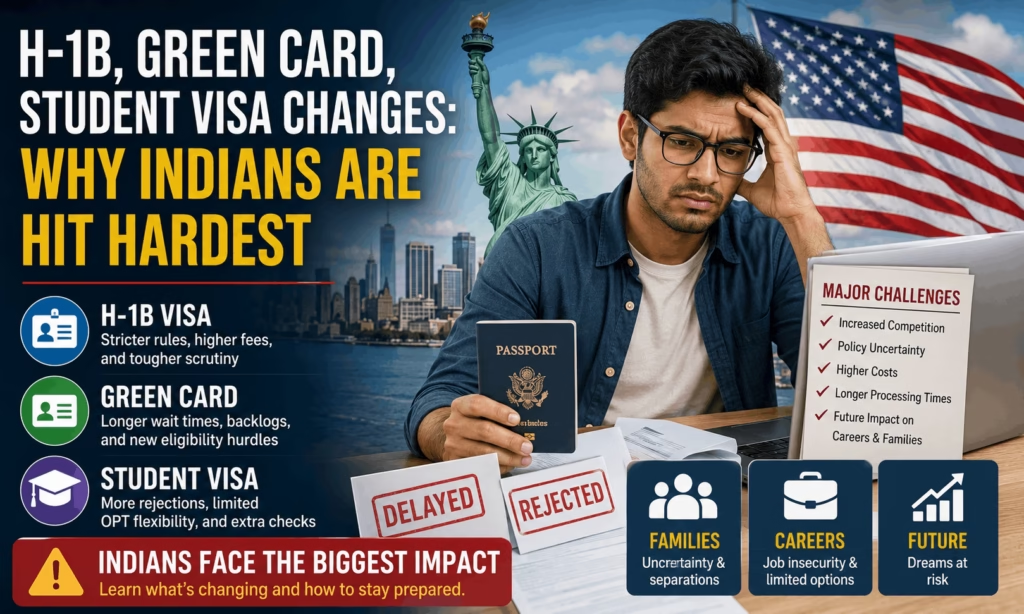
H-1B, Green Card, Student Visa Changes: The United States is rewriting the rules for skilled workers, green card applicants and international students all at once, and the timing could not be more consequential for India. Within the span of less than a year, Washington has pushed through a $100,000 H-1B petition fee, ended the decades-old Duration of Status system for F-1 students, expanded social media vetting to H-1B and H-4 applicants, and put a new H-1B reform rule on track for August 2026. Each of these changes touches a different visa category, but they share one thing in common: Indian nationals make up the largest share of applicants in almost every one of them, so the impact lands disproportionately on Indian professionals, students and their families.
For a country that sends more skilled workers and students to the United States than any other, this is not background noise, it is a direct hit on career plans, family reunification timelines and years of financial investment in US education. The H-1B program remains dominated by Indian talent, the employment-based green card backlog is now overwhelmingly Indian, and Indian students form one of the two largest international student groups on US campuses. This article breaks down what has actually changed, what is still proposed, and what it means in practical terms if you are an Indian H-1B holder, a green card applicant, a student heading to the US this fall, or a family trying to plan the next five years around an uncertain visa system. We will be updating this article monthly as new rules, court rulings and visa bulletin data come in, so bookmark it rather than relying on a single snapshot in time.
What Has Changed and What Is Still Pending?
| Category | Change | Status as of August 2026 |
|---|---|---|
| H-1B petition fee | $100,000 one-time fee on new H-1B petitions filed after September 21, 2025 | Struck down by a Massachusetts federal court on June 8, 2026, but stayed pending appeal, so the fee still applies while the case moves through the First Circuit |
| H-1B structural reform | DHS plan to tighten third-party placement rules, narrow cap-gap exemptions, revise prevailing wage calculations | Proposed rule expected around August 2026, not yet finalised |
| End H-1B Visa Abuse Act of 2026 | Congressional bill proposing a temporary H-1B pause, higher salary floor, and no automatic green card path | Introduced in Congress, still under debate, not law |
| F-1 student visa | End of Duration of Status, replaced by fixed admission period of up to four years | Final rule published July 17, 2026, takes effect September 15, 2026 |
| Consular vetting | Mandatory social media review for F, M, J, H-1B and H-4 applicants | In effect since June 2025 (students) and December 15, 2025 (H-1B/H-4) |
| Green card backlog | EB-2 and EB-3 India priority dates stuck in 2013-2014 range | Ongoing, worsening with each visa bulletin cycle |
What Actually Changed With the H-1B $100,000 Fee
On September 19, 2025, President Trump signed a proclamation imposing a $100,000 fee on new H-1B petitions filed for beneficiaries outside the United States, effective from September 21, 2025. The fee sparked immediate confusion because it did not apply to existing visa holders, renewals with the same employer, or petitions filed before the deadline, but it did apply to fresh consular-processed filings, including the 2026 lottery batch.
The legal fight over the fee has been messy. A Washington DC court initially upheld the proclamation in December 2025. Then, on June 8, 2026, a federal judge in Massachusetts, ruling in a case brought by twenty state attorneys general, vacated the fee entirely, calling it an unconstitutional tax that only Congress has the authority to impose. That should have ended the matter, but the administration filed an appeal within days and asked the court to pause its own ruling while the appeal is heard. The court agreed, so employers currently still have to pay the fee for qualifying petitions even though a judge has already found it unlawful. Legal observers expect the case to eventually reach the Supreme Court, since a separate DC court reached the opposite conclusion. Until that is resolved, Indian professionals awaiting new H-1B sponsorship from outside the US, and the companies sponsoring them, are operating under a fee that is legally contested but still being enforced.
VA Burial Allowance 2026 Rates, Eligibility and How to Apply?
Form I-551 Confirmed Green Card Holders Enter US Without a Visa
H-1B Reform Rule and What It Targets
Separately from the fee fight, the Department of Homeland Security is preparing a broader regulatory overhaul of the H-1B program, expected to be published around August 2026. This proposal goes after the operational model used heavily by Indian IT consulting and staffing firms, where employees are placed at client sites rather than working directly for the sponsoring company. The draft rule would require petitioners to show a genuine employer-employee relationship, prove the assignment involves specialty occupation work, and back the petition with additional contracts and work orders, all of which raises the evidentiary bar for approval.
The Department of Labor is working in parallel on changes to how prevailing wages are calculated, which would push wage levels higher across the board. A special fee that currently applies only to certain H-1B filings could also be expanded to cover more categories. For Indian outsourcing and consulting firms that rely on third-party placement, this combination of tighter scrutiny and higher wage floors is expected to raise both compliance costs and outright rejection rates.
On top of this, a group of Republican lawmakers introduced the End H-1B Visa Abuse Act of 2026, sponsored by Congressman Eli Crane. The bill proposes a temporary freeze on new H-1B issuance, a significantly higher minimum salary threshold, and removal of the current pathway that lets H-1B holders transition toward a green card. It has not become law and faces a long road through Congress, but its introduction signals where political appetite is heading, and Indian professionals make up the overwhelming majority of the workforce this bill targets.
Visa Stamping and Interview Delays Are Getting Worse, Not Better
Even for H-1B holders whose petitions are approved, actually getting the visa stamped in India has become significantly harder in 2026. Since December 15, 2025, all H-1B and H-4 applicants have been required to make their social media profiles public and list every handle used over the past five years, so consular officers can run an online presence review. The same requirement has applied to F, M and J student visa applicants since mid-2025. Consular officers say the review adds roughly 30 minutes of processing per case, but the real damage has been to appointment availability. A wave of interview rescheduling in December 2025 pushed thousands of confirmed H-1B appointments in Delhi, Mumbai, Chennai and Hyderabad from that month into mid-2026, and normal scheduling only resumed on April 21, 2026.
The interview waiver, informally called the Dropbox facility, has also been narrowed sharply. It now generally covers only a limited set of renewal applicants, meaning most H-1B, H-4, F-1 and L-1 applicants must sit for an in-person interview. Third-country processing, where applicants used to book faster appointments in Canada or Mexico, has been restricted too, so Indian applicants are now largely required to process their visas at home. Wait times vary by city, with New Delhi and Chennai currently moving faster than Mumbai, but even the fastest posts are running well beyond pre-2025 norms.
Green Card Backlog: The Indian Wait Just Keeps Growing
If H-1B changes are about entry, the green card backlog is about what happens after Indian professionals are already working in the US. This is where the imbalance is starkest. USCIS data puts the total employment-based green card backlog at roughly 1.8 million pending cases across all nationalities, and Indian applicants account for close to 63 percent of that number, more than 1.2 million people including dependents.
The structural cause has not changed in over three decades. Congress caps employment-based green cards at 140,000 a year, and no single country can receive more than about 7 percent of that total, roughly 9,800 visas annually, regardless of how many qualified applicants that country produces. Because India sends far more EB-2 and EB-3 applicants than any other nation, that flat per-country cap creates a bottleneck that other countries simply do not face. As of the 2026 visa bulletins, the EB-2 India final action date sits around July 2014, and EB-3 India is parked near November 2013, meaning a professional whose priority date falls after those cutoffs is still waiting more than a decade after their employer first filed on their behalf. Some newer estimates put the effective wait for a fresh EB-2 or EB-3 filing from India at anywhere between 20 and over 100 years if allocation patterns do not change, compared with roughly five years for Chinese applicants and about three years for Filipino applicants in similar categories.
The practical fallout is significant. Families spend a decade or more in H-1B status renewed year after year, children who arrive as dependents risk aging out of coverage before a green card comes through, and spouses on H-4 visas depend on employment authorisation rules that are themselves under review. Projections cited by immigration researchers suggest the Indian backlog could climb toward 2.2 million by 2030 if current trends hold.
Student Visas: The End of Duration of Status
The biggest structural change for Indian students arrived on July 17, 2026, when DHS published a final rule ending Duration of Status, the system that has governed F-1 and J-1 stays since the late 1970s. Under the old system, a student could remain in the US for as long as they stayed enrolled and made normal progress, with no fixed expiry date on their status. From September 15, 2026, new F-1, J-1 and I visa holders will instead be admitted for a fixed period tied to their program length, capped at four years, or up to 24 months for language-training programs. Anyone needing more time will have to formally apply for an extension rather than relying on automatic continuation.
More than 3.6 lakh Indian students were enrolled at American universities in the 2024-25 academic year, making this one of the most consequential visa rule changes for India in nearly fifty years. Students already in the US under the old Duration of Status framework get transition provisions rather than an automatic switch, and those who filed on time for post-completion OPT or STEM OPT by March 18, 2027 will not need to file a separate extension-of-stay application for that period. But anyone whose program runs past September 2030, or who plans to travel home to India and re-enter after the rule takes effect, needs to track their fixed admission date carefully, because re-entry can trigger the new fixed-period system even for continuing students.
Restrictions on Optional Practical Training and Curricular Practical Training are also expected to tighten further by early 2027, and H-4 dependent spouses are losing the convenience of automatic employment authorisation extensions, moving instead to a mandatory renewal process that carries real risk of employment gaps during routine processing delays.
Interview backlogs are compounding the problem. A months-long pause tied to expanded social media vetting in late 2025 cut F-1 visa issuances to Indian students by an estimated 69 percent in peak months, and although interviews resumed in April 2026, wait times at some posts have stretched to two to three months during the Fall intake season, on top of administrative processing that can add up to 90 days for applicants in sensitive research fields.
Max Social Security Benefit at Age 67 in 2026: How to Get It?
IRS confirms ACTC Refund 2026: $1,700 Child Tax Credit Payout Dates & Eligibility
Why Indians Specifically Bear the Brunt
Every one of these changes lands hardest on India for the same structural reason: scale. Indian nationals have consistently accounted for the large majority of H-1B beneficiaries each fiscal year, they make up nearly two-thirds of the entire employment-based green card backlog, and they represent one of the two biggest international student populations on US campuses. A policy that tightens third-party placement rules disproportionately affects Indian IT consulting firms because that is the dominant business model in that sector. A flat 7 percent per-country cap on green cards disproportionately affects India because Indian demand is several multiples higher than the cap allows. A fixed four-year student admission period disproportionately affects Indian STEM graduate students because many of their programs, especially PhDs, routinely run longer than four years. The rules on paper are country-neutral, but the arithmetic behind them is not.
What Indian Applicants Should Do Right Now
For H-1B holders and prospective applicants, the safest approach is to confirm with your employer whether your specific petition category or timing exposes you to the $100,000 fee while the court appeal is pending, and to avoid unnecessary international travel until a stamped visa or valid status is confirmed. For green card applicants, tracking each month’s visa bulletin remains essential, along with exploring whether EB-1 or EB-2 National Interest Waiver categories, which move faster than standard EB-2 and EB-3 India, might apply to your profile. For students and families planning Fall or Spring intake, book visa interview slots as early as possible, keep social media profiles compliant with the public-visibility requirement well before the interview date, and speak to your university’s international student office about how the new fixed admission period will apply to your specific program length.
Official Sources and Useful Links
| Resource | Purpose | Official Link |
|---|---|---|
| USCIS H-1B Electronic Registration | H-1B cap registration and case status | uscis.gov/working-in-the-united-states/h-1b-specialty-occupations |
| USCIS Case Status Online | Track pending petition status | egov.uscis.gov/casestatus |
| US Department of State Visa Bulletin | Monthly green card priority date movement | travel.state.gov/content/travel/en/legal/visa-law0/visa-bulletin.html |
| Study in the States (DHS/SEVP) | F-1 and J-1 rule updates, SEVIS guidance | studyinthestates.dhs.gov |
| US Embassy and Consulates in India | Visa interview scheduling and appointment status | in.usembassy.gov |
| DHS Newsroom | Official rule publications and proclamations | dhs.gov/news |
| USCIS Fee Schedule | Current filing and form fees | uscis.gov/forms/filing-fees |
Trump Birthright Citizenship Executive Orders: What Changed After Supreme Court Ruling
State-by-State SNAP Food Ban 2026: What’s Banned, Status Update
FAQs
Is the $100,000 H-1B fee still in effect right now?
Yes, for now. A federal court in Massachusetts ruled the fee unlawful on June 8, 2026, but the same court paused its own decision while the government appeals, so USCIS is still collecting the fee on qualifying petitions.
Has Duration of Status for F-1 students actually ended, or is it still proposed?
It has been finalised. DHS published the final rule on July 17, 2026, and it takes effect September 15, 2026. Students admitted before that date get transition protections rather than an automatic switch.
How long is the green card wait for Indian applicants right now?
As of the 2026 visa bulletins, EB-2 India priority dates sit around mid-2014 and EB-3 India around late 2013, meaning applicants who filed after those dates are still waiting, with total wait times commonly estimated at over a decade depending on category and future visa bulletin movement.
Does the new student visa rule affect Indian students already studying in the US?
Students already in the US under the old Duration of Status system are covered by transition provisions, not an automatic switch to the fixed period. However, travelling home and re-entering the US after September 15, 2026 can move a continuing student onto the new fixed-admission system.
Why do H-1B and green card delays affect Indians more than applicants from other countries?
Because Indian nationals file the largest volume of H-1B and employment-based green card applications by far, while the law caps how many green cards any single country can receive each year regardless of demand, creating a much longer queue for India than for lower-demand countries.
Will the End H-1B Visa Abuse Act become law?
Not yet. It has been introduced in Congress by Representative Eli Crane but still needs to pass committee review, both chambers of Congress, and be signed into law, a process that could take months or longer, or may not succeed at all.
People Also Ask
What is the current status of the H-1B $100,000 fee lawsuit? The fee was struck down by a district court in June 2026 but remains enforced during the government’s appeal, with the case likely headed toward the Supreme Court given conflicting rulings from different courts.
What replaces Duration of Status for international students? A fixed admission period tied to the length of the academic program, capped at four years for most degree programs and up to 24 months for language-training programs, starting September 15, 2026.
Why is the Indian green card backlog so much longer than other countries? The 7 percent per-country cap on employment-based green cards does not adjust for how many applicants a country actually produces, and India’s demand vastly exceeds that fixed share, unlike lower-demand countries such as the Philippines.
Do H-1B visa holders need to make their social media public? Yes. Since December 15, 2025, H-1B and H-4 applicants must set their social media profiles to public and disclose handles used over the past five years as part of mandatory online presence vetting.
Conclusion
Taken together, the H-1B fee dispute, the pending August 2026 reform rule, the end of Duration of Status for students, and an employment-based green card backlog that keeps stretching further into the future point to the same conclusion: the US immigration system is tightening at exactly the points where Indian professionals and students are most concentrated. None of these changes explicitly single out India, but the per-country caps, the outsourcing-heavy H-1B model, and the sheer scale of Indian applicants mean the practical weight falls disproportionately on Indian nationals. Whether you are a working professional watching the fee litigation, a green card applicant tracking next month’s visa bulletin, or a student mapping out a fixed four-year admission window, the smartest move right now is to stay close to official sources rather than rumour, because these rules are still moving. We will keep updating this article every month as new court rulings, DHS rules and visa bulletin data become available.
New CRA Disability Tax Credit Changes 2026: What’s Different and How to Apply?
2027 Social Security COLA Forecast: Latest Estimate, Medicare Offset & What Retirees Can Expect
Social Security 2100 Act 2027: Bigger COLA Increase, Higher Benefits & Latest Bill Update