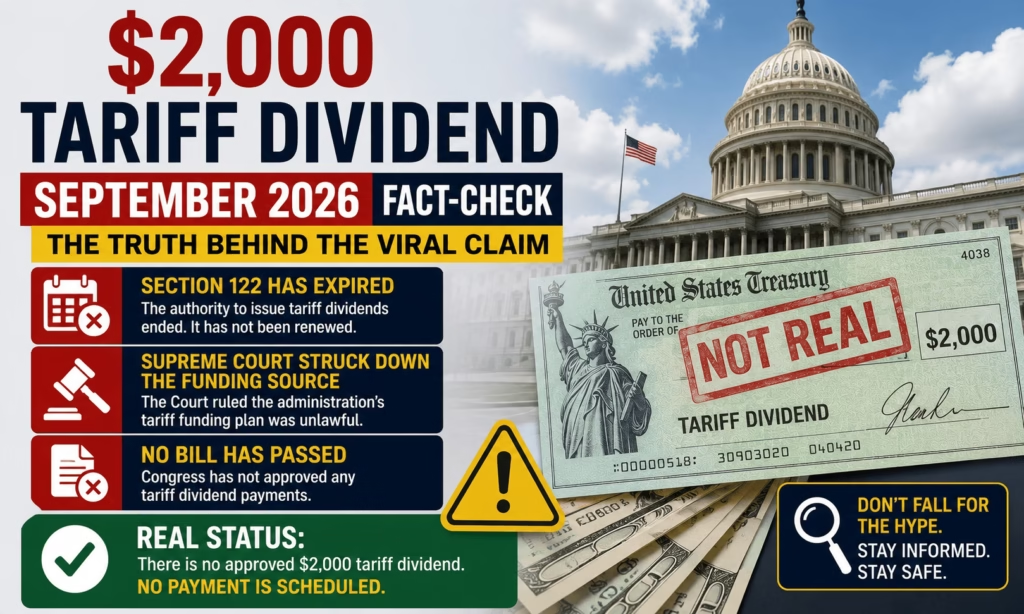
$2000 Tariff Dividend Update: The $2000 tariff dividend is not going out in September 2026, and nothing in the past several weeks has moved the promise any closer to becoming an actual payment. The idea has now been alive for nearly ten months, ever since President Trump first floated it at a December 2025 cabinet meeting, and in that time it has survived a Supreme Court defeat, a scrambled replacement tariff, and the quiet expiration of that replacement tariff too. No tariff rebate check legislation has passed the House, passed the Senate, or reached the president’s desk. Treasury and IRS officials have not announced a payment schedule, an application process, or an eligibility list, because none of those things currently exist in law.
What has changed heading into fall is the funding picture, and it has gotten weaker, not stronger. The 10% global tariff surcharge under Section 122 of the Trade Act of 1974, the mechanism the administration leaned on after its original tariffs were struck down, hit its 150-day legal limit on July 24, 2026, and Congress let it lapse rather than extend it. A narrower Section 301 tariff structure took its place the same day, but that revenue stream was never part of the original household dividend proposal. Meanwhile, a bipartisan push in the Senate to rein in the president’s unilateral tariff powers gained more traction over the summer than any bill authorizing a $2,000 household check ever did. We’ll be updating this article monthly, so bookmark this page instead of relying on screenshots of old Truth Social posts or recycled headlines from last December.
$2000 Tariff Dividend Key Facts
| Detail | Current Status |
|---|---|
| Federal $2,000 tariff dividend legislation | Never introduced as a standalone bill and never passed; no vote scheduled |
| Original funding source (IEEPA tariffs) | Ruled unlawful by the Supreme Court on February 20, 2026 |
| Backup funding source (Section 122 surcharge) | Expired by statute on July 24, 2026; Congress did not renew it |
| What replaced Section 122 | A two-tier Section 301 tariff (roughly 10%–12.5%) on about 60 trading partners |
| IEEPA-era tariff refunds paid to importers | Roughly $86–90 billion refunded to businesses, not households, as of late summer 2026 |
| Official Treasury/IRS position | No $2,000 household payment is planned, funded, or scheduled |
| Analyst consensus on the odds | Widely described as “a long shot” to “effectively zero” |
| Real alternative for relief | Several individual states run their own, separately funded rebate programs |
Is the Tariff Dividend Coming in September 2026?
No. There is still no approved payment, no application portal, and no confirmed date. The proposal remains exactly what it has been since December: a suggestion floated in speeches and social media posts, not a funded government program. Even the administration’s own economic advisers have said publicly, more than once, that a payment like this would need congressional appropriation, not a presidential signature alone. That step has not happened, and the legislative momentum this summer has trended in the opposite direction, toward restricting future unilateral tariff moves rather than expanding them.
If you’re seeing claims online that a $2,000 stimulus payment is “confirmed” or that applications are “open now,” treat that as a red flag rather than good news. There is no legitimate portal accepting applications for this specific payment because no law authorizing it exists yet.
Social Security SSI Payment Date September 2026 Confirmed by SSA- Check Full Schedule here!
How the Tariff Dividend Promise Unraveled?
Understanding the current dead end means tracing exactly how the funding mechanism collapsed piece by piece.
| Date | Event |
|---|---|
| July 2025 | Trump first mentions the idea of a tariff-funded “rebate” during a press conference |
| November 9–17, 2025 | Trump specifies a figure of “at least $2,000 a person,” excluding high earners, on Truth Social |
| December 2, 2025 | Trump tells a cabinet meeting the government will issue a “nice dividend to the people” from tariff revenue |
| December 18, 2025 | Separate $1,776 “Warrior dividend” checks go out to service members, funded by the Defense Department, unrelated to tariffs |
| December 21, 2025 | National Economic Council Director Kevin Hassett confirms on CBS that Congress, not the president alone, must approve any dividend |
| February 20, 2026 | The Supreme Court rules 6-3 that the IEEPA tariffs underpinning the whole plan were unlawful |
| February 24, 2026 | The administration pivots to a 10% global surcharge under Section 122 of the Trade Act of 1974 |
| March 13, 2026 | Sen. Martin Heinrich introduces the Tariff Refunds for Working Families Act, a narrower rebate bill |
| May 7, 2026 | The Court of International Trade rules the Section 122 surcharge also exceeded presidential authority |
| July 22, 2026 | Sen. Ron Wyden introduces the Congressional Trade Powers Reform Act to curb future unilateral tariff use |
| July 24, 2026 | Section 122 expires at its 150-day statutory limit; no extension is passed |
| July 24, 2026 | A new two-tier Section 301 tariff regime takes effect the same day |
| August 2026 | Treasury and CBP continue processing importer refunds; no household payment bill advances |
Each stage removed another piece of the original funding story without Congress ever passing a replacement that sends money directly to households.
Where the Tariff Refund Money Actually Went?
A lot of confusion online comes from mixing up two very different things: tariff refunds to importers and a household tariff dividend. They are not the same program.
After the Supreme Court struck down the IEEPA tariffs, Customs and Border Protection built a processing system to refund the businesses that had paid those tariffs at the border. That covers an estimated $160-plus billion collected from hundreds of thousands of importers across tens of millions of customs entries. Tens of billions of that has already been paid out over the summer. Every dollar of it goes back to the companies that imported the goods, not to individual taxpayers, because tariffs are legally collected from importers, not consumers, even though the cost is typically passed along in retail prices.
This is the structural reason financial analysts have called the household dividend “a long shot from the beginning”: the refunded money was never sitting in a separate pool that Congress or the White House could simply redirect into $2,000 checks. Any household payment would require entirely new appropriated funding, on top of the refund obligations already in motion.
Is Any Tariff Rebate Bill Still Alive in Congress?
A few narrower bills touch on this idea, but none of them creates a flat $2,000 federal payment, and none has become law.
- American Worker Rebate Act of 2025 — Introduced by Sen. Josh Hawley in July 2025, proposing $600 per adult and dependent (up to $2,400 for a family of four). It remains in Senate Finance Committee review with no scheduled vote.
- Tariff Refunds for Working Families Act — Introduced by Sen. Martin Heinrich in March 2026, proposing $1,200 for joint filers under $180,000 plus $600 per dependent child, starting with the 2026 tax year. Still in committee.
- Trump Tariff Rebate Act — Introduced in the House, this one would raise the standard deduction rather than send a check, referred to the Ways and Means Committee.
- American Consumer Tariff Rebate Act of 2026 — Another House proposal along similar lines, also stuck in committee.
Independent estimates from the Yale Budget Lab put the true cost of a genuine $2,000-per-person tariff dividend payment at roughly $450 billion, which is well above what current tariff revenue generates once refund obligations and reduced trade volume are factored in. That math gap is the single biggest reason the proposal hasn’t moved, regardless of which party controls which chamber.
$2000 Stimulus Payment 2026 Fact-Check: Is It Really Coming?
How to Apply for the Tariff Dividend?
There is currently no application process because there is no approved payment. When people ask how to apply for the tariff dividend, the honest answer is: there is nothing to apply for yet. If legislation eventually passes, any real payment would most likely be distributed automatically through the IRS using existing tax return data, the way pandemic-era stimulus payments were handled, rather than through a separate application form. Until a bill is signed into law, any website, email, or text asking you to “apply,” “register,” or “verify eligibility” for this specific payment is not affiliated with the federal government.
Tariff Dividend Processing Time and Payment Schedule
Because no bill has passed, there is no processing time or payment schedule to report. For comparison, when Congress approved the 2020 and 2021 stimulus payments, the IRS began direct deposits within roughly two to three weeks of the legislation being signed, with paper checks and debit cards following over the next several weeks. If a tariff dividend bill were signed tomorrow, a similar rollout window would be plausible, but that is a hypothetical based on past precedent, not a confirmed timeline for this proposal, since no such bill currently exists.
State-Level Rebates: The Real, Available Alternative
While the federal tariff dividend remains unconfirmed, several states have run their own, entirely separate rebate or relief programs in 2026, including Pennsylvania, New Jersey, New York, Oregon, Colorado, and California. These are funded through state budgets, property tax relief programs, or energy assistance funds, not tariff revenue, and each has its own eligibility rules and application windows. If you live in one of these states, check your state revenue department’s official website directly rather than assuming a viral “$2,000 federal stimulus” post applies to you. State programs and the federal tariff dividend proposal are two completely separate conversations that frequently get merged in social media posts.
Tariff Dividend Scams to Watch For
Because this idea started with real, on-camera presidential statements, it has become a popular hook for scam messages. Watch for:
- Texts or emails claiming your tariff dividend payment is “ready to claim” — neither the IRS nor Treasury initiates contact this way
- Requests for your Social Security number, bank login, or a “processing fee” to release a payment
- Links to unofficial-looking websites using “gov” in the domain name without actually ending in .gov
- Countdown timers or urgent deadlines pressuring you to “act now” before a payment expires
Legitimate federal payments never require an upfront fee, and no real government agency asks you to confirm banking details through a text message link.
Official Resources for Verified Information
| Resource | What It’s For | Official Site |
|---|---|---|
| IRS Newsroom | Official confirmation of which payments are and aren’t authorized | irs.gov/newsroom |
| U.S. Treasury Department | Statements on federal payment programs | home.treasury.gov |
| Congress.gov | Track pending tariff rebate and reform bills | congress.gov |
| U.S. Customs and Border Protection | Tariff refund processing for importers (CAPE system) | cbp.gov |
| Office of the U.S. Trade Representative | Current Section 301 tariff actions and schedules | ustr.gov |
| U.S. Court of International Trade | Case filings and rulings on tariff litigation | cit.uscourts.gov |
There is no official login or registration portal for a household tariff dividend because no such program has been signed into law. Be skeptical of any site claiming otherwise.
Canada Citizenship Proof Rules Updated Document Checklist, Requirements and Application Process
FAQs
Is the $2,000 tariff dividend still coming in September 2026?
No. No legislation authorizing the payment has passed Congress, and the Section 122 tariff originally tied to the idea expired on July 24, 2026, without renewal.
Why did the tariff dividend plan fall apart?
The Supreme Court ruled in February 2026 that the underlying IEEPA tariffs were unlawful. The backup Section 122 tariff has since expired by statute, and no direct household payment bill has been signed into law at any point.
What happened to the tariff refund money?
Tens of billions of dollars in IEEPA tariff refunds have been paid out, but that money went to the businesses and importers who originally paid the tariffs at the border, not to individual households.
Is there any tariff rebate bill still active in Congress?
Yes, several, including the American Worker Rebate Act and the Tariff Refunds for Working Families Act, but none of them authorizes a flat $2,000 payment, and none has passed either chamber.
What replaced the Section 122 tariff after it expired?
A new two-tier Section 301 tariff, roughly 10% to 12.5%, took effect the same day, covering about 60 trading partners. That revenue was never part of the original dividend proposal.
Are any $2,000-style payments real right now?
The $1,776 “Warrior dividend” paid to service members in December 2025 was real but funded through the Defense Department, unrelated to tariffs. Several states also run their own separate rebate programs.
How can I tell if a tariff dividend message is a scam?
Any message asking for personal information, banking details, or a fee to “release” a payment is fraudulent, since neither the IRS nor Treasury contacts people this way about federal payments.
Could the tariff dividend still happen later in 2026?
It isn’t impossible in theory, since Congress could still pass new legislation, but nothing currently pending creates a $2,000 flat payment, and the funding math has gotten harder, not easier, since midyear.
People Also Ask
Did Trump ever sign a law creating the tariff dividend? No. The idea has only been raised in speeches, cabinet meetings, and social media posts. It has always required congressional legislation to become real, and no such bill has passed.
Will the tariff dividend arrive before the midterm elections? There’s no confirmed timeline. No funding mechanism or bill currently exists to support the payment, and the tariff structure it originally depended on has already expired once.
Can businesses pass tariff refund savings on to consumers? In theory, a business could lower prices after receiving a refund, but there’s no requirement that they do, so any benefit to shoppers would come indirectly through market pricing, not as a direct government payment.
Is the tariff dividend the same thing as a stimulus check? No. Pandemic-era stimulus checks were direct payments authorized by Congress through actual legislation. The tariff dividend has never been authorized by any comparable law and remains a proposal only.
Conclusion
Heading into September 2026, the $2000 tariff dividend is still an unfunded proposal, not a program. The legal foundation it depended on has been struck down once by the Supreme Court and has now also expired on its own statutory clock, while the tariff regime that replaced it was never designed to fund a household payment in the first place. Tens of billions in refunds have gone out, but to businesses, not individuals, and every bill in Congress that touches this issue remains stuck in committee. If you’re looking for real, available help with rising costs, your state’s own rebate or relief program is a far more concrete place to look than a federal promise that still has no legislative path forward. This page will be updated monthly as the situation develops.
Also Read
SNAP Delay 2026: Payment Delays, Benefit Changes, Participation Decline & State-by-State Breakdown
Canada Pension Plan Payment August 27th, 2026: Who Will Receive CPP Benefits and How Much?
$2000 Stimulus Payment 2026 Fact-Check: Is It Really Coming?
Social Security COLA 2026: How Much Extra Will You Receive in Your Aug 2026 Benefit Payment?