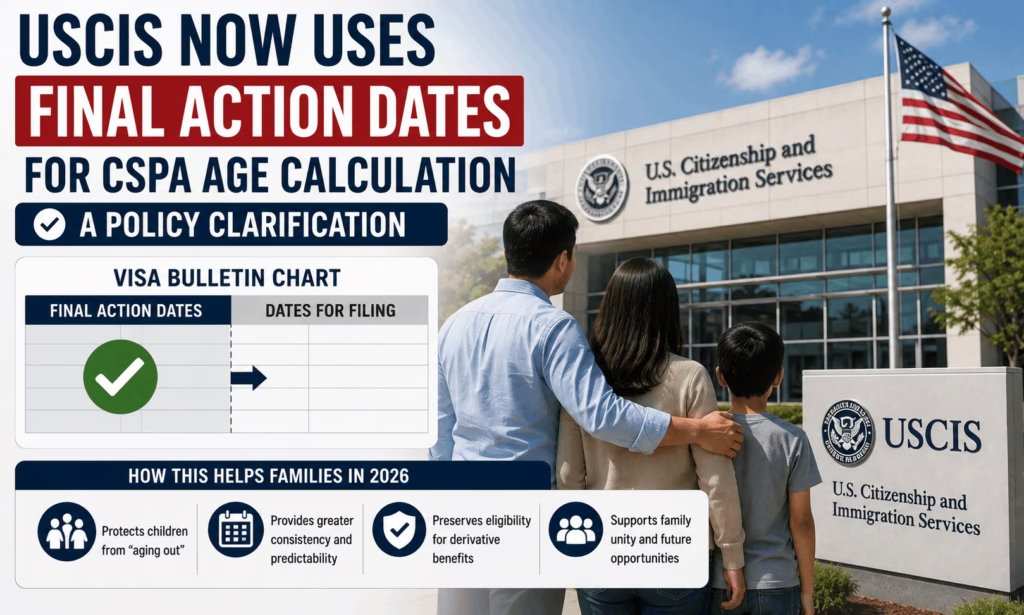
CSPA Age Calculation: Thousands of families waiting on employment-based and family-sponsored green cards are running into a timing rule that can decide, almost overnight, whether a son or daughter still qualifies as a dependent child or suddenly ages out of the process entirely. USCIS issued a formal policy clarification on August 8, 2025, changing how it calculates a person’s CSPA age, the age used under the Child Status Protection Act to determine whether a child can still immigrate alongside a parent after turning 21. The clarification, effective August 15, 2025, switched USCIS back to using the Final Action Dates chart in the State Department’s Visa Bulletin instead of the more generous Dates for Filing chart that had been in use since February 2023, and a year into its rollout, immigration attorneys say the change is still catching families off guard.
The stakes could not be higher for the people affected. Under this CSPA age calculation policy clarification, the exact same child, with the exact same birthday and the exact same underlying petition, can be found to qualify as a protected child under one chart and to have aged out under the other. Attorneys tracking real cases through 2026 have documented scenarios where a derivative child calculated at 20 years and 9 months under the old rule turned out to be 21 years and 2 months, and therefore ineligible, once the Final Action Dates chart was applied instead. We’ll be updating this article monthly as USCIS issues further guidance and as new Visa Bulletin data affects pending CSPA calculations.
Latest Update On The CSPA Age Calculation Policy
As of this month, the Final Action Dates standard announced in the August 2025 policy clarification remains the governing rule for any adjustment of status application filed on or after August 15, 2025. USCIS has not reversed or further modified this guidance since it took effect, and the agency’s Policy Manual, Volume 7, Part A, Chapter 7, continues to reflect the Final Action Dates methodology as current law. Immigration law firms report that the practical effects of the switch are still playing out this year, since many families with pending I-140 or family-based petitions filed before the policy changed are only now approaching the age thresholds where the difference between the two charts actually determines the outcome of their case.
The policy clarification itself was issued as Policy Alert PA-2025-15, and it did two connected things. First, it reversed the February 2023 guidance that let USCIS calculate CSPA age using whichever chart, Dates for Filing or Final Action Dates, was open for adjustment of status filings in a given month. Second, it restored the interpretation USCIS used from 2015 through 2023, aligning the agency’s methodology with how the State Department has always calculated CSPA age for immigrant visa applicants processing abroad, a consistency USCIS says was the primary reason for the reversal.
What Is The Child Status Protection Act
The Child Status Protection Act became law on August 6, 2002, created specifically to address a problem known as aging out. Under the Immigration and Nationality Act, a child is defined as someone who is both unmarried and under 21 years old, and a person who applies for a green card as a dependent child but turns 21 before their case is approved would traditionally lose their eligibility to immigrate alongside their parent. Because visa backlogs and USCIS processing times can stretch for years, especially in oversubscribed categories, Congress created CSPA to give these children a way to freeze their age using a specific mathematical formula rather than losing their place in line entirely.
The CSPA age formula subtracts the number of days a family’s underlying immigrant petition was pending from the child’s actual age on the date a visa becomes available. If that calculated result comes out under 21, the child retains eligibility to immigrate as a dependent even though their real-world birthday has already passed the cutoff. CSPA applies broadly across immediate relatives, family-sponsored preference categories, employment-based preference derivatives, diversity visa derivatives, VAWA self-petitioners, and derivative refugees and asylees.
Key Highlights
| Detail | Information |
|---|---|
| Policy | CSPA age calculation, visa availability standard |
| Governing chart under current rule | Final Action Dates chart, Visa Bulletin Chart A |
| Prior chart used, 2023 to 2025 | Dates for Filing chart, Visa Bulletin Chart B |
| Policy alert number | PA-2025-15 |
| Announced | August 8, 2025 |
| Effective date | August 15, 2025 |
| Applies to | Adjustment of status applications filed on or after August 15, 2025 |
| Cases still under prior policy | AOS applications pending before August 15, 2025 |
| Governing law | Child Status Protection Act, effective August 6, 2002 |
| USCIS Policy Manual reference | Volume 7, Part A, Chapter 7 |
| Sought to acquire requirement | Must seek LPR status within one year of visa availability |
Canada FMCSP Study Permit: 2,970 Spots Open August 26, See Eligibility, PR Pathway & How to Apply?
Direct Express Card Transition to Fifth Third Bank: What 3.6 Million Cardholders Need to Know
Federal Fuel Excise Tax Suspension: Ford Pushes Carney to Extend Relief Past Labour Day
Why USCIS Reversed Course On CSPA Age Calculation
USCIS has explained that the reversal was about consistency rather than a new policy direction. Before 2023, the agency had used the Final Action Dates chart for CSPA calculations since 2015, and the State Department has always used that same chart for immigrant visa applicants processing their cases outside the United States. The February 2023 policy created a split, letting USCIS use the earlier, more generous Dates for Filing chart for people adjusting status inside the country, while the State Department continued using Final Action Dates abroad. That meant two children with functionally identical circumstances, one applying domestically and one applying from overseas, could receive different CSPA outcomes purely because of where their case was being processed.
According to USCIS, the August 2025 clarification was designed to close that gap and apply one consistent standard regardless of where a family’s case is being handled. The agency has stated this establishes parity for CSPA age calculation between adjustment of status applicants and immigrant visa applicants abroad, which is the core rationale documented in the policy manual update itself.
How The Final Action Dates Chart Changes Real Outcomes
The practical difference between the two charts comes down to timing. In any given month, the Dates for Filing chart tends to be more current, sometimes showing a category as current or nearly current, while the Final Action Dates chart for the same category can sit months or even years behind. Because CSPA age is calculated based on the child’s age at the moment a visa becomes available, and because an earlier availability date generally produces a younger calculated age, using the more generous Dates for Filing chart tended to help more children qualify under the 2023 policy.
Immigration attorneys reviewing real family scenarios in 2026 have illustrated just how significant this gap can be. In one documented case, a family’s I-140 petition was approved after four months of pending time, with their son at 21 years and 1 month old at approval. Under the old Dates for Filing approach, the son’s calculated CSPA age came out to 20 years and 9 months, comfortably under the cutoff. But because the Final Action Dates chart for that category did not become current until several months later, the son’s age at the point USCIS now considers the visa available climbed to 21 years and 6 months, producing a final CSPA age of 21 years and 2 months, over the limit, meaning the same son who would have qualified under the prior rule aged out entirely under the current one.
Who Is Protected Under The Transition Rule
USCIS built a specific safeguard into this policy clarification for families who had already relied on the 2023 guidance before it changed. Any adjustment of status application that was already pending with USCIS before August 15, 2025 continues to be evaluated under the February 2023 Dates for Filing standard, rather than being retroactively reassessed under the new Final Action Dates rule. This protection exists specifically because USCIS recognized that families may have made filing decisions, including the timing of when to submit an adjustment of status application, based on the more favorable rule that was in effect at the time.
The policy clarification also addressed the separate sought to acquire requirement, which obligates a CSPA beneficiary to take affirmative steps toward lawful permanent residence within one year of when a visa becomes available. USCIS clarified that an applicant can satisfy this requirement by demonstrating extraordinary circumstances for failing to act within that one-year window, an important detail for families who may have delayed filing during the period when the Dates for Filing versus Final Action Dates question was creating confusion about which date actually controlled.
What Families Approaching The Age-21 Threshold Should Do
Families with a child approaching 21 who are relying on an employment-based or family-sponsored petition should treat the CSPA age calculation as a moving target rather than a one-time check. Because the Final Action Dates chart can shift month to month, and because a family’s actual CSPA age is only finalized once a visa formally becomes available under that chart, attorneys recommend recalculating the projected age regularly using the current Visa Bulletin rather than relying on a single calculation performed months earlier.
Filing timing matters more under the current rule than it did under the 2023 policy, since the gap between when Dates for Filing opens and when Final Action Dates actually catches up can, in oversubscribed categories such as EB-2 and EB-3 for India and China, stretch out for many months. Families in categories with a significant gap between the two charts should work closely with an immigration attorney to model different scenarios well before a child’s actual 21st birthday approaches, since the margin for error under the current rule is often much thinner than it was under the previous policy.
ICE Detained Military Families: AP Finds 50+ Spouses and Parents Held
Official Sources
| Resource | Link |
|---|---|
| USCIS official CSPA age calculation policy alert | uscis.gov/newsroom/alerts/uscis-updates-policy-on-cspa-age-calculation |
| USCIS Policy Manual, Chapter 7, CSPA | uscis.gov/policy-manual/volume-7-part-a-chapter-7 |
| USCIS Child Status Protection Act overview | uscis.gov/green-card/green-card-processes-and-procedures/child-status-protection-act-cspa |
| Current Visa Bulletin | travel.state.gov/content/travel/en/legal/visa-law0/visa-bulletin.html |
| Check which chart USCIS is using this month | uscis.gov/visabulletininfo |
| USCIS online case status check | egov.uscis.gov/casestatus |
FAQs About CSPA Age Calculation
What changed in the CSPA age calculation policy?
USCIS now uses the Final Action Dates chart in the Visa Bulletin to determine when a visa becomes available for CSPA age calculation, reversing a February 2023 policy that allowed use of the more generous Dates for Filing chart.
When did this CSPA policy clarification take effect?
The clarification was announced August 8, 2025 and became effective for adjustment of status applications filed on or after August 15, 2025.
Does this change affect applications that were already filed before August 15, 2025?
No. Adjustment of status applications pending with USCIS before August 15, 2025 continue to be evaluated under the earlier February 2023 Dates for Filing policy.
Why does the chart used for CSPA calculation matter so much?
Because CSPA age depends on a child’s age at the moment a visa becomes available, and the Final Action Dates chart is often less current than the Dates for Filing chart, the same child can calculate as under 21 using one chart and over 21 using the other.
How do I calculate my child’s CSPA age under the current policy?
Subtract the number of days your immigrant petition was pending from your child’s age on the date a visa becomes available under the Final Action Dates chart. If the result is under 21, your child is protected from aging out.
What is the sought to acquire requirement under CSPA?
It requires a CSPA beneficiary to take steps toward lawful permanent residence within one year of when a visa becomes available, though USCIS allows exceptions for applicants who can demonstrate extraordinary circumstances.
People Also Ask
What does aging out mean in US immigration? Aging out refers to a dependent child turning 21 while their family’s green card case is still pending, which can make them ineligible to immigrate as a derivative unless CSPA protections apply.
Which chart does USCIS currently use for CSPA age calculation? USCIS currently uses the Final Action Dates chart, also called Chart A, in the Department of State’s monthly Visa Bulletin.
Can a CSPA age calculation change over time? Yes. Because the calculation depends on when a visa becomes available under the Final Action Dates chart, and that chart moves month to month, a family’s projected CSPA age can shift until the visa is formally available.
Who does the Child Status Protection Act apply to? CSPA applies to immediate relatives, family-sponsored preference derivatives, employment-based preference derivatives, diversity visa derivatives, VAWA self-petitioners, and derivative refugees and asylees.
Conclusion
More than a year after USCIS issued its CSPA age calculation policy clarification, families navigating employment-based and family-sponsored green card cases are still feeling its effects, particularly those with children approaching the age-21 threshold in oversubscribed visa categories. Because the Final Action Dates chart can lag significantly behind the Dates for Filing chart in categories with long backlogs, the margin between a child qualifying as protected and aging out entirely can come down to a matter of months or even weeks. Families in this position should track the current Visa Bulletin closely, recalculate their child’s projected CSPA age regularly, and consult an immigration attorney well before a 21st birthday approaches to understand exactly how the current policy applies to their specific case.
2027 Social Security COLA: 3.6% Estimate Beats Medicare Hike
2027 HSA Contribution Limits Announced: IRS Confirms $4,500 and $9,000 Caps
FTC Refund 2026: Millions of Americans May Be Owed Money and Most Don’t Know It