USPS Operational Restructuring: The US Postal Service is deep into the most sweeping USPS operational restructuring effort in decades, and the latest numbers show just how much pressure the agency is under. USPS reported a $2.5 billion net loss for its third fiscal quarter, even as operating revenue climbed 6.1 percent year over year to $19.9 billion. Postmaster General David Steiner said in a statement accompanying the results that the agency is continuing to face a severe liquidity crisis, pointing to systemic challenges baked into the congressionally established business model that governs how the Postal Service operates and prices its services.
The quarterly loss extends a losing streak that now stretches back nearly two decades. USPS has recorded 19 consecutive years of operating losses and has lost more than 117 billion dollars since 2007. Steiner has repeatedly told Congress that without structural change, the Postal Service risks running out of operating cash, a warning that has driven the agency to bring in an outside restructuring firm, freeze non-essential spending, and push forward with a network modernization plan that is reshaping how mail and packages move across the country. We’ll be updating this article monthly as new financial results and restructuring details come in, so check back for the latest developments.
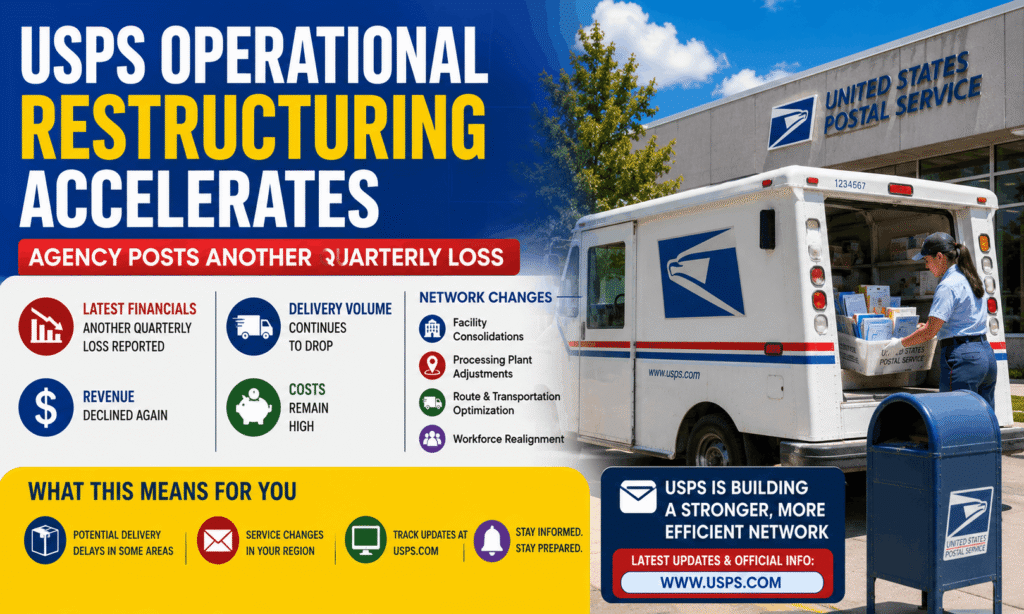
USPS Operational Restructuring Key Highlights
| Metric or Detail | Latest Figure |
|---|---|
| Q3 FY2026 net loss | $2.5 billion |
| Q3 FY2026 operating revenue | $19.9 billion, up 6.1% year over year |
| Q2 FY2026 net loss | $1.95 billion (fifth straight quarterly loss) |
| Consecutive years of operating losses | 19 years |
| Cumulative losses since 2007 | Over $117 billion |
| Statutory federal borrowing cap | $15 billion, set in 1990 |
| Projected FY2026 net loss (full year) | $8.1 billion |
| Projected FY2026 total mail and package volume | 101.5 billion pieces, down 6.6% from 2025 |
| Estimated year-end 2026 cash position | $3.4 billion, down from $14.0 billion at end of FY2025 |
| Restructuring consultant hired | Alvarez & Marsal |
| Proposed First-Class stamp price | 95 cents, up from 90 cents |
Latest Financial Results Driving the Restructuring Push
The newest quarterly numbers give the clearest picture yet of why USPS leadership considers restructuring urgent rather than optional. The $2.5 billion loss for the third quarter came even though revenue grew compared to the same period last year, an increase Steiner attributed largely to growth in the agency’s Ground Advantage package shipping service. But that revenue growth was not enough to offset rising operating costs, and it actually represented a step down from the $20.2 billion in revenue the agency brought in during the previous quarter.
Steiner has been blunt in congressional testimony about what is driving the losses. First-Class Mail volume, historically the Postal Service’s most profitable product, has fallen 34 percent since 2014 as households and businesses shift to digital communication. Yet over that same period, the agency’s career workforce actually grew by roughly 9 percent, a mismatch between shrinking core volume and a workforce that did not shrink alongside it. That imbalance sits at the center of the current postal service financial crisis and is a major reason the agency is now pursuing job reductions alongside its network changes.
Social Security $200 Monthly Increase 2027: Which Seniors Qualify for the Biggest Raise?
H-1B 60-Day Grace Period Elimination: What US Visa Workers Should Know
450,000 Borrowers Student Debt Erased: How to Check If You Qualify?
How USPS Delayed a Cash Crisis, But Did Not Solve It
Earlier this year, Steiner warned lawmakers that the Postal Service could run out of cash to pay employees and vendors as soon as September 2026 without intervention. That timeline has since shifted. By suspending payments into the Federal Employees Retirement System, USPS effectively borrowed against its own retirement obligations to preserve short-term cash, pushing the projected cash crisis date out to somewhere between fiscal year 2031 and 2035.
Steiner has been careful not to frame that shift as good news. Testifying before the Senate Homeland Security and Governmental Affairs Committee, he told lawmakers plainly that the agency is basically borrowing money from its own retirement plans to fund current operations, and that neither he, employees, nor Congress should be comfortable with that arrangement. Without structural reform, USPS projects its unrestricted cash position could turn negative by more than 125 billion dollars by fiscal year 2035, a scenario that would force far more disruptive measures than the ones currently under discussion.
Part of what makes the math so difficult is the agency’s borrowing limit. USPS is capped at 15 billion dollars in federal borrowing authority, a ceiling that was set in 1990 and has never been adjusted for inflation or for how much the mail and package business has changed since then. Steiner has asked Congress to raise that cap and to reform how the agency’s retirement obligations are funded, arguing that both changes are necessary before any restructuring plan can put USPS on solid footing long term.
Inside the USPS Network Modernization and Logistics Overhaul
The operational side of the restructuring is already visible to mailers and shipping partners. USPS has been rebuilding its logistics network around regional hubs and a more optimized transportation system, an effort the agency calls Regional Transportation Optimization, which was fully implemented nationwide in July 2025. The goal is to speed up how packages and mail move between processing facilities while cutting the transportation costs that have ballooned in recent years.
As part of the same modernization push, USPS has invested nearly 20 billion dollars in new automation and expanded package processing capacity. Sorting operations are shifting away from the traditional class-based system, where letters, flats, and parcels were routed separately, toward a shape-driven model built around Sectional Center Facilities. Beginning in January 2026, Area Distribution Centers were phased out entirely, replaced by expanded SCF-based sortation, while Network Distribution Centers were fully phased out for Marketing Mail parcels. For large-volume mailers and shipping software providers, that meant updating postage statement formats and Mail.dat specifications to align with the new routing structure.
Leadership changes have accompanied the network overhaul. In May 2026, USPS announced that Matt Connelly had joined the organization as Chief Solutions and Strategy Officer, bringing four decades of transportation and supply chain experience, including a leadership role in network strategy at UPS. Steiner said Connelly’s expertise would help sharpen network planning and execution as the agency works to make its logistics system respond to customer needs rather than, in his words, forcing customers to fit the wants of the bureaucracy.
Workforce Reductions and the Alvarez & Marsal Restructuring Review
Because payroll represents the largest share of USPS operating costs, workforce reductions have become one of the most closely watched parts of the restructuring effort. Earlier this year, USPS brought in Alvarez & Marsal, described by Steiner as the preeminent restructuring firm in the world, to examine cost-cutting options across the organization. The firm’s recommendations are expected around the close of fiscal year 2026 in September, a timeline that has fueled speculation among postal employees and their unions about a possible new early retirement or buyout offer.
USPS previously ran a Voluntary Early Retirement Authority and Voluntary Separation Incentive Payment program in 2025. Employees who separated under that program are scheduled to receive a second incentive payment of 5,000 dollars on August 28, 2026, a disbursement tied to the earlier program rather than a new offer. Whether a fresh round of buyouts or early retirement incentives follows the Alvarez & Marsal review depends on three things that had not yet happened as of this writing: a formal agency announcement, a memorandum of understanding with postal unions, and authorization from the Office of Personnel Management. Steiner has acknowledged that further workforce changes remain possible, telling reporters that when an organization is in a genuine financial crisis, everything has to be on the table.
Weekly Jobless Claims Report: 199,000 Filings Signal Labor Market Cooling
Federal Employee RIF Rules 2026: What the New OPM Regulations Actually Change
IRS Releases New Details on the Saver’s Match Program: Up to $1,000 for Your Retirement Account
Congressional Reaction to the USPS Restructuring Plan
The restructuring effort has become tangled up with a separate political fight in Washington. The Trump administration has pushed for aggressive changes at USPS, including a proposed rule affecting how the agency handles mail-in ballots, a measure Democrats argue has nothing to do with fixing the agency’s finances. Senator Gary Peters, who previously led passage of the Postal Service Reform Act of 2022, has argued that tying postal restructuring to voting policy conflicts with the agency’s core mission of universal mail service. A federal judge in Massachusetts blocked the mail-in ballot proposal in late June 2026, one day after Steiner’s Senate testimony on the agency’s finances.
Other lawmakers have focused more narrowly on operational efficiency. Senator Rand Paul pointed out during a Senate hearing that when a private company’s business volume falls, it typically cuts labor costs to match, while USPS has historically added staff even as mail volume declined. That tension, between an agency legally required to serve every address in the country and one that is also expected to operate like a self-sustaining business, remains at the heart of the disagreement over how far restructuring should go.
Oversight Warnings on Fraud and Technology Risk
The Postal Service’s own Office of Inspector General has added another layer of urgency to the restructuring conversation. Recent OIG reports found that USPS has insufficient controls to detect counterfeit shipping labels and to prevent fraud involving its Enterprise Payment Account system. The agency identified the payment fraud issue as early as May 2025, but the OIG found that mitigation efforts through January 2026 remained limited. Left unaddressed, the inspector general estimates the fraud could cost the agency an additional 1.3 billion dollars in lost revenue across 2026 and the following year.
Critics of the current restructuring approach have also questioned USPS’s decision to build some payment and software systems in-house rather than relying on established private-sector platforms, arguing that the move has left the agency more exposed to exactly the kind of technological and security gaps the OIG has flagged. Agency leadership has not publicly detailed a specific fix for the payment fraud issue beyond acknowledging the OIG’s findings.
What USPS Restructuring Means for Prices and Delivery
For everyday customers and businesses that rely on the mail, the most visible effect of the restructuring plan so far has been on pricing. Steiner has proposed raising the price of a First-Class stamp from 90 cents to 95 cents, framing postage as one of the few revenue levers still available to the agency under its current legal structure. Regulatory review by the Postal Regulatory Commission typically follows any proposed rate change before it can take effect.
On the delivery side, the network modernization plan is designed to preserve the six-day delivery standard that was codified into law under the 2022 reform act, even as USPS shifts more volume onto regional hubs and ground transportation. The Postal Service maintains that its long-term Delivering for America strategy, first launched in 2021, remains structured to reach break-even operating performance and avoid an estimated 160 billion dollars in projected losses by 2030, though the agency’s own recent results suggest that timeline continues to face significant pressure.
Why This Restructuring Effort Is Different From Past USPS Reform Attempts
USPS has attempted large-scale reorganization before, including a 10-year plan unveiled under a previous postmaster general in 2021 that also targeted facility consolidations and transportation changes. What sets the current effort apart is the scale of financial urgency behind it. Previous reform plans were framed primarily around long-term sustainability. The current restructuring is being driven by near-term liquidity concerns serious enough that the agency’s leadership has openly discussed the possibility of defaulting on payments to contractors and vendors if cash preservation measures fail.
Trucking and logistics contractors that work with USPS have taken that warning seriously. Agency officials have acknowledged that if short-term cash measures are not enough, payment obligations that were previously managed through internal accounting adjustments could shift into actual defaults on payments owed to outside transportation partners, a scenario that would ripple through the broader shipping and logistics industry well beyond USPS itself.
Official USPS Resources and Tracking Links
| Resource | Purpose | Official Link |
|---|---|---|
| USPS.com | Track packages, calculate postage, find ZIP codes | https://www.usps.com |
| USPS Package Tracking | Check delivery status of mail and packages | https://tools.usps.com/go/TrackConfirmAction |
| Informed Delivery | Preview incoming mail and manage delivery notifications | https://informeddelivery.usps.com |
| Click-N-Ship | Print shipping labels and schedule pickups | https://cns.usps.com |
| USPS Rate Cases and Pricing | Official information on proposed postage rate changes | https://about.usps.com/what/financials |
| Postal Regulatory Commission | Independent oversight of USPS rates and service changes | https://www.prc.gov |
| USPS Newsroom | Official statements, financial reports, and leadership updates | https://about.usps.com/newsroom |
| LiteBlue (USPS employee portal) | Employee login for pay, benefits, and retirement information | https://liteblue.usps.gov |
FAQs on USPS Operational Restructuring
Why is USPS restructuring its operations right now?
USPS is restructuring because it has posted 19 consecutive years of operating losses and faces a long-term cash crisis. Declining First-Class Mail volume, rising costs, and a workforce that grew even as mail volume fell have combined to push the agency toward major structural changes.
Is the Postal Service actually going to run out of money?
USPS pushed back its projected cash crisis from as early as 2027 to sometime between 2031 and 2035 by suspending payments into its retirement system. Postmaster General David Steiner has said this is a temporary fix, not a solution, and that the agency remains financially fragile without further reform.
Will USPS raise stamp prices because of the restructuring?
Postmaster General Steiner has proposed raising the price of a First-Class stamp from 90 cents to 95 cents. Any rate change must go through review by the Postal Regulatory Commission before it can take effect. USPS has not announced a new layoff or buyout program as of this writing. The agency is awaiting recommendations from the restructuring firm Alvarez & Marsal, expected around the end of fiscal year 2026 in September, which could inform future workforce decisions. Any new voluntary separation program would still require union agreement and federal authorization.
What is the USPS Delivering for America plan?
Delivering for America is the Postal Service’s 10-year strategic plan, launched in 2021, aimed at reaching break-even financial performance through network modernization, cost reductions, and legislative reforms, including changes to retiree health benefit funding.
Will mail delivery slow down because of USPS restructuring?
USPS says its network modernization plan is designed to maintain the legally required six-day delivery standard while shifting more volume through regional processing hubs and ground transportation rather than air carriers, which the agency says will improve efficiency without reducing service frequency.
Who is the current Postmaster General overseeing the restructuring?
David Steiner has served as Postmaster General and CEO of the US Postal Service during this restructuring period, testifying repeatedly before Senate and House committees on the agency’s financial condition and reform plans.
How can I track how USPS restructuring is affecting my mail or packages?
Customers can track individual packages and check delivery status directly through USPS.com or the Informed Delivery service, which shows preview images of incoming mail and notifications for expected packages.
Conclusion
The Postal Service finds itself at a genuine inflection point. Another quarterly loss, a borrowing cap that has not moved since 1990, and a cash position that keeps getting pushed further into the future rather than resolved all point to an agency still searching for a sustainable business model. At the same time, the operational side of the restructuring, from regional transportation hubs to shape-based sortation to a reshaped leadership team, is already changing how mail physically moves through the system. Whether the combination of network modernization, workforce changes, and a possible stamp price increase is enough to close the gap will become clearer once the Alvarez & Marsal recommendations land and Congress decides whether to act on Steiner’s requests to raise the borrowing cap and reform retirement funding. Until then, the Postal Service remains exactly what Steiner has called it: an agency in crisis, with every option still on the table.
Service Canada Benefit Payments August 2026 Dates, Amounts and Who Qualifies
Government Shutdown Stopgap Spending Bill: Senate Passes Funding Patch Through December 11