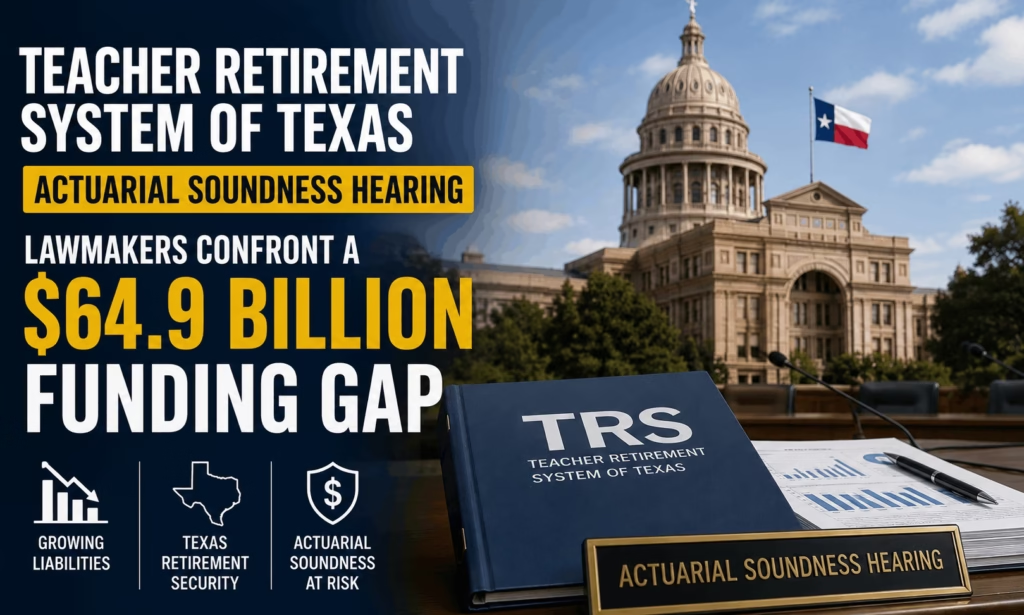
Teacher Retirement System of Texas Actuarial Soundness Hearing: Texas lawmakers sat down this week to confront a problem that has been building for years inside the state’s largest pension fund. The House Committee on Pensions, Investments and Financial Services met on Tuesday, August 18, 2026, at the Capitol Extension in Austin to review the actuarial soundness of the Teacher Retirement System of Texas, the retirement fund that covers more than 2.1 million current and retired public school, college and university employees across the state. The hearing, called under a formal interim charge from House Speaker Dustin Burrows, focused on current contribution levels, defined benefit plan assumptions, and projected liabilities, with lawmakers specifically asked to evaluate whether employer contributions should be based on total payroll and whether contribution rates should be made more consistent across school districts statewide.
The stakes are significant for both active teachers and the more than half a million Texans already drawing a TRS pension. Under state law, the Teacher Retirement System of Texas is only considered actuarially sound when it is projected to pay off its unfunded liabilities within 31 years, and that threshold is not just a technical accounting benchmark. It is the legal gate that determines whether the Legislature can even consider a cost of living adjustment for retired educators. Right now, TRS is falling short of that mark, with its funding period sitting at roughly 35 years and its unfunded actuarial accrued liability climbing to $64.9 billion, an increase of nearly $5 billion over the prior year alone. We’ll be updating this article monthly as the Texas Legislature moves toward the 2027 session and as TRS releases updated valuation data.
What Happened At The August 18 Hearing
The House Pensions, Investments and Financial Services Committee, often referred to by the shorthand PIFS Committee, convened for invited testimony only at 10 a.m. in Room E2.012 of the Capitol Extension. The session was built around a specific interim charge issued earlier this year by Speaker Burrows, directing the committee to study the long-term financial stability of the Teacher Retirement System of Texas ahead of the 90th Legislature convening in 2027. Committee members heard from TRS staff and outside actuaries about the fund’s current position, its assumptions on investment returns and payroll growth, and the range of policy options available to bring the system back into compliance with the state’s actuarial soundness standard.
Lawmakers were specifically directed to evaluate the impact of basing employer contributions on total payroll rather than the current structure, examine options to increase parity in contribution rates paid by different school districts and entities, and weigh the fiscal impact of any future benefit enhancements for retirees. No formal committee vote or bill action took place at this stage, since interim hearings are used to gather information and build the record ahead of the regular legislative session rather than to pass legislation directly.
Why Actuarial Soundness Matters For Texas Teachers
Actuarial soundness is the legal standard Texas uses to judge whether a public pension fund is financially healthy enough to safely take on new obligations. For the Teacher Retirement System of Texas, the statute defines soundness as being on track to pay off the fund’s unfunded actuarial accrued liability, essentially the gap between what TRS owes in future benefits and what it currently holds in assets, within 31 years. When the funding period stretches beyond that window, the system is classified as not actuarially sound, and that classification carries real consequences.
Most importantly, TRS statute bars the Legislature from approving a cost of living adjustment, commonly called a COLA, for retired teachers unless the fund meets the actuarial soundness threshold. That rule has left hundreds of thousands of retired Texas educators without a COLA for years even as inflation erodes the purchasing power of their fixed pension checks. Advocacy groups tracking the issue note that even after benefit increases the Legislature approved in 2023, the average TRS retiree still trails cumulative inflation by roughly 30 percent, a gap that has only widened as the fund’s soundness metrics have deteriorated further.
ICE Detained Military Families: AP Finds 50+ Spouses and Parents Held
Key Highlights
| Detail | Information |
|---|---|
| Hearing date | Tuesday, August 18, 2026 |
| Committee | Texas House Pensions, Investments and Financial Services Committee |
| Location | Room E2.012, Capitol Extension, Austin |
| Interim charge issued by | House Speaker Dustin Burrows |
| Current TRS funding period | Approximately 35 years |
| Statutory soundness threshold | Funding period under 31 years |
| Unfunded actuarial accrued liability | $64.9 billion |
| Year-over-year growth in UAAL | Nearly $5 billion |
| Total TRS trust fund assets | Approximately $225 billion |
| TRS members and retirees covered | More than 2.1 million |
| National ranking by assets | Sixth largest public pension fund in the United States |
| Next legislative session | 90th Texas Legislature, convenes 2027 |
The Numbers Behind The Funding Gap
The Teacher Retirement System of Texas manages one of the largest public pension trust funds in the country, with roughly $225 billion in assets supporting benefits for public school, community college and university employees across the state. Despite that scale, the system’s most recent actuarial valuation showed its unfunded liability climbing to $64.9 billion, up from roughly $60 billion a year earlier, pushing the projected payoff period further away from the statutory 31 year requirement.
Several factors are driving the gap. Payroll growth across Texas school districts has outpaced the assumptions built into TRS actuarial models in recent years, meaning benefit obligations are growing faster than the contribution base funding them. Investment return assumptions, inflation projections and mortality tables are all reviewed periodically by the system’s outside actuary, Gabriel, Roeder, Smith and Company, whose most recent experience study was delivered to the TRS board in February 2026 and recommended updated mortality tables reflecting slightly longer retiree lifespans, a change that itself adds modestly to the long-term liability picture even as it makes the fund’s projections more accurate.
Contribution Rate Debate: Total Payroll And Parity Questions
One of the most closely watched pieces of the interim charge is the question of whether TRS employer contributions should be calculated based on total payroll rather than the current structure, which in some cases has allowed contribution obligations to lag behind actual payroll growth in fast-growing districts. Shifting to a total payroll basis would generally increase the contribution base and could meaningfully shorten the fund’s projected payoff period, but it would also raise costs for school districts and the state at a time when education budgets are already under pressure from other priorities.
The committee was also asked to study options for increasing parity in contribution rates across different entities participating in TRS. Currently, contribution structures can vary in ways that create uneven funding pressure depending on a district’s payroll composition and growth rate, and lawmakers are examining whether a more uniform approach would stabilize the system’s long-term outlook without placing a disproportionate burden on any single group of districts or employees.
What This Means For Retired And Active Teachers
For the more than half a million Texans currently drawing a TRS pension, the practical consequence of the fund’s soundness gap is straightforward. As long as the funding period remains above 31 years, the Legislature cannot legally approve a new cost of living adjustment, regardless of how much retiree advocacy groups push for one. The Texas Retired Teachers Association has already signaled it plans to make a benefit enhancement for TRS retirees a top priority heading into the 2027 legislative session, arguing that the 2023 increases have not kept pace with the cost of living for educators who, in many cases, do not receive Social Security benefits and rely on their TRS pension as their primary source of retirement income.
For active teachers and school employees still contributing to the system, the hearing’s focus on contribution rates and total payroll calculations matters just as directly, since any structural change adopted by the Legislature would affect how much school districts, and by extension the state budget, must set aside each year to keep the system on a sustainable path. TRS itself has stressed that maintaining the fund’s long-term health protects the retirement security of every current member, not just those already collecting benefits.
2027 HSA Contribution Limits Announced: IRS Confirms $4,500 and $9,000 Caps
FTC Refund 2026: Millions of Americans May Be Owed Money and Most Don’t Know It
Background: How TRS Got Here
The Teacher Retirement System of Texas was established in 1937 and has grown into the largest public retirement system in the state and the sixth largest public pension fund in the country by assets. For much of the past decade, TRS moved in and out of actuarial soundness depending on market performance and legislative funding decisions, with the fund’s own reporting showing a funding period as short as roughly 28 years in years when investment returns were strong and legislative contributions kept pace with growing liabilities.
The current stretch outside the soundness threshold reflects a combination of slower than assumed investment returns in some recent years, payroll growth in Texas school districts that has outpaced contribution increases, and the compounding effect of benefit enhancements approved in 2023 that, while providing needed relief to retirees, also added to the system’s long-term liability without a matching permanent increase in the contribution rate needed to fully offset that cost. The August 18 hearing represents the formal starting point for lawmakers to work through how to close that gap before the 90th Legislature convenes in 2027.
Official Sources
| Resource | Link |
|---|---|
| Teacher Retirement System of Texas official site | trs.texas.gov |
| TRS Actuarial Valuation Reports | trs.texas.gov/learning-resources/publications/actuarial-valuation-reports |
| Texas House Committee on Pensions, Investments and Financial Services | house.texas.gov/committees/committee/395 |
| MyTRS member portal login | mytrs.texas.gov |
| Texas Legislature Online, interim hearing notices | capitol.texas.gov |
| Texas Retired Teachers Association | trta.org |
FAQs
What does it mean when TRS is not actuarially sound?
It means the Teacher Retirement System of Texas is projected to take longer than 31 years to pay off its unfunded liabilities, which under state law blocks the Legislature from approving a cost of living adjustment for retirees until the fund’s soundness improves.
Why did the Texas House hold a hearing on TRS actuarial soundness?
House Speaker Dustin Burrows issued a formal interim charge directing the Pensions, Investments and Financial Services Committee to study the long-term financial stability of TRS ahead of the 2027 legislative session, including contribution levels and potential benefit enhancements.
Will TRS retirees get a cost of living adjustment soon?
Not immediately. Because TRS currently does not meet the statutory actuarial soundness threshold, the Legislature cannot approve a new COLA until the fund’s projected payoff period falls back under 31 years.
What is the current TRS unfunded liability?
The Teacher Retirement System of Texas reported an unfunded actuarial accrued liability of $64.9 billion in its most recent valuation, an increase of nearly $5 billion from the prior year.
How many people does the Teacher Retirement System of Texas cover?
TRS serves more than 2.1 million active members, retirees and beneficiaries, making it the largest public retirement system in Texas and the sixth largest public pension fund in the country.
Did the August hearing result in any new legislation?
No. Interim hearings are for gathering testimony and information ahead of the regular session. Any formal changes to TRS contribution structure or benefits would need to be passed as legislation when the 90th Texas Legislature convenes in 2027.
What is the Teacher Retirement System of Texas actuarial soundness standard?
State law defines TRS as actuarially sound when its unfunded liabilities are projected to be paid off within 31 years, based on current contribution levels and actuarial assumptions.
How much money does TRS manage?
The Teacher Retirement System of Texas manages a trust fund of approximately $225 billion to support pension and health care benefits for its members.
Who oversees the Teacher Retirement System of Texas?
A Board of Trustees governs TRS, while the Texas House Committee on Pensions, Investments and Financial Services and corresponding Senate committees provide legislative oversight of the system’s funding and policy.
What happens if TRS remains underfunded?
Continued underfunding keeps TRS below the actuarial soundness threshold, blocking retiree cost of living adjustments and potentially requiring higher contribution rates from the state, school districts or employees in future legislative sessions.
Conclusion
The August 18 hearing before the Texas House Pensions, Investments and Financial Services Committee marks the opening round of what is likely to be a defining debate in the 2027 legislative session over how to bring the Teacher Retirement System of Texas back into actuarial soundness. With a $64.9 billion unfunded liability and a funding period still running roughly four years past the statutory threshold, lawmakers face difficult choices about contribution structures, payroll-based funding formulas and the timing of any future benefit enhancement for retirees. For the 2.1 million Texans who depend on TRS for their retirement security, the outcome of this review will directly shape both the size of their pension checks and the long-term stability of the fund itself in the years ahead.
Direct Express Card Transition to Fifth Third Bank: What 3.6 Million Cardholders Need to Know
Federal Fuel Excise Tax Suspension: Ford Pushes Carney to Extend Relief Past Labour Day
USCIS Restored Power To Deny Without RFE: Here Is What Policy Alert PA-2026-05 Actually Changes
IEEPA Tariff Refund Process: How Businesses Are Claiming Their Share of $166 Billion