Chapter 33 VA Benefits Housing Allowance: Veterans and military dependents using the Post-9/11 GI Bill now have updated numbers to work with, since the Department of Veterans Affairs officially rolled out new Chapter 33 VA benefits housing allowance rates for the 2026 to 2027 academic year on August 1, 2026. The Monthly Housing Allowance, widely known as MHA, is tied directly to military Basic Allowance for Housing rates and can vary by hundreds of dollars depending on where a student attends school, making it one of the most valuable but least understood parts of the education benefit. With school back in session across the country, veterans are asking a very specific question, how much money will actually land in their account each month.
The short answer is that most full-time students attending classes in person will receive a payment equal to the BAH rate for an E-5 with dependents at their school’s ZIP code, while online-only students are capped at a flat national rate of 1,261 dollars per month. Those numbers now reflect current 2026 BAH data rather than older figures, following a formula change the VA confirmed applies to this academic year. We’ll be updating this article monthly as the VA releases additional guidance and as new academic terms begin.
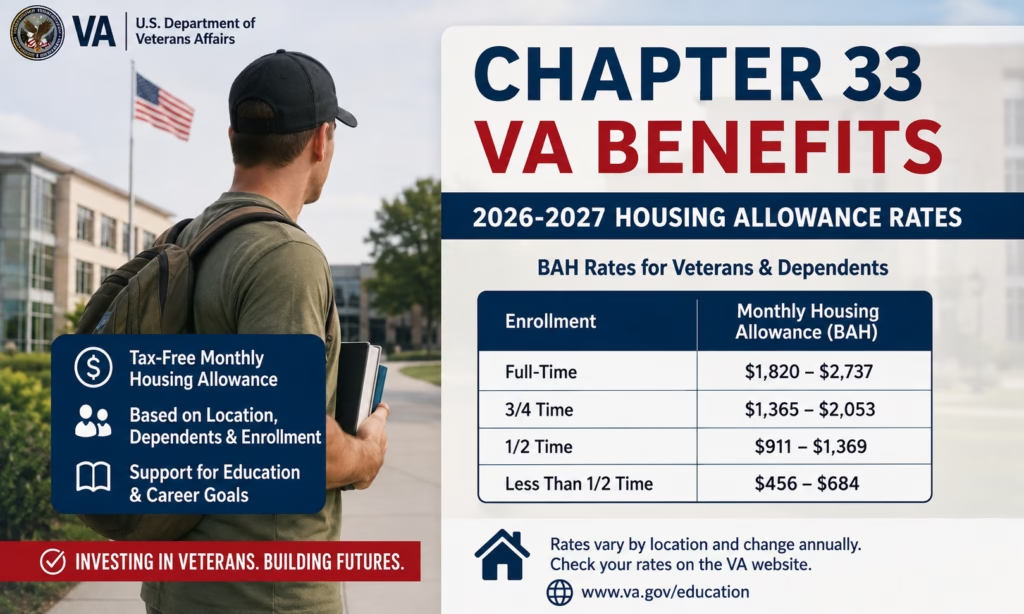
Chapter 33 VA Benefits Housing Allowance Key Rates and Dates
| Detail | Information |
|---|---|
| Academic year covered | August 1, 2026 to July 31, 2027 |
| Rate basis | E-5 with dependents BAH at school ZIP code |
| National BAH increase for 2026 | 4.2 percent |
| Online-only MHA cap | 1,261 dollars per month at 100 percent benefit level |
| Minimum enrollment for any MHA | Rate of pursuit above 50 percent, meaning more than half-time |
| Private and foreign school tuition cap | 30,908.34 dollars per year, up 3.3 percent |
| Book and supplies stipend | Up to 1,000 dollars per academic year, prorated by rate of pursuit |
| Maximum benefit duration | 36 months of full-time equivalent benefits |
| Payment timing | Paid monthly, in arrears, directly to the student |
| Active duty and TOE spouses | Not eligible for the housing allowance while sponsor remains on active duty |
What Is the Chapter 33 Monthly Housing Allowance?
Chapter 33 of Title 38 of the United States Code governs the Post-9/11 GI Bill, the education benefit available to veterans and service members who completed at least 90 days of aggregate active duty service after September 10, 2001, or who were discharged due to a service-connected disability after at least 30 days of service. Alongside covering tuition and fees, the program pays a monthly housing allowance directly to the student, intended to help cover rent, utilities and everyday living costs while attending school.
Unlike tuition payments, which the VA sends straight to the school, the housing allowance goes directly into the student’s own bank account, arriving at the beginning of each month for the previous month of enrollment. That timing detail catches many first time users off guard, since it means new students typically do not see their first housing payment until several weeks after classes have already started.
How the 2026 to 2027 Housing Allowance Is Calculated?
The MHA amount is based on the Department of Defense’s Basic Allowance for Housing rate for an E-5 service member with dependents, using the ZIP code of the school where the student takes the majority of their in-person classes. This holds true regardless of the veteran’s actual military rank or family situation, since the E-5 with dependents figure is simply the benchmark rate Congress built into the statute. A veteran attending school in a high-cost metropolitan area will receive a noticeably larger monthly payment than one attending a similar program in a rural, lower-cost region, purely because BAH rates themselves vary sharply by location.
For the 2026 to 2027 academic year, which runs from August 1, 2026 through July 31, 2027, the VA is calculating housing payments using current 2026 BAH rates, which increased 4.2 percent nationally compared with the prior year. That is an important update for veterans to know, since it means this year’s housing allowance reflects the most recent military housing cost data available rather than a lagging prior year figure, giving most students a modest increase in their monthly payment compared with the 2025 to 2026 academic year.
Colorado TABOR Refund and PTC Rebate 2026: Who Qualifies and How Much You Can Get
2027 Social Security COLA: 3.6% Estimate Beats Medicare Hike
Who Qualifies for the Full Housing Allowance
Not every Chapter 33 beneficiary receives the same monthly amount, since eligibility depends on both the veteran’s benefit percentage tier and their rate of pursuit for the current term. The benefit percentage tier is based on cumulative active-duty service time after September 10, 2001, ranging from 50 percent for shorter service periods up to 100 percent for veterans with 36 or more cumulative months of qualifying active duty, or for those who received a Purple Heart or were medically discharged after at least 30 days of service.
Rate of pursuit measures how many credit hours a student is taking relative to what the school defines as a full-time course load. Students must maintain a rate of pursuit above 50 percent, meaning more than half-time enrollment, to receive any housing allowance at all. Students exactly at half-time enrollment or below receive no MHA payment for that term, even if they otherwise qualify for tuition assistance. Between half-time and full-time enrollment, the housing payment is prorated, so a student taking a partial course load receives a partial monthly housing payment rather than the full ZIP code based rate.
Online-Only Students Receive a Different, Flat Rate
Students enrolled exclusively in online or distance learning programs are treated differently under the housing allowance formula. Instead of receiving a payment tied to their school’s ZIP code, online-only students receive half of the national average BAH rate, which works out to a maximum of 1,261 dollars per month at the 100 percent benefit tier for the 2026 to 2027 academic year. This flat national rate applies regardless of whether the student happens to live in an expensive city or a lower-cost area, since there is no in-person campus location to base the calculation on.
Students who take at least one class in person, even while taking additional courses online, may qualify for the higher, ZIP code based resident MHA rate instead of the reduced online-only rate. Veterans mixing online and in-person coursework should confirm with their school’s VA certifying official exactly how their enrollment will be classified each term, since misclassification can significantly change the monthly payment amount.
Active Duty Service Members and Certain Spouses Are Excluded
One frequently misunderstood rule involves who is actually eligible to receive the housing allowance in the first place. Active-duty service members using their own Chapter 33 benefits are not eligible for the monthly housing allowance while they remain on active duty, since the benefit is designed to offset civilian housing costs that active-duty members already have covered through their military housing arrangements or standard BAH. Similarly, spouses using benefits transferred to them through the Transfer of Entitlement program cannot receive the housing allowance if the transferring service member sponsor is still on active duty. Children using transferred benefits do not face this same restriction and can generally receive the housing allowance regardless of the sponsor’s active-duty status, subject to the standard enrollment and rate of pursuit rules.
Verification of Enrollment Is Required Every Month
Since December 2022, all students using Chapter 33 benefits have been required to verify their enrollment with the VA each month in order to continue receiving the Monthly Housing Allowance. This verification can be completed quickly through text message or phone call once a student is enrolled in the system, and failing to verify enrollment can delay or interrupt housing payments even if the student remains actively enrolled in classes. Students setting up Chapter 33 benefits for the first time should confirm during their initial certification process that they are properly enrolled in the monthly verification system, since missing this step is one of the most common reasons new students experience payment delays.
How Housing Payments Compare Across Benefit Tiers and Enrollment Levels
The combination of benefit percentage tier and rate of pursuit means two students at the exact same school can receive very different monthly housing payments. A veteran with a full 100 percent benefit tier taking a full course load will receive the entire BAH figure tied to their school’s ZIP code. A veteran with only a 70 percent tier, based on a shorter period of qualifying active-duty service, receives 70 percent of that same ZIP code based BAH figure, prorated further if their rate of pursuit falls below full-time. Understanding both variables together is essential before assuming any single published BAH number represents an accurate personal estimate.
Because tuition and fee caps also increase every academic year in step with national tuition trends, and because MHA now updates using the most current year’s BAH data rather than a lagged figure, veterans planning a full academic year of expenses should recalculate their expected benefits each August rather than relying on the prior year’s numbers, since even a modest annual increase can meaningfully change a student’s monthly budget.
An Important Exception for Transferred Benefits
Veterans who transfer their unused Chapter 33 entitlement to a spouse or child through the Transfer of Entitlement program should be aware of a subtle but important difference in how the housing rate is calculated. While a veteran using their own benefit directly gets the current year’s BAH figures for the 2026 to 2027 academic year, the VA calculates transferred benefit housing payments using 2024 BAH rates for that same period. This lag exists because of how the transferred benefit rate schedule is published relative to the direct veteran rate schedule, and it means a dependent using a transferred benefit could receive a somewhat different monthly housing figure than the veteran sponsor would have received using the same ZIP code, even though both fall under Chapter 33. Families relying on transferred benefits should check the VA’s dedicated transferred benefit rate table rather than assuming the standard veteran housing figures apply identically to their situation.
H-1B Visa Ban Texas Schools: Abbott Wants Exactly Zero Foreign Workers, What Indians Should Know
Trump Halts 50 Percent Tariffs Canada: What the Last Minute Deal With Ottawa Means
Green Card Rule Changes: New Public Charge Test to Assess Age, Health, Family Status and Finances
A Worked Example of How the Numbers Add Up
To make the calculation concrete, consider a veteran with a 100 percent benefit tier attending a public university in-state on a full-time basis, where the local E-5 with dependents BAH rate is 1,800 dollars per month. That veteran would receive the full 1,800 dollars per month during each month of enrollment, in addition to full coverage of in-state tuition and fees paid directly to the school, plus up to 1,000 dollars in book stipend money spread across the academic year based on credit hours certified. Over a nine-month academic year excluding summer break, that housing allowance alone would total roughly 16,200 dollars, on top of tuition coverage that could easily exceed 10,000 dollars annually depending on the school.
Now compare that to a veteran with a 70 percent benefit tier taking classes part-time at a rate of pursuit around 80 percent, at the same school with the same 1,800 dollar local BAH rate. That veteran’s housing payment would be reduced first by the 70 percent tier, bringing the base figure to 1,260 dollars, and then further prorated by the 80 percent rate of pursuit, landing at roughly 1,008 dollars per month. This layered calculation, tier percentage multiplied by rate of pursuit multiplied by the local BAH rate, is the core formula behind every Chapter 33 housing payment, and running through a personal example like this one is often the clearest way for a new student to understand what to expect in their own bank account.
Tuition and Fee Caps Alongside the Housing Allowance
For veterans attending private, foreign or non-public institutions, the housing allowance works alongside a separate annual tuition and fee cap that also increased for the 2026 to 2027 academic year, rising 3.3 percent to a maximum of 30,908.34 dollars per year at the 100 percent benefit tier. Public in-state tuition and mandatory fees, by contrast, continue to be covered in full with no dollar cap at all for veterans at the 100 percent tier, meaning the housing allowance is often the single largest fixed monthly benefit a veteran actually manages personally, since tuition itself is typically paid directly to the school rather than passing through the student’s own account.
What Book and Supply Stipends Add on Top of Housing
Beyond the monthly housing allowance, Chapter 33 also provides a book and supplies stipend, paid as a lump sum at the start of each term rather than monthly. At the 100 percent benefit level, this stipend pays 41.67 dollars per credit hour, up to a maximum of 1,000 dollars per academic year, with the amount scaling down proportionally for lower benefit tiers, similar to how the housing allowance itself scales. This stipend is separate from and in addition to the monthly housing payment, and it is intended specifically to help cover the cost of textbooks and required course materials rather than general living expenses.
Common Reasons Housing Payments Get Delayed or Reduced
Veterans occasionally see their housing allowance arrive late, arrive at a lower amount than expected, or stop entirely partway through a term, and there are a handful of recurring reasons behind these situations. A change in enrollment status partway through a term, such as dropping a class and falling below the half-time threshold, will reduce or eliminate that month’s housing payment. A gap in monthly enrollment verification can pause payments until the student completes the required confirmation. School breaks, including winter and summer recesses between terms, typically do not generate a housing payment unless the student is actively enrolled during that specific period. Finally, switching from an in-person to an online-only schedule partway through a program will shift a student from the higher ZIP code based rate to the lower flat national rate for any term affected by that change.
Official Resources for Chapter 33 Housing Allowance
| Resource | Purpose | Official Link |
|---|---|---|
| VA GI Bill benefit rates page | Official Post-9/11 GI Bill and MHA rates by academic year | va.gov/education/benefit-rates |
| VA.gov GI Bill application | Apply for Chapter 33 benefits and request a Certificate of Eligibility | va.gov/education/how-to-apply |
| VA enrollment verification | Monthly verification required to receive MHA payments | benefits.va.gov/gibill/isaksonroe/verification_of_enrollment.asp |
| Defense Travel Management Office BAH lookup | Find current BAH rates by school ZIP code | travel.dod.mil/Allowances/Basic-Allowance-for-Housing |
| VA education benefits hotline | Phone support for GI Bill questions | 1-888-442-4551 |
| VA.gov debt and payment status | Check GI Bill payment history and status | va.gov/education/gi-bill-comparison-tool |
FAQs
How much does Chapter 33 pay for housing per month?
The amount equals the E-5 with dependents BAH rate for the ZIP code of the student’s school, prorated by benefit percentage tier and rate of pursuit, while online-only students receive up to 1,261 dollars per month at the 100 percent tier for the 2026 to 2027 academic year.
Does the GI Bill housing allowance depend on my military rank?
No. The Monthly Housing Allowance is always calculated using the BAH rate for an E-5 with dependents, regardless of the veteran’s actual rank or personal dependent status.
Do I get housing allowance during school breaks?
No. The MHA is paid only for months in which a student is actively enrolled above the half-time threshold, so payments generally pause during extended breaks between academic terms.
Can active-duty service members receive the Chapter 33 housing allowance?
No. Active-duty service members using their own Chapter 33 benefits, and spouses using benefits transferred from a sponsor still on active duty, are not eligible for the monthly housing allowance.
What happens if I only take online classes?
Online-only students receive a flat national rate equal to half the national average BAH, rather than the higher ZIP code based rate available to students attending at least some classes in person.
Why do I need to verify my enrollment every month?
The VA requires monthly enrollment verification to confirm a student remains actively enrolled before releasing each month’s housing payment, and skipping this step is a common cause of delayed payments.
Does the housing allowance change if I switch schools mid-year?
Yes. Since the housing rate is tied to the ZIP code of the school where a student takes most of their classes, transferring to a school in a different location will change the monthly payment starting with the term at the new school, even within the same academic year.
Conclusion
The Chapter 33 VA benefits housing allowance remains one of the most significant pieces of the Post-9/11 GI Bill for veterans balancing school with everyday living costs, and the 2026 to 2027 academic year brings an updated set of rates tied to current BAH figures. Because the exact monthly amount depends on a student’s benefit percentage, school location, and rate of pursuit, veterans should confirm their personal numbers directly through the VA rather than relying on general averages. Staying current with monthly enrollment verification and understanding how enrollment changes affect payments can help avoid unexpected delays throughout the academic year.
State Farm Dividend: Who Qualifies to Receive Part of the $5 Billion Payout
Social Security Phone Claims New Process in 2026: What Changed and New Process Explained
Trump Accounts Dell $250 Grant: Check State & ZIP Code Eligibility