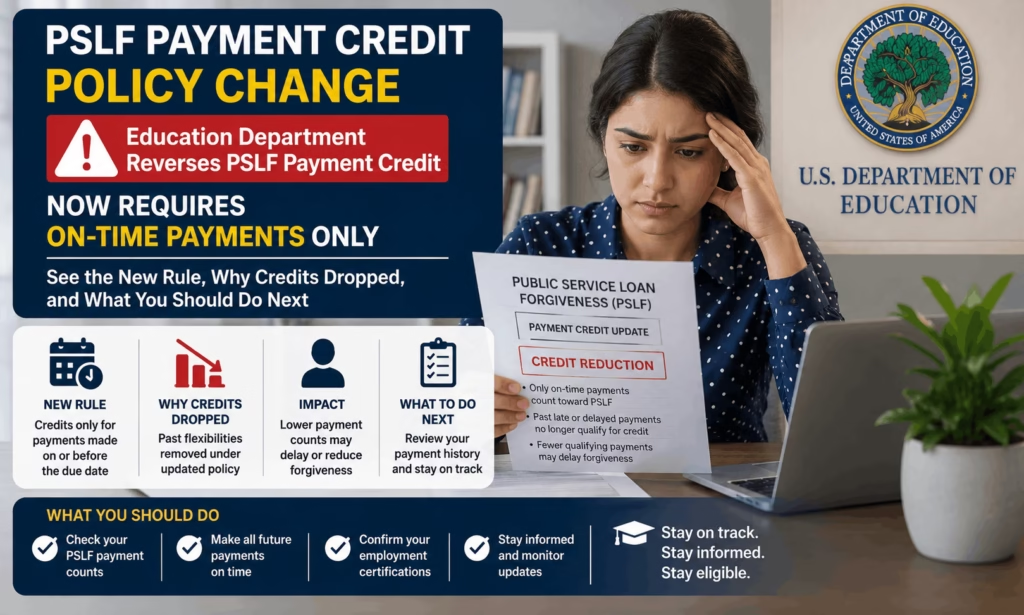
PSLF Payment Reversal: Public service workers across the country are watching their student loan forgiveness progress vanish overnight, after the Department of Education confirmed it is actively reversing previously earned Public Service Loan Forgiveness credit for an undisclosed number of borrowers. The department says the rollback is meant to correct data errors inherited from the prior administration, but the reversals are landing alongside a separate and newly tightened rule: going forward, only payments made on time will count toward the 120 payments required to erase a borrower’s remaining federal student debt, a stricter standard than the grace-period flexibility PSLF has allowed for years. We’ll be updating this article monthly, so check back here for the latest confirmed details as affected borrowers, advocacy groups, and the department continue sorting out the scope of this rollback.
For a public school teacher in Ohio or an ICU nurse in Texas who has spent years tracking their qualifying payment count, discovering that number has suddenly dropped, sometimes by dozens of payments, is not a minor technical inconvenience. It can mean the difference between forgiveness arriving next year or being pushed out by several additional years of payments on a loan balance many borrowers assumed was close to being erased for good. Understanding exactly what changed, why the Department of Education’s student loan forgiveness reversal is happening now, and what the new on-time payment requirement actually means for anyone currently working toward PSLF has become urgent, practical information for the more than one million Americans who have used this program to escape federal student debt.
What Is Actually Happening With PSLF Right Now?
Beginning in mid-August 2026, borrowers across online forums and social media began reporting that their qualifying PSLF payment counts had suddenly and unexpectedly dropped, in some cases erasing what appeared to be legitimately earned credit toward the 120 payments required for forgiveness. The Department of Education subsequently confirmed publicly that it is reversing some PSLF credit, attributing the change to an effort to correct data errors it says originated during the Biden administration’s handling of the program.
Critically, the department has not disclosed how many borrowers are affected, nor has it clarified whether borrowers who lost what they believe to be legitimately earned credit will have that credit restored. This lack of clarity is precisely what has alarmed borrower advocacy organizations, who argue that at least some of the reversed payments were earned entirely within the normal rules of the program, by borrowers who were on Direct federal loans, enrolled in an income-driven repayment plan, and working full-time in a qualifying public service job, exactly the combination of factors PSLF has always required.
Key Facts and Latest PSLF Reversal Highlights
| Detail | Information |
|---|---|
| Program affected | Public Service Loan Forgiveness (PSLF) |
| Administered by | U.S. Department of Education, Federal Student Aid |
| Reversal publicly confirmed | Mid-to-late August 2026 |
| Department’s stated reason | Correcting data errors from prior administration handling |
| Number of borrowers affected | Not disclosed by the department |
| Whether reversed credit will be restored | Not yet confirmed |
| New requirement for future qualifying payments | Payments must be made on time to count |
| Overhaul that triggered broader turbulence | Took effect July 1, 2026 |
| PSLF payments required for forgiveness | 120 qualifying monthly payments (approximately 10 years) |
| Borrowers forgiven under PSLF as of January 2026 | Over 1.2 million |
| Total forgiveness issued as of January 2026 | $90.6 billion |
| Average forgiveness amount per borrower | Nearly $75,000 |
| Related employer eligibility rule | Final rule published October 31, 2025, effective July 1, 2026 |
| Status of that employer eligibility rule | Vacated by federal courts on June 30, 2026 |
The New On-Time Payment Requirement, Explained
Separate from the credit reversals themselves, the Department of Education has instituted a new rule specifically tightening what counts as a qualifying payment going forward. Under this newly confirmed requirement, a payment must be made on time to count toward a borrower’s 120 qualifying payments, a meaningfully stricter standard than the flexibility PSLF has generally extended in the past, where certain late payments and grace-period timing had, in various circumstances over the years, still been counted toward a borrower’s total.
This shift toward requiring strict, on-time payment compliance represents a departure from the more forgiving administrative posture that characterized PSLF in recent years, including a notable 2021 limited waiver period during the COVID-19 national emergency, when the department announced that any prior payment made would count as qualifying, regardless of loan type, repayment plan, or whether that specific payment was made in full or on time, as long as the borrower had qualifying employment. That waiver-era flexibility no longer applies under the current, tightened standard, meaning borrowers currently working toward their 120 payments need to pay considerably closer attention to payment timing than they may have needed to in the recent past.
$1,636 ODSP and Canada Disability Benefit Now Stack Fully in Ontario, No Clawback on Either Payment
$4427 EITC Payment: How to Know If You Qualify and When Will You Get It?
Why This Is Happening: The Broader 2026 Overhaul?
This reversal did not emerge in isolation. It sits within a much larger restructuring of federal student loan programs that began with President Trump’s Executive Order 14235, signed March 7, 2025, directing the Department of Education to revise which employers qualify for PSLF. That directive was followed by the One Big Beautiful Bill Act, signed July 4, 2025, which created a new repayment plan called RAP and began phasing out most existing income-driven repayment plans that borrowers had previously relied on to make their PSLF-qualifying payments.
The Department of Education subsequently published a final rule on October 31, 2025, amending the definition of a qualifying PSLF employer to exclude organizations found to have what the rule calls a substantial illegal purpose, specifically citing examples like supporting terrorism or aiding and abetting illegal immigration, and granting Education Secretary Linda McMahon broad discretionary authority to disqualify employers under that standard. That specific employer-eligibility rule, originally set to take effect July 1, 2026, was ultimately vacated by federal courts on June 30, 2026, just one day before it would have applied to any borrower, following a lawsuit from a coalition of nonprofits and government entities who argued the rule was being used to weaponize PSLF against organizations whose activities conflicted with the administration’s broader policy agenda.
Even with that specific employer rule struck down before taking effect, the surrounding overhaul that took effect July 1, 2026 has continued to generate what borrowers and reporting have described as widespread turbulence across federal student loan programs, including incorrect monthly payment calculations, erroneous past-due notices, application backlogs, and now, the payment credit reversals at the center of this article.
Who Is Being Affected by the Credit Reversals?
Borrower reports gathered from forums like Reddit, along with reporting that has reached advocacy organizations directly, describe a consistent pattern among affected borrowers: individuals who were making payments on Direct federal student loans, enrolled in a qualifying income-driven repayment plan, and working in qualifying public service employment, precisely the combination PSLF has always required for a payment to count, are nonetheless finding a chunk of their previously credited payments simply gone from their official count.
Teachers, nurses, and servicemembers have been specifically named among those affected in reporting on this issue, reflecting PSLF’s broad reach across the public service, nonprofit, and government sectors the program was originally designed to support when it was established under President George W. Bush in 2007. Borrower advocacy group Protect Borrowers has warned that this unprecedented reversal may require affected teachers, nurses, servicemembers, and other public service workers to make years of additional student loan payments before obtaining the debt relief they had been promised, and cautioned that in some cases it might even result in previously forgiven loans being reinstated, a possibility the department has not ruled out or clarified.
What Advocacy Groups and Experts Are Saying?
The response from borrower advocacy organizations has been sharply critical. Julia Barnard, former student loan ombudsman for the Consumer Financial Protection Bureau and now affiliated with the Debt Collective, described the situation bluntly, saying that playing games with people’s payment counts is profoundly cruel. Randi Weingarten, president of the American Federation of Teachers, characterized the loss of forgiveness credit as more than a technical issue for the borrowers experiencing it, and indicated the union is prepared to pursue legal action if the department does not take steps to ensure affected public service workers are made whole.
The scale of what is at stake in this dispute is significant given how much PSLF has already delivered. By January 2026, more than 1.2 million borrowers had received a combined $90.6 billion in forgiveness through the program, with the average relief per borrower reaching nearly $75,000, according to Brookings Institution analysis. That expansion followed years of earlier program failures caused by loan servicer errors and administrative mismanagement, meaning this current reversal controversy arrives on top of a program that borrowers and advocates already view as having a troubled history of tracking payments accurately.
How to Check If Your PSLF Credit Was Affected?
For any borrower currently working toward PSLF forgiveness, checking your own qualifying payment count directly has become an essential, immediate step given this ongoing situation. Borrowers can log into their account through the Federal Student Aid website and review their PSLF Help Tool or loan servicer dashboard to see their current qualifying payment count, comparing that figure against their own records or prior statements to determine whether a reduction has occurred.
Because the Department of Education has not disclosed the specific criteria used to identify which payments were reversed, borrowers who notice a drop in their count are generally advised to document the discrepancy thoroughly, including screenshots of prior payment counts if available, before reaching out to their loan servicer or the Federal Student Aid ombudsman group to formally dispute the change. Given that advocacy organizations and at least one major union have signaled they may pursue legal action over this issue, borrowers experiencing an unexplained credit reversal may also want to document their situation for potential inclusion in any future legal challenge or class action that emerges from this controversy.
PSLF Processing Time: What to Expect Right Now?
Given the currently unsettled state of PSLF administration, borrowers should expect processing and response times related to this specific issue to be considerably less predictable than the program’s standard, already lengthy timelines. Under normal circumstances, PSLF forgiveness itself is only reached after 120 qualifying monthly payments, roughly ten years of consistent, qualifying payments while working in public service, and even routine PSLF Help Tool certifications and payment count updates have historically taken weeks to reflect accurately in a borrower’s account.
Given the reported application backlogs, incorrect payment calculations, and erroneous notices that have accompanied the broader 2026 overhaul, borrowers attempting to dispute a specific payment reversal should anticipate that resolution may take considerably longer than routine servicing inquiries have in the past, particularly since the department itself has not yet publicly clarified the scope or review process for these reversals, leaving loan servicers with limited guidance to offer borrowers who call in with questions about their own specific case.
What This Means for Your Forgiveness Payment Schedule?
For borrowers who have not yet reached the full 120 qualifying payments, the combination of a payment count reversal and the newly enforced on-time payment requirement can meaningfully push back an already-planned forgiveness date. A borrower who believed they were, for example, eighteen months from reaching 120 qualifying payments before a reversal wiped out a portion of their credited history may now be facing a considerably longer remaining timeline, on top of needing to ensure every future payment going forward is made strictly on time to actually count under the newly tightened standard.
For borrowers who had already reached 120 qualifying payments and received forgiveness, the specific concern raised by Protect Borrowers, that reversals might in some cases even result in reinstated loans previously believed to be forgiven, remains an unconfirmed but serious possibility that has not been ruled out by the department, and any borrower in this situation who notices unexpected activity on a loan they believed was already forgiven should contact their servicer and document the situation immediately.
Trump Halts 50 Percent Tariffs Canada: What the Last Minute Deal With Ottawa Means
Green Card Rule Changes: New Public Charge Test to Assess Age, Health, Family Status and Finances
Steps Borrowers Should Take While This Situation Develops
Given how unsettled this situation remains, borrowers currently pursuing PSLF are generally advised to take several concrete, protective steps rather than waiting passively for the department to clarify the scope of these reversals. Regularly checking and saving documentation of your qualifying payment count, ideally on a monthly basis going forward, creates a personal record independent of whatever the department’s system shows at any given moment, which could prove valuable if a future dispute or correction process requires evidence of your prior standing.
Ensuring every payment is submitted on time going forward, rather than relying on any grace period flexibility that may have applied under prior rules, is now essential under the newly tightened requirement, since a late payment that might once have still counted toward your total may no longer qualify under the current standard. Borrowers who are members of a union or professional association connected to their public service employer, such as the American Federation of Teachers for educators, may also want to stay in contact with that organization specifically, given the stated willingness of at least one major union to pursue legal action over this issue on behalf of affected members.
Official Resources and Links
| Resource | Purpose | Link |
|---|---|---|
| Federal Student Aid, PSLF program overview | Official program rules and current requirements | https://studentaid.gov/pslf/ |
| PSLF Help Tool | Check your qualifying employment and payment count | https://studentaid.gov/pslf/ |
| Federal Student Aid, PSLF Certification and Application | Certify employment and payments toward PSLF | https://studentaid.gov/manage-loans/forgiveness-cancellation/public-service |
| Department of Education press release on PSLF final rule | Official announcement of the employer eligibility rule | https://www.ed.gov/about/news/press-release/us-department-of-education-announces-final-rule-public-service-loan-forgiveness-protect-american-taxpayers |
| Federal Student Aid ombudsman group | Dispute an incorrect payment count or servicer error | https://studentaid.gov/feedback-ombudsman/disputes/prepare |
| Protect Borrowers | Advocacy resources and updates on PSLF reversals | https://protectborrowers.org |
FAQs
What is the PSLF payment reversal that’s happening right now?
The Department of Education has confirmed it is reversing some previously earned Public Service Loan Forgiveness credit for an undisclosed number of borrowers, attributing the change to correcting data errors from the prior administration, though the exact scope and whether affected credit will be restored remains unclear.
What is the new requirement to get PSLF forgiveness now?
Going forward, payments must be made on time to count toward the 120 qualifying payments required for PSLF forgiveness, a stricter standard than some of the payment flexibility the program has allowed in the past.
Will I get my reversed PSLF payments back?
The Department of Education has not confirmed whether borrowers who lost legitimately earned credit will have it restored, and advocacy groups, including the American Federation of Teachers, have indicated they may pursue legal action if the department does not address the issue.
How do I check if my PSLF payment count was reduced?
You can log into your Federal Student Aid account and review your PSLF Help Tool or servicer dashboard to see your current qualifying payment count, comparing it against your own prior records or statements to identify any unexpected drop.
How many people have received PSLF forgiveness so far?
As of January 2026, more than 1.2 million borrowers had received a combined $90.6 billion in forgiveness through PSLF, with an average relief of nearly $75,000 per borrower.
Can PSLF forgiveness be reversed after it’s already been granted?
Advocacy group Protect Borrowers has warned this reversal controversy could, in some cases, even result in previously forgiven loans being reinstated, though the Department of Education has not confirmed or clarified this specific possibility.
People Also Ask
What is Public Service Loan Forgiveness? PSLF is a federal program, established in 2007, that forgives the remaining balance on Direct federal student loans for borrowers who make 120 qualifying monthly payments while working full-time for a qualifying public service employer, such as a government agency or eligible nonprofit organization.
Why did my PSLF qualifying payment count drop? The Department of Education has stated it is correcting data errors from prior administration handling of the program, though borrowers and advocacy groups argue that at least some of the reversed payments were legitimately earned under the program’s normal rules.
What is RAP and how does it affect PSLF? RAP is a new federal student loan repayment plan created by the One Big Beautiful Bill Act, signed July 4, 2025, which began phasing out most existing income-driven repayment plans that borrowers had previously used to make PSLF-qualifying payments.
Was the new PSLF employer eligibility rule blocked? Yes, the specific rule allowing the Department of Education to disqualify employers found to have a substantial illegal purpose, originally set to take effect July 1, 2026, was vacated by federal courts on June 30, 2026, before it applied to any borrower.
Do late payments count toward PSLF forgiveness? Under the newly tightened requirement, payments must be made on time to count toward your 120 qualifying payments, a stricter standard than certain past flexibility the program has extended, including during a 2021 limited waiver period tied to the COVID-19 national emergency.
Conclusion
The Department of Education’s decision to reverse previously earned PSLF credit, combined with a newly enforced requirement that only on-time payments count going forward, has introduced real uncertainty into a program more than 1.2 million borrowers have already relied on for nearly $91 billion in forgiveness. With the department still declining to disclose how many borrowers are affected or whether reversed credit will ultimately be restored, and with advocacy organizations openly discussing potential legal action, borrowers currently working toward their 120 qualifying payments should check their payment count regularly, document any unexpected changes, and ensure every future payment is made strictly on time under the new standard. As this situation continues developing and as the department, courts, or Congress potentially provide further clarity, this article will be updated every month with the latest confirmed details.
$1750 Minnesota Child Tax Credit: No Limit on Children, Eligibility & How to Claim It
$1250 New Jersey Child Tax Credit: State Budget Delivers 25% Boost for Families With Young Children