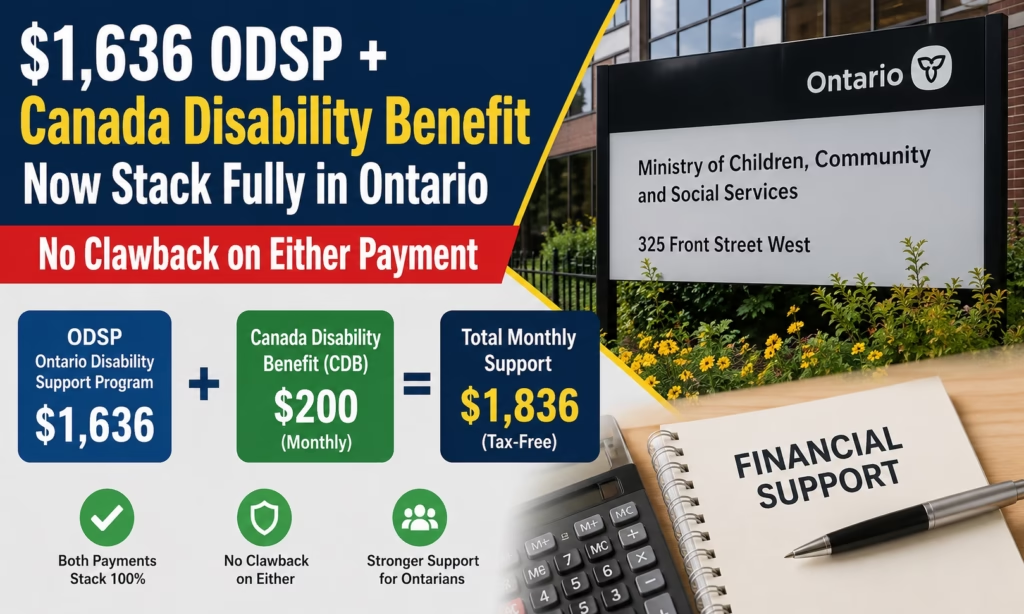
$1,636 ODSP and Canada Disability Benefit: Ontario residents living with disabilities are now able to collect both the provincial Ontario Disability Support Program payment and the federal Canada Disability Benefit at the same time, with no reduction to either amount, pushing combined monthly support for a single recipient toward the highest level this ODSP and Canada Disability Benefit stacking arrangement has ever reached. The Ontario government confirmed it will treat the Canada Disability Benefit as fully exempt income for ODSP purposes, meaning the federal payment is added directly on top of the provincial one rather than triggering a dollar-for-dollar reduction the way other forms of income often do. We’ll be updating this article monthly, so check back for the latest combined payment figures and any changes to either program’s rates.
For years, disability advocates in Ontario warned that a new federal benefit meant to fight poverty could be quietly undone at the provincial level if Ontario chose to treat it as countable income and simply reduce ODSP payments by the same amount. That did not happen. Ontario’s Ministry of Children, Community and Social Services formally announced it would exempt the Canada Disability Benefit from ODSP income calculations, a decision that means a single ODSP recipient receiving the maximum provincial rate can now add the full federal amount on top without losing a cent of their existing support, bringing the combined monthly total for many households close to the $1,636 to $1,640 range once both programs’ current rates are applied together.
What ODSP and Canada Disability Benefit Stacking Actually Means
Stacking, in benefits terminology, refers to a situation where a person can collect two or more income support programs simultaneously without one program clawing back or reducing the amount paid by the other. Ordinarily, provincial social assistance programs like ODSP treat most other income, including many federal benefits, as countable income that reduces the monthly ODSP payment dollar for dollar or through a set formula.
Ontario made a deliberate policy choice to exempt the Canada Disability Benefit from that calculation entirely. That means the CDB does not count as income for ODSP, Ontario Works, or the Assistance for Children with Severe Disabilities program, so recipients keep their full ODSP entitlement and their full CDB payment side by side, rather than seeing their provincial cheque shrink to offset the new federal money.
Key Facts and Combined Payment Highlights
| Detail | Information |
|---|---|
| Program 1 | Ontario Disability Support Program (ODSP) |
| Program 2 | Canada Disability Benefit (CDB) |
| Ontario’s clawback policy | CDB fully exempt as income for ODSP, Ontario Works, and ACSD |
| Maximum CDB payment | Up to $200 per month, or $2,400 per year |
| Current ODSP maximum for a single recipient (July 2026) | Approximately $1,436 per month |
| Approximate combined monthly maximum | Around $1,636 to $1,640 per month |
| CDB funding announced | $6.1 billion in the 2024 federal budget |
| CDB payments began | July 2025 |
| Age requirement for CDB | 18 to 64 years old |
| Core CDB eligibility requirement | Approved Disability Tax Credit (DTC) certificate |
| ODSP earnings exemption before clawback applies | First $1,000 per month of net employment income |
| Ontario announcement date on exemption | May 27, 2025 |
Why Ontario Chose Not to Claw Back the Federal Benefit
When the Canada Disability Benefit was first legislated in 2023, disability advocacy groups across the country immediately raised concerns that provinces and territories could simply treat the new federal payment as income and reduce their own provincial assistance by an equivalent amount, effectively cancelling out the benefit’s intended impact. That fear was not hypothetical. Provincial governments have broad discretion over how they define countable income for their own social assistance programs, and at least one province has said it would claw back the CDB under certain circumstances.
Ontario took the opposite approach. The Ministry of Children, Community and Social Services announced ahead of the CDB’s first payments in July 2025 that it would formally exempt the federal benefit from income calculations across its major social assistance programs. Provincial officials framed the decision as protecting the province’s most vulnerable residents during a period of broader economic uncertainty, while disability advocacy organizations, including the ODSP Action Coalition and Disability Without Poverty, publicly welcomed the move as a critical win, even while continuing to argue that the federal benefit’s maximum amount remains too low on its own to lift most recipients out of poverty.
How Much You Can Actually Receive When Stacking Both Benefits
The combined value of stacking ODSP and the Canada Disability Benefit depends on which ODSP rate a person qualifies for, since the provincial program pays different amounts depending on household composition, disability-related costs, and other individual circumstances. For a single recipient receiving the maximum standard ODSP rate, which reached approximately $1,436 per month following the July 2026 inflation adjustment, adding the maximum CDB amount of $200 per month brings total combined monthly support to roughly $1,636. Some benefit calculators and advocacy trackers cite a slightly higher combined figure closer to $1,640 once specific regional or household adjustments are factored in, underscoring that the exact number can shift slightly based on an individual’s full ODSP entitlement before the CDB is even added.
It is worth understanding how ODSP itself is structured, since the maximum rate is not a single flat number. ODSP payments are generally built from two components, a basic needs amount and a shelter allowance, both of which can vary based on family size and actual housing costs up to a maximum shelter allowance. The July 2026 rate adjustment reflected a modest 1.9% increase, continuing a series of annual inflation-linked increases that began after the province raised ODSP rates by 5% in September 2022 and committed to tying future increases to inflation going forward.
$4427 EITC Payment: How to Know If You Qualify and When Will You Get It?
Employment Insurance (EI) 2026 Rule Changes: What Every Canadian Worker Needs to Know
Empire State Child Credit 2026: $1,000 Per Child Under 4, Full Eligibility & Payment Guide
Who Qualifies for the Canada Disability Benefit
Qualifying for ODSP does not automatically make someone eligible for the Canada Disability Benefit, since the two programs use different eligibility tests. To receive the CDB, an applicant must be between 18 and 64 years of age, must hold an approved Disability Tax Credit certificate from the Canada Revenue Agency, must be a resident of Canada for tax purposes, and must have filed the required tax return used to calculate the federal benefit amount.
The Disability Tax Credit requirement is the most important gatekeeping factor for many ODSP recipients who assume their existing provincial disability status is sufficient on its own. It is not. Someone already receiving ODSP still needs to separately apply for and receive DTC approval through Form T2201, certified by a qualified medical practitioner, before they can access the Canada Disability Benefit, even though many ODSP recipients do already qualify medically for the DTC given the overlapping nature of the underlying disability criteria.
How to Apply for Both Benefits
Applying for ODSP and the Canada Disability Benefit involves two entirely separate application processes handled by different levels of government, and stacking only becomes possible once both applications are approved individually.
For ODSP, applicants generally start by contacting their local ODSP office to begin an application, which involves an initial financial eligibility screening followed by a disability adjudication process to confirm the applicant meets the program’s definition of disability. The full process, from initial contact to a final decision, can take a significant amount of time, with many applicants experiencing waits stretching to around ninety days or longer depending on case complexity and whether additional medical documentation is required.
For the Canada Disability Benefit, applicants first need an approved Disability Tax Credit certificate on file with the Canada Revenue Agency. Once DTC approval is confirmed, applicants apply directly through the federal Canada Disability Benefit application channel, which for many applicants involves an application code sent by Service Canada. Because the CDB calculation also relies on the applicant’s filed tax return, keeping tax filings current is essential to avoid delays or incorrect payment calculations.
What Counts as Income and What Does Not
Understanding the broader ODSP income rules helps explain why the Canada Disability Benefit exemption is such a significant policy decision. Under standard ODSP rules, most forms of income, including many other government benefits and employment earnings above a certain threshold, are counted against a recipient’s monthly entitlement.
For employment income specifically, ODSP allows the first $1,000 per month of net earnings to be fully exempt with no reduction to the ODSP payment at all. Above that $1,000 threshold, a 75% deduction rate applies to the remaining earnings, meaning a recipient keeps 25 cents of every additional dollar earned beyond the exemption, while ODSP also provides a separate $100 monthly Work-Related Benefit on top of regular payments for those who are employed. This is notably more generous than the Ontario Works earnings exemption, which sits at just $200 per month with a 50% deduction rate above that threshold. The Canada Disability Benefit’s full exemption from this entire calculation means it sits completely outside these earnings and income rules, unlike a paycheque or many other benefit types that do interact with the ODSP formula.
Provinces That Handle the Canada Disability Benefit Differently
Ontario’s decision to fully exempt the CDB is not universal across Canada. As the federal benefit rolled out, most provinces and territories, at least seven according to tracking done shortly before payments began, made similar commitments not to claw back the benefit from their own provincial disability assistance programs. At least one province, however, indicated it would apply a clawback under certain circumstances, meaning a recipient’s actual combined benefit total can vary meaningfully depending on which province or territory they live in, even though the federal CDB amount itself is calculated the same way nationally. Anyone who splits time between provinces or is considering a move should confirm the current provincial treatment of the CDB before assuming stacking rules will be identical elsewhere.
Why Advocates Say the Combined Amount Still Falls Short
Even with full stacking and no clawback, disability advocacy groups continue to argue that the combined ODSP and Canada Disability Benefit total remains below what is generally considered a livable income in most parts of Ontario, particularly in higher-cost regions like the Greater Toronto Area. Advocates have repeatedly pointed out that the CDB’s maximum monthly amount of $200 is modest relative to the scale of poverty many recipients face, and organizations such as the ODSP Action Coalition have continued to call for increases to both the federal and provincial amounts even while welcoming the no-clawback policy as an important protective measure.
Economists and policy researchers who have studied ODSP rates over time have also noted that, even after several years of inflation-linked increases, the provincial rate remains well below various commonly cited living wage benchmarks for Ontario, meaning that stacking the two programs closes only part of the gap between actual disability-related living costs and available government support.
Official Resources and Links
| Resource | Purpose | Link |
|---|---|---|
| Ontario ODSP overview and application | Start or manage an ODSP application | https://www.ontario.ca/page/ontario-disability-support-program |
| Canada Disability Benefit official page | Eligibility rules and application process | https://www.canada.ca/en/services/benefits/disability/canada-disability-benefit.html |
| Disability Tax Credit information | Apply for the DTC required for CDB eligibility | https://www.canada.ca/en/revenue-agency/services/tax/individuals/segments/tax-credits-deductions-persons-disabilities/disability-tax-credit.html |
| My Service Canada Account login | Track your CDB application status | https://www.canada.ca/en/employment-social-development/services/my-account.html |
| MyBenefits ODSP portal | Manage your existing ODSP file online | https://www.mybenefits.mcss.gov.on.ca |
| Ontario ODSP earnings and income rules | Full details on exempt income and clawback formulas | https://www.ontario.ca/page/get-help-through-ontario-works |
Oregon Kicker Tax Credit 2026: How To Claim Your Share Of The $1.41 Billion Surplus
California Climate Credit 2026: Payment Timing Just Changed, Here Is What to Expect on Your Bill
$145.83 BC Family Benefit First Child Payment Confirmed as Income Phase-Out Shifts to $96,562
Trump Halts 50 Percent Tariffs Canada: What the Last Minute Deal With Ottawa Means
Green Card Rule Changes: New Public Charge Test to Assess Age, Health, Family Status and Finances
FAQs
Can I receive both ODSP and the Canada Disability Benefit at the same time?
Yes. Ontario has confirmed that the Canada Disability Benefit is fully exempt from ODSP income calculations, so eligible residents can receive their full ODSP payment and their full CDB payment together without either one reducing the other.
How much is the combined ODSP and Canada Disability Benefit payment?
For a single recipient at the maximum ODSP rate combined with the maximum CDB amount, total monthly support is approximately $1,636 to $1,640, though the exact figure depends on the individual’s specific ODSP entitlement before the CDB is added.
Do I need the Disability Tax Credit to get the Canada Disability Benefit if I already have ODSP?
Yes. ODSP eligibility does not automatically qualify someone for the Canada Disability Benefit. An approved Disability Tax Credit certificate is a separate, required step for federal eligibility, regardless of provincial disability status.
Will the Canada Disability Benefit reduce my ODSP payment?
No. Ontario has formally exempted the CDB as income for ODSP, Ontario Works, and the Assistance for Children with Severe Disabilities program, so it does not trigger any reduction to those provincial payments.
How do I apply for the Canada Disability Benefit in Ontario?
Applicants need an approved Disability Tax Credit certificate first, followed by a completed and up-to-date tax filing, and then apply directly through the federal government’s Canada Disability Benefit application process, often using an application code sent by Service Canada.
Is the Canada Disability Benefit taxable income?
The Canada Disability Benefit is designed as a non-taxable benefit at the federal level, and Ontario’s decision to exempt it from provincial income calculations means it also does not reduce ODSP eligibility or payment amounts.
People Also Ask
What is the maximum amount for ODSP in Ontario? The maximum monthly ODSP amount for a single recipient reached approximately $1,436 following the July 2026 inflation adjustment, with the exact figure varying based on household size, shelter costs, and other individual circumstances.
How much money can you make on ODSP before it affects your payment? ODSP recipients can earn up to $1,000 per month in net employment income with no reduction to their payment, and earnings above that threshold are subject to a 75% deduction rate on the additional income.
Who is eligible for the Canada Disability Benefit? Eligibility generally requires being between 18 and 64 years old, holding an approved Disability Tax Credit certificate, being a Canadian resident for tax purposes, and having filed the tax return needed to calculate the benefit amount.
Does every province allow ODSP-style stacking with the Canada Disability Benefit? No. While most provinces and territories committed to exempting the CDB from their own social assistance calculations, treatment varies by jurisdiction, and at least one province has indicated it will apply some form of clawback under certain conditions.
Why is the Canada Disability Benefit only $200 a month? The federal government set the maximum CDB amount at $200 per month, or $2,400 annually, as an initial benefit level following its 2024 budget commitment of $6.1 billion in funding, though disability advocacy groups have continued to call for the amount to be increased in future budgets.
Conclusion
Ontario’s decision to fully exempt the Canada Disability Benefit from ODSP income calculations means eligible residents no longer have to choose between the two programs or watch one payment shrink to offset the other, a protection that advocates spent years pushing for before the federal benefit’s rollout. With combined monthly support now approaching the $1,640 range for many single recipients receiving both maximum amounts, the practical next step for ODSP recipients who have not yet applied is confirming their Disability Tax Credit status, since that approval remains the essential gateway to accessing the federal benefit on top of existing provincial support. As both programs continue to see periodic rate adjustments and as other provinces refine their own clawback policies, this article will be updated monthly with the latest combined payment figures and eligibility details.