USCIS Adjustment of Status Only in Extraordinary Circumstances: U.S. Citizenship and Immigration Services dropped a policy bombshell on the green card community this year, announcing that it will now grant Adjustment of Status inside the United States only in what it calls “extraordinary circumstances.” The announcement, made through Policy Memorandum PM-602-0199 on May 22, 2026, immediately triggered confusion among hundreds of thousands of pending applicants, since USCIS Spokesman Zach Kahler told reporters that “an alien who is in the U.S. temporarily and wants a Green Card must return to their home country to apply, except in extraordinary circumstances.” For applicants who had built their entire immigration strategy around filing Form I-485 from inside the country, that single sentence upended months, sometimes years, of planning almost overnight.
Months later, the picture has become somewhat clearer, though far from settled. The Department of Homeland Security walked back some of the sweeping language within a week, telling The New York Times the policy would be applied case by case rather than as a blanket rule. Yet the underlying memorandum itself has never been rescinded, no federal court has issued an injunction against it specifically, and immigration attorneys nationwide report real, measurable changes in how USCIS officers are questioning applicants at adjustment interviews. This is not a story that ended in May, it is an ongoing policy shift that every pending or prospective Adjustment of Status applicant needs to track closely. We’ll be updating this article monthly as USCIS, DHS, and the federal courts release further guidance on PM-602-0199.
Latest Update: Key Facts About the Extraordinary Circumstances Policy
Before getting into what this means for specific applicant categories, here is the essential timeline and data every green card applicant should understand.
| Detail | Information |
|---|---|
| Policy memorandum number | PM-602-0199 |
| Memo dated | May 21, 2026 |
| Publicly announced | May 22, 2026 |
| Full memo title | “Adjustment of Status is a Matter of Discretion and Administrative Grace, and an Extraordinary Relief that Permits Applicants to Dispense with the Ordinary Consular Visa Process” |
| Issuing agency | USCIS, under the Department of Homeland Security |
| Governing law | INA Section 245 / 8 U.S.C. § 1255, 8 CFR Part 245 |
| DHS clarification issued | May 29, 2026 — described as “case-by-case,” not blanket |
| AILA practice pointer released | May 27, 2026 (Doc. No. 26052602) |
| Court injunction status (as of this update) | No injunction has been issued against PM-602-0199 specifically |
| Applies to | Pending and new Form I-485 filings, applied immediately and retroactively |
| Best-positioned categories | Dual-intent visa holders (H-1B, L-1) |
| More vulnerable categories | Single-intent visa holders (F-1, B-1/B-2) |
What USCIS Actually Announced About Adjustment of Status?
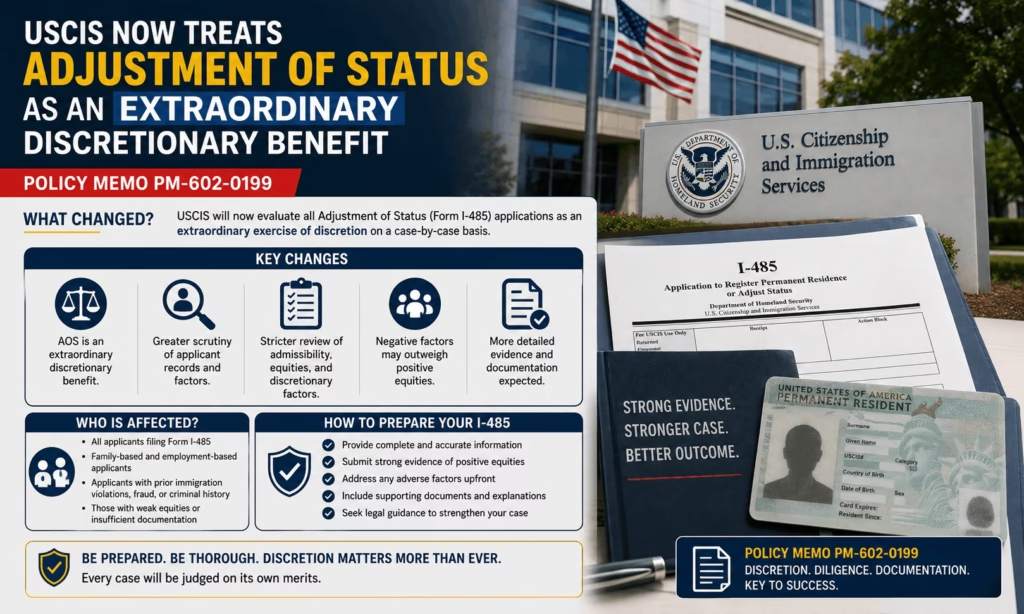
The memo’s core claim is that Adjustment of Status, long treated by applicants and attorneys as a routine administrative pathway to a green card for people already eligible under the law, is instead “a matter of discretion and administrative grace” — an extraordinary form of relief, not a right. USCIS argues this interpretation reflects longstanding immigration law and court precedent rather than a new rule, framing the memo as a return to the “original intent of the law” rather than a policy change.
In practice, the memo tells USCIS officers to treat consular processing abroad, through the Department of State, as the expected default path to a green card. Filing Form I-485 to adjust status from within the United States is now framed as the exception that an applicant must affirmatively justify, not the standard route it has functioned as for decades.
SSA Ticket to Work Program: How Disability Beneficiaries Can Return to Work Without Losing Benefits
SSA Strategic Plan FY2026-2030: New Goals, Wait Times & Service Targets
Does the Memo Actually Define “Extraordinary Circumstances”?
This is the single most important, and most frequently misunderstood, detail in the entire policy. The memo does not provide a standalone definition, checklist, or list of examples of what qualifies as an extraordinary circumstance. Instead of a defined test, USCIS directs officers to weigh the “totality of the circumstances” on a case-by-case basis, considering both positive and negative discretionary factors before deciding whether an applicant deserves what the memo calls this “extraordinary” grant of administrative grace.
That open-ended standard is exactly what has generated so much anxiety in the immigration community. Without a fixed definition, adjudications can vary meaningfully between individual officers and even between different USCIS field offices, leaving applicants unable to predict with confidence how their own case will be evaluated.
Has the Policy Actually Changed the Law?
No. This distinction matters enormously and is one that multiple immigration law firms have emphasized since May. Form I-485 remains legally available under INA Section 245, and the statutory eligibility requirements for Adjustment of Status have not been amended by Congress or through formal rulemaking. What has changed is the discretionary standard USCIS officers are instructed to apply once an applicant clears the eligibility bar.
Historically, an applicant who met every statutory requirement for Adjustment of Status and had no significant negative factors on their record could reasonably expect approval. Under PM-602-0199, meeting eligibility requirements alone is treated as insufficient. Officers are now instructed to require what the memo describes, citing precedent from Matter of Blas, as a showing of “unusual or even outstanding equities” to offset any adverse factors, and the memo notes that simply having no negative factors, by itself, does not automatically demonstrate that a favorable exercise of discretion is warranted.
DHS Walks Back the Sweeping Framing — But the Memo Still Stands
Just one week after the initial announcement, the story took an important turn. On May 29, 2026, a Department of Homeland Security spokesperson told The New York Times that the policy is not a blanket change, and that individual immigration officers would decide on a case-by-case basis whether a particular applicant needs to leave the country to obtain permanent residence. A senior White House official went further, describing the guidance to reporters as “a housekeeping measure rather than a major policy shift.”
A separate DHS spokesperson clarification indicated the agency’s practical enforcement focus is aimed primarily at “people who overstay visas or come from countries whose citizens are heavy users of public assistance,” a narrower target than the initial press release suggested.
It is critical for applicants to understand what these statements are, and are not. They are spokesperson comments reported by journalists — not a new policy memorandum, not a formal regulation, and not a rescission of PM-602-0199. The memorandum remains the official, operative policy document that USCIS officers are working from, and as of this writing, the agency has not published binding implementing guidance that codifies the “case-by-case” framing DHS described to reporters. In short: the headline softened considerably, but the underlying discretionary standard did not.
Which Adjustment of Status Applicants Are Most at Risk?
Not every green card category faces the same level of exposure under this policy shift. Immigration attorneys have generally sorted applicants into rough risk tiers based on their current visa status and immigration history.
| Applicant Category | Relative Exposure Under PM-602-0199 |
|---|---|
| H-1B and L-1 holders (dual-intent visas) | Better positioned, since dual intent is already recognized under existing law, though not immune from scrutiny |
| F-1 and B-1/B-2 holders (single-intent visas) | Higher exposure, since these categories require officers to reconcile nonimmigrant intent with an immigrant petition |
| Family-based applicants already in the U.S. | Significant concern reported among immigrant families, particularly where visa overstays or status gaps exist |
| Applicants with a clean immigration history and strong U.S. ties | Generally viewed as better positioned to demonstrate the “positive equities” the memo requires |
| Pending I-485 cases filed before May 2026 | Affected immediately, since the memo applies retroactively to cases already on file |
| EB-5 investor applicants | Facing case delays; mandamus litigation being used by some applicants whose cases have stalled |
SSI Address Change Service Enhancements: SSA’s New Fast-Track Process Explained
IRCC Tightens Citizenship by Descent: What the New 1,095-Day Presence Test Rules Mean for Applicants
Why the “Extraordinary Relief” Framing Matters for Employment-Based Green Cards
For employment-based applicants, the practical stakes extend well beyond the green card timeline itself. Many workers pursuing Adjustment of Status rely on the pending I-485 application to access an Employment Authorization Document and Advance Parole, which together allow continued work authorization and international travel while the green card case is pending. If an officer directs an applicant toward consular processing abroad instead of approving in-country adjustment, that can disrupt ongoing employment, complicate international travel plans, and in some cases create unexpected inadmissibility issues tied to a prior overstay or unlawful presence that domestic adjustment would have avoided entirely.
USCIS has stated that one goal of the policy is to reallocate agency resources toward other priorities, including visas for crime and trafficking victims and naturalization applications, framing the shift as an efficiency measure rather than a restriction targeted at any particular group.
The Legal Challenges Building Against PM-602-0199
As of this update, no federal court has issued an injunction specifically blocking PM-602-0199, and the memorandum remains in active effect. That does not mean it is legally uncontested. Immigration advocacy organizations, including the American Immigration Lawyers Association, have argued publicly that Congress deliberately built the in-country adjustment framework into law specifically to keep families together during the immigration process, and that PM-602-0199 undermines that legislative intent without going through the formal rulemaking process required for substantive policy changes.
Attorneys have identified several potential legal theories for challenging the memo, including that it lacks clear statutory authority, that it reinterprets congressional intent without a proper legal basis, that a change of this magnitude should have gone through notice-and-comment rulemaking under the Administrative Procedure Act, and that applying the new discretionary standard retroactively to cases filed before May 2026 raises fairness and due process concerns.
It’s also worth understanding the broader context. PM-602-0199 did not emerge in isolation — it followed a sequence of related 2025 and 2026 discretionary policies, including country-based adjudication holds that had already drawn successful, though narrow, legal challenges limited to specific named plaintiffs. That litigation history is part of why many attorneys believe PM-602-0199 itself sits on comparatively shaky legal ground, even though no court has yet ruled on the memo by name.
How to Apply for Adjustment of Status Under the New Standard?
For applicants who remain eligible and are proceeding with an in-country filing, the practical process has not changed procedurally, but the preparation strategy has shifted meaningfully.
- Confirm continued statutory eligibility for Adjustment of Status under your specific immigrant category before filing or continuing a pending case.
- File Form I-485, Application to Register Permanent Residence or Adjust Status, along with all required supporting evidence and fees.
- Proactively document positive discretionary factors, including strong family ties in the United States, a clean immigration and criminal history, community and employment contributions, and length of lawful residence.
- Prepare for more detailed interview questioning, since officers are now instructed to probe an applicant’s full immigration history and circumstances rather than relying primarily on documentary eligibility alone.
- Consult an immigration attorney before international travel, since departing the U.S. while a case is pending can trigger unexpected complications tied to prior status history under the current discretionary climate.
- Monitor USCIS Policy Manual updates and court rulings closely, since implementing guidance defining “extraordinary circumstances” has not yet been published and may materially change how cases are evaluated going forward.
Processing Time Under the Current Policy Climate
USCIS has not published a specific new processing time standard tied to PM-602-0199, and standard Form I-485 processing timelines continue to vary widely by service center, immigrant category, and individual case complexity. What attorneys are reporting anecdotally is not necessarily longer raw processing times in every case, but rather more intensive discretionary review at the interview stage, additional requests for evidence tied to positive equities, and increased uncertainty in outcome even for applicants who meet every statutory eligibility requirement. Applicants with pending or planned filings should expect more thorough officer questioning rather than assuming faster or slower processing purely based on the memo.
What This Means for the Adjustment of Status Fee and Payment Schedule?
The policy memorandum does not introduce any new government filing fee specific to the discretionary review process. Standard Form I-485 filing fees, along with associated biometrics and any required medical examination costs, remain governed by USCIS’s existing fee schedule. Applicants budgeting for a case under this heightened scrutiny environment should, however, factor in the realistic likelihood of additional legal consultation costs, since building a stronger discretionary record often requires more attorney involvement than a standard, previously routine adjustment filing.
Indian Student Applications to US Colleges Fall 15% Amid Visa Uncertainty: What the New Data Shows
Adjustment of Status vs. Consular Processing: A Quick Comparison
Understanding the practical difference between these two pathways helps explain exactly what is at stake under the new discretionary framework.
| Feature | Adjustment of Status (In the U.S.) | Consular Processing (Abroad) |
|---|---|---|
| Where the application is filed | USCIS, within the United States | U.S. embassy or consulate abroad, via Department of State |
| Ability to remain in the U.S. during processing | Yes, generally | No — applicant must depart and remain abroad pending visa issuance |
| Interim work authorization | Available via Employment Authorization Document | Not applicable in the same way |
| Interim travel authorization | Available via Advance Parole | Not applicable |
| Risk from prior status violations | Can sometimes be addressed without leaving the country | Departure can trigger unlawful presence bars in certain cases |
| Current USCIS framing under PM-602-0199 | Treated as “extraordinary” discretionary relief | Treated as the expected, default pathway |
Official USCIS Resources for Adjustment of Status Applicants
Always verify current forms, policy documents, and case status directly through official government channels rather than third-party summaries.
| Resource | Purpose | Official Link |
|---|---|---|
| USCIS Adjustment of Status program page | Official eligibility and process overview | uscis.gov/green-card/green-card-processes-and-procedures/adjustment-of-status |
| Form I-485 | Application to Register Permanent Residence or Adjust Status | uscis.gov/i-485 |
| Policy Memorandum PM-602-0199 (full text) | Original policy document | uscis.gov/sites/default/files/document/memos |
| USCIS Policy Manual, Volume 7 | Adjustment of status governing policy chapter | uscis.gov/policy-manual |
| Case status check | Track a pending I-485 application | uscis.gov/casestatus |
| myUSCIS online account (login) | Manage applications, upload evidence, receive notices | my.uscis.gov |
| USCIS Contact Center | General phone and online support | uscis.gov/contactcenter |
| USCIS newsroom | Official press releases and policy announcements | uscis.gov/newsroom |
FAQs
Did USCIS eliminate Adjustment of Status entirely?
No. Form I-485 remains legally available under INA Section 245, and the statutory eligibility rules for Adjustment of Status have not changed. What changed is the discretionary standard officers apply once an applicant is found eligible.
Does the extraordinary circumstances policy apply to pending I-485 cases?
Yes. Attorneys and legal analysts report that the policy applies immediately and retroactively to cases already on file with USCIS, not only to new filings submitted after May 2026.
Is there an official definition of “extraordinary circumstances” for Adjustment of Status?
No formal definition has been published. USCIS has not released a standalone checklist or list of qualifying examples, instructing officers instead to apply a broad, case-by-case totality-of-the-circumstances analysis.
Has a court blocked or paused PM-602-0199?
As of this update, no federal court has issued an injunction specifically against PM-602-0199. Related, earlier discretionary policies from late 2025 and January 2026 have drawn narrower injunctions limited to specific named plaintiffs.
Are H-1B and L-1 visa holders exempt from the new policy?
No one is fully exempt, but dual-intent visa holders such as H-1B and L-1 workers are generally viewed by immigration attorneys as better positioned than single-intent visa holders, since dual intent is already recognized under existing immigration law.
Will I have to leave the United States to get my green card now?
Not necessarily. DHS has publicly stated the policy will be applied case by case rather than as a blanket rule, though the underlying memorandum’s heightened discretionary standard remains formally in effect for all in-country adjustment applications.
Should I cancel international travel while my Adjustment of Status case is pending?
Many immigration attorneys are advising clients to reconsider non-essential international travel until more implementing guidance is published, since departure while a case is pending can trigger complications tied to prior immigration status history under the current discretionary climate.
Conclusion
The USCIS Adjustment of Status policy shift announced through PM-602-0199 represents one of the most consequential discretionary changes to the green card process in recent memory, even though the underlying statute has not moved an inch. What began as an alarming press release in May 2026, declaring that adjustment would be granted “only in extraordinary circumstances,” has since been softened by DHS spokesperson comments describing a case-by-case approach — but the memorandum itself remains the operative policy, undefined terms and all. For applicants and their attorneys, the practical lesson is clear regardless of how the political messaging evolves: eligibility alone is no longer treated as sufficient, and building a documented record of positive equities has become an essential part of every Adjustment of Status filing. With litigation building in the background and no court injunction yet in place, this is a policy environment that demands close, ongoing attention rather than a one-time read of the news.
TPS Somalia Termination: Work Permits No Longer Valid After August 14 Deadline
Meta Safety Changes on Instagram and Facebook: What Teens and Parents Need to Know Right Now
H-1B Crackdown Employer Warning Now Covers OPT, PERM and J-1 Hiring Practices
Japan Visa Renewal Fee Increase 2026: New Charges From October Explained