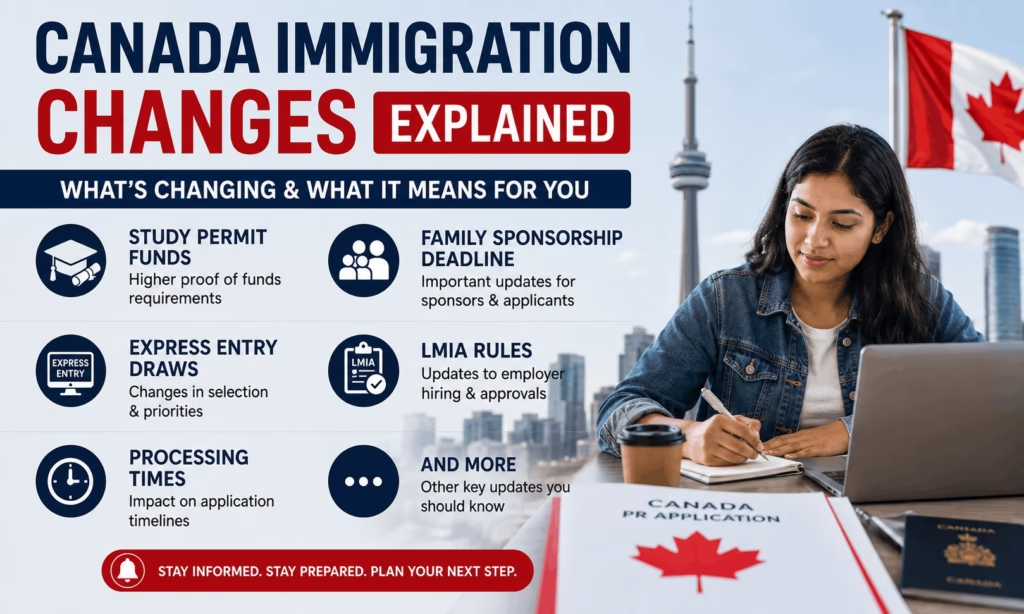
New Canada Immigration Changes And Updates: Canada’s immigration system has entered one of its busiest stretches of the year, and international students, skilled workers and families waiting to sponsor relatives all have something to track this month. From a higher study permit financial requirement to a hard deadline for undeclared family sponsorship, from shifting Express Entry cutoffs to new rules for employers hiring temporary foreign workers, September has brought a cluster of changes that will directly affect who gets into Canada, who gets to stay, and how long the wait actually is. We’ll be updating this article monthly as IRCC and other departments release further clarifications, so check back regularly if you have an application in progress.
What makes this month different is not one single announcement but the sheer number of moving parts landing at once. IRCC’s own processing time data released in the last week of August showed citizenship certificate wait times jumping from three months to twenty five months in less than half a year, while some temporary resident categories improved. A long-running public policy that has protected certain families from a lifetime sponsorship ban is set to close on September 10. Meanwhile, the government’s Express Entry system keeps favouring French-speaking and category-specific candidates over general applicants, and employers hiring through the Labour Market Impact Assessment process now face a different set of rules than they did just a few weeks ago. Here is a complete breakdown of the ten biggest Canada immigration changes and updates in September 2026.
1. Study Permit Proof of Funds Rises to $23,448 for International Students
The most talked-about change this month affects anyone applying for a Canadian study permit. Effective September 1, a single applicant must show at least 23,448 dollars in living expense funds, up from 22,895 dollars, an increase of 553 dollars driven by Statistics Canada’s Low Income Cut Off calculation, which IRCC uses to set roughly 75 percent of the required threshold. The new amount applies to every province and territory except Quebec, which assesses financial capacity separately through its own Quebec Acceptance Certificate process. A student applying with two accompanying family members must now show 35,888 dollars, up from 35,040 dollars. Applications submitted before September 1 are still assessed under the lower amount, so the exact submission date matters enormously for anyone finalising paperwork right now. This figure covers living expenses only, and applicants must separately demonstrate first-year tuition and return transportation costs on top of it.
2. Undeclared Family Member Sponsorship Policy Closes on September 10
Permanent residents who never declared a spouse, common-law partner, or dependent child on their original immigration application have only until September 10 to apply under a special consecutive public policy that exempts them from the usual lifetime sponsorship ban. This policy has already been extended twice since it was first introduced in 2019, and IRCC has given no indication that a fourth extension is coming. Applications received on or before the deadline will continue to be processed under the policy’s protections even if a final decision arrives later, so sponsors do not need a completed decision by September 10, only a submitted application. Once the window closes, the lifetime bar under sections 117(9)(d) and 125(1)(d) of the Immigration and Refugee Protection Regulations snaps back into force, meaning affected relatives could be permanently barred from family class sponsorship unless the government introduces a new exemption or amends the regulation itself.
3. IRCC Processing Times Show a Sharp, Uneven Shift
The latest processing time release, published in the final week of August and expected to update again around September 2, revealed one of the most dramatic swings this system has seen in a single reporting cycle. Citizenship certificate processing jumped to twenty five months, up from just three months in March, with the pending queue growing to roughly 121,800 applicants. At the same time, the Federal Skilled Worker Program improved to six months for the first time this year, and the Canadian Experience Class queue shrank slightly while holding steady at six months. Visitor record extensions spiked to 416 days in one weekly cycle. Study permit wait times for India rose by two weeks after two months of no movement, while work permit processing for Pakistan and the Philippines improved by roughly one week. Applicants should check the live IRCC processing time tool close to their submission date rather than relying on any single snapshot, since these figures now shift on a near-weekly basis.
4. Express Entry Draws Keep Favouring French Speakers and Category-Based Candidates
Express Entry continues to move away from broad, general draws toward narrower category-based selections. A Provincial Nominee Program round on August 31 issued 562 invitations at a Comprehensive Ranking System cutoff of 697, while a French-language category draw earlier in the month issued 5,000 invitations at a far lower cutoff of 382, making French proficiency one of the fastest routes into the pool this year. Canadian Experience Class draws have hovered in the 514 to 523 point range through most of August, occasionally spiking higher when invitation volumes shrink. Candidates sitting between 400 and 500 points are being advised to look closely at category-based draws for healthcare, trades, transport and French-language proficiency, since these consistently deliver lower cutoffs than general or Canadian Experience Class rounds. The Express Entry pool itself has been shrinking slightly week over week, dropping from roughly 229,100 to under 227,000 candidates through most of August.
TPS Terminations 2026: Complete Tracker for Somalia, Ethiopia, South Sudan, Syria, Haiti, and Yemen
USCIS Ukraine TPS EAD Extension: Work Permits Automatically Extended Through October 19, 2026
BC PNP Entrepreneur Immigration Draw Invites 16 Business Candidates in Latest Round
5. Two New LMIA Rules Reshape Hiring for Temporary Foreign Workers
Employers relying on the Temporary Foreign Worker Program now operate under two rule changes introduced in the past few weeks. From August 18, Employment and Social Development Canada changed how it calculates the low-wage workforce cap for employers with fewer than ten employees, now assessing that cap per individual work location rather than across the employer’s entire Canadian operation, which gives multi-location small businesses more flexibility. Separately, from August 21, IRCC extended the concurrent processing grace period for certain in-Canada work permit renewals from sixty days to ninety days, giving workers whose employer’s Labour Market Impact Assessment is still pending an extra month to submit proof of a positive decision before their existing permit expires. Alongside both dated changes, officers continue to place growing weight on genuine work location and business legitimacy documentation, meaning employers without a recent positive assessment may be asked for a municipal business licence or equivalent proof that their operation is real and active.
6. Canada’s 2026-2028 Immigration Levels Plan Keeps Squeezing Temporary Residents
Canada’s current levels plan holds permanent resident admissions at roughly 380,000 for the year, a modest reduction from the previous year’s target, while continuing an aggressive push to shrink the temporary resident population as a share of the country’s overall population. Economic-class candidates make up the majority of planned admissions, and the government has repeatedly stated that its priority has shifted from rapid growth toward a more sustainable pace tied to housing, healthcare and infrastructure capacity. This broader target explains much of what is happening underneath it this month, from the study permit cap to narrower Express Entry category draws to slower processing in several temporary resident streams, since every one of those levers is being used to bring temporary resident numbers down without abandoning economic immigration altogether.
7. Ontario Workforce Priority Stream Opens New Provincial Pathway
Ontario opened its new Workforce Priority stream on August 4, adding another provincial nomination pathway at a time when most provinces are working with reduced federal allocations rather than expanded ones. Provincial programs across the country are being redesigned this year, with several provinces consolidating older streams, tightening eligibility, or introducing new sector-specific priorities in response to smaller nomination allocations from the federal government. For candidates chasing a provincial nomination to boost their Express Entry score, tracking which provinces are opening new intake windows this month, rather than relying on older stream names that may have already been replaced, has become an essential part of any serious strategy.
8. Bill C-12 Moves Forward With New Application Control Powers
Legislation known as the Strengthening Canada’s Immigration System and Borders Act, or Bill C-12, continues to progress through the federal process this year. Unlike typical rule changes that simply adjust eligibility criteria or launch a new stream, this bill is notable for proposing powers that would let the government cancel or suspend certain categories of applications already in processing, a capability immigration lawyers say has no direct precedent in the current system. While final operational details are still being worked out, applicants and representatives are watching this bill closely because its scope extends beyond any single program and could affect how much certainty a submitted application actually carries going forward.
9. Right of Permanent Residence Fee Increase Still Affecting New Applications
Applicants finalising permanent residence applications this month are still working under the Right of Permanent Residence Fee increase to 600 dollars, which took effect on April 30 and applies to most principal applicants and spouses, while dependent children remain exempt from this particular fee. Combined with rising application fees across several other categories this year, total government costs for a permanent residence application have climbed noticeably compared to two years ago, and applicants are advised to budget for this fee separately from biometrics, medical exams and any provincial nomination charges rather than assuming one lump sum covers everything.
10. Study Permit and Work Permit Rules From Earlier in the Year Remain Fully in Force
Several rules that took effect earlier in the year continue to shape every study permit and post-graduation work permit decision made this month. Most post-secondary applicants still need a Provincial or Territorial Attestation Letter before IRCC will process their study permit, though master’s and doctoral applicants at public designated learning institutions have been exempt from both the national cap and this attestation requirement since January 1. Spousal open work permits remain restricted largely to partners of master’s, doctoral and select professional degree students, and dependent children of international students are no longer eligible for open work permits at all. Post-secondary students no longer need a separate work permit for mandatory co-op placements or internships as of April 1, and students completing short prerequisite courses continue to receive shorter study permits capped at ninety days beyond the prerequisite course length rather than the older formula of course length plus a full year.
How to Apply Under the Current Rules
Applicants moving forward this month should treat every application as if the rules could tighten again before a decision is made. Start by confirming eligibility under the specific stream you are pursuing, whether that is a study permit, an Express Entry profile, a provincial nomination, or a family sponsorship application. Gather every supporting document early, since incomplete submissions remain one of the leading causes of refusal across nearly all categories this year. For time-sensitive pathways such as the undeclared family member policy, submit before the deadline rather than waiting for a final decision, since a submitted application is generally protected even if it is decided after the cutoff date. For Express Entry, monitor category-based draws rather than fixating only on general rounds, since category cutoffs are frequently far more achievable. Finally, always cross-check figures, fees and processing times directly on IRCC’s official website before submitting, since third-party guidance can occasionally lag behind the government’s own updates.
Processing Time Expectations This Month
Processing times vary sharply by category and country right now, and treating any single number as universal is a mistake. Citizenship certificate applications are currently the slowest-moving category, sitting at twenty five months. Federal Skilled Worker applications have improved to around six months, matching the Canadian Experience Class timeline. Study permit processing continues to vary by country, with India recently seeing a two-week increase while other regions held steady. Work permit extensions tied to certain student and temporary foreign worker pathways are averaging well over a year in some categories. Because IRCC updates weekly categories, including visitor visas, study permits, work permits and PR cards, on a rolling basis, applicants should treat the official processing time tool as a living document rather than a fixed number.
IRCC Tightens Citizenship by Descent: What the New 1,095-Day Presence Test Rules Mean for Applicants
September 2026 Refund Payments: All the Real Deposits You Could Actually Get This Month
Social Security Proposals in Congress: What Changes Could Affect Your SSI and SSDI Benefits
Payment Schedule for Common Immigration Applications
Government fees are due at different stages depending on the pathway. Study permit applicants pay the application fee at submission and separately arrange tuition deposits directly with their institution, alongside proof of living expense funds that do not need to be transferred to Canada in advance. Permanent residence applicants generally pay the processing fee at submission and the 600 dollar Right of Permanent Residence Fee either at the same time or before their visa is issued, depending on the stream. Family sponsorship applicants pay a combined sponsorship and processing fee upfront, and biometrics fees are billed separately for most temporary and permanent resident categories. Employers filing a Labour Market Impact Assessment pay a processing fee per position requested, which is non-refundable regardless of the outcome, making early and accurate preparation especially important given the added scrutiny on business legitimacy this year.
Key Dates and Highlights
| Date | Change |
|---|---|
| September 1 | Study permit proof of funds rises to 23,448 dollars for a single applicant |
| September 2 (expected) | IRCC’s next temporary residence processing time update |
| September 10 | Deadline to apply under the undeclared family member sponsorship public policy |
| August 18 | LMIA low-wage cap now calculated per work location for small employers |
| August 21 | Concurrent work permit processing grace period extended from 60 to 90 days |
| August 26 | IRCC processing times updated; citizenship certificates reach 25 months |
| August 31 | Express Entry PNP draw issues 562 invitations at a 697 CRS cutoff |
| April 30 | Right of Permanent Residence Fee increased to 600 dollars |
| January 1 | Master’s and PhD applicants exempted from study permit cap and PAL/TAL requirement |
Official Canada Immigration Resources
| Purpose | Official Link |
|---|---|
| Express Entry profile and draws | canada.ca/en/immigration-refugees-citizenship/services/immigrate-canada/express-entry.html |
| Study permit application | canada.ca/en/immigration-refugees-citizenship/services/study-canada/study-permit.html |
| Family sponsorship and undeclared family members | canada.ca/en/immigration-refugees-citizenship/services/immigrate-canada/family-sponsorship.html |
| Check application status (login) | canada.ca/en/immigration-refugees-citizenship/services/application/account.html |
| Processing times tool | canada.ca/en/immigration-refugees-citizenship/services/application/check-processing-times.html |
| Labour Market Impact Assessment for employers | canada.ca/en/employment-social-development/services/foreign-workers.html |
| Immigration Levels Plan 2026-2028 | canada.ca/en/immigration-refugees-citizenship/corporate/mandate/policies-operational-instructions-agreements/annual-report-parliament-immigration.html |
FY2027 Government Shutdown Risk: Congress Races the September 30 Funding Cliff
Florida Minimum Wage Reaches $15/Hour: The Final Step of a Six-Year Countdown Arrives September 30
IRS Seize Bank Accounts, Vehicles and Property From Taxpayers Who Ignore This Final Notice
Manitoba EIA Payment and CDB Exemption: What Changes and What Stays Protected in 2026
FAQs About New Canada Immigration Changes 2026
What are the biggest Canada immigration changes in September 2026?
The most significant changes this month are the study permit proof of funds increase to 23,448 dollars, the September 10 deadline for undeclared family member sponsorship, sharp swings in IRCC processing times, and new LMIA rules for employers hiring temporary foreign workers.
Will the study permit proof of funds requirement increase again next year?
Yes, IRCC reviews and typically adjusts this amount every year on September 1, based on Statistics Canada’s Low Income Cut Off data, so a further increase next September is likely.
What happens if I miss the September 10 deadline for undeclared family sponsorship?
If IRCC does not receive your application by September 10, the lifetime sponsorship ban under the Immigration and Refugee Protection Regulations returns, and you would need a new public policy or regulatory change to sponsor that family member in the future.
Why did citizenship certificate processing times increase so dramatically?
IRCC’s own data shows the citizenship certificate queue grew rapidly over a five-month period in 2026, pushing processing from three months to twenty five months, though the department has not published a detailed public explanation for the specific cause of this increase.
Is it harder to get an Express Entry invitation right now?
It depends heavily on your profile. General and Canadian Experience Class cutoffs remain elevated, but French-language and several occupation-specific category draws continue to invite candidates at noticeably lower Comprehensive Ranking System scores.
Do the new LMIA rules make it easier or harder for employers to hire foreign workers?
The changes are mixed. The per-location cap calculation gives small multi-location employers more flexibility, while the extended concurrent processing window helps workers already in Canada, but overall scrutiny on business legitimacy and genuine work location continues to increase.
Where can I check the official status of my Canada immigration application?
You can check your application status directly through your IRCC secure account on the official Canada.ca website using your application number and personal details.
Conclusion
September 2026 is shaping up as one of the more consequential months in Canada’s ongoing immigration recalibration, with changes touching students, workers, sponsors and employers all at once. None of these updates exist in isolation. A higher study permit financial requirement, a closing sponsorship window, uneven processing times, tighter Express Entry competition and new LMIA obligations are all part of the same broader push to manage population growth while still meeting specific labour market and family reunification goals. Anyone with an application in progress, or planning to submit one soon, should treat official IRCC sources as the final word on eligibility and deadlines, act early on time-sensitive pathways like the September 10 sponsorship deadline, and expect this pace of change to continue well into the rest of the year.
SSA Ticket to Work Program: How Disability Beneficiaries Can Return to Work Without Losing Benefits
SSA Strategic Plan FY2026-2030: New Goals, Wait Times & Service Targets
SSI Address Change Service Enhancements: SSA’s New Fast-Track Process Explained
IRS Confirms Payments of Up to $8,231: Who Qualifies for the EITC in 2026