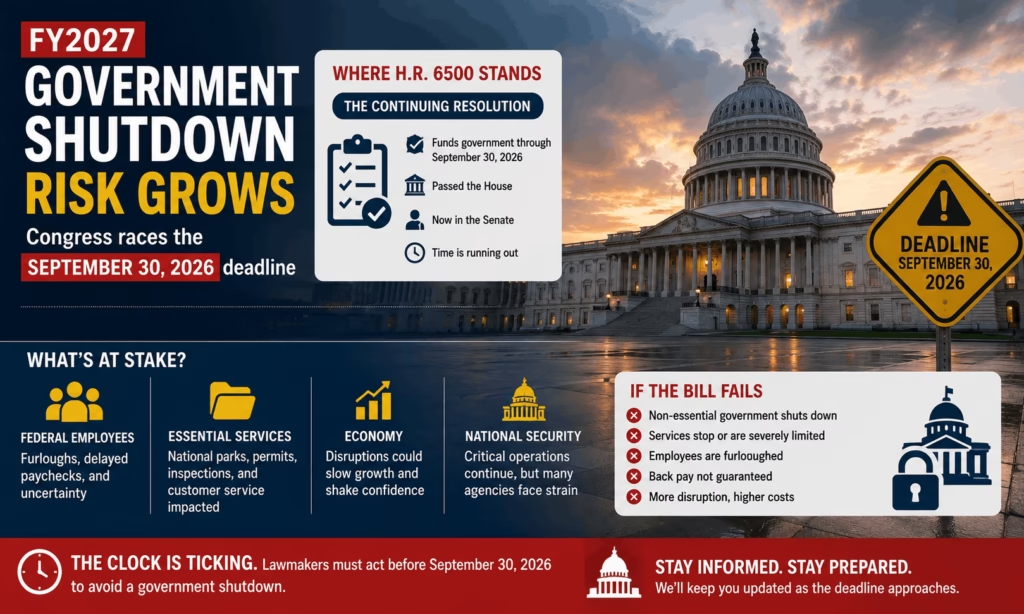
FY2027 Government Shutdown Risk: Washington is barreling toward another government shutdown deadline, and this time the stakes are compounded by a brutal recent history. With FY2027 set to begin October 1, 2026, Congress has until midnight on September 30 to pass funding legislation, or federal agencies run out of money for the third time in twelve months. The Senate cleared its version of a stopgap bill, H.R. 6500, by a lopsided 90-6 vote on August 8, 2026, funding the government through December 11. But as of the most recent congressional tracking update on August 24, 2026, that bill still sits unresolved, awaiting House action when lawmakers return from recess around August 31.
The timing could not be more fraught. The country just emerged from its two longest shutdowns on record within the same fiscal year, a 43-day lapse that ran from October 1 to November 12, 2025, followed by a 76-day Department of Homeland Security-specific shutdown that stretched from February 14 to April 30, 2026, the longest single-agency funding lapse in U.S. history. Federal workers, contractors, and families relying on federal benefits have now lived through roughly four months of funding chaos in less than a year, and the FY2027 government shutdown risk is the question of whether a fifth round is coming. We’ll be updating this article monthly as new developments emerge on the September 30 funding deadline.
Latest Update: Where FY2027 Funding Stands Right Now
Here is the complete, current snapshot of the legislative fight heading into the final weeks before the deadline.
| Detail | Information |
|---|---|
| Fiscal Year 2026 ends | September 30, 2026 |
| Fiscal Year 2027 begins | October 1, 2026 |
| House-passed CR (H.R. 9770) | Funds through December 4, 2026; passed July 21, 2026, 220-205 |
| Senate-passed CR (H.R. 6500, amended) | Funds through December 11, 2026; passed August 8, 2026, 90-6 |
| Bill’s current status | Sent back to House; House action still pending as of August 24, 2026 |
| House FY2027 appropriations bills passed (full year) | 3 of 12, as of mid-July 2026 |
| Senate FY2027 appropriations bills passed | 0, as of mid-2026 |
| Most recent full shutdown | October 1 – November 12, 2025 (43 days) |
| Most recent partial shutdown | February 14 – April 30, 2026 (76 days, DHS only) |
| CR includes | WIC adjustments, disaster relief funds, shipbuilding funds, block on OMB grant-approval rule |
Why FY2027 Government Shutdown Risk Is Higher Than a Typical Year
Every fiscal year-end carries some funding uncertainty, but 2026 has been anything but typical. The current fiscal year alone has already produced two separate shutdowns tied to the same underlying dispute, congressional disagreement over federal immigration enforcement reforms following the killing of Alex Pretti by Customs and Border Protection agents. That fight first shut down roughly half of federal departments for four days in late January and early February, then escalated into a 76-day standoff over Department of Homeland Security funding specifically, the longest single-agency shutdown ever recorded, before President Trump signed a compromise bill on April 30, 2026.
With that history still fresh, lawmakers on both sides have signaled some appetite to avoid a repeat performance heading into a midterm election year. The House Appropriations Committee moved earlier than usual in July, introducing its own continuing resolution well ahead of the September 30 deadline specifically to, in the committee’s own words, prevent shutdown brinkmanship from becoming a late-September crisis. That early action produced the House’s version of the CR, funding the government through December 4, which passed 220-205 on July 21 with six Democrats crossing over to support it.
USCIS Ukraine TPS EAD Extension: Work Permits Automatically Extended Through October 19, 2026
TPS Terminations 2026: Complete Tracker for Somalia, Ethiopia, South Sudan, Syria, Haiti, and Yemen
September 2026 Refund Payments: All the Real Deposits You Could Actually Get This Month
The Two Competing Continuing Resolutions
The core sticking point right now isn’t whether Congress wants to avoid a shutdown, both chambers have already passed some version of a stopgap bill, it’s reconciling two versions that don’t quite match.
| Feature | House Version (H.R. 9770) | Senate Version (H.R. 6500, amended) |
|---|---|---|
| Funding extended through | December 4, 2026 | December 11, 2026 |
| Passed by | 220-205 (House) | 90-6 (Senate) |
| Date passed | July 21, 2026 | August 8, 2026 |
| Funding level | FY2026 levels, most programs | FY2026 levels, most programs |
| Notable provisions | WIC, TANF, National Flood Insurance, wildfire suppression, disaster relief extended | WIC adjustments, shipbuilding funds, disaster relief, OMB grant-rule block |
| Next step required | House must concur with Senate’s amended version | Already passed; awaiting House action |
The seven-day gap between the two dates, December 4 versus December 11, might look trivial, but reconciling it requires an actual House vote before anything can reach the President’s desk. That single procedural step is what stood unresolved as of the most recent tracking update in late August, with the House out of session until roughly August 31 and returning just weeks before the funding cliff.
What Happens If Congress Misses the September 30 Deadline
If neither a reconciled continuing resolution nor full-year appropriations bills are signed into law before midnight on September 30, most federal discretionary funding lapses automatically, triggering a shutdown identical in mechanism to the ones the country experienced twice already this fiscal year. Historically, this plays out in one of three ways: Congress passes nothing and a full shutdown begins at midnight; Congress passes some, but not all, of its required funding bills, producing a partial shutdown limited to unfunded agencies; or Congress passes a clean continuing resolution, avoiding a lapse entirely while full-year negotiations continue in the background.
Given that both chambers have already independently passed stopgap legislation, just not identical versions, a full nationwide shutdown appears less likely than a scenario where the House simply concurs with the Senate’s December 11 date once lawmakers return. Still, nothing is guaranteed until identical legislation clears both chambers and receives a presidential signature, and the same dynamic played out in September 2025 before producing a 43-day shutdown anyway.
What a New Shutdown Would Mean for Federal Services
Based on the pattern established during the two shutdowns earlier this fiscal year, a lapse in FY2027 appropriations would not affect every federal service equally. Mandatory spending programs, including Social Security and Medicare benefits for current recipients, generally continue during a shutdown, though enrollment processing and staff-assisted services can face delays. Essential and safety-related personnel, including active-duty military, air traffic controllers, and federal law enforcement, are typically required to continue working without pay until funding resumes. Non-essential functions, along with many grant-processing systems, permit approvals, and administrative services, are the most likely to face immediate disruption if a lapse occurs.
Federal contractors and furloughed employees bore the brunt of the two shutdowns that already occurred this fiscal year, with roughly 900,000 employees furloughed during the October-November 2025 shutdown alone. The Congressional Budget Office estimated the cumulative real GDP effect of that six-week shutdown at roughly $11 billion by the first quarter of FY2027, a modest but real economic drag layered on top of the direct disruption to federal operations and pay.
How to Track FY2027 Funding Status
For anyone monitoring this situation closely, whether a federal employee, contractor, or benefits recipient, a few practical steps help cut through the noise of competing headlines.
- Check the official Congress.gov Appropriations Status Table, which tracks the real-time status of every FY2027 appropriations bill and continuing resolution moving through both chambers.
- Monitor House and Senate floor schedules directly, since the House’s return date and floor calendar in early September will determine whether a reconciled CR passes before the deadline.
- Watch for OMB shutdown contingency guidance, which federal agencies typically publish in the days immediately before a funding deadline, outlining which functions would continue and which would pause.
- Follow the Committee for a Responsible Federal Budget’s tracker, a nonpartisan resource that has closely followed the FY2027 appropriations process bill by bill since early 2026.
Service Canada Benefit Payments September 2026 Dates, Amounts and Who Qualifies
Canada FMCSP Study Permit: 2,970 Spots Now Open for French-Speaking Students From 33 Countries
Processing Time: How Fast Could a Deal Actually Happen?
If the House simply concurs with the Senate’s amended version of H.R. 6500 once back in session, that step could theoretically happen within a single legislative day, since no new negotiation would technically be required, only a floor vote to accept the Senate’s December 11 date. Realistically, however, previous funding fights this fiscal year have shown that even seemingly minor procedural differences can stretch into extended standoffs when unrelated political disputes get attached to the process, as happened repeatedly during both the 2025 and early 2026 shutdowns. Anyone budgeting around a specific resolution date should treat the September 30 deadline as the real risk point, not an assumed early House vote.
What This Means for Federal Pay and Benefit Schedules
A lapse in FY2027 appropriations would not, by itself, change the payment schedule for programs funded through mandatory spending, including Social Security, SSI, and Medicare benefits for people already receiving them. What it would affect is federal employee paychecks for furloughed and excepted staff, who under back-pay guarantees established after prior shutdowns are entitled to retroactive pay once funding resumes, though the timing of that back pay depends on how quickly agencies can process payroll once a deal is signed. Federal contractors, notably, are not guaranteed the same automatic back-pay protection, a gap that drew significant attention during the record-length 2025 and 2026 shutdowns.
FAQs About FY2027 Government Shutdown Risk
Is a government shutdown definitely happening on October 1, 2026?
Not necessarily. Both the House and Senate have already passed their own versions of a continuing resolution to prevent a shutdown, though as of the most recent tracking update, the House still needs to formally concur with the Senate’s amended December 11 funding date before it becomes law.
What is the difference between the House and Senate continuing resolutions?
The House-passed version (H.R. 9770) funds the government through December 4, 2026, while the Senate’s amended version of H.R. 6500 extends funding through December 11, 2026. The House must vote to accept the Senate’s version, or negotiate a compromise, before either becomes law.
How many government shutdowns have happened during fiscal year 2026?
Two. A 43-day shutdown ran from October 1 to November 12, 2025, followed by a 76-day Department of Homeland Security-specific shutdown from February 14 to April 30, 2026, the longest single-agency shutdown in U.S. history.
Will Social Security and Medicare payments stop if there’s another shutdown?
No. These are mandatory spending programs, and payments to current beneficiaries generally continue during a government shutdown, though enrollment processing and staff-assisted services can experience delays.
When exactly is the FY2027 government funding deadline?
Federal funding must be extended or fully appropriated by midnight on September 30, 2026, the last day of Fiscal Year 2026, or a lapse in appropriations begins when Fiscal Year 2027 starts on October 1.
Do federal employees get back pay after a shutdown ends?
Yes, for federal employees. Excepted and furloughed federal employees are entitled to retroactive back pay once funding resumes, based on protections established following prior shutdowns. Federal contractors generally do not receive the same automatic guarantee.
How many of the 12 annual appropriations bills have actually passed for FY2027?
As of mid-2026, the House had passed 3 of the 12 full-year FY2027 appropriations bills on the floor, while the Senate had not passed any full-year appropriations bills, relying instead on continuing resolutions to avoid a lapse.
What triggered the two shutdowns earlier in fiscal year 2026?
Both shutdowns stemmed from congressional disputes over federal immigration enforcement reforms following the killing of Alex Pretti by Customs and Border Protection agents, which derailed negotiations over Department of Homeland Security funding specifically.
The Political Dynamics Driving This Fight
Understanding why FY2027 funding has been unusually contentious requires looking past the calendar dates and into the underlying political pressure points. House Republican hard-liners have at various points this year used government funding legislation as leverage in an unrelated fight over the SAVE America Act, a proposed election overhaul bill requiring proof of citizenship for voter registration and photo identification at the polls. That dynamic nearly complicated the July continuing resolution vote, though lawmakers ultimately let the funding bill proceed without attaching the unrelated legislation.
Senate Democrats, for their part, have pointed to the two shutdowns already endured this fiscal year as evidence that Republican leadership has repeatedly failed to secure enough bipartisan support in the Senate, where 60 votes are required to overcome a filibuster on spending bills. House Republicans, meanwhile, have characterized Senate inaction on FY2027 appropriations bills, zero passed as of mid-2026, as the primary obstacle preventing full-year funding certainty rather than reliance on repeated short-term patches. Both characterizations point to the same underlying structural reality: divided control between the chambers, combined with a narrow House majority, has made even routine funding votes into high-stakes negotiations throughout 2026.
A Fiscal Year Like No Other: Comparing 2026’s Shutdowns
To fully grasp why the FY2027 deadline is drawing so much attention, it helps to see the fiscal year’s shutdown history laid out together rather than as isolated news events.
| Shutdown | Dates | Duration | Scope |
|---|---|---|---|
| FY2026 initial shutdown | October 1 – November 12, 2025 | 43 days | All federal departments |
| Brief four-day lapse | January 31 – February 3, 2026 | 4 days | Roughly half of federal departments |
| DHS-specific shutdown | February 14 – April 30, 2026 | 76 days | Department of Homeland Security only |
| FY2027 risk window | Beginning October 1, 2026 | Outcome pending | Full federal government, if unresolved |
Three separate funding lapses, or near-lapses, within a single fiscal year is not a routine pattern even by Washington’s recent standards of budget dysfunction. That repetition is precisely why both chambers moved earlier than usual this time, introducing continuing resolutions weeks ahead of the deadline rather than waiting for a last-minute scramble in the final days of September, a pattern that characterized several of the shutdowns of the past decade.
What Federal Employees and Contractors Should Do Now
Given the fiscal year’s track record, federal workers and contractors are right to prepare proactively rather than wait for a resolution to become clear. A few concrete steps can reduce the disruption if a lapse does occur:
- Review your agency’s shutdown contingency plan, typically published or updated by OMB and individual agencies in the days before a funding deadline, to understand whether your specific role would be excepted or furloughed.
- Build a short-term financial cushion if possible, particularly federal contractors who are not guaranteed automatic back pay the way federal employees are.
- Confirm your direct deposit and contact information is current with your payroll provider, since delays in processing back pay once funding resumes can be compounded by outdated banking details.
- Stay in contact with your union or employee association if applicable, since these organizations often provide real-time updates and guidance specific to your agency during a lapse.
- Avoid making major financial commitments contingent on a specific paycheck date in the weeks surrounding September 30, given how unpredictable the resolution timeline proved during the two shutdowns earlier this fiscal year.
Official Resources for Tracking FY2027 Funding Status
Always verify the current legislative status directly through these official government tracking sources.
| Resource | Purpose | Official Link |
|---|---|---|
| Congress.gov Appropriations Status Table | Real-time bill-by-bill FY2027 funding status | congress.gov/crs-appropriations-status-table |
| H.R. 6500 official bill page | Full text and status of the Senate-passed CR | congress.gov (H.R. 6500, 119th Congress) |
| H.R. 9770 official bill page | Full text and status of the House-passed CR | congress.gov (H.R. 9770, 119th Congress) |
| House Committee on Appropriations | Official House funding bill updates | appropriations.house.gov |
| Senate Committee on Appropriations | Official Senate funding bill updates | appropriations.senate.gov |
| Office of Management and Budget | Shutdown contingency plans and agency guidance | whitehouse.gov/omb |
| Congressional Budget Office | Economic impact analysis of funding lapses | cbo.gov |
Conclusion
The FY2027 government shutdown risk heading into the September 30, 2026 deadline sits in an unusual middle ground: both chambers have already passed stopgap funding bills, which is more progress than existed at this point before either of the two shutdowns earlier this fiscal year, yet a formal House vote to reconcile the December 4 and December 11 dates remained outstanding as of the latest update. Given the exhausting toll of the 43-day and 76-day shutdowns the country just endured, there’s real political incentive on both sides to avoid a third lapse heading into a midterm election season. Whether that incentive is enough to clear the final procedural hurdle before midnight on September 30 is the question Washington will answer in the first weeks of September, and it’s one worth watching closely if you’re a federal employee, contractor, or anyone who depends on federal services running without interruption.
80% to 100% VA Disability: Why the Final Jump Is the Hardest One Veterans Face
H-1B Spouse Work Permit at Risk: How Trump’s Latest Move Could Cut Family Incomes in Half