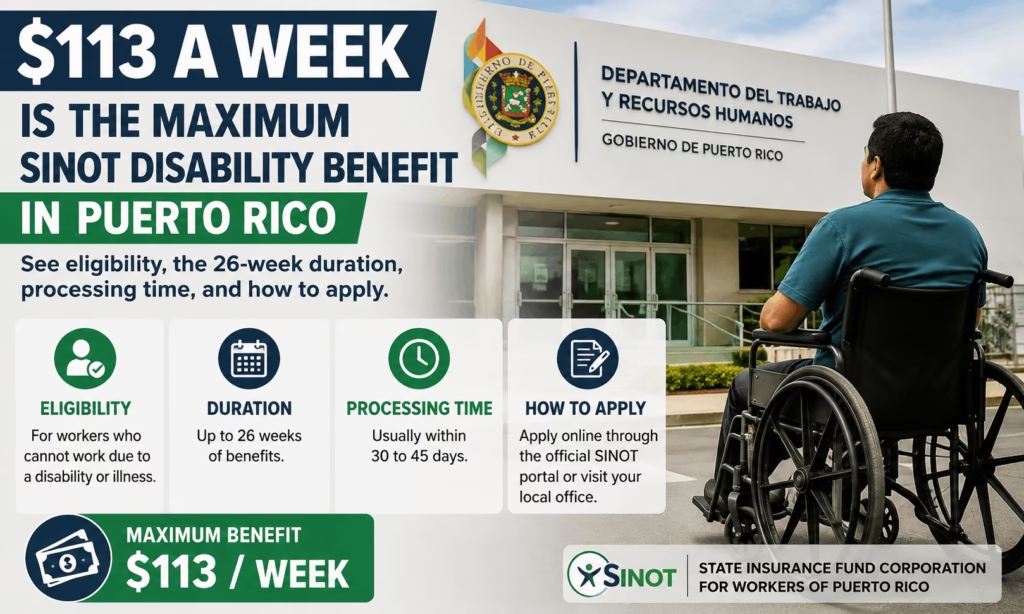
$113 Puerto Rico SINOT disability benefit: Every private-sector employee in Puerto Rico is legally covered by a mandatory disability insurance program most mainland Americans have never heard of, and even many island residents rarely think about until they actually need it. SINOT, Puerto Rico’s Seguro por Incapacidad No Ocupacional Temporal, pays a maximum weekly benefit of just $113 a week for up to 26 weeks, a figure that has remained essentially unchanged for years even as neighboring mainland programs like California’s and Rhode Island’s climbed past $1,100 and $1,700 a week respectively. We’ll be updating this article monthly, so check back here for the latest benefit figures, processing timelines, and program details as Puerto Rico’s Department of Labor and Human Resources releases updates.
For a retail worker in San Juan or a hotel employee in Ponce who suddenly cannot work due to surgery, a serious illness, or a difficult pregnancy, SINOT is often the only income protection standing between them and going completely without pay, since Puerto Rico does not have the kind of robust private short-term disability insurance market common on the mainland. Despite covering the vast majority of the island’s private-sector workforce by law, SINOT remains one of the least discussed employee benefit programs in the entire United States, a genuine information gap that leaves many eligible workers unaware the coverage exists at all until a medical emergency forces them to ask questions their employer may not be prepared to answer clearly.
What Puerto Rico’s SINOT Program?
SINOT stands for Seguro por Incapacidad No Ocupacional Temporal, which translates directly to Temporary Non-Occupational Disability Insurance, and it is sometimes referred to in English-language materials as the Disability Benefits Act program, since the underlying law dates back to 1968. The program requires most employers operating in Puerto Rico to provide disability coverage for their employees, protecting workers who cannot perform their job due to a non-work-related illness, injury, or pregnancy, distinct from Puerto Rico’s separate workers’ compensation system that covers job-related injuries.
Unlike some mainland state disability programs that operate exclusively through a single state-run fund, SINOT gives employers several compliance options. An employer can participate through the Puerto Rico insurance fund managed by the State Insurance Fund Corporation, purchase private insurance coverage from an approved carrier, or establish a self-insured plan that meets the program’s statutory requirements. Regardless of which option an employer selects, the underlying benefit structure, eligibility rules, and maximum payment amounts remain governed by the same territorial law.
Hawaii TDI 2026: New Weekly Benefit Rate, Eligibility & Payment Rules
$1,636 ODSP and Canada Disability Benefit Now Stack Fully in Ontario, No Clawback on Either Payment
$4427 EITC Payment: How to Know If You Qualify and When Will You Get It?
Key Facts and Latest SINOT Program Highlights
| Detail | Information |
|---|---|
| Program name | Seguro por Incapacidad No Ocupacional Temporal (SINOT) |
| English name | Temporary Non-Occupational Disability Insurance |
| Governing law | Puerto Rico Disability Benefit Act of 1968 |
| Administered by | Puerto Rico Department of Labor and Human Resources |
| Maximum weekly benefit, standard employees | $113 |
| Maximum weekly benefit, agricultural employees | $55 |
| Minimum weekly benefit | $12 |
| Maximum claim duration | Up to 26 weeks in any 52 consecutive calendar weeks |
| Minimum earnings to qualify | At least $150 in insured employment during the base year |
| Funding structure | Joint employer and employee contributions, or employer-only in some plan structures |
| Employer compliance options | State fund, approved private insurance, or self-insured plan |
| Covers | Non-work illness, injury, pregnancy, dismemberment, and death benefits |
| Does not cover | Work-related injuries (covered separately under Puerto Rico workers’ compensation) |
| Contact number | (787) 754-5353 |
| Official web portal | trabajo.pr.gov |
Why SINOT’s Benefit Amount Has Stayed So Low?
The gap between SINOT’s $113 weekly maximum and the benefit levels available under mainland programs is stark once placed side by side. California’s State Disability Insurance program pays up to $1,765 a week for 2026, Rhode Island’s Temporary Disability Insurance program pays up to $1,150 a week, and even New York, frequently cited as having the lowest maximum among mainland programs at $170 a week, still pays substantially more than SINOT’s ceiling.
This gap largely reflects Puerto Rico’s considerably lower average wage levels compared to the U.S. mainland, since SINOT’s benefit formula and statutory maximum were set with the island’s wage structure in mind rather than being pegged to mainland cost-of-living or wage benchmarks. Unlike California’s program, which recalculates its maximum benefit annually based on the state’s average weekly wage, SINOT’s dollar figures have historically moved far less frequently, meaning the program’s real-world purchasing power has arguably eroded more over time relative to inflation than comparable mainland programs that see regular annual adjustments.
Who Qualifies for SINOT Benefits?
Eligibility for SINOT hinges on a relatively modest earnings threshold compared to some mainland equivalents. A worker generally needs to have received at least $150 in insured employment during their applicable base year to qualify for benefits, a considerably lower bar than the earnings thresholds required under most mainland state disability programs, reflecting both Puerto Rico’s lower wage levels and the program’s design intent to cover a broad swath of the island’s workforce.
Beyond the earnings requirement, a SINOT claimant must be unable to work due to a qualifying non-work-related condition, which can include illness, injury, or pregnancy and childbirth recovery, and the claim generally requires certification from a treating physician confirming the nature of the disability and the expected period the worker will be unable to perform their job duties. SINOT also extends beyond standard disability wage replacement to include dismemberment benefits for qualifying injuries and death benefits payable to an insured employee’s dependents, a broader scope than many mainland programs that focus exclusively on wage replacement during a disability period.
Agricultural employees are subject to a separate, lower maximum weekly benefit of $55, reflecting a distinct wage and contribution structure that has historically applied to agricultural work in Puerto Rico under the underlying statute.
How the SINOT Benefit Amount Is Calculated?
SINOT calculates a claimant’s weekly benefit based on their wages during a defined base period, similar in concept to how mainland programs like California’s SDI or Rhode Island’s TDI operate, though the resulting dollar figures differ dramatically given the underlying wage base and statutory caps involved. Because the maximum weekly benefit is capped at $113 for standard employees, workers whose calculated benefit based on their actual wages would exceed that figure simply receive the $113 maximum instead, meaning many claimants, particularly those with steady, moderate-to-higher earnings by island standards, end up receiving the flat maximum rather than a benefit proportional to their actual prior income.
At the other end of the scale, the program guarantees a minimum weekly benefit of $12 for qualifying claimants, ensuring that even workers with relatively limited base year earnings receive some baseline level of income protection during an approved disability period, though this minimum figure itself underscores how modest SINOT’s overall benefit structure remains compared to mainland disability programs.
How Long You Can Receive SINOT Benefits?
SINOT provides disability benefits for up to 26 weeks within any period of 52 consecutive calendar weeks, a duration that sits at roughly the midpoint compared to other mandatory state and territorial programs, shorter than California’s 52-week maximum and Rhode Island’s 30-week maximum, but equal to the standard duration offered under several other mainland programs. This 26-week limit applies per disability period, meaning a worker who exhausts their SINOT benefits for one qualifying disability and later experiences a separate, unrelated disabling condition may become eligible for a new benefit period, subject to meeting the program’s ongoing eligibility requirements at that time.
Because SINOT’s total duration is a flat 26-week ceiling rather than a formula tied to base period earnings the way Rhode Island’s program calculates duration, claimants generally know upfront that their maximum possible benefit period is 26 weeks, regardless of how their specific weekly benefit amount was calculated within the program’s minimum and maximum range.
How to Apply for SINOT Benefits?
Filing a SINOT claim begins with notifying the employer of the disability and initiating the claims process through whichever compliance mechanism that specific employer uses to provide SINOT coverage, whether that is the state insurance fund, an approved private insurance carrier, or a self-insured employer plan. Because SINOT compliance is not centralized through a single uniform online portal the way some mainland programs like California’s SDI Online system operate, the specific application steps and required forms can vary somewhat depending on which insurance arrangement a given employer has selected to meet its SINOT obligations.
Workers generally need to notify their employer promptly once a qualifying disability begins, since employers play an active role in initiating and processing SINOT claims alongside whichever insurer or fund actually administers the specific employer’s coverage. A treating physician’s certification confirming the nature and expected duration of the disability is a standard requirement across SINOT claims regardless of which underlying insurance arrangement applies, similar to the medical certification requirements found in mainland disability programs. Workers who are unsure how to begin the claims process, or who are not receiving clear guidance from their employer, can contact the Puerto Rico Department of Labor and Human Resources directly at (787) 754-5353 for assistance navigating the specific requirements applicable to their situation, or visit the department’s official portal at trabajo.pr.gov for further program information.
SINOT Processing Time: What to Expect After You Apply?
Because SINOT claims are processed through one of three possible administrative pathways, the state insurance fund, a private insurer, or a self-insured employer plan, actual processing timelines can vary meaningfully depending on which specific arrangement covers a given worker’s employer, unlike mainland programs with a single centralized state agency handling every claim under one uniform timeline.
Claims processed through the state insurance fund generally follow the Department of Labor and Human Resources’ standard review procedures, which involve verifying the claimant’s reported base year earnings against available employment records, confirming the medical certification submitted by the treating physician adequately supports the claimed disability, and calculating the applicable weekly benefit within the program’s $12 to $113 range. Claims routed through a private insurance carrier or a self-insured employer plan follow that specific insurer’s or plan’s internal claims review process, though the underlying eligibility standards and benefit calculation rules remain governed by the same SINOT statute regardless of which entity is actually processing the claim.
Workers submitting a complete application, including prompt medical certification, generally experience faster processing than those with missing documentation or unresolved questions about their base year earnings, a pattern consistent with virtually every disability benefit program regardless of jurisdiction. Given the relative lack of centralized public information about SINOT compared to mainland state programs, workers who have questions about where their specific claim stands are generally encouraged to follow up directly with whichever entity, the state fund, their private insurer, or their employer’s self-insured plan administrator, is actually handling their particular claim.
Employment Insurance (EI) 2026 Rule Changes: What Every Canadian Worker Needs to Know
Empire State Child Credit 2026: $1,000 Per Child Under 4, Full Eligibility & Payment Guide
SINOT Payment Schedule: When and How Benefits Arrive?
Once a SINOT claim is approved, benefits are generally paid on a periodic basis throughout the approved disability period rather than as a single lump sum covering the entire claim duration upfront, a structure broadly consistent with how mainland disability programs distribute payments, though SINOT’s specific payment cadence can depend somewhat on which administrative pathway, the state fund, a private insurer, or a self-insured plan, is handling a given claim.
Continuing eligibility for ongoing payments generally requires the claimant to maintain current medical documentation supporting their continued inability to work, similar to certification requirements found in mainland programs, since disability benefits are not typically approved as a single indefinite payment stream but rather require periodic confirmation that the underlying medical condition continues to prevent the claimant from returning to work. Given SINOT’s relatively modest maximum weekly benefit, many claimants also rely on any available employer-provided sick leave, vacation pay, or supplemental coverage to help bridge the gap between their regular wages and the SINOT benefit amount during an approved disability period, since the $113 weekly maximum, standing alone, replaces only a small fraction of most workers’ typical earnings.
Why More Puerto Rico Workers Should Know About This Program?
Given how little mainstream attention SINOT receives compared to programs like California’s SDI or New Jersey’s TDI, a meaningful number of Puerto Rico workers may not fully understand that this coverage exists as a mandatory legal protection tied to their employment, rather than an optional benefit some employers choose to offer and others do not. Understanding SINOT’s coverage in advance, well before an actual medical emergency arises, gives workers a clearer sense of what income protection they can genuinely count on, and just as importantly, what gap remains between that protection and their actual living expenses, information that can meaningfully inform decisions about supplemental savings, private disability coverage, or other financial planning specific to Puerto Rico’s unique benefit landscape compared to the mainland United States.
Because SINOT sits alongside other Puerto Rico-specific programs, including the island’s own workers’ compensation system for work-related injuries and various Social Security Administration public disability benefit provisions applicable specifically to Puerto Rico, workers navigating a disability situation on the island should understand which specific program actually applies to their circumstances, since applying to the wrong program, or assuming mainland federal disability rules apply identically in Puerto Rico, can lead to confusion, delay, or missed benefits during an already difficult period.
Trump Halts 50 Percent Tariffs Canada: What the Last Minute Deal With Ottawa Means
Green Card Rule Changes: New Public Charge Test to Assess Age, Health, Family Status and Finances
Official Resources and Links
| Resource | Purpose | Link |
|---|---|---|
| Puerto Rico Department of Labor and Human Resources | Official SINOT program administration and information | https://www.trabajo.pr.gov |
| SINOT program phone assistance | Direct assistance with claims and eligibility questions | Call (787) 754-5353 |
| SSA POMS guidance on Puerto Rico Public Disability Benefits | Federal reference confirming SINOT benefit structure | https://secure.ssa.gov/poms.nsf/lnx/0452135215 |
| Puerto Rico State Insurance Fund Corporation | Workers’ compensation for work-related injuries (separate from SINOT) | https://www.trabajo.pr.gov |
| Puerto Rico Department of Labor general portal | General employment and labor rights information | https://www.trabajo.pr.gov |
FAQs About SINOT Benefits
What is SINOT in Puerto Rico?
SINOT, or Seguro por Incapacidad No Ocupacional Temporal, is Puerto Rico’s mandatory Temporary Non-Occupational Disability Insurance program, requiring most employers to provide wage replacement coverage for employees who cannot work due to a non-work-related illness, injury, or pregnancy.
How much does SINOT pay per week?
The maximum weekly benefit is $113 for standard employees and $55 for agricultural employees, with a minimum weekly benefit of $12, making it the lowest maximum among mandatory U.S. state and territorial short-term disability programs.
How long can I receive SINOT benefits?
SINOT benefits can be paid for up to 26 weeks within any period of 52 consecutive calendar weeks, calculated per qualifying disability period.
Who is eligible for SINOT in Puerto Rico?
Eligibility generally requires having earned at least $150 in insured employment during the applicable base year and being unable to work due to a qualifying non-work-related illness, injury, or pregnancy, certified by a treating physician.
How do I apply for SINOT benefits?
Applications are initiated by notifying your employer, who directs the claim to whichever compliance option they use, the state insurance fund, an approved private insurer, or a self-insured plan, along with providing a physician’s certification confirming your disability.
Is SINOT the same as workers’ compensation in Puerto Rico?
No. SINOT covers non-work-related disabilities, while Puerto Rico’s separate workers’ compensation system, administered through the State Insurance Fund Corporation, covers injuries and illnesses connected to a person’s job.
People Also Ask
Why is Puerto Rico’s disability benefit so much lower than mainland states? SINOT’s benefit levels largely reflect Puerto Rico’s lower average wage levels compared to the U.S. mainland, and unlike some mainland programs that adjust their maximum benefit annually based on rising wages, SINOT’s dollar figures have historically changed far less frequently.
Does every employer in Puerto Rico have to offer SINOT? Yes, SINOT is a mandatory program under the Puerto Rico Disability Benefit Act of 1968, requiring most private employers on the island to provide this coverage through one of several approved compliance options.
Can agricultural workers in Puerto Rico get SINOT benefits? Yes, but agricultural employees are subject to a lower maximum weekly benefit of $55, compared to the $113 maximum available to standard, non-agricultural employees under the same program.
What other benefits does SINOT provide besides weekly disability payments? Beyond wage replacement during a qualifying disability, SINOT also provides dismemberment benefits for certain injuries and death benefits payable to an insured employee’s dependents, a broader scope than many comparable mainland disability programs.
How does SINOT compare to California’s or Rhode Island’s disability program? SINOT’s maximum weekly benefit of $113 is dramatically lower than California’s $1,765 maximum or Rhode Island’s $1,150 maximum, largely reflecting the significant difference in average wages between Puerto Rico and those mainland states, even though all three programs share a similar underlying structure of mandatory, payroll-funded, short-term disability coverage.
Conclusion
Puerto Rico’s SINOT program remains a legally mandatory but strikingly under-discussed piece of the island’s employment benefit landscape, offering wage replacement of up to $113 a week for as long as 26 weeks to workers sidelined by a non-work-related illness, injury, or pregnancy. While the benefit amount itself pales in comparison to mainland programs like California’s or Rhode Island’s, understanding that this coverage exists, confirming eligibility through the applicable earnings threshold, and knowing how to properly initiate a claim through an employer’s specific compliance arrangement remains essential knowledge for the island’s private-sector workforce. Given how little centralized public information exists about this program compared to its mainland counterparts, this article will be updated every month with the latest confirmed program details and any changes to Puerto Rico’s disability benefit structure.
$1,150 a Week: Rhode Island TDI Benefit Rises Again as State Delivers Second Increase in 2026
$994 SNAP Benefit: New Work Rules Hit Millions as SNAP E&T Program Explained
Oregon Kicker Tax Credit 2026: How To Claim Your Share Of The $1.41 Billion Surplus
California Climate Credit 2026: Payment Timing Just Changed, Here Is What to Expect on Your Bill
$145.83 BC Family Benefit First Child Payment Confirmed as Income Phase-Out Shifts to $96,562