New Canada Laws and Rules September 2026: Canadians are waking up to one of the busiest regulatory months of the year. Starting this week, a wave of new Canada laws and rules for September 2026 begins reshaping paycheques, grocery bills, gas prices, disability supports, and even what counts as “Canadian content” on television. From new retaliatory tariffs on U.S. goods to a fresh Canada Disability Benefit supplemental payment, the federal government and several provinces are rolling out changes that touch nearly every household and business in the country.
The trigger point for most of these updates is September 1, with a second major shift arriving September 8 when Canada’s counter-tariffs on American imports officially kick in. Together, these changes affect commercial drivers, farmers, broadcasters, international students, disability benefit recipients, and everyday consumers who will notice the return of the federal fuel tax at the pumps. We’ll be updating this article monthly so readers always have the latest confirmed dates, dollar figures, and official government links in one place.
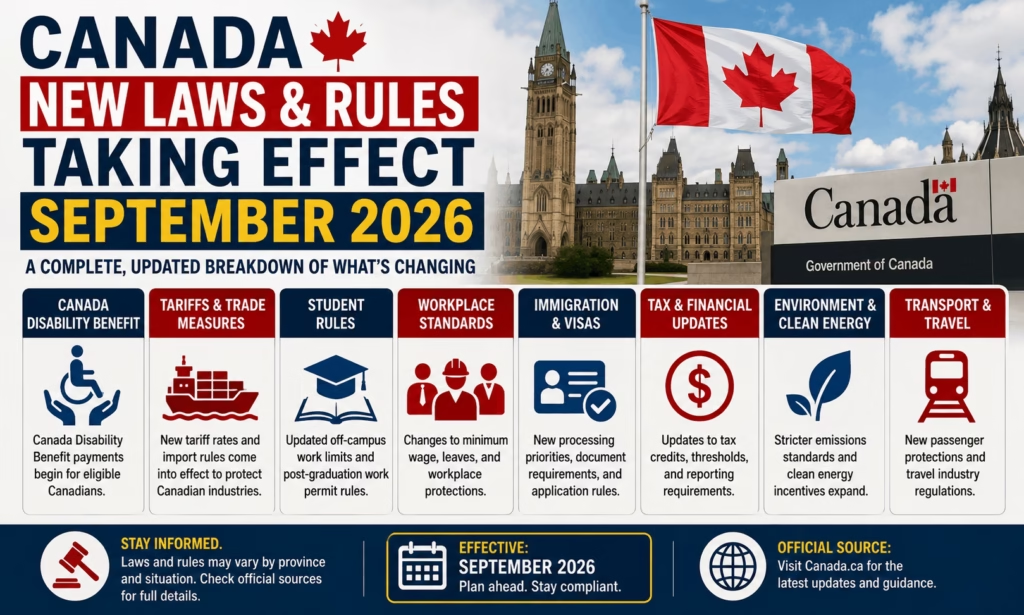
September 2026 Canada Law Changes Key Highlights
Before diving into the details, here is a snapshot table of the most searched Canada law changes September 2026, organized by effective date.
| Change | Effective Date | Who It Affects |
|---|---|---|
| Canada Disability Benefit $150 supplemental payment | September 1, 2026 | CDB recipients who paid for a medical certificate |
| International student financial requirement increase | September 1, 2026 | New study permit applicants |
| CRTC Canadian-content certification rules | September 1, 2026 | Broadcasters, streamers, film/TV producers |
| Canada-U.K. CPTPP trade rules | September 1, 2026 | Exporters, importers, businesses trading with the U.K. |
| CBSA Commercial Driver Registration Program ends | September 1, 2026 | Commercial truck drivers at the border |
| New chemical reporting requirements (184 substances) | Already in effect; Phase 1 deadline March 3, 2027 | Manufacturers, importers of listed chemicals |
| Federal fuel excise tax resumes | September 8, 2026 | Drivers, households, businesses |
| Canada’s retaliatory tariffs on U.S. imports | September 8, 2026 | Consumers, retailers, manufacturers |
| Regional Tariff Response Initiative top-up ($1.5B) | Ongoing through September | Small and medium businesses hit by tariffs |
| AgriInvest 2025 form submission deadline | September 30, 2026 | Agricultural producers |
| Controlled Substances temporary exemption ends | September 30, 2026 | Pharmacists, healthcare professionals |
| Ontario rental N13 licensing bylaw | September 2026 | Toronto landlords issuing N13 eviction notices |
| Ontario Student and Family Support Offices | By September 1, 2026 | Parents and students across Ontario school boards |
Now let’s break down each change in detail, including how to apply where applicable, processing timelines, and payment schedules.
$150 Canada Disability Benefit Supplemental Payment
The most talked-about financial update this month is the Canada Disability Benefit (CDB) supplemental payment. Under new regulations that took effect September 1, eligible CDB recipients are receiving a one-time $150 top-up, separate from their regular monthly payment.
The reasoning behind this measure is straightforward. To qualify for the CDB in the first place, applicants must hold a valid Disability Tax Credit (DTC) certificate from the Canada Revenue Agency, which requires a medical practitioner to confirm a severe or prolonged impairment. While the certification is free in some provinces, many Canadians are charged between $125 and $150 by their doctor or nurse practitioner to complete the paperwork, plus travel costs to attend the appointment. The $150 supplement is designed to offset exactly that expense.
Who qualifies: Canadians already receiving monthly CDB payments, including those who receive $20 or less per month and those who receive their benefit as a lump-sum payment for an entire payment period.
How to apply: No separate application is required. Payment schedule for this supplement is automatic, meaning Service Canada issues it directly to the same bank account or mailing address already on file for existing CDB recipients.
Processing time: Since this is not a new application-based benefit, there is no processing queue. Recipients should watch their September deposit for the extra amount, which typically arrives as a distinct transaction rather than being merged into the regular monthly payment.
International Student Financial Requirements Increase
If you’re planning to study in Canada, the cost of proving you can support yourself just went up. Effective September 1, 2026, Immigration, Refugees and Citizenship Canada (IRCC) raised the minimum financial threshold that study permit applicants must demonstrate.
Previously, applicants needed to show $22,895 in available funds to cover one year of living costs. That figure has now increased to $23,448 per applicant. This is an annual, inflation-linked adjustment that IRCC reviews every year to keep pace with the actual cost of tuition, housing, and daily expenses across Canada.
How to apply: Prospective students must include proof of funds, such as bank statements, a Guaranteed Investment Certificate (GIC), or a letter from a financial institution, as part of their study permit application through the IRCC portal.
Processing time: Study permit processing times vary by country of application and season, but IRCC recommends applying at least 60 to 90 days before the intended program start date, since the fall intake typically sees higher application volumes.
Canada’s Retaliatory Tariffs on U.S. Goods Begin September 8
Perhaps the change with the widest everyday impact is the start of Canada’s counter-tariffs on American imports, which take effect September 8, 2026. The federal government is applying tariffs ranging from 15% to 50% on roughly $27.6 billion worth of U.S. products, matching tariff levels the United States has placed on Canadian goods.
Categories facing the steepest tariff rates include steel and aluminum, furniture, and clothing, while dairy, appliances, agricultural equipment, pulp and paper, plastics, and electronics are also affected. Retailers sourcing these goods from the U.S. are expected to pass at least part of the added cost on to consumers, meaning shoppers could see price increases on select imported items through the fall.
Alongside the tariffs, Ottawa is rolling out a $7.5 billion support package for Canadian workers and businesses caught in the trade dispute. Of that total, $3.5 billion is earmarked for worker support, including expanded Employment Insurance (EI) flexibility, workplace training programs, and incentives for employers trying to avoid layoffs.
Federal Fuel Excise Tax Returns September 8
Drivers who have enjoyed a break at the pump should take note. The temporary suspension of the federal fuel excise tax ends after September 7, meaning the tax returns on September 8 at its previous rate of 10 cents per litre for gasoline and 4 cents per litre for diesel.
How much this actually changes at the pump will depend on wholesale fuel prices, provincial taxes, and retailer pricing at the time, but households that budget for commuting costs should expect a modest increase heading into fall.
Colorado TABOR Refund and PTC Rebate 2026: Who Qualifies and How Much You Can Get
New CRTC Canadian-Content Rules for Broadcasters
Effective September 1, 2026, the CRTC (Canadian Radio-television and Telecommunications Commission) implemented an updated framework for certifying Canadian content in television and audiovisual productions. The new rules change how a show or film qualifies as “Canadian,” with added emphasis on Canadian creative participation, copyright ownership, and the use of artificial intelligence in production.
This matters for streaming platforms, broadcasters, and independent producers, since Canadian-content certification is directly tied to funding eligibility, tax credits, and mandated content quotas under the Broadcasting Act. Productions that previously qualified under older criteria may need to reassess how they meet the new standard going forward.
Controlled Substances Regulatory Overhaul
A temporary Health Canada exemption that has given pharmacists and other healthcare professionals additional flexibility around controlled substances since 2020 is set to expire on September 30, 2026. In its place, a new, consolidated set of Controlled Substances Regulations is scheduled to come into force on October 1, replacing the patchwork temporary framework that has been in place for six years.
Pharmacists, prescribers, and healthcare institutions handling controlled substances should review the updated regulatory requirements before the exemption lapses to avoid any gap in compliance.
Commercial Driver Registration Program Ends September 1
The Canada Border Services Agency (CBSA) is discontinuing the Commercial Driver Registration Program (CDRP) as of September 1, 2026, citing low participation and significant overlap with the existing FAST (Free and Secure Trade) program. Truckers who already hold a CDRP card can continue using it until the printed expiry date, but no new registrations or renewals will be issued. Commercial drivers moving forward are being directed toward the FAST program for expedited border processing.
Regional Tariff Response Initiative Gets $1.5 Billion Top-Up
Small and medium-sized businesses hurt by the ongoing tariff dispute have access to more support this month. The federal government expanded its Regional Tariff Response Initiative with an additional $1.5 billion in funding.
How to apply: Eligible businesses affected by tariffs can apply through their regional development agency for non-repayable contributions of up to $3 million, with separate liquidity assistance of up to $2 million also available for qualifying applicants.
Processing time: Regional development agencies typically review applications on a rolling basis, with funding decisions taking several weeks depending on application volume and documentation completeness.
AgriInvest Deadline: September 30, 2026
Farmers have a hard deadline this month. September 30, 2026, is the final date for eligible agricultural producers to submit their 2025 AgriInvest forms and related tax information. Producers who file late risk a reduction in their government-matched contribution, and any submission received after September 30 will not qualify for the 2025 program year at all.
Canada-U.K. CPTPP Trade Rules Take Effect
New trade rules between Canada and the United Kingdom under the Comprehensive and Progressive Agreement for Trans-Pacific Partnership (CPTPP) officially took effect on September 1, 2026. The agreement expands trade opportunities for Canadian businesses through broader rules of origin and new tariff advantages on qualifying products, giving exporters another avenue to diversify away from reliance on the U.S. market amid the ongoing tariff dispute.
Ontario-Specific Changes This September
Ontario residents face two additional provincial updates this month.
Rental N13 licensing bylaw: Landlords in Toronto who issue an N13 notice, which ends a tenancy for major repairs, renovations, or demolition, must now also apply for a City licence within seven days of issuing that notice. The bylaw is meant to curb misuse of renovation-related evictions.
Student and Family Support Offices: Ontario school boards are required to have Student and Family Support Offices established by September 1, 2026, giving families a clearer channel to raise complex concerns and access community resources. The first offices opened at five supervised school boards in January, while every other board was required to submit implementation plans earlier this year.
What’s Coming Next: Ontario Minimum Wage Increase in October
While it technically lands just after this month, it’s worth flagging now since payroll teams need lead time. Ontario’s general minimum wage rises from $17.60 to $17.95 per hour on October 1, 2026, a roughly 1.9% increase tied to the provincial Consumer Price Index. Student, homeworker, and wilderness guide rates are also increasing on the same date. Employers should apply the new rate starting with the first pay period that includes October 1.
Official Government Resources and Links
Always verify details directly through official sources before making financial or legal decisions. Here are the direct links for the programs covered in this article.
| Program | Official Resource |
|---|---|
| Canada Disability Benefit (status, eligibility) | canada.ca/en/services/benefits/disability/canada-disability-benefit.html |
| Study permit financial requirements | canada.ca/en/immigration-refugees-citizenship/services/study-canada/study-permit/get-documents/financial-support.html |
| CBSA FAST program (commercial drivers) | cbsa-asfc.gc.ca/prog/fast-expres/menu-eng.html |
| CRTC broadcasting rules | crtc.gc.ca |
| Health Canada controlled substances regulations | canada.ca/en/health-canada/services/health-concerns/controlled-substances-precursor-chemicals.html |
| AgriInvest program | agriculture.canada.ca/en/agricultural-programs-and-services/agriinvest |
| CPTPP trade agreement details | international.gc.ca (Trade and Investment Agreements section) |
| Ontario minimum wage rules | ontario.ca (Employment Standards Act, minimum wage) |
| Regional development agency tariff support | canada.ca (Regional Development Agencies) |
FAQs About New Canada Laws and Rules September 2026
Who is eligible for the $150 Canada Disability Benefit supplemental payment?
Anyone already receiving the monthly Canada Disability Benefit is automatically considered, including recipients who get $20 or less per payment or who receive a lump-sum payment for an entire period. No separate application is needed.
When do Canada’s new tariffs on U.S. goods start?
The retaliatory tariffs begin September 8, 2026, applying rates between 15% and 50% on about $27.6 billion worth of American imports.
How much do international students need to show for a study permit now?
As of September 1, 2026, applicants must demonstrate $23,448 in available funds, up from $22,895 the previous year.
Is the federal fuel tax coming back in September 2026?
Yes. The temporary suspension ends after September 7, and the tax resumes on September 8 at 10 cents per litre for gasoline and 4 cents per litre for diesel.
What happens to Commercial Driver Registration Program cards after September 1?
Existing CDRP cards remain valid until their printed expiry date, but the CBSA is no longer issuing new registrations, directing drivers to the FAST program instead.
What is the AgriInvest deadline for 2026?
Agricultural producers must submit their 2025 AgriInvest forms and tax information by September 30, 2026, or risk losing eligibility for that program year.
Does the Ontario minimum wage change in September 2026?
Not in September. The increase to $17.95 per hour takes effect October 1, 2026, though employers should prepare payroll systems ahead of time.
Where can I check the status of my Canada Disability Benefit payment?
Recipients can check payment status through their My Service Canada Account or by contacting Service Canada directly, since the supplemental payment is issued automatically alongside existing benefit information.
People Also Ask
What new laws are coming to Canada in 2026? Beyond the September changes, 2026 has already brought a middle-class income tax cut, an increased CPP contribution rate, capped NSF banking fees, and new interprovincial trade rules under the Free Trade and Labour Mobility in Canada Act.
Why are Canada’s tariffs on the U.S. increasing in September 2026? The tariffs are a retaliatory measure matching tariff levels the United States has imposed on Canadian exports, part of an ongoing trade dispute between the two countries.
Will grocery prices go up because of the new tariffs? Some categories such as dairy and agricultural equipment are included in the tariff list, so shoppers may see gradual price adjustments, though the overall effect will depend on retailer sourcing decisions and existing inventory.
How do I know if I qualify for the Canada Disability Benefit? Eligibility requires holding a valid Disability Tax Credit certificate from the CRA along with meeting the CDB’s income and residency criteria, which can be confirmed through the official Government of Canada disability benefit page.
Conclusion
September 2026 is shaping up to be one of the more consequential regulatory months of the year for Canadians, with changes spanning disability support, immigration, trade, transportation, and provincial housing rules. Some updates, like the CDB supplemental payment, put money directly back into people’s pockets, while others, like the return of the fuel tax and new tariffs on U.S. goods, will modestly raise costs for households and businesses. Farmers, commercial drivers, broadcasters, and Ontario renters each face their own specific deadlines this month as well. Given how fast these rules are evolving amid the broader Canada-U.S. trade dispute, it’s worth bookmarking this page, since we’ll be updating this article monthly with the latest confirmed dates, figures, and official links as new information becomes available.
2027 COLA Increase for VA Disability: How Much Could Benefits Rise Under the Latest Projection
Social Security SSI Payment Date September 2026 Confirmed by SSA- Check Full Schedule here!