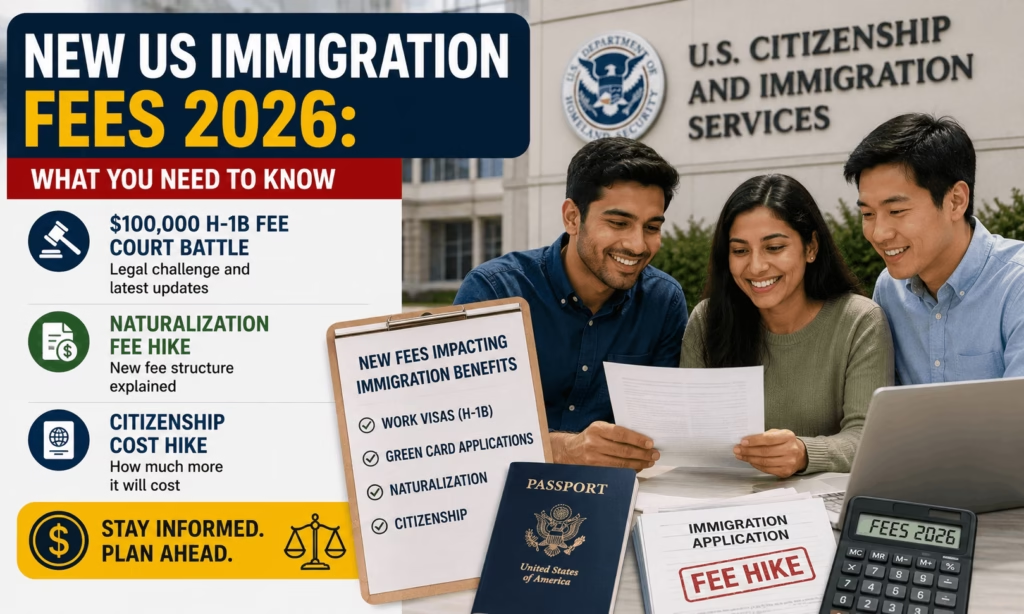
New US Immigration Fees 2026: The fight over President Trump’s $100,000 H-1B visa fee took a decisive turn on July 24, 2026, when the First Circuit Court of Appeals denied the federal government’s request to keep collecting the fee while its appeal proceeds. That means, as of this writing, the fee is not currently in effect a major but possibly temporary reprieve for employers filing new H-1B petitions requiring consular processing. The reversal caps a whiplash-inducing seven months: the fee took effect in September 2025, was struck down by a federal judge in June 2026, briefly reinstated under a temporary stay, and then blocked again when the appeals court refused to extend that stay.
At the same time, a separate and unrelated cost increase is moving through the federal rulemaking process: DHS proposed raising the naturalization application fee by up to 80% on June 23, 2026, which would push the Form N-400 fee from $760 to $1,330. Between an H-1B fee still fighting for its life in court and a citizenship fee hike working through public comment, 2026 has brought more fee-related uncertainty to the U.S. immigration system than any year in recent memory with Indian applicants, who make up the largest single share of the employment-based green card backlog, facing the most compounding pressure from both changes. We’ll be updating this article monthly as the H-1B appeal and the naturalization fee rule both move toward resolution.
New US Immigration Fees 2026 Summary
| Fee/Policy | Current Status |
|---|---|
| $100,000 H-1B Fee | Not currently in effect (First Circuit denied stay, July 24, 2026) |
| Original Fee Announcement | Presidential Proclamation, September 19, 2025 |
| Court That Vacated the Fee | U.S. District Court, District of Massachusetts (Judge Leo Sorokin) |
| Ruling Date | June 8, 2026 |
| Case Name | State of California, et al. v. Mullin, et al. |
| Appeal Status | Pending at the First Circuit; final merits ruling not yet issued |
| N-400 Naturalization Fee (Current) | $760 paper / $710 online |
| N-400 Naturalization Fee (Proposed) | $1,330 paper / $1,280 online |
| Naturalization Fee Comment Period Closes | August 24, 2026 |
| EB-2 India Backlog (2026) | Priority date around July 2014 — roughly 12 years |
| EB-3 India Backlog (2026) | Priority date November 15, 2013 — 13+ years |
| Per-Country Cap | 7%, unchanged since 1990 |
The $100,000 H-1B Fee: A Full Timeline of the Legal Battle
To understand where things stand, it helps to walk through exactly how this fight unfolded, because the fee’s legal status has flipped multiple times in under a year.
September 19, 2025: President Trump issued a Presidential Proclamation imposing a one-time $100,000 fee on new H-1B visa petitions. Federal agencies later clarified the fee applied specifically to new H-1B petitions filed on or after September 21, 2025, that require consular processing — meaning the worker must obtain their visa stamp at a U.S. consulate abroad before entering H-1B status.
December 12, 2025: A coalition of 20 state attorneys general, led by California’s Rob Bonta, filed suit challenging the fee in federal court.
June 8, 2026: U.S. District Judge Leo T. Sorokin issued a nationwide ruling in State of California v. Mullin, granting summary judgment for the plaintiff states. The court found the $100,000 payment functioned as an unauthorized tax that only Congress — not the executive branch — has the constitutional authority to impose, and that the implementing policy separately violated the Administrative Procedure Act.
June 16, 2026: A federal court granted the government a temporary stay, allowing USCIS to resume collecting the fee while the government pursued a longer-term stay.
June 18, 2026: The government formally filed its motion to stay Judge Sorokin’s order with the First Circuit Court of Appeals for the duration of the full appeal.
July 24, 2026: The First Circuit denied the government’s stay motion, stating simply: “We deny the motion.” This means Judge Sorokin’s order vacating the fee is now back in effect, and USCIS is not currently permitted to require the $100,000 fee.
Importantly, this is still an interim ruling on the stay request only — the First Circuit has not yet issued a final decision on the merits of the government’s appeal. The legal status of the fee could change again depending on how that appeal is ultimately resolved.
Max Social Security Benefit at Age 67 in 2026: How to Get It?
Canada Ranked Second Most Trustworthy Country for Investment 2026
Who Does the H-1B Fee Currently Apply To?
While the fee remains vacated, it’s worth understanding its intended scope in case it’s reinstated: the $100,000 charge was designed to apply only to new H-1B petitions for initial status that require consular processing abroad — it was not designed to apply to H-1B extensions, transfers, or petitions for workers already in the U.S. changing status domestically. Universities, nonprofit research institutions, and hospitals had specifically flagged the fee as a major burden, arguing it threatened their ability to recruit specialized researchers and medical professionals.
Naturalization Fees: What DHS Is Actually Proposing
Separate from the H-1B litigation, DHS published a Notice of Proposed Rulemaking on June 23, 2026 (Docket No. USCIS-2026-0265) that would substantially raise the cost of becoming a U.S. citizen. This is currently a proposal, not a final rule — current fees remain in place while DHS reviews public comments, and the comment period runs through August 24, 2026.
| Form | Current Fee | Proposed Fee | Increase |
|---|---|---|---|
| N-400 (paper) | $760 | $1,330 | ~75% |
| N-400 (online) | $710 | $1,280 | ~80% |
| N-336 (paper, appeal after denial) | $830 | $1,475 | ~78% |
| N-336 (online) | $780 | $1,425 | ~83% |
Beyond the raw dollar increase, the proposal would eliminate two significant relief mechanisms: the $380 reduced fee currently available to applicants with household income at or below 400% of the Federal Poverty Guidelines, and fee waivers for both Form N-400 and Form N-336. Under the proposal, only active-duty and former military members would remain exempt, since that exemption is required by statute. DHS explained the shift bluntly in the rule’s text, stating it no longer believes naturalization applications should receive subsidized fees “at the potential expense of other immigration benefits” — a marked departure from the agency’s longstanding policy of keeping citizenship costs relatively low to encourage naturalization.
What This Means for Indian Green Card Applicants Specifically
Indian nationals occupy a uniquely difficult position in the U.S. employment-based immigration system, and both of these fee developments land squarely on top of an already severe structural problem: the per-country cap. Under current law, no single country can receive more than 7% of employment-based green cards in a given year, a limit that hasn’t been adjusted since 1990 — even though Indian nationals now account for more than half of all employment-based green card demand.
The result is a backlog measured in decades, not years. As of 2026 Visa Bulletin data:
- EB-2 India sits at a priority date around July 2014, meaning applicants filing new petitions today face a wait of roughly 12 years before their priority date becomes current.
- EB-3 India sits at a priority date of November 15, 2013, translating to a backlog of 13-plus years.
- Separately, the libertarian Cato Institute has published a more extreme long-range projection, estimating that under current caps, some new Indian applicants entering the queue today could face waits exceeding 130 years if demand and allocation trends continue unchanged — though this figure represents a theoretical worst-case extrapolation rather than a near-term Visa Bulletin projection, and estimates vary significantly depending on the methodology used.
For context, Indian professionals face roughly a 12-year EB-2 wait compared to about 5 years for Chinese applicants and around 3 years for Filipino applicants, purely because of the per-country cap rather than any difference in individual qualifications.
How the H-1B Fee and Naturalization Hike Compound the Problem
These two policies hit different points in the same pipeline. The H-1B fee if ultimately reinstated after the appeal concludes would add a massive upfront cost specifically to new consular-processed H-1B petitions, the visa category most Indian tech and healthcare professionals use to first enter the U.S. workforce before eventually pursuing employer-sponsored green cards. The naturalization fee hike hits the opposite end of the journey: applicants who have already endured a decade-plus green card wait and finally become eligible to naturalize would face a 75-80% higher cost, with no reduced-fee safety net for lower-income households.
Combined, immigration attorneys have noted this creates a system where Indian applicants specifically face higher entry costs, the longest middle-stage backlog of any nationality, and a steeper final cost to citizenship even though none of the three policies technically singles out any one nationality by name.
Visa Waiver Program (VWP) 2026: ESTA Fee, Eligible Countries & Entry Rules
EB-5 Visa Cap India: Why New Green Card Approvals Stay Blocked Until October
What Applicants and Employers Should Do Right Now
- For H-1B employers: Because the fee’s legal status remains genuinely uncertain pending the First Circuit’s final ruling, employers should consult immigration counsel before filing new consular-processing H-1B petitions and build contingency planning around the possibility the fee could be reinstated later in the appeal process.
- For prospective naturalization applicants: Since current fees remain in effect throughout the public comment period, individuals who are already eligible to naturalize may want to file before any final rule takes effect to lock in the current, lower fee — though eligibility requirements should always be confirmed with an attorney first rather than filing prematurely.
- For green card applicants from India: Given the structural nature of the per-country cap backlog, applicants should discuss category strategy — including EB-1 eligibility, EB-2 National Interest Waiver options, or cross-chargeability through a spouse born in a non-backlogged country — directly with a qualified immigration attorney, since none of these fee changes alter the underlying visa-number math.
Official Resources
| Resource | Purpose | Official Link |
|---|---|---|
| USCIS Fee Schedule | Current, official filing fees | uscis.gov/feecalculator |
| USCIS Form N-400 Page | Naturalization application and fee status | uscis.gov/n-400 |
| Federal Register — Naturalization Fee Rule | Full proposed rule text and comment submission | regulations.gov (Docket USCIS-2026-0265) |
| U.S. Department of State Visa Bulletin | Monthly priority date updates | travel.state.gov/visabulletin |
| USCIS Case Status Check | Check H-1B or green card case status | egov.uscis.gov/casestatus |
| First Circuit Court of Appeals | Track the H-1B fee appeal | ca1.uscourts.gov |
FAQs
Is the $100,000 H-1B fee currently in effect?
No. As of July 24, 2026, the First Circuit Court of Appeals denied the government’s request to keep enforcing the fee during its appeal, meaning USCIS currently cannot require it — though the underlying appeal is still pending and the outcome could change.
Has the naturalization fee increase to $1,330 taken effect?
No. It remains a proposed rule. Current fees ($760 paper / $710 online) stay in effect throughout the public comment period, which closes August 24, 2026, and any final rule would follow after DHS reviews public feedback.
Why is the Indian green card backlog so much longer than other countries?
It’s driven by the 7% per-country cap, unchanged since 1990, combined with Indian nationals accounting for over half of total employment-based green card demand — not by any difference in individual case processing.
Does the H-1B fee apply to all H-1B petitions?
No. As designed, it applied specifically to new H-1B petitions requiring consular processing abroad, not extensions, transfers, or in-country status changes.
Will the fee waiver for naturalization be completely eliminated?
Under the current proposal, yes — both the $380 reduced fee and standard fee waivers for Form N-400 and N-336 would be eliminated, with only statutory military exemptions remaining.
What’s the fastest green card category for Indian applicants right now?
EB-1 (extraordinary ability, outstanding researchers, or multinational executives) currently moves significantly faster than EB-2 or EB-3 for Indian nationals, though eligibility requirements are considerably stricter.
People Also Ask
Will the $100,000 H-1B fee come back? It’s genuinely uncertain. The fee is currently blocked, but the First Circuit has only ruled on the temporary stay request, not the underlying merits of the government’s appeal — a later ruling could reinstate it.
How much does it cost to become a U.S. citizen in 2026? Under current fees, N-400 naturalization costs $760 (paper) or $710 (online). If the proposed rule is finalized, that would rise to $1,330 and $1,280 respectively.
How long is the EB-2 green card wait for Indian applicants in 2026? Roughly 12 years based on current Visa Bulletin priority dates, though some longer-range projections estimate significantly longer waits for new applicants entering the queue today if current trends continue.
Can I still get a fee waiver for naturalization right now? Yes, under current rules, low-income applicants may still qualify for the $380 reduced fee or a full fee waiver — these protections remain in place unless and until DHS finalizes its proposed rule change.
Conclusion
Both of these fee stories remain genuinely unresolved as of August 2026: the $100,000 H-1B fee is blocked for now but still fighting through the appeals process, and the naturalization fee hike is still a proposal awaiting final DHS action after public comments close. For Indian applicants navigating an already decade-plus green card backlog driven by the per-country cap, both changes represent added cost and uncertainty layered onto a structural problem neither policy actually addresses. Anyone directly affected — employers filing H-1B petitions, or green card holders considering naturalization — should track the First Circuit’s next ruling and the naturalization rule’s final publication closely, and consult a qualified immigration attorney before making filing decisions based on the current, still-shifting fee landscape. We’ll be updating this article monthly as the H-1B appeal and the naturalization fee rule both move toward resolution.
Form I-551 Confirmed Green Card Holders Enter US Without a Visa