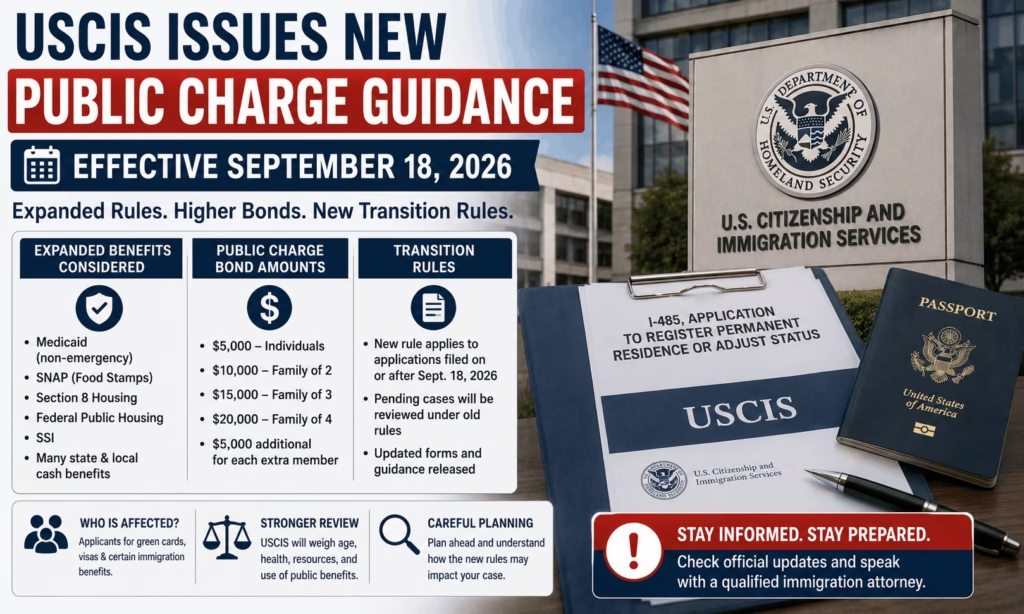
Public Charge Policy 2026: Green card applicants now have a firm deadline that could change how their financial history is judged. On August 18, 2026, USCIS issued extensive new guidance in the Policy Manual explaining exactly how immigration officers will apply the public charge ground of inadmissibility, and the new framework takes effect September 18, 2026 for any Form I-485 application postmarked, electronically submitted, or admission requested on or after that date. The change follows a Department of Homeland Security final rule, published in the Federal Register on July 20, 2026, that formally rescinds the narrower 2022 Biden-era public charge regulation. Under the public charge policy 2026 framework, USCIS officers can once again consider a much wider range of government benefits, including SNAP, Medicaid, housing assistance, and education aid, when deciding whether a green card applicant is likely to become dependent on the government. We’ll be updating this article monthly as USCIS releases further implementation guidance and as legal challenges to the new framework develop.
The stakes for getting this right are significant. Under the new guidance, USCIS generally considers someone likely to become a public charge if they are more likely than not to become dependent on government assistance to meet basic needs such as food, shelter, or healthcare, based on a prospective, totality-of-circumstances review of their individual case. Crucially, the date a benefit was received determines which rules apply, meaning the exact same fact pattern, such as a green card applicant’s spouse who briefly used SNAP, could produce a completely different outcome depending on whether that benefit use fell before or after September 18, 2026. This article breaks down precisely what changed, which benefits now count, how public charge bonds work, and what applicants filing in the coming months need to know.
Key Highlights of the New Public Charge Policy
| Detail | Information |
|---|---|
| DHS final rule announced | July 16, 2026 |
| Federal Register publication date | July 20, 2026 |
| USCIS Policy Manual guidance issued | August 18, 2026 |
| Effective date | September 18, 2026 |
| Applies to | Form I-485 applications postmarked or e-filed on or after September 18, 2026 |
| Legal citation | Section 212(a)(4), Immigration and Nationality Act |
| Policy Manual location | Volume 8, Part G |
| Rule rescinded | 2022 Public Charge Ground of Inadmissibility Final Rule |
| Standard applied | Totality of circumstances, no bright-line test |
| Minimum public charge bond | $1,000 |
| Maximum projected 5-year benefit estimate | Up to $53,430 for certain adults without children |
| Does NOT apply to | Public charge determinations at ports of entry, handled separately by CBP |
What Actually Counts as a Public Benefit Now
The single biggest change in the public charge policy 2026 guidance is the expanded list of benefits officers may consider. For any means-tested public benefit received on or after September 18, 2026, officers can weigh both cash and non-cash assistance in their determination. The guidance specifically identifies several benefit categories as potentially relevant, including cash assistance for income maintenance, public or subsidized housing, financial aid for post-secondary education, food assistance programs, and government-funded health coverage.
| Benefit category | Examples named in USCIS guidance |
|---|---|
| Cash assistance | Temporary Assistance for Needy Families (TANF), Supplemental Security Income (SSI) |
| Health coverage | Medicaid, Children’s Health Insurance Program (CHIP) |
| Food assistance | Supplemental Nutrition Assistance Program (SNAP), WIC |
| Housing assistance | Public and subsidized housing programs |
| Education aid | Financial aid for post-secondary education |
This is a sharp departure from the narrower list that applied under the 2022 rule, which had specifically excluded programs like Medicaid, SNAP, and housing assistance from consideration for most applicants. Under the new guidance, using any of these programs after the effective date becomes a factor officers can weigh, though no single benefit automatically disqualifies an applicant.
IRS Notice 2026-28: New Paid Family Leave Employer Credit Rules
The Critical Transition Date: Why September 18, 2026 Matters So Much
Because USCIS is applying different standards depending on exactly when a benefit was received, the transition rules matter just as much as the substantive policy change itself. Immigration attorneys have laid out three distinct time periods that now apply to public charge determinations.
| Filing or benefit period | Rule that applies |
|---|---|
| Before December 23, 2022 | 1999 Interim Field Guidance |
| December 23, 2022 through September 17, 2026 | 2022 Final Rule and its narrower benefits list |
| On or after September 18, 2026 | New 2026 guidance with expanded benefits list |
For benefits received before September 18, 2026, USCIS will generally consider only public cash assistance for income maintenance and long-term institutionalization at government expense, essentially the older, narrower standard. For benefits received on or after that date, the full expanded list applies. This means an applicant who enrolled in Medicaid in 2024 will have that specific enrollment judged under the older rule, but if that same person remains enrolled in Medicaid past September 18, 2026, continued enrollment counts under the new, broader framework going forward.
No Bright-Line Test: How Officers Will Actually Decide Cases
USCIS has been explicit that there is no single factor that automatically determines a public charge outcome. The guidance directs officers to weigh a defined set of statutory factors together, in what the agency calls a totality of the circumstances analysis, rather than relying on any one data point in isolation.
- Age of the applicant, particularly whether they are very young or approaching retirement age.
- Health, including any medical condition that could affect the applicant’s ability to work or attend school.
- Family status, including household size and the number of dependents.
- Assets, resources, and financial status, covering income, savings, and financial obligations.
- Education and skills, which factor into future employability.
- Affidavit of support, when a sponsor has filed Form I-864 committing to financially support the applicant.
- Benefit history, meaning any documented receipt of means-tested public benefits, weighted according to the transition rules above.
The guidance emphasizes that this determination is inherently prospective, meaning officers are assessing the likelihood of future dependency, not simply penalizing someone for past hardship. A favorable factor, such as a strong affidavit of support or stable employment, can offset a less favorable one, such as a documented history of benefit use.
Public Charge Bonds: A Path Forward for Some Applicants
One of the more detailed additions in the new guidance covers public charge bonds, a mechanism that allows certain applicants who would otherwise be found inadmissible solely on public charge grounds to proceed by posting a bond instead. If USCIS determines an applicant is inadmissible only because of the public charge ground, the agency may, at its discretion, allow that person to file Form I-945 and post a bond rather than being denied outright.
| Bond category | Estimated 5-year benefit projection |
|---|---|
| Certain adults with children | Up to $42,000 |
| Certain adults without children | Up to $53,430 |
| Certain children | Up to $28,200 |
| Minimum bond amount (any category) | $1,000 |
USCIS will set the actual bond amount case by case, considering the applicant’s projected use of public benefits over a five-year period rather than applying a flat fee. The minimum bond remains $1,000, but the agency has made clear it may set substantially higher amounts depending on individual circumstances, meaning applicants relying on this option should budget for a wide potential range.
ACA Subsidy Cliff 2026: What Is It, Who Is Affected and Why Health Insurance Costs Are Rising
Social Security Compassionate Allowances List: 14 Conditions Added
How the New Guidance Differs From the 2022 Rule It Replaces
The 2022 Final Rule, in place since December 23, 2022, took a narrower approach that excluded most non-cash benefits, including Medicaid, SNAP, and housing assistance, from public charge consideration for the majority of applicants. USCIS’s own stated justification for reversing that approach is that the narrower standard failed to account for all the factors Congress intended officers to weigh under the statute. Whether that legal reasoning ultimately survives court challenges remains an open question, but for now, it is the operative policy USCIS will apply to any qualifying application filed on or after September 18, 2026.
How to Apply Under the New Public Charge Rules
- Determine your filing date carefully, since the postmark date for paper applications or the electronic submission date for online filings determines which rule set applies to your case, not the date you began preparing your application.
- Review your household’s benefit history, distinguishing between benefits received before September 18, 2026, which fall under the older, narrower standard, and any benefits received on or after that date, which fall under the expanded list.
- Gather documentation supporting the statutory factors that favor your case, including evidence of income, assets, education, employment history, and health status.
- If you have a financial sponsor, ensure Form I-864, Affidavit of Support, is complete and properly documented, since this remains a central factor in the totality of circumstances analysis.
- If you are notified that public charge is the sole basis for a finding of inadmissibility, consult an immigration attorney immediately about whether posting a bond through Form I-945 is a viable path forward.
- Confirm you are using the correct, current edition of Form I-485 before filing, since USCIS periodically updates form editions to reflect policy changes like this one.
Processing Time and What to Expect After Filing
USCIS has not published a specific processing time projection tied exclusively to the new public charge guidance, and standard Form I-485 adjustment of status processing times, which commonly range from several months to over a year depending on the local field office and category, are expected to continue applying. However, immigration attorneys anticipate that applications filed on or after September 18, 2026 may involve a more expansive review of financial circumstances than applications filed under the narrower 2022 framework, potentially resulting in additional Requests for Evidence in cases involving documented benefit use or limited financial resources. Applicants should build extra time into their planning for gathering financial documentation given the broader scope of factors officers may now examine.
Who Is Most Affected by the New Public Charge Policy
Green card applicants adjusting status from within the United States through Form I-485 are the most directly affected group, particularly those whose households have used or plan to use means-tested benefits such as Medicaid, SNAP, WIC, TANF, SSI, or housing assistance. Family-sponsored immigrants, especially those with lower income sponsors, and applicants with health conditions or limited work history may see more scrutiny under the totality of circumstances review than they would have under the narrower 2022 rule. Employment-based applicants are generally less affected in practice, since they typically demonstrate self-sufficiency through employment and often do not have extensive public benefit histories, though the guidance technically applies to all covered adjustment of status categories. It is important to note that the guidance does not apply to public charge determinations made by Customs and Border Protection at ports of entry, which are handled under a separate process.
Official USCIS Resources for Public Charge Determinations
| Resource | Link |
|---|---|
| USCIS Policy Manual, public charge guidance (Volume 8, Part G) | https://www.uscis.gov/policy-manual |
| Form I-485, Application to Register Permanent Residence or Adjust Status | https://www.uscis.gov/i-485 |
| Form I-864, Affidavit of Support | https://www.uscis.gov/i-864 |
| Form I-945, Public Charge Bond | https://www.uscis.gov/i-945 |
| USCIS case status check | https://egov.uscis.gov/casestatus/landing.do |
| USCIS newsroom and policy alerts | https://www.uscis.gov/newsroom |
| myUSCIS account login | https://my.uscis.gov |
Conclusion
The public charge policy 2026 guidance represents the most significant shift in how USCIS evaluates green card applicants’ financial self-sufficiency since the 2022 rule took effect, restoring a broader benefits list and giving officers wider discretion to weigh means-tested assistance as part of a full totality of circumstances review. With the effective date set for September 18, 2026, applicants have a narrow window to understand exactly how the timing of their filing and their household’s benefit history will be evaluated, since the same facts can lead to different outcomes depending on which side of that date they fall on. The addition of detailed public charge bond guidance also gives some applicants a formal path forward even if they are found inadmissible solely on public charge grounds. Anyone preparing to file Form I-485 in the coming months should review their benefit history carefully, gather strong supporting documentation for the statutory factors, and consult an immigration attorney if their case involves any history of public benefit use. This article will continue to be updated monthly as USCIS issues further guidance and as legal challenges to the rescission of the 2022 rule move through the courts.
2027 Social Security COLA: 3.6% Estimate Beats Medicare Hike
2027 HSA Contribution Limits Announced: IRS Confirms $4,500 and $9,000 Caps
FAQs
When does the new public charge policy take effect?
The new USCIS Policy Manual guidance takes effect September 18, 2026, and applies to Form I-485 applications postmarked, electronically submitted, or admission requested on or after that date.
What benefits count toward a public charge determination under the new rules?
For benefits received on or after September 18, 2026, USCIS may consider cash assistance, Medicaid, CHIP, SNAP, WIC, TANF, SSI, public or subsidized housing, and financial aid for post-secondary education, among other means-tested benefits.
Will benefits I received before September 18, 2026 count against me?
Generally, benefits received before September 18, 2026 are evaluated under the older, narrower standard, which considers mainly public cash assistance for income maintenance and long-term institutionalization at government expense.
Is there a single factor that automatically disqualifies a green card applicant?
No, USCIS has stated there is no bright-line test. Officers weigh age, health, family status, financial resources, education and skills, affidavit of support, and benefit history together under a totality of circumstances analysis.
What is a public charge bond and who can use one?
A public charge bond is a payment, filed using Form I-945, that certain applicants found inadmissible solely on public charge grounds may post at USCIS’s discretion in order to proceed with their green card application instead of being denied.
How much does a public charge bond cost?
The minimum bond is $1,000, but USCIS may set a substantially higher amount based on projected benefit usage, with estimated five-year projections ranging up to $53,430 depending on the applicant’s household circumstances.
Does the new policy apply to applicants seeking entry at a U.S. port of entry?
No, this USCIS guidance does not apply to public charge determinations made by Customs and Border Protection at ports of entry, which follow a separate process.
How is this new guidance different from the 2022 public charge rule?
The 2022 rule excluded most non-cash benefits, including Medicaid, SNAP, and housing assistance, from consideration for most applicants. The 2026 guidance restores a much broader benefits list and grants officers wider discretion.
Do employment-based green card applicants need to worry about public charge?
The guidance technically applies to all covered adjustment of status categories, but employment-based applicants are generally less affected in practice since they typically demonstrate self-sufficiency through stable employment.
Where can I read the official USCIS public charge guidance?
The full guidance is published in Volume 8, Part G of the USCIS Policy Manual, linked in the official resources table above.