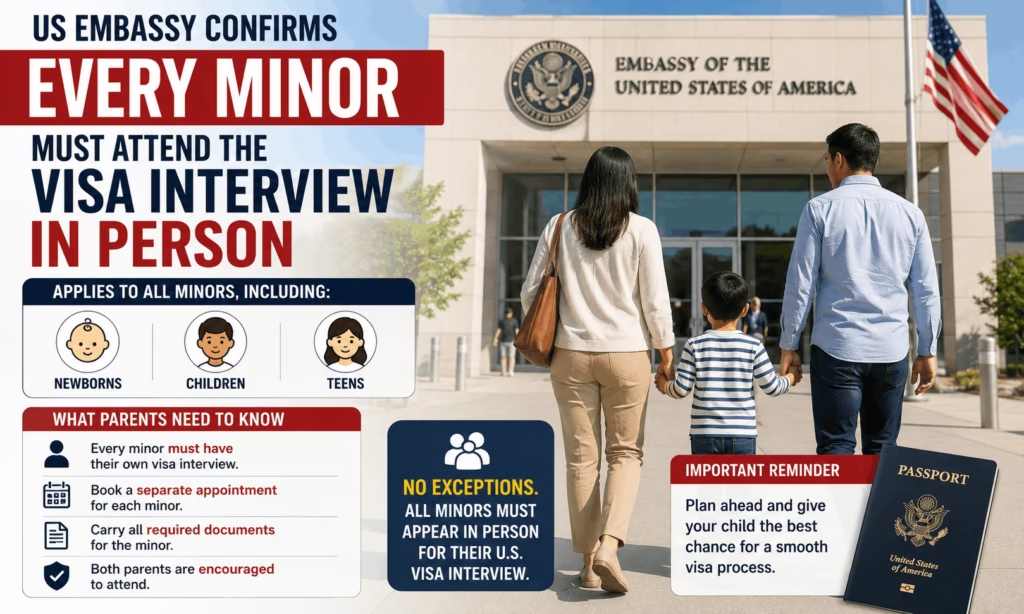
US Visa Alert For Minors: The US Embassy in India has just shut down one of the most common assumptions parents make while booking a visa appointment for their child. In a “Visa Friday” video posted on X on August 14, 2026, the embassy stated in plain terms that every visa applicant, including a newborn just days old, must appear in person for the consular interview. There is no age cutoff, no exception for very young children, and no way for a parent to complete this step on a child’s behalf. We’ll be updating this article monthly as new guidance comes in from the State Department and US embassies worldwide.
The clarification matters because a lot of outdated advice is still circulating online. Many visa consultants, travel forums, and even some older embassy pages still tell families that “children under 14 do not need to attend the interview” or that infants are usually exempt from biometrics. That guidance is no longer accurate. Since October 1, 2025, the Department of State rolled back nearly all of its interview waiver categories, and the US visa interview for minors is now mandatory in almost every case. A consular officer must physically see and observe every applicant, whether that applicant is six months old or seventeen years and 364 days old, before a visa can be issued. This piece breaks down exactly what changed, who is still exempt, what documents families need, and how to prepare a young child for a consular interview without confusion or last minute appointment problems.
What The US Embassy Actually Said About Minors
The embassy’s video was aimed squarely at parents who assume that age alone is a reason to skip the in-person interview. The message was direct: whether a child is a newborn or almost 18, they must appear in person for the consular interview. The embassy also confirmed that this applies at every single age in between, naming both a newborn and a 17-year-old as examples in the same breath to remove any ambiguity.
According to the embassy, this requirement exists because the interview is one of the most consequential steps in the entire visa process. A consular officer is required by policy to physically see every applicant before deciding on an application, and that rule now applies regardless of how young the traveler is. The embassy framed this as part of a broader effort tied to border security and national security screening, stating that keeping America’s border secure remains a top priority and that the visa vetting process is designed to uphold that standard.
For parents, the practical takeaway is simple. A mother or father cannot walk into the consulate, present the child’s documents, and answer questions on the child’s behalf while the child waits outside or stays home. The child has to be present in the interview room, even if a very young child does not actively answer any questions themselves.
Why This Confusion Exists In The First Place
Older, outdated guidance is the main reason so many parents get this wrong. For several years, various interview waiver programs allowed children under 14 and adults over 79 to skip the in-person interview altogether, provided a parent held a valid US visa or the child was renewing a visa that had not expired long ago. Some embassy pages from 2023 and 2024 still describe this older policy, and several visa consultancy websites, some updated as recently as mid-2026, continue to repeat it.
That earlier flexibility came from pandemic-era rules that let consular sections manage appointment backlogs by waiving interviews for lower-risk categories, including young children. Those flexibilities were gradually narrowed through 2025 and were mostly eliminated by October of that year. The result is a gap between what older articles say and what the actual policy requires today, and that gap is exactly what the embassy’s August 2026 video was trying to close.
Direct Express Card Transition to Fifth Third Bank: What 3.6 Million Cardholders Need to Know
Federal Fuel Excise Tax Suspension: Ford Pushes Carney to Extend Relief Past Labour Day
USCIS Restored Power To Deny Without RFE: Here Is What Policy Alert PA-2026-05 Actually Changes
IEEPA Tariff Refund Process: How Businesses Are Claiming Their Share of $166 Billion
The Policy Change Explained: From Waivers To Mandatory Interviews
To understand today’s rule, it helps to look at how the policy moved in stages over the past two years.
In December 2023, the State Department expanded interview waiver eligibility, letting more applicants, including many renewing visa holders and some first-time applicants, skip the interview if they met certain conditions. In February 2025, that expansion was reversed, and the renewal eligibility window was cut back to the standard 12-month limit set by law.
The bigger shift came later. Effective October 1, 2025, the Department of State updated its interview waiver categories again, and this time the age-based exemptions for children under 14 and adults over 79 were removed entirely. From that date forward, nearly all nonimmigrant visa applicants, regardless of age, are required to attend an in-person interview unless they fall into one of a small number of narrowly defined categories.
Those remaining categories are limited to certain diplomatic and official visa types, and to adult renewal applicants aged 18 or older who are renewing the same B-1, B-2, or B1/B2 visa within 12 months of the prior visa’s expiration, provided that prior visa was issued at full validity. Minors do not qualify for this renewal exception under any circumstance, since it explicitly requires the applicant to be at least 18 years old.
Who Is Still Exempt From The In-Person Interview
The list of exemptions left after the October 2025 change is short, and none of it applies to a typical family visa application. Below is a simple breakdown.
| Category | Interview Requirement |
|---|---|
| Newborns, infants, and toddlers | Must attend in person, no exception |
| Children under 14 | Must attend in person, no exception |
| Teenagers up to age 17 | Must attend in person, no exception |
| Adults 18 to 79 (first time applicants) | Must attend in person |
| Adults over 79 | Must attend in person, age exemption removed |
| B-1/B-2 renewal, applicant 18 or older, prior visa expired within 12 months at full validity | May qualify for interview waiver |
| A-1, A-2, G-1 to G-4, NATO categories, certain diplomatic/official visas | May qualify for interview waiver |
| First time H-2 agricultural or non-agricultural workers | Consular officer discretion, may qualify for waiver in some cases |
Even applicants who technically meet a waiver category are not guaranteed to skip the interview. Consular officers retain full discretion to call in any applicant for an in-person interview on a case by case basis, regardless of eligibility.
US Visa Alert For Minors Key Dates And Highlights
| Date | Development |
|---|---|
| December 21, 2023 | Interview waiver eligibility expanded, renewal window extended to 48 months |
| February 18, 2025 | Expansion reversed, renewal window cut back to statutory 12 months |
| July 25, 2025 | Department of State announces further rollback of waiver categories |
| September 18, 2025 | Updated waiver categories confirmed, age based exemptions to be removed |
| October 1, 2025 | New policy takes effect, children under 14 and adults over 79 lose automatic waiver eligibility |
| August 14, 2026 | US Embassy India posts video reminder confirming minors must attend interviews in person |
What Parents And Guardians Need To Do Before The Appointment
Booking a US visa interview for a child now takes the same amount of planning as booking one for an adult. Here is what typically needs to happen before appointment day.
First, complete the DS-160 nonimmigrant visa application form for the child through the official Consular Electronic Application Center. A parent or guardian fills this out on the child’s behalf, but the child’s own details, photograph, and passport information must be entered accurately.
Second, schedule the interview through the official visa appointment system used by the embassy or consulate where the family is applying. In India, and in most countries, this is handled through the ustraveldocs.com portal, which is linked from the embassy’s official visa pages.
Third, gather the required documents. These generally include the child’s valid passport, the DS-160 confirmation page, a recent passport-style photograph that meets State Department specifications, proof of the purpose of travel such as an admission letter or invitation, and financial documents showing the family can support the trip. For accompanied minors, a birth certificate and, where relevant, consent letters from a non-traveling parent may also be requested.
Fourth, plan for the child to be physically present at the consulate for the full appointment window, not just for a few minutes. Some consulates request biometric data, including fingerprints for children above a certain age, and a photograph for all applicants, so families should confirm the exact process listed on their specific consulate’s website in advance, since procedures for very young children can vary slightly by location.
Fifth, if a scheduled appointment cannot be kept because the child is unwell or unavailable, parents should contact the consulate promptly to reschedule rather than attending without the child, since an interview cannot proceed without the applicant present.
2027 Social Security COLA: 3.6% Estimate Beats Medicare Hike
2027 HSA Contribution Limits Announced: IRS Confirms $4,500 and $9,000 Caps
FTC Refund 2026: Millions of Americans May Be Owed Money and Most Don’t Know It
What Happens During The Interview For A Young Child
A common question from parents is what actually happens once they are in the interview room with an infant or toddler. The requirement is that the consular officer must be able to physically see and observe the applicant. It does not mean a two-year-old is expected to answer questions independently. In practice, the parent or guardian answers questions on behalf of a very young child while the child is present in the room, and the officer visually confirms the child matches the passport photograph and application details. For older children and teenagers, officers may ask the child simple, age-appropriate questions directly, particularly around the purpose of the trip or family details, though the extent of this varies by consular officer and consulate.
Official Resources
| Resource | Purpose | Official Link |
|---|---|---|
| DS-160 Application Form | Complete the nonimmigrant visa application | ceac.state.gov/genniv |
| Visa Appointment Scheduling | Book, reschedule, or check interview slots | ustraveldocs.com |
| US Embassy India Visa Page | Country specific rules, fees, and documents | in.usembassy.gov/visas |
| Department of State Visa News | Official national policy updates | travel.state.gov/content/travel/en/News/visas-news.html |
| Visa Appointment Wait Times | Check current wait times by consulate | travel.state.gov/content/travel/en/us-visas/visa-information-resources/wait-times.html |
| MRV Fee Payment and Status | Pay visa fee, check application status | ceac.state.gov/ceac |
Always confirm details directly on these official pages, since local procedures can differ slightly between consulates and can change with little notice.
FAQs About US Visa Alert For Minors
Does a newborn baby really need to attend a visa interview in person?
Yes. The current policy makes no exception for age. A newborn applying for a US visa must be present at the consular interview along with the parent or guardian.
Can one parent attend the interview while the other stays home with the baby?
No. At least one parent or guardian must bring the child to the interview in person. A visa cannot be issued to a minor applicant who was not physically present.
Is there any interview waiver left for children under 14?
No. The age based waiver for children under 14 was removed effective October 1, 2025. The only interview waivers that survive are for specific diplomatic and official visa categories, and for adult renewal applicants aged 18 or older under narrow conditions.
Do infants need to give fingerprints during the visa process?
Requirements can vary slightly by consulate and by the child’s age. Many consulates request a photograph for all applicants and may adjust biometric collection for very young children. Parents should check their specific consulate’s page for exact rules.
What documents does a minor need for a US visa interview?
Typically a valid passport, the DS-160 confirmation page, a compliant photograph, proof of the trip’s purpose, financial support documents, and a birth certificate. Some cases also require parental consent letters, especially if the child is traveling without both parents.
Can grandparents or other relatives take a child to the visa interview instead of a parent?
This depends on the child’s situation and the specific consulate’s requirements. In many cases a legal guardian or an adult with documented consent from the parents can accompany the child, but families should confirm this directly with the consulate before the appointment.
What happens if a child cannot attend the scheduled interview date?
Parents should contact the consulate as soon as possible to reschedule. It is better to postpone the appointment than to attend without the child, since the interview cannot proceed without the applicant present.
People Also Ask
Why did the US remove the interview waiver for children under 14? The State Department has tied the change to a broader effort to strengthen visa vetting across all applicant categories, stating that in-person interviews support border security and national security screening for every applicant, regardless of age.
Is this rule the same at every US embassy worldwide? The core interview requirement comes from Department of State policy and applies globally, though scheduling systems, biometric procedures, and appointment wait times can differ by country and by individual consulate.
How long does it take to get a US visa interview appointment for a child in 2026? Wait times vary widely by consulate and change frequently based on demand. Families should check the official State Department wait times page for the specific consulate where they plan to apply before making any fixed travel plans.
Conclusion
The core message from the US Embassy’s latest reminder is straightforward even if it surprises some parents. Since October 1, 2025, age is no longer a valid reason to skip the in-person visa interview, and that includes infants, toddlers, and teenagers applying alongside their parents. Families planning US travel should build the child’s physical presence into their appointment planning from the very start, gather the required documents ahead of time, and rely only on official State Department and embassy sources rather than older articles describing rules that no longer apply. Doing this early avoids last minute rescheduling and keeps the visa process moving smoothly for the whole family.
ICE Detained Military Families: AP Finds 50+ Spouses and Parents Held