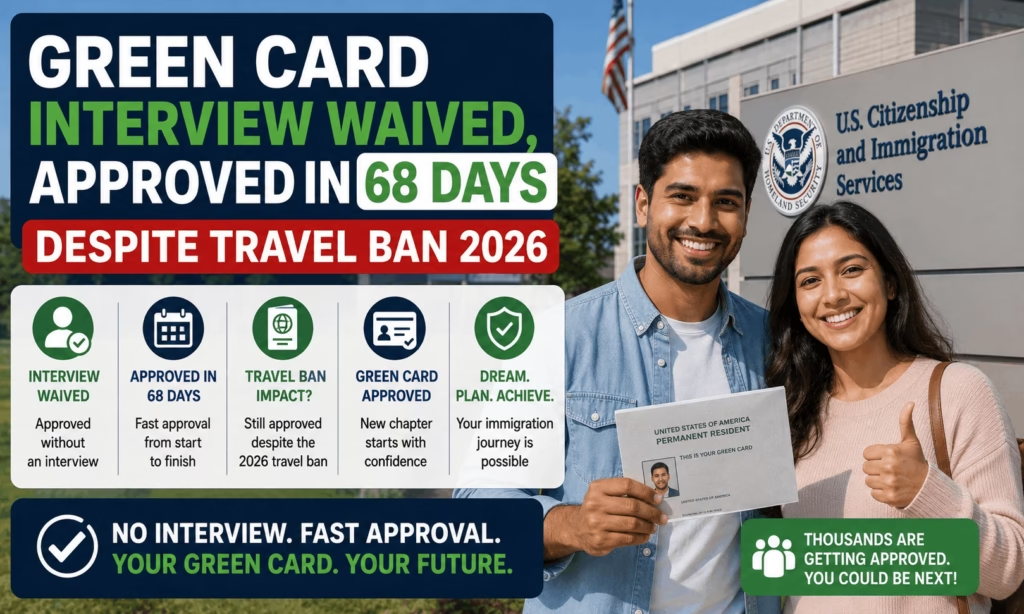
Green Card Interview Waived: At a time when USCIS has made in-person interviews the default for nearly every green card applicant, one case moving through the system stands out as a rare exception. A permanent residence applicant whose file had been frozen under the 39-country travel ban got their green card interview waived and their case approved in just 68 days once the hold was lifted, a result immigration attorneys say is now the exception rather than the rule. The case reflects a pattern lawyers have started reporting since a federal court in Rhode Island ordered USCIS to resume adjudicating green card applications that had been placed on indefinite hold because of the applicant’s nationality.
The core of the story is not luck. It comes down to a complete, well-documented file that gave a USCIS officer enough evidence to approve the case without scheduling an interview, even as the agency’s 2026 policy shift has sharply reduced how often that happens. This guide walks through what actually happened in cases like this one, why interview waivers are becoming rarer overall, how the 2026 travel restrictions affected pending applications, and what applicants can realistically do to put themselves in the same position. We’ll be updating this article monthly as USCIS processing patterns and court rulings continue to evolve.
Green Card Interview Waived Key Highlights
| Detail | Information |
|---|---|
| Outcome | Green card interview waived, case approved administratively |
| Total time from case reactivation to approval | 68 days |
| Policy background | 2026 Policy Manual update restricting interview waivers |
| Travel restriction involved | Presidential Proclamation 10998, the 39-country travel ban |
| Court ruling that unfroze cases | Dorcas International Institute of Rhode Island v. USCIS, June 5, 2026 |
| Standard I-485 processing time in 2026 | Roughly 8 to 14 months |
| Marriage-based interview waivers in 2026 | Effectively eliminated, interviews now mandatory |
| Employment-based/self-petition waivers | Still possible at officer discretion with strong evidence |
| Legal tool used to accelerate frozen cases | Individual mandamus or APA lawsuit against USCIS |
| RFE response window after interview | Typically 87 days |
The Case: What Happened and Why It Matters
The applicant’s Form I-485 had been sitting in USCIS’s system for months after their file was placed on an indefinite hold, one of hundreds of thousands of cases affected once the applicant’s country of nationality landed on the 39-country travel ban list that took effect January 1, 2026. Rather than wait indefinitely, the applicant’s attorney pursued a federal lawsuit compelling USCIS to act on the file, a strategy immigration lawyers increasingly use when an agency delay has no reasonable end date. Once a court ordered USCIS to resume processing, the officer assigned to the case reviewed a complete record, including consistent tax filings, medical exam results, biometrics already on file, and no red flags in the applicant’s immigration history, and determined an in-person interview was unnecessary. The I-485 was approved 68 days after the case was reactivated.
This kind of outcome illustrates a broader pattern immigration attorneys have started documenting since courts began pushing back on the nationality-based freeze: when USCIS resumes a case with a clean, thoroughly prepared file, the agency can still exercise its discretion to skip the interview, even in the current stricter climate. It does not mean interview waivers are common again, but it shows they remain possible for the right case.
Canada Disability Benefit: New $150 Payment Coming, Here’s the Update
Quebec Family Sponsorship Program Reopens With a New 15,700 Application Cap
Canadian Citizenship Certificate Wait Time Hits 19 Months as Backlog Nears 100,000
Why Green Card Interviews Are Mandatory Again in 2026
For years, well-documented marriage-based and employment-based green card cases saw waiver rates well above 90 percent under earlier USCIS guidance. That changed at the start of 2026. USCIS updated its Policy Manual to dramatically restrict interview waivers, citing stronger fraud detection, enhanced national security vetting, and closer review of applicants’ social media activity, financial records, and immigration history. For marriage-based green cards specifically, the limited waiver provisions that previously existed have been eliminated entirely; every marriage-based applicant is now expected to appear for an interview, with essentially no exceptions.
Employment-based applicants, particularly in categories like EB-1A and EB-2 NIW where historical fraud rates are low, still see interview waivers more often than other categories, but even these cases are increasingly scheduled for interviews if the applicant filed I-140 and I-485 concurrently for the first time or has a complex immigration history.
How the 39-Country Travel Ban Froze Pending Cases
On December 16, 2025, the Trump administration issued Presidential Proclamation 10998, expanding an earlier travel ban from 19 countries to 39 countries, effective January 1, 2026. Nineteen countries face a full suspension of entry, including Afghanistan, Haiti, Iran, Libya, Somalia, Sudan, and Yemen, while twenty more face partial restrictions. Beyond the entry ban itself, USCIS separately rolled out internal policies that placed indefinite holds on pending applications for green cards, work permits, and naturalization filed by nationals of the 39 designated countries. Officers were also directed to treat an applicant’s nationality from one of those countries as a “significant negative factor” in any pending case, and USCIS began a re-review of benefits already granted to nationals of those countries since the start of the prior administration.
Separately, the State Department paused immigrant visa issuance for nationals of 75 countries starting January 21, 2026, a distinct policy from the entry ban that specifically affects consular processing of green card cases filed from abroad.
The Court Ruling That Reopened Frozen Files
On June 5, 2026, a federal judge in the District of Rhode Island ruled in Dorcas International Institute of Rhode Island v. USCIS, striking down four USCIS policies that had paused benefits for nationals of the 39 travel-ban countries and directed officers to treat nationality as a negative factor. The court ordered USCIS to resume adjudicating the frozen applications. Importantly, the ruling did not lift the travel ban itself, nor the State Department’s separate visa-issuance pause for nationals of certain countries applying from abroad; it applies to USCIS’s internal processing of applications already filed, largely benefiting people already inside the United States. The government retains the option to appeal.
For applicants like the one in this case, the ruling meant a file that had effectively been sitting untouched for months was suddenly back in an officer’s queue, and because the underlying case was strong, it moved quickly once reopened.
Who Can Still Get an Interview Waiver in 2026
USCIS interview waivers cannot be requested directly. There is no checkbox, form, or formal procedure for an applicant to ask for one; the decision rests entirely with the assigned officer, based on whether the complete file already establishes eligibility and admissibility. Cases that still have a realistic chance at a waiver typically share these traits:
- Employment-based self-petitions (EB-1A extraordinary ability, EB-2 NIW) with strong, well-organized evidence
- No prior visa refusals or unresolved discrepancies in the immigration record
- Consistent tax filings and financial records matching claimed income
- No red flags such as multiple prior I-130 petitions, entry on a short-term visa shortly before filing, or unresolved prior marriages
- A single, well-organized filing package with all required forms, medical exam results, and supporting evidence submitted together
Marriage-based applicants, by contrast, should assume an interview will happen and prepare accordingly rather than counting on a waiver.
COVID Tax Refunds: Who Might Still Qualify, What The Kwong Ruling Means, And Your Options Now
Canada Asylum Rules 2026: What Changed, What’s Next?
Canada’s High-Wage Occupation Proposal: Who Could Benefit Most
What Made This 68-Day Approval Possible
Three factors combined to make this outcome possible. First, the underlying I-485 package was complete and internally consistent well before the freeze, meaning there was nothing left for an officer to chase down once the case was reactivated. Second, the case fell into a category, employment-based self-petition, where USCIS retains meaningfully more discretion to waive interviews than it does for marriage-based filings. Third, the applicant’s attorney used a federal mandamus or Administrative Procedure Act (APA) lawsuit to force USCIS to act rather than waiting indefinitely for the agency to revisit the file on its own timeline. Courts can, and increasingly do, order USCIS to adjudicate a specific case within a set number of days once a lawsuit is filed and the delay is shown to be unreasonable.
Timeline: From Freeze to Approval
| Stage | What Happened |
|---|---|
| I-485 originally filed | Complete package submitted with I-140/self-petition evidence |
| Case placed on hold | Nationality-based freeze applied under 2026 travel ban policies |
| Mandamus/APA lawsuit filed | Attorney petitions federal court to compel USCIS action |
| Court orders resumption | USCIS directed to adjudicate the case on a set timeline |
| Case reactivated | File reassigned to an officer for review |
| Interview determination | Officer reviews the complete record and waives the interview |
| Approval | I-485 approved 68 days after reactivation |
What Applicants Can Do If Their Case Is Stuck
Applicants whose green card cases have been sitting without movement, particularly nationals of the 39 travel-ban countries, have a few realistic options. They can submit a case inquiry through the USCIS online account or contact center once a case has exceeded normal processing times. If that produces no result, they can request assistance from the USCIS Ombudsman. For cases stuck well beyond a reasonable timeframe, many attorneys now recommend evaluating a federal mandamus or APA lawsuit, which does not guarantee a favorable outcome but compels the agency to make a decision, positive or negative, within a court-ordered window. Applicants should also make sure their own file has no outstanding gaps, since a court order to adjudicate a case does not override normal eligibility requirements.
Latest Updates
- June 5, 2026 ruling still in effect: The Rhode Island federal court’s order requiring USCIS to resume processing frozen applications for nationals of the 39 travel-ban countries remains in force, though the government retains the ability to appeal.
- Travel ban unchanged: Presidential Proclamation 10998’s entry restrictions for the 39 countries remain active; the June 5 ruling addressed USCIS’s internal benefits freeze, not the entry ban itself.
- State Department visa freeze ongoing: The separate pause on immigrant visa issuance for nationals of 75 countries, which began January 21, 2026, remains in place with no announced end date.
- Marriage-based interviews remain mandatory: USCIS has given no indication it will reinstate marriage-based interview waivers in 2026, and legal practitioners continue advising all spousal applicants to prepare for an in-person interview.
- Mandamus filings rising: Immigration attorneys report a noticeable increase in federal mandamus and APA lawsuits filed on behalf of applicants whose cases were frozen under the nationality-based hold, several resulting in court-ordered adjudication deadlines.
Official USCIS and Government Resources
| Resource | Purpose | Official Link |
|---|---|---|
| USCIS Online Account | Case status, document uploads, secure messaging | uscis.gov/myaccount |
| Check Case Status | Track your I-485 in real time | uscis.gov/casestatus |
| Check Processing Times | Field-office specific I-485 estimates | egov.uscis.gov/processing-times |
| USCIS Contact Center | Submit case inquiries beyond normal processing time | uscis.gov/contactcenter |
| USCIS Ombudsman | Escalate unresolved case delays | dhs.gov/case-assistance |
| Form I-485 Instructions | Official filing requirements | uscis.gov/i-485 |
| Presidential Proclamation 10998 | Full text of the 2026 travel ban | whitehouse.gov |
FAQs
Can I request that USCIS waive my green card interview?
No. There is no form or request process. The decision is entirely up to the assigned USCIS officer based on your complete file.
Does the 39-country travel ban stop someone from getting a green card entirely?
Not permanently. The June 5, 2026 court ruling ordered USCIS to resume processing applications that had been frozen, though the underlying travel ban on new entries remains in effect.
Are marriage-based green card interviews ever waived in 2026?
Essentially no. USCIS eliminated the limited marriage-based waiver provisions at the start of 2026, and interviews are now considered mandatory for spousal cases.
What is a mandamus lawsuit and how does it help a stuck green card case?
It is a federal lawsuit asking a court to compel a government agency to act on an unreasonably delayed application. It does not guarantee approval but forces USCIS to issue a decision within a set timeframe.
How long does a typical green card application take in 2026?
Most I-485 applications take roughly 8 to 14 months from filing to a decision, though nationality-based holds and RFEs can extend that significantly.
What happens if I get a Request for Evidence after my interview?
Applicants generally have about 87 days to respond, and working with an immigration attorney on the response is strongly recommended.
People Also Ask
Why would USCIS waive a green card interview? An officer may waive the interview when the applicant’s file already contains sufficient evidence of eligibility and admissibility, most commonly in strong employment-based self-petition cases.
Is it normal to get a green card without an interview in 2026? It’s less common than in prior years. USCIS restricted waiver eligibility broadly at the start of 2026, though certain employment-based categories still see waivers more often than others.
What is the 39-country travel ban and who does it affect? It’s a 2026 presidential proclamation restricting entry for nationals of 39 countries, with 19 facing a full suspension and 20 facing partial restrictions on visas and green card processing.
Can a lawsuit speed up a stuck green card case? Yes, a federal mandamus or APA lawsuit can compel USCIS to issue a decision within a court-ordered deadline when a case has been delayed beyond a reasonable time.
Do green card holders still need interviews if their case was frozen and reopened? It depends on the category. Employment-based cases with strong documentation may still qualify for a waiver, while marriage-based cases will almost always require an interview regardless of prior delays.
Conclusion
A green card interview waived and approved in 68 days sounds unusual in 2026’s stricter environment, and it is, but it is not impossible. This case shows how a genuinely complete, well-documented file combined with legal pressure through a federal lawsuit can cut through even a nationality-based freeze tied to the 39-country travel ban. For most applicants, especially those pursuing marriage-based green cards, the realistic expectation in 2026 is a mandatory in-person interview and a total timeline closer to 8 to 14 months. But for employment-based self-petitioners with clean, thorough filings, and for anyone whose case has been unreasonably delayed by the current travel restrictions, this outcome is a reminder that strong preparation and, when necessary, court intervention can still move a stalled case forward.
Missouri SNAP Food Ban Delayed: What’s Banned & Latest Status
Hawaii SNAP Soda Ban Delayed to 2027: What Will Be Banned & Status
Florida SNAP Junk Food Ban 2026: What’s Banned, Court Update, EBT Rules & Latest Status
Nevada SNAP Food Ban: What’s Banned & Start Date Explained