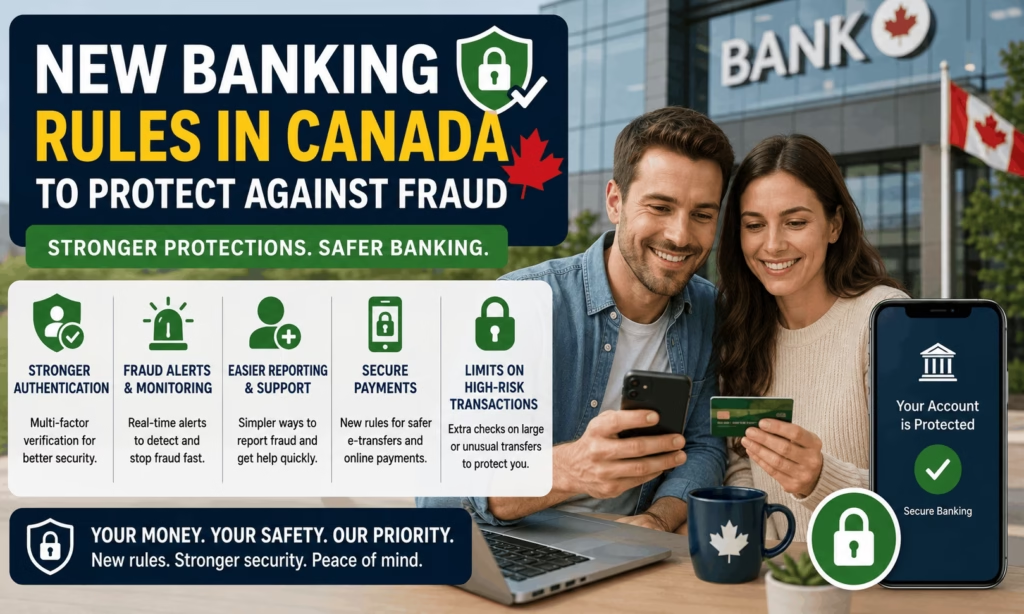
New Canada Banking Rules 2026: Canada’s Department of Finance has pre-published a sweeping set of new banking fraud protection rules that will change how every bank governed by the Bank Act handles your money, your wire transfers, and your fraud complaints. The proposed regulations, released in the Canada Gazette, Part I on June 27, 2026, mark the first real teeth behind Bill C-15, the law that gave Ottawa the power to force banks into actively fighting consumer-targeted fraud instead of just apologizing for it after the fact. For anyone who banks in Canada, this is the most significant consumer-protection shake-up in years, and it arrives at a moment when fraud losses have never been higher.
The timing is not a coincidence. Canadians lost more than $704 million to fraud in 2025 alone, according to the Canadian Anti-Fraud Centre (CAFC) — the worst year on record, and up sharply from $638 million in 2024. Because the CAFC itself estimates that only 5% to 10% of fraud is ever reported, the real national toll could run into the billions. The new banking rules in Canada are designed to close the biggest gap fraudsters exploit: banks that let money move out of an account too easily, with too little friction, and too little accountability. We’ll be updating this article monthly as the regulations move from proposal to final law, so bookmark this page for the latest developments.
New Canada Banking Rules 2026 Key Highlights
| Detail | Information |
|---|---|
| Governing law | Budget Implementation Act, 2025, No. 1 (Bill C-15) |
| Royal Assent date | March 26, 2026 |
| Regulations published | June 27, 2026 (Canada Gazette, Part I) |
| Public comment period | June 27, 2026 – July 27, 2026 |
| Regulator overseeing rules | Financial Consumer Agency of Canada (FCAC) |
| Regulations come into force | July 1, 2027 (staggered rollout) |
| First fraud-data reporting period | January 1, 2028 – December 31, 2028 |
| First FCAC annual report due | May 15, 2029 |
| 2025 fraud losses (reported) | $704 million+ (CAFC) |
| Cumulative losses since 2022 | Over $2.4 billion |
| Estimated 10-year net benefit | $2.3 billion (Finance Canada regulatory impact analysis) |
Why Canada Is Overhauling Bank Fraud Protection Right Now
Fraud in Canada is no longer a slow, low-tech nuisance — it is an organized, AI-assisted industry. Officials at the Competition Bureau have said openly that generative AI has handed scammers powerful new tools to build convincing fake identities, fake investment platforms, and deceptive marketing schemes that are far harder for ordinary Canadians to spot. That warning lines up with what the numbers show: investment fraud alone cost Canadians $351 million in 2025, romance and relationship scams cost more than $63 million, and job scams cost over $50 million. Identity fraud was the single most reported category, with over 8,400 cases logged by the CAFC last year.
Interestingly, younger Canadians are not immune. Despite the common assumption that seniors are the primary targets, industry survey data now shows Canadians aged 18 to 34 are increasingly falling for scams delivered through social media and email, even though this age group reports the highest confidence in spotting AI-generated fraud. Older Canadians, meanwhile, tend to lose far larger sums per incident when they are targeted. This is one reason the new banking regulations apply broadly across account types and age groups rather than targeting a single demographic.
Missouri SNAP Food Ban Delayed: What’s Banned & Latest Status
Hawaii SNAP Soda Ban Delayed to 2027: What Will Be Banned & Status
Florida SNAP Junk Food Ban 2026: What’s Banned, Court Update, EBT Rules & Latest Status
Nevada SNAP Food Ban: What’s Banned & Start Date Explained
The 7 New Banking Rules Protecting Canadian Consumers From Fraud
1. Banks Must Get Your Express Consent Before Enabling Wire Transfers
Under the proposed Financial Consumer Protection Framework Regulations, banks can no longer automatically switch on electronic funds transfer (EFT) capabilities — including wire transfers — on a personal deposit account. You must actively opt in. This single change targets one of the most common fraud patterns: a scammer convincing a victim to authorize a large, irreversible wire transfer that the account never needed enabled in the first place.
2. You Can Disable Specific Account Capabilities Yourself
The rules give consumers the right to switch off certain account features entirely — not just wire transfers, but other electronic transfer capabilities they don’t use. If you never send international wires or large e-transfers, you’ll be able to lock that functionality down, shrinking the attack surface a fraudster can exploit even if your login credentials are compromised.
3. Banks Must Process Withdrawal and Transaction Limit Changes Within Set Timelines
Right now, changing your daily withdrawal or transfer limit can be slow and inconsistent between banks. The new framework requires banks to process customer requests to adjust withdrawal and transaction limits within prescribed timelines, giving Canadians a faster, more predictable way to tighten controls on their own accounts the moment they suspect something is wrong.
4. Mandatory Fraud Detection and Prevention Policies
Every bank will be legally required to maintain formal policies and procedures to detect consumer-targeted fraud and reduce its impact — not as a best practice, but as a binding obligation under the amended Bank Act. This shifts fraud prevention from a reputational concern to a compliance requirement enforced by the Financial Consumer Agency of Canada.
5. Standardized Fraud Victim Determination Process
Banks will have to establish clear criteria to determine whether a customer is a victim of fraud, assess whether any remedy applies, and communicate that decision to the affected consumer. It’s worth being precise here: the regulations do not introduce new mandatory reimbursement rules. Consumers remain protected on unauthorized card transactions, but losses from account-based transfers made under deception may still not be automatically refunded. What changes is that banks must now follow a consistent, documented process rather than an ad hoc one.
6. Mandatory Annual Fraud Reporting to the FCAC
Banks will be required to collect and annually report fraud-related data to the Financial Consumer Agency of Canada. The first full reporting period runs from January 1 to December 31, 2028, with the initial submission due by May 15, 2029. This is expected to give regulators, and eventually the public, a much clearer national picture of how fraud actually moves through the banking system.
7. An Annual Public Report From the FCAC Commissioner
The Commissioner of the FCAC must, in turn, prepare an annual report summarizing fraud data collected from banks and submit it to the Minister of Finance. Over time, this creates an accountability loop: banks report fraud data to the regulator, and the regulator reports a national summary back to government and, indirectly, to the public — something Canada has never had in this level of detail before.
How This Connects to Canada’s Open Banking Rollout
These fraud protections aren’t happening in isolation. They are being introduced alongside Canada’s long-delayed consumer-driven banking framework, more commonly known as open banking. The idea, first floated in the 2018 federal budget, lets Canadians securely share their financial data with third-party apps and services — but only if the underlying system is trustworthy. Finance Canada’s own regulatory impact analysis estimates the combined framework will deliver a net benefit of $2.3 billion over 10 years, with total benefits reaching roughly $13.2 billion against $457.7 million in compliance costs. In short, fraud protection is being treated as the security foundation that has to exist before open banking can safely expand.
National Anti-Fraud Strategy
The banking-specific rules are just the first visible piece of a much larger initiative. The federal government formally launched public consultations on Canada’s first-ever National Anti-Fraud Strategy on March 30, 2026, aiming for a coordinated, whole-of-government approach across banks, telecoms, law enforcement, and consumer protection agencies. Fraud Prevention Month 2026, held every March and jointly run by the Competition Bureau, the CAFC, and the RCMP, was used this year to spotlight just how fast organized fraud rings have scaled up their operations across Ontario and beyond.
COVID Tax Refunds: Who Might Still Qualify, What The Kwong Ruling Means, And Your Options Now
Canada Asylum Rules 2026: What Changed, What’s Next?
Canada’s High-Wage Occupation Proposal: Who Could Benefit Most
Fraud Statistics Every Canadian Should Know in 2026
- $704 million+ reported fraud losses in 2025 — the highest on record
- 112,000+ individual fraud reports filed with the CAFC in 2025
- $2.4 billion+ in cumulative reported losses since 2022
- $351 million lost to investment fraud in 2025 (the single largest category)
- $63.3 million lost to romance and relationship scams
- $50.6 million lost to job and employment scams
- 8,403 identity fraud cases, the most frequently reported fraud type
- Only 5–10% of actual fraud incidents are believed to be reported at all
What You Should Do Right Now
While these regulations won’t be legally binding until July 1, 2027, there is no reason to wait to protect yourself. Call your bank and ask whether wire transfer or international e-transfer capabilities are currently active on your account if you don’t use them. Set conservative daily withdrawal and transfer limits. Enable multi-factor authentication everywhere it’s offered, and never share a one-time passcode with anyone, even someone claiming to be from your bank, the CRA, or the CAFC itself — legitimate institutions never ask for that code over the phone. If you’re ever unsure whether a call, text, or email is genuine, hang up and call your bank back using the number printed on your card, not a number given to you by the caller.
Official Resources and Where to Report Fraud
| Resource | Purpose | Official Link |
|---|---|---|
| Department of Finance Canada | Full regulatory announcement and consultation details | canada.ca/en/department-finance |
| Canada Gazette, Part I | Read and comment on the proposed regulations | gazette.gc.ca |
| Canadian Anti-Fraud Centre (CAFC) | Report fraud, view current scam alerts | antifraudcentre-centreantifraude.ca |
| CAFC Fraud Reporting Line | Report fraud by phone | 1-888-495-8501 |
| Financial Consumer Agency of Canada (FCAC) | Bank complaints, consumer rights, account protections | canada.ca/en/financial-consumer-agency |
| Competition Bureau Canada | Report deceptive marketing and scam schemes | competitionbureau.gc.ca |
| Report Cybercrime and Fraud Portal | File an official fraud report online | antifraudcentre-centreantifraude.ca/report-signalez |
FAQs
When do the new banking fraud rules actually take effect?
The regulations are still in the proposal stage. They were pre-published on June 27, 2026, and are set to come into force on July 1, 2027, following a staggered rollout that starts with accreditation and common-rule requirements.
Do these rules guarantee I’ll get my money back if I’m scammed?
Not automatically. The rules standardize how banks investigate and determine fraud claims, but they do not create a blanket reimbursement guarantee. You remain protected against unauthorized card transactions, while transfers you were tricked into authorizing yourself are assessed case by case.
Will my bank turn off wire transfers on my account automatically?
No. Existing account features won’t be switched off retroactively just because the rule takes effect. The requirement is that banks obtain your express consent before newly enabling electronic funds transfer capabilities, and that you’re given the ability to disable them if you choose.
How do I report a scam right now, before the new rules exist?
Contact the Canadian Anti-Fraud Centre at 1-888-495-8501 or file a report through their online portal, and also notify your bank directly and your local police. Report it even if you didn’t lose money — the data still helps track scam patterns.
Why did fraud losses hit a record high in 2025 if Canada already had consumer protection rules?
Existing rules focused mainly on card-based transactions. Fraudsters increasingly shifted toward e-transfers, wire transfers, and investment scams that fall outside older protections, which is precisely the gap these new regulations are designed to close.
Is this related to open banking in Canada?
Yes. The fraud protection rules and the consumer-driven banking (open banking) framework are being rolled out together, since regulators consider strong fraud safeguards a prerequisite for safely allowing Canadians to share financial data with third-party apps.
Can I still submit feedback on these proposed rules?
The official 30-day comment period ran from June 27 to July 27, 2026. Final regulations, incorporating public feedback, are expected to be published ahead of the July 1, 2027 implementation date — check the Canada Gazette for updates on the finalized text.
Conclusion
Canada’s new banking rules for fraud protection represent the most concrete regulatory response yet to a fraud crisis that cost Canadians a record $704 million in 2025 alone. From mandatory consent before wire transfers to standardized fraud-victim assessments and annual public reporting, the framework built around Bill C-15 puts real, enforceable obligations on banks for the first time. The rules won’t be fully in force until July 1, 2027, and the fine print may still shift before then, but the direction is clear: Canadian regulators are treating bank fraud prevention as a structural requirement, not a customer-service nicety. Until the law fully takes effect, the strongest protection remains the oldest advice — verify before you transfer, and never share a one-time code with anyone.
Canada Disability Benefit: New $150 Payment Coming, Here’s the Update
Quebec Family Sponsorship Program Reopens With a New 15,700 Application Cap
Canadian Citizenship Certificate Wait Time Hits 19 Months as Backlog Nears 100,000