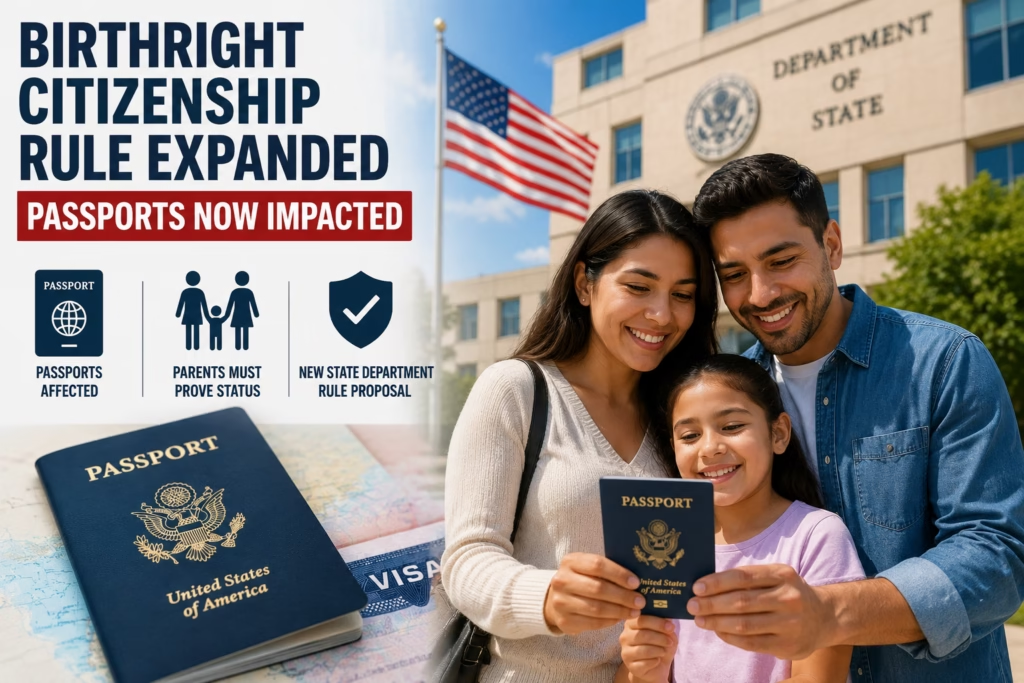
Trump’s Birthright Citizenship Crackdown Reaches Passport Applications: The State Department is drafting a rule that would fundamentally change how every American parent applies for a passport for their U.S.-born child, requiring proof of the parent’s own citizenship or immigration status for the first time in the process’s history. Reuters reported on September 1, 2026, after reviewing the draft guidance directly, that this represents the first detailed look at how the administration plans to enforce President Trump’s August 6, 2026 executive order targeting so-called “birth tourism.” State Department spokesman Tommy Pigott confirmed the administration’s intent bluntly, saying the passport adjudication process needs to fully reflect the administration’s stated commitment to protecting what it calls the meaning and value of American citizenship.
This isn’t a return of the broader executive order the Supreme Court already struck down. That earlier order, signed on Trump’s first day back in office in January 2025, would have denied automatic citizenship to children born to undocumented or temporarily present parents, and the Court ruled 6-3 against it in Trump v. Barbara on June 30, 2026. What’s happening now is narrower but still consequential: a passport paperwork requirement built around a different, more limited August 6 order, one legal experts note could still face its own court challenge before ever taking effect. We’ll be updating this article monthly as new details on this passport rule and related birthright citizenship litigation emerge.
Latest Update: What the Draft Passport Rule Would Actually Require
| Detail | Information |
|---|---|
| Reported by | Reuters (Kristina Cooke and Nate Raymond), September 1, 2026 |
| Status | Draft guidance, not yet finalized or implemented |
| Underlying executive order | Executive Order 14418, signed August 6, 2026 |
| What EO 14418 targets | “Birth tourism,” entering the U.S. on a nonimmigrant visa specifically to give birth |
| Current passport requirement | Parents check a box confirming citizenship status; no supporting documents required |
| Proposed new requirement | Parents must submit proof: valid U.S. passport, birth certificate, I-94 form, or green card |
| Legal basis cited in draft guidance | Determining whether the applicant is subject to EO 14418 |
| Related June 2026 ruling | Supreme Court, 6-3, struck down the broader January 2025 EO 14160 in Trump v. Barbara |
| Groups excluded from citizenship under EO 14418 | Children of foreign government employees, “alien enemies,” those born via commercial/fraudulent birth tourism arrangements |
| Legal challenge status | Order already being challenged in court by the Asian Law Caucus, ACLU, Legal Defense Fund, and Democracy Defenders Fund |
How Passport Applications Work for Children Right Now?
To understand how significant this proposed change actually is, it helps to know exactly what today’s process looks like. Currently, when a parent applies for a passport for their U.S.-born child, they need to prove the child’s citizenship, typically through a birth certificate, and confirm the child’s relationship to the parent or guardian applying. Both parents or legal guardians generally need to appear in person for children under 16, presenting government-issued identification.
Critically, parents themselves are not currently required to prove their own citizenship or immigration status. They simply check a box on the application form indicating whether they’re U.S. citizens, with no supporting documentation demanded for that specific declaration. That distinction, between proving a child’s status versus proving a parent’s status, is exactly what the draft guidance would eliminate.
What the Draft Guidance Would Change?
Under the proposed rule reviewed by Reuters, the State Department draft states plainly that the agency “will require parental information and evidence of parental citizenship or immigration status as part of its determination whether the applicant is subject to EO 14418.” In practice, this means every parent applying for a child’s passport would need to submit one of several forms of documentation: a valid U.S. passport or birth certificate proving their own citizenship, or, if not a citizen, evidence of lawful immigration status such as an I-94 arrival/departure record or a green card.
This represents a structural shift from a self-reported checkbox to a documented verification requirement, applied broadly to all parents rather than narrowly targeted only at the specific categories the underlying executive order actually addresses. That gap between the order’s stated narrow purpose and the proposed rule’s broader documentation demand is likely to become a central point in any legal challenge to the guidance.
Executive Order 14418: What It Actually Targets
It’s worth being precise about what this order does and doesn’t do, since confusion between it and the earlier, broader order has been widespread. President Trump signed two separate executive orders on August 6, 2026. The first identifies specific categories of children the administration argues fall outside birthright citizenship under historical exceptions the Supreme Court referenced in its June ruling, including children of foreign diplomatic staff, children of individuals classified as “alien enemies,” and children born through what the order calls deceptive commercial birth tourism arrangements. The second order, Executive Order 14418, the one directly tied to this passport guidance, directs the Secretary of State and Secretary of Homeland Security to combat birth tourism specifically, defined as entering the U.S. on a nonimmigrant visa for the purpose of giving birth on American soil.
Legal analysts have consistently noted this pair of orders is considerably narrower than the broader January 2025 order the Supreme Court struck down. According to multiple legal explainers published in the weeks after the August signing, children of H-1B workers, F-1 students, green card holders, and ordinary visitors generally remain unaffected, and the order’s scope is limited to specific, defined categories rather than a blanket exclusion based on parental immigration status.
Trump Birthright Citizenship Executive Orders: What Changed After Supreme Court Ruling
US Birthright Citizenship 2026: Supreme Court Ruling, New Congressional Bills & What Happens Next
Florida Minimum Wage Reaches $15/Hour: The Final Step of a Six-Year Countdown Arrives September 30
Why This Rule Would Still Affect Far More Than Its Stated Target
Here’s the practical tension driving most of the criticism directed at this draft guidance: even though Executive Order 14418 narrowly targets birth tourism, a documentation requirement applied to every parent seeking a child’s passport doesn’t stay narrowly targeted in practice. A U.S. citizen parent with a straightforward citizenship history would need to locate and submit proof just like anyone else, adding a new documentary burden to a process that previously required nothing beyond identification and the child’s own citizenship evidence.
Advocacy organizations already challenging the underlying executive orders in court, including the Asian Law Caucus, the ACLU, the NAACP Legal Defense Fund, and the Democracy Defenders Fund, have argued the broader pattern of 2026’s birthright citizenship orders represents an attempt to achieve through administrative and procedural means what the Supreme Court already ruled unconstitutional through direct executive action. Whether this specific passport guidance survives that same legal scrutiny, if it’s formally proposed and challenged, remains an open question, since draft guidance reviewed by a reporter is not the same as a finalized, legally binding State Department rule.
Where This Stands in the Broader 2026 Birthright Citizenship Timeline
This passport guidance is the latest entry in a fast-moving sequence of legal and administrative actions that has played out over the past several months.
| Date | Development |
|---|---|
| January 20, 2025 | Trump signs Executive Order 14160, broadly restricting birthright citizenship |
| June 30, 2026 | Supreme Court rules 6-3 in Trump v. Barbara, striking down EO 14160 as unconstitutional |
| August 6, 2026 | Trump signs two new, narrower executive orders, including EO 14418 targeting birth tourism |
| Late August 2026 | Advocacy groups file legal challenges against the new executive orders |
| September 1, 2026 | Reuters reveals draft State Department guidance requiring parental status proof for child passports |
This pattern, a Supreme Court loss followed by narrower, more procedurally-focused follow-up actions, is consistent with how the administration approached similar setbacks elsewhere in its immigration agenda throughout 2026, and it’s part of why immigration attorneys are advising affected families to track implementation guidance closely rather than assuming a single court ruling permanently resolves an issue.
What Parents Should Know Right Now
Given that this is still draft guidance rather than an implemented rule, a few practical points matter most for parents navigating passport applications during this period of uncertainty.
- Nothing has changed yet for standard passport applications. As of this update, parents applying for a child’s passport still follow the existing process: checking a box confirming citizenship status without submitting supporting documentation for that specific declaration.
- Birthright citizenship itself remains fully intact. The Supreme Court’s June 30, 2026 ruling means any child born on U.S. soil is a citizen at birth regardless of parental immigration status, and that constitutional holding has not been altered by either of the August 6 executive orders or this draft passport guidance.
- This guidance, if finalized, would primarily create a documentation burden, not a citizenship determination change, for the vast majority of parents whose children don’t fall into the narrow categories EO 14418 actually targets.
- Watch for formal rulemaking or a Federal Register notice. Draft guidance reviewed by journalists represents an early stage; a final rule would typically require additional agency action before taking legal effect.
- Consult an immigration attorney if your family’s situation involves any of the specific categories referenced in the August 6 orders, including foreign government employment, alien enemy designations, or a temporary visa entered specifically for childbirth purposes.
Social Security 2100 Act 2027: Bigger COLA Increase, Higher Benefits & Latest Bill Update
2027 HSA Contribution Limits Announced: IRS Confirms $4,500 and $9,000 Caps
How to Apply for a Child’s Passport Under Current Rules
- Complete Form DS-11 for a first-time child passport application.
- Gather the child’s evidence of U.S. citizenship, typically a certified birth certificate.
- Provide evidence of the child’s relationship to the applying parents or guardians.
- Both parents or legal guardians should appear in person where possible; if only one parent appears, additional consent documentation is required.
- Present original parental identification, along with photocopies of the front and back.
- Submit the application at an acceptance facility or passport agency, along with applicable fees.
Processing Time for Child Passport Applications
Standard child passport processing currently follows the same general timeline as adult passport applications, typically several weeks for routine service, with expedited options available for an additional fee. If the draft parental documentation requirement is eventually finalized, processing times could be affected for applications where parents haven’t gathered the newly required proof in advance, since incomplete applications are typically returned or delayed pending additional documentation, a pattern consistent with how other 2026 immigration-adjacent form changes have been implemented.
What This Means for Application Fees
The draft guidance reviewed by Reuters does not indicate any new fee tied specifically to the proposed parental documentation requirement. Standard child passport application fees remain governed by the existing State Department fee schedule. Families should be aware, however, that gathering additional documentation, such as replacing a lost birth certificate or requesting a copy of an I-94 record, can carry its own separate costs depending on the specific document needed.
How Supporters and Critics View This Proposal
As with most elements of the broader birthright citizenship debate, this draft guidance has drawn sharply different reactions depending on who’s evaluating it. The administration’s stated position, articulated by State Department spokesman Tommy Pigott, frames the change as a necessary alignment between passport adjudication and the administration’s broader citizenship policy goals, arguing that verifying parental status is a reasonable step to ensure passport issuance genuinely reflects who qualifies under the narrower exceptions the Supreme Court itself acknowledged exist within the Fourteenth Amendment’s Citizenship Clause. Supporters of stricter immigration enforcement have generally argued that documentation requirements matching a stated policy goal, in this case identifying birth tourism cases, are a normal part of implementing any executive order once it’s signed.
Critics, including the advocacy organizations already challenging the underlying executive orders in court, argue the mismatch between the order’s narrow stated purpose, targeting a specific and relatively small category of birth tourism cases, and a documentation requirement applied to every parent regardless of citizenship history reveals a broader intent to create friction and delay across the entire passport system, not just the narrow population the order describes. Immigration attorneys have also raised practical concerns about parents who may struggle to quickly produce older documents, such as birth certificates from decades past or naturalization records, potentially delaying passport issuance for citizen families with no connection whatsoever to the birth tourism concerns the order describes.
What Happens Next: The Path From Draft to Final Rule
Understanding the typical process for how draft agency guidance becomes binding policy helps set realistic expectations for timing. Federal agencies generally move from internal draft guidance, the stage this passport proposal currently sits at, through several possible next steps: formal publication in the Federal Register, potentially including a public comment period depending on how the agency classifies the rule change, and eventual implementation with a specified effective date. Given that the underlying executive orders are already facing active litigation, any formal passport rule tied to EO 14418 would likely face its own separate legal challenge before or shortly after implementation, following the same pattern seen with several other 2026 immigration policy changes that encountered court intervention during their rollout. Families and immigration attorneys tracking this issue should expect a period of continued uncertainty rather than a swift, uncontested rollout, consistent with how the broader birthright citizenship fight has unfolded since January 2025.
Official Resources for Passport Applications and Birthright Citizenship Information
Always verify current requirements directly through official government sources rather than social media or unofficial trackers.
| Resource | Purpose | Official Link |
|---|---|---|
| U.S. Department of State, Passports | Official child passport application requirements and forms | travel.state.gov/passport |
| Form DS-11 | Application for a U.S. passport (first-time applicants, including children) | travel.state.gov (Form DS-11) |
| Passport application status check | Track a submitted passport application | travel.state.gov (status check tool) |
| White House Presidential Actions | Official text of Executive Order 14418 and related orders | whitehouse.gov/presidential-actions |
| U.S. Supreme Court opinions | Full text of the Trump v. Barbara ruling | supremecourt.gov/opinions |
| USCIS citizenship and naturalization | General citizenship eligibility guidance | uscis.gov/citizenship |
| Federal Register | Official rulemaking notices once formally proposed | federalregister.gov |
10 New Canada Immigration Changes And Updates In September 2026
SSA Ticket to Work Program: How Disability Beneficiaries Can Return to Work Without Losing Benefits
SSA Strategic Plan FY2026-2030: New Goals, Wait Times & Service Targets
Conclusion
The Trump birthright citizenship crackdown has entered a new, more procedural phase with this draft State Department passport guidance, one that doesn’t attempt to redefine who is a citizen at birth, a fight the administration already lost at the Supreme Court, but instead builds a documentation requirement around a narrower executive order targeting birth tourism specifically. For the overwhelming majority of American parents, this proposal, if finalized, would mean gathering and submitting proof of their own citizenship or immigration status for the first time when applying for their child’s passport, a new administrative burden layered onto a process that previously required none. With the underlying executive orders already facing legal challenges and this passport rule still sitting at the draft stage, the practical reality for families right now is that nothing has changed yet, but this is exactly the kind of developing story worth checking against official State Department guidance before assuming either the best or worst-case outcome.
FAQs About Trump’s Birthright Citizenship Crackdown
Is the new passport rule requiring parents to prove citizenship already in effect?
No. As of this update, this remains draft guidance reviewed by Reuters, not a finalized or implemented State Department rule. Parents applying for a child’s passport today still follow the existing process without submitting proof of their own citizenship status.
Does this affect whether my U.S.-born child is a citizen?
No. Birthright citizenship itself was reaffirmed by the Supreme Court’s June 30, 2026 ruling in Trump v. Barbara. This draft guidance concerns passport application paperwork and documentation, not the underlying constitutional citizenship determination for children born on U.S. soil.
What is Executive Order 14418?
It’s one of two executive orders President Trump signed on August 6, 2026, directing the Secretary of State and Secretary of Homeland Security to combat “birth tourism,” defined as entering the U.S. on a nonimmigrant visa specifically to give birth on American soil.
Who would actually be affected by the narrower August 2026 executive orders?
According to legal analysts, the orders target specific categories: children of foreign diplomatic or government staff, children of individuals classified as alien enemies, and children born through deceptive commercial birth tourism arrangements. Children of H-1B workers, F-1 students, green card holders, and ordinary visitors are generally not affected.
What documents would parents need to provide under the proposed rule?
The draft guidance describes proof of a parent’s own U.S. citizenship, such as a valid passport or birth certificate, or evidence of lawful immigration status, such as an I-94 form or a green card.
Has this executive order and passport guidance been challenged in court?
Yes. Advocacy organizations including the Asian Law Caucus, the ACLU, the NAACP Legal Defense Fund, and the Democracy Defenders Fund have already filed legal challenges against the August 6, 2026 executive orders.
How is this different from the executive order the Supreme Court struck down?
The January 2025 order the Supreme Court struck down broadly denied citizenship to children of undocumented or temporarily present parents. The August 2026 orders are narrower, targeting only specific categories tied to diplomatic status, alien enemy designation, and birth tourism, while this passport guidance addresses documentation requirements rather than citizenship status directly.
When might this passport rule actually take effect?
No implementation date has been confirmed. Draft guidance reviewed by journalists typically precedes formal rulemaking, meaning additional agency action, and potentially a public comment period or legal challenge, would likely occur before any final rule takes effect.
H-1B Spouse Work Permit at Risk: How Trump’s Latest Move Could Cut Family Incomes in Half
80% to 100% VA Disability: Why the Final Jump Is the Hardest One Veterans Face
FY2027 Government Shutdown Risk: Congress Races the September 30 Funding Cliff