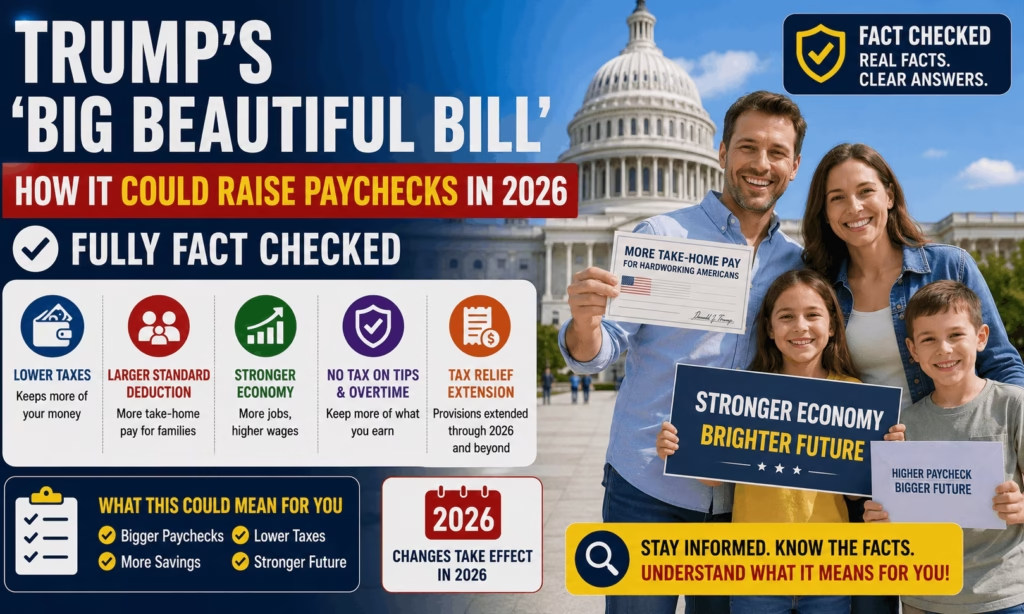
The Big Beautiful Bill Paycheck 2026 question is real and worth taking seriously, but it needs one important clarification before you expect a bigger direct deposit next month. The One Big Beautiful Bill Act (OBBBA), signed into law on July 4, 2025, and now also referred to by lawmakers as the Working Families Tax Cuts, does not mandate an employer wage increase. What it actually does is permanently extend and expand several federal tax provisions, confirmed directly by the IRS, including a temporary deduction for qualified tips (up to $25,000), a temporary deduction for qualified overtime pay (up to $12,500 for single filers, $25,000 for joint filers), a new $6,000 senior deduction for taxpayers 65 and older, a permanently higher Child Tax Credit of $2,200 per child, and a raised standard deduction of $16,100 for single filers and $32,200 for married couples filing jointly in 2026. These changes can increase your take-home pay if you update your W-4 withholding to reflect them, and they can increase your tax refund at filing time even if you don’t. We’ll be updating this article monthly as the IRS releases further guidance and as 2026 filing season data comes in.
This guide separates confirmed, IRS verified provisions from vague headline claims, walks through exactly how the no tax on tips and no tax on overtime deductions work, what changed on the 2026 Form W-4, who actually benefits from the new senior deduction and child tax credit increase, and how to check your own paycheck impact through official IRS tools rather than a generic viral summary.
Does the Big Beautiful Bill Actually Raise Paychecks?
Not automatically, and this is the most important fact check in this entire topic. The OBBBA does not require employers to pay anyone more. What it does is reduce the amount of federal income tax owed on certain types of income (tips, overtime, and general income through a higher standard deduction), and it allows employees to adjust their W-4 withholding to reflect these lower expected tax bills. If you update your withholding, your take-home pay per paycheck can increase because less tax is withheld throughout the year. If you don’t update your withholding, your paycheck stays the same, but you’ll likely see a larger refund when you file your 2025 or 2026 tax return.
What Is the One Big Beautiful Bill Act (OBBBA)?
The OBBBA is a real, signed federal law (Public Law 119-21), passed through the budget reconciliation process and signed by President Trump on July 4, 2025. It permanently extended most of the individual tax provisions from the 2017 Tax Cuts and Jobs Act that were otherwise set to expire at the end of 2025, and added several new, temporary provisions specifically aimed at tips, overtime pay, seniors, and car loan interest.
No Tax on Tips: How the Deduction Actually Works
- Eligible workers can deduct up to $25,000 in qualified tips from their federal taxable income.
- This applies to 2025 through 2028 and is not permanent; it is scheduled to expire after the 2028 tax year.
- The deduction phases out for individuals earning over $150,000 (or $300,000 for joint filers).
- Employers still withhold federal income tax, Social Security, and Medicare taxes from tips throughout the year as usual; the deduction is claimed when you file your tax return, not automatically removed from withholding unless you update your W-4.
- Beginning with the 2026 tax year, employers must separately report qualified tips using a new Box 12 code (TP) on Form W-2.
No Tax on Overtime: How the Deduction Actually Works
- Eligible workers can deduct up to $12,500 (single filers) or $25,000 (married filing jointly) of qualified overtime pay.
- The deduction applies only to the overtime premium (the extra “half” in time and a half), not your entire overtime paycheck.
- This is retroactive to January 1, 2025, and is scheduled to expire December 31, 2028.
- The same income phase out applies: $150,000 single filers, $300,000 joint filers.
- Starting with the 2026 tax year, employers must report qualified overtime compensation using a new Box 12 code (TT) on Form W-2.
- Exempt salaried employees generally do not qualify, since they aren’t entitled to overtime under the Fair Labor Standards Act; hourly and non-exempt salaried workers are the primary beneficiaries.
Full List of Canada Benefit Payments July 2026: CPP, OAS, CCB, GST Credit and More!
39 States May Have to Repay Foster Children’s Social Security Benefits — Why It’s Happening in 2026
How the 2026 Form W-4 Changed
The IRS updated the 2026 Form W-4 specifically to help workers capture these benefits in their regular paycheck rather than waiting until tax filing:
- The Deductions Worksheet now includes Line 1(a) for estimated qualified tips and Line 1(b) for estimated qualified overtime compensation.
- Adjusting these lines can reduce the amount of federal tax withheld from each paycheck, effectively increasing take-home pay throughout the year.
- The IRS cautions that if your estimate is too high, you could owe money when you file, so it recommends revisiting your W-4 estimate periodically during the year.
The New $6,000 Senior Deduction
- Taxpayers age 65 and older can claim an additional $6,000 deduction per person (so up to $12,000 for a married couple where both spouses qualify).
- This is a temporary provision, currently in effect for tax years 2025 through 2028.
- It applies on top of the standard deduction or itemized deductions, and on top of the existing additional standard deduction seniors already received.
- This is separate from personal exemptions, which remain permanently eliminated under the law.
Child Tax Credit: What Changed for 2026
- The Child Tax Credit is now permanently set at $2,200 per qualifying child, up from the prior $2,000 level, and will be adjusted for inflation starting in 2026.
- The refundable portion (Additional Child Tax Credit) is $1,700 for 2025, permanently indexed for inflation going forward.
- Income phase out thresholds are permanently locked in at $200,000 for single filers and $400,000 for married couples filing jointly.
- Both the qualifying child and at least one parent must have a valid Social Security number to claim the credit.
2026 Standard Deduction and Tax Bracket Changes (Confirmed by IRS)
| Filing Status | 2025 Standard Deduction | 2026 Standard Deduction |
|---|---|---|
| Single / Married Filing Separately | $15,750 | $16,100 |
| Married Filing Jointly | $31,500 | $32,200 |
| Head of Household | $23,625 | $24,150 |
For 2026, the top 37% marginal rate applies to income over $640,600 (single) or $768,700 (married filing jointly). The 35% bracket applies above $256,225 (single) or $512,450 (married filing jointly).
Other Confirmed Paycheck Related Provisions
| Provision | Key Detail |
|---|---|
| No tax on car loan interest | Deduct up to $10,000 in interest on qualifying vehicle loans (2025-2028), phases out above $100,000 MAGI ($200,000 joint) |
| SALT deduction cap | Raised from $10,000 to $40,400 ($20,200 for married filing separately), phasing out above $505,000 AGI |
| Child and Dependent Care Credit | Increased from a maximum of 35% to up to 50% of eligible expenses starting in 2026 |
| Employer-Provided Childcare Tax Credit | Increased from $150,000 to $500,000 ($600,000 for eligible small businesses) for 2026 |
| Earned Income Tax Credit (EITC) | 2026 maximum credit for three or more qualifying children rises to $8,231, up from $8,046 in 2025 |
| Estate and gift tax exemption | Rises to $15 million per individual for 2026, up from $13.99 million in 2025 |
| Trump Accounts | $1,000 federal deposit for children born 2025-2028; employers may contribute up to $2,500 per year per employee’s child |
Estimated Real World Impact on Refunds and Take Home Pay
Independent analysis from the Tax Foundation estimates the OBBBA’s 2025 provisions will reduce individual income taxes by roughly $129 billion, potentially resulting in up to $100 billion in higher combined refunds in the 2026 filing season, with average refunds rising between $300 and $1,000 compared to a typical year, though this varies significantly by household. The same analysis estimates an average tax cut of $611, or about a 0.8% increase in after-tax income, across affected taxpayers for the 2025 tax year, with seniors, tipped workers, overtime earners, and families claiming the Child Tax Credit seeing the most direct benefit.
USA Visa-Free Travel 2026: Check Eligible Countries and All Entry Rules
New IRS Tax Brackets 2026 Full Income Tax Rates, Changes & Who Pays More or Less
How to Check Your Own Paycheck Impact
- IRS Tax Withholding Estimator: Updated to reflect the Working Families Tax Cuts provisions; the most reliable way to see how adjusting your W-4 could change your take-home pay.
- Form W-4 (2026 version): File an updated version with your employer if you want your withholding to reflect tips or overtime deductions during the year rather than only at tax filing.
- Your pay stub: Check whether your employer has started separately reporting tips or overtime under the new W-2 Box 12 codes (TP for tips, TT for overtime).
- IRS.gov Working Families Tax Cuts page: The official, continuously updated source for provision details, FAQs, and further guidance as it’s released.
Common Points of Confusion to Avoid
- “No tax on tips/overtime” does not mean zero withholding during the year. Employers still withhold federal income tax, Social Security, and Medicare taxes as usual unless you specifically adjust your W-4.
- These are not permanent provisions. The tips, overtime, senior, and car loan interest deductions are scheduled to expire after 2028 unless Congress extends them again.
- Exempt salaried employees generally do not qualify for the overtime deduction, since they don’t receive FLSA overtime pay in the first place.
- Income phase outs apply. Higher earners (above $150,000/$300,000 for tips and overtime; $100,000/$200,000 for car loan interest) receive a reduced benefit or none at all.
Conclusion
The honest, fact checked answer to whether the Big Beautiful Bill raises paychecks in 2026 is: it can, but only if you take action, and it’s a tax law change, not a wage mandate. The confirmed provisions, verified directly through the IRS, include real deductions for tips (up to $25,000), overtime (up to $12,500/$25,000), a new $6,000 senior deduction, a higher $2,200 per child Child Tax Credit, and a raised standard deduction for 2026. These can increase your take-home pay if you update your W-4 to reflect them, or increase your refund at tax time if you don’t. None of them come automatically as a paycheck bump from your employer; they come through the tax system, and several are temporary, running only through 2028. Use the official IRS Tax Withholding Estimator to see your specific, personalized impact rather than relying on a general headline.
FAQs
Does the Big Beautiful Bill automatically raise my paycheck in 2026?
No. It changes federal tax law, not employer wage requirements. Your take-home pay can increase only if you update your W-4 withholding to reflect the new deductions; otherwise, the benefit shows up as a larger refund at tax time.
How much can I deduct under no tax on tips?
Up to $25,000 in qualified tips, for tax years 2025 through 2028, phasing out above $150,000 income ($300,000 for joint filers).
How much can I deduct under no tax on overtime?
Up to $12,500 (single) or $25,000 (married filing jointly) of the overtime premium portion of your pay, for 2025 through 2028.
Is the senior deduction real?
Yes. It’s a confirmed, IRS verified $6,000 deduction per person for taxpayers 65 and older, in effect for tax years 2025 through 2028.
What is the 2026 standard deduction?
$16,100 for single filers, $32,200 for married couples filing jointly, and $24,150 for heads of household.
How much is the Child Tax Credit in 2026?
$2,200 per qualifying child, permanently set and now indexed for inflation starting in 2026, with a $1,700 refundable portion for 2025.
Are these tax changes permanent?
Some are (the higher standard deduction, the $2,200 Child Tax Credit, the raised SALT cap). Others (tips, overtime, senior, and car loan interest deductions) are temporary and currently scheduled to expire after 2028.
Do I need to do anything to get these benefits?
For the refund benefit, no, they apply automatically when you file. For an immediate paycheck increase, yes, you need to update your Form W-4 with your employer.
Will my state taxes on tips and overtime also go away?
Not necessarily. These deductions apply to federal income tax. Tips and overtime remain fully taxable under most state and local tax laws unless your state has passed its own separate provision.
How do I check my exact tax impact?
Use the IRS Tax Withholding Estimator at IRS.gov, which has been updated to reflect the Working Families Tax Cuts provisions.
People Also Ask
Is the Big Beautiful Bill giving people a raise? Not directly. It changes how much federal tax is withheld and owed, which can increase take-home pay if you adjust your withholding, but it does not require employers to raise wages.
When did the Big Beautiful Bill become law? July 4, 2025, signed as Public Law 119-21, and now also referred to as the Working Families Tax Cuts.
Do salaried employees get the no tax on overtime benefit? Generally no, unless they are non-exempt salaried employees entitled to FLSA overtime. Exempt salaried employees typically do not qualify.
How much bigger will my tax refund be in 2026? Independent estimates suggest average refunds could rise by $300 to $1,000 compared to a typical year, though the amount varies significantly based on individual circumstances like tips, overtime, age, and number of children.
Official Resources
| Resource | Purpose | Official Link |
|---|---|---|
| IRS, One Big Beautiful Bill Provisions | Official, continuously updated list of all confirmed tax provisions | https://www.irs.gov/newsroom/one-big-beautiful-bill-provisions |
| IRS Tax Withholding Estimator | Check your personalized paycheck and refund impact | https://www.irs.gov/individuals/tax-withholding-estimator |
| IRS Form W-4 | Update your withholding to reflect tips or overtime deductions | https://www.irs.gov/forms-pubs/about-form-w-4 |
| IRS, No Tax on Tips and Overtime Guidance | Official explanation of eligibility and deduction limits | https://www.irs.gov/newsroom/one-big-beautiful-bill-how-to-take-advantage-of-no-tax-on-tips-and-overtime |
Also Read
3 Secret Social Security Rules Every Retiree Needs to Know, Don’t Make These Mistakes
OAS Survivor Allowance 2026 Eligibility and Application Process
Canada Pension Payment 2026 Full Schedule: CPP, OAS & GIS Payment Dates Released!
OAS Allowance in 2026 – Complete Payment Schedule, Amounts and Eligibility (Age 60–64)!