
Canadian Citizenship Certificate: Getting urgent processing of a Canadian citizenship certificate has become one of the most searched immigration topics in 2026, and for good reason. Standard proof of citizenship applications with Immigration, Refugees and Citizenship Canada (IRCC) are currently taking anywhere from 12 to 19 months, largely because of a massive surge in applications following Bill C-3, which received royal assent in December 2025 and removed the old generational limit on citizenship by descent. This means grandchildren, great-grandchildren, and further descendants of a Canadian-born ancestor can now claim citizenship, and hundreds of thousands of new applicants, many of them from the United States, have joined the queue. If you need your Canadian citizenship certificate quickly, for a passport application, a job offer, a family emergency, or an urgent international move, IRCC does offer a legitimate fast-track option called urgent processing. This guide breaks down exactly who qualifies, what proof IRCC expects, and the step-by-step process to submit a request the right way.
A Canadian citizenship certificate, also called proof of citizenship, is the official document confirming that a person is already a Canadian citizen under the law. It is not the same as applying to become a citizen through the grant of citizenship process, which follows a completely separate queue and timeline. You typically need this certificate before you can apply for a Canadian passport, register for government benefits, enrol a child in certain programs, or prove citizenship by descent through a Canadian-born parent or grandparent. Because the standard wait has stretched well beyond a year, IRCC allows applicants facing genuine, documented hardship, not mere inconvenience, to request urgent processing. There is currently no additional government fee for making this request, but the explanation and supporting evidence you submit must clearly show serious harm if the delay continues. We’ll be updating this article monthly to reflect the latest IRCC processing times, backlog figures, and policy changes.
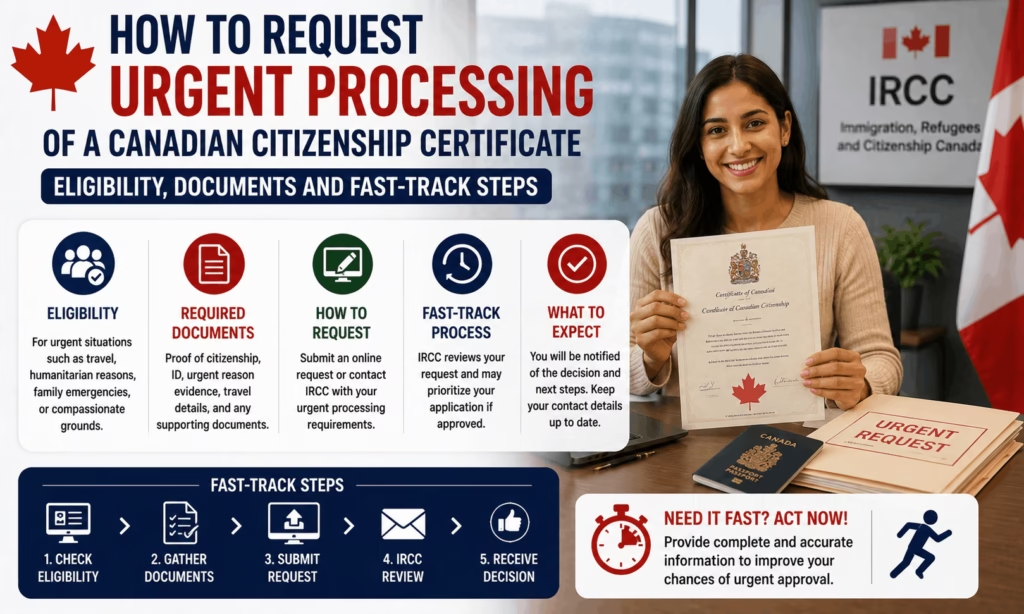
What Is Urgent Processing for a Canadian Citizenship Certificate?
Urgent processing is a discretionary pathway that allows IRCC officers to move a proof of citizenship file ahead of the regular queue when a delay would cause serious, measurable harm, not simply frustration or a general desire to travel sooner. IRCC reviews every request individually, and approval is never guaranteed. Even when a request is accepted, the file still goes through the same verification steps as any other application; it is simply prioritized within the workload. Some applicants who qualify have reported receiving their certificate in as little as two weeks, while others see their timeline compressed from many months down to a handful of weeks, depending on officer workload and the complexity of the file.
It is important to separate this from general application processing. Urgent processing does not create a new queue or a paid premium service; there is no “express fee” option like some countries offer for passports. It is a needs-based exception, and IRCC explicitly warns that phrases like “I want to travel” or “I’ve been waiting a long time” do not meet the bar.
Who Is Eligible for Urgent Processing of a Citizenship Certificate?
IRCC generally considers the following situations as valid grounds for urgent processing:
- Employment requirements: A confirmed job offer that requires proof of Canadian citizenship and will be withdrawn if you cannot start by a specific date.
- Educational deadlines: A college or university enrolment deadline where proof of citizenship is mandatory for admission or funding.
- Family emergencies: Serious illness or death of a close relative abroad, where you need to travel urgently and your current travel document does not allow visa-free entry.
- Medical situations: A personal or family medical emergency requiring immediate international travel.
- Statelessness cases: Applicants who need to establish citizenship status to resolve a stateless situation.
- Minor children: Bringing a minor child born outside Canada to live in Canada with a Canadian parent.
IRCC expects applicants to rely on their permanent resident card or existing passport for travel wherever possible while the citizenship file is in process. If a valid PR card or current passport can meet the travel need, urgent processing is unlikely to be approved.
Missouri SNAP Food Ban Delayed: What’s Banned & Latest Status
Hawaii SNAP Soda Ban Delayed to 2027: What Will Be Banned & Status
Florida SNAP Junk Food Ban 2026: What’s Banned, Court Update, EBT Rules & Latest Status
Nevada SNAP Food Ban: What’s Banned & Start Date Explained
Documents Required for an Urgent Processing Request
A strong urgent processing request always includes two core components:
- A detailed explanation letter describing exactly why the delay will cause serious harm, including your full name, date of birth, contact details, and your Unique Client Identifier (UCI) or application number.
- Supporting evidence that proves the claim, such as:
- A job offer letter with a specific start date
- A doctor’s letter explaining a medical emergency
- A death certificate or hospital letter for a family emergency
- A plane ticket or travel itinerary with proof of payment
- A university or college acceptance letter with an enrolment deadline
- A letter from a foreign government or employer, where relevant
All files must typically be submitted in PDF, JPEG, TIFF, DOC, or DOCX format, with each file under 2 MB and a combined total under 3.5 MB. It is critical not to submit fabricated or exaggerated claims. Providing false information to IRCC can result in application refusal, processing delays, or more serious immigration consequences, so every urgent processing request should be truthful and backed by genuine documentation.
Step-by-Step: How to Apply for Urgent Processing
If You Have Not Yet Submitted Your Application
- Apply online through your IRCC secure account and indicate the need for urgent processing during the application process, uploading your explanation letter and supporting documents at the same time.
- Apply on paper using form CIT 0001 (for adults and minors) and clearly write “Urgent – Citizenship Certificate (Proof)” in large, dark letters on the outside of the envelope, including all supporting documentation inside.
If You Already Submitted Your Application and the Situation Has Since Become Urgent
- Applicants in Canada or the United States should not file a second application. Instead, submit a request through IRCC’s official web form, explaining the urgency and attaching supporting documents.
- Applicants outside Canada and the United States should contact the Canadian embassy, high commission, or consulate responsible for their application, rather than using the web form.
It is important never to submit a duplicate application while waiting for a decision, since IRCC will not process multiple requests tied to the same case, and doing so can actually slow down your file.
What Happens After You Submit an Urgent Processing Request
An IRCC officer first reviews your request to determine whether it genuinely meets the urgent processing criteria. If approved, your file is prioritized within the existing workload, but it still passes through the standard verification, background, and quality checks. IRCC does not publish a guaranteed turnaround time for urgent files. If the officer determines the request does not qualify, your application simply continues at the standard processing pace, which currently sits well above a year for most proof of citizenship files.
Current Processing Times and Backlog
| Standard proof of citizenship processing time | Approx. 12 to 19 months, depending on volume and time of year |
| Citizenship grant (become a citizen) processing time | Approx. 13 months from Acknowledgement of Receipt (AOR) |
| Applicants currently in the proof of citizenship queue | Roughly 70,000 to 100,000 files nationwide |
| Urgent processing turnaround (if approved) | As fast as 2 weeks, though not guaranteed |
| Additional government fee for urgent processing | None |
| Trigger for the current backlog | Surge in citizenship by descent applications after Bill C-3 (royal assent December 2025) |
| Processing for applicants outside Canada/US | Add 3 to 4 months for international mailing time |
Note: These figures are drawn from the most recent publicly reported IRCC data available as of this update and should always be verified against the official IRCC processing times tool, since they change frequently.
Understanding Bill C-3 and Why Wait Times Have Increased
Bill C-3 removed the long-standing “first-generation limit” on citizenship by descent, a rule that previously blocked most people born abroad to a Canadian parent (who was themselves born outside Canada) from automatically claiming citizenship. After the law took effect, anyone with a Canadian-born ancestor, regardless of how many generations back, became potentially eligible to claim citizenship, provided they meet the 1,095-day substantial connection requirement and can document the ancestral link. This opened the door for millions of new applicants worldwide, particularly Americans, and directly caused the sharp jump in proof of citizenship applications and the resulting delays that make urgent processing such an important option today.
Canada Grocery Rebate 2026 Full Schedule: Confirmed Payment Dates, Amounts & Status Check!
Common Mistakes That Delay Urgent Processing Requests
- Submitting a second application instead of using the correct web form or letter process
- Providing a vague explanation letter without specific dates, names, or measurable consequences
- Missing required UCI or application number, which prevents IRCC from locating the file
- Uploading files that exceed the size or format limits
- Framing a general desire to travel as an emergency, which does not meet the criteria
- Sending outdated versions of form CIT 0001 instead of downloading the current version from canada.ca
Proof of Citizenship vs. Grant of Citizenship: Know the Difference
Many applicants confuse these two processes, which slows down their own research and sometimes their applications. Proof of citizenship is for people who are already Canadian citizens under the law, whether by birth in Canada, by descent, or through a prior grant, but who need an official certificate to demonstrate that status. A grant of citizenship, on the other hand, is the process permanent residents go through to become citizens for the first time, which involves a residency requirement, a citizenship test, and an oath ceremony. These are entirely separate queues with different processing times, different forms, and different urgent processing criteria. If you are unsure which category applies to you, check your Unique Client Identifier (UCI) and prior IRCC correspondence, or consult the official Proof of Citizenship page on canada.ca before applying.
Tips to Strengthen Your Urgent Processing Request
- Be specific, not emotional. IRCC officers respond to concrete facts: exact dates, named institutions, and clear consequences, rather than general statements about stress or inconvenience.
- Attach primary evidence wherever possible. A signed job offer letter or a hospital document carries far more weight than a personal statement alone.
- Keep your letter concise. One to two pages that clearly state the who, what, when, and why is more effective than a lengthy narrative.
- Double-check your UCI and application number. A request without correct identifiers can be delayed simply because IRCC cannot match it to your file.
- Avoid third-party template sites for form CIT 0001. Always download the current version directly from canada.ca, since outdated forms are a common reason applications are returned as incomplete.
- Consider whether you truly need the certificate right now. If a valid PR card or existing passport can meet your immediate travel need, IRCC often expects you to use that option while the citizenship file continues in the background.
Official IRCC Resources and Links
| Purpose | Resource |
|---|---|
| Create an account, apply online, and pay fees | IRCC Account Sign In / Registration |
| Track your citizenship certificate application | Check Application Status |
| Overview, eligibility, and application guide | Proof of Citizenship (Main Page) |
| Paper application guide and forms for adults and minors | Guide 0001 – CIT 0001 Application Form |
| Submit an urgent processing request for an existing application | IRCC Web Form (Contact IRCC) |
| Check the latest official wait times by application type | Current Processing Times Tool |
| 1-888-242-2100 (within Canada) or 1-613-944-4000 (outside Canada) | IRCC Call Centre |
FAQs
How long does urgent processing of a Canadian citizenship certificate take?
There is no guaranteed timeline, but applicants who qualify have reported receiving their certificate in as little as two weeks. If your request is not approved, your file continues at the standard pace, which can be 12 months or longer in 2026.
Is there a fee to request urgent processing?
No. IRCC does not charge an extra fee for requesting urgent processing. You only pay the standard proof of citizenship application fee.
Can I apply for urgent processing if I live outside Canada and the United States?
Yes, but instead of using the online web form, you must contact the Canadian embassy, high commission, or consulate responsible for your region.
What counts as a valid reason for urgent processing?
Genuine, documented situations such as a job offer with a firm start date, a medical emergency, a death in the family abroad, an educational enrolment deadline, or bringing a minor child to live in Canada with a Canadian parent.
Can I submit a second application to speed things up?
No. Submitting a duplicate application is not permitted and can actually delay your existing file. Use the correct urgent processing channel instead.
Does Bill C-3 affect how long my application will take?
Yes. Since Bill C-3 expanded eligibility for citizenship by descent, application volumes have increased significantly, which is a major reason standard processing times have grown longer throughout 2026.
What documents prove a citizenship by descent claim under Bill C-3?
You generally need vital records (birth, marriage, and death certificates) tracing the family line back to the Canadian-born ancestor, along with proof of the 1,095-day substantial connection to Canada, where applicable.
Can urgent processing guarantee I get my certificate before a specific date?
No. Even approved urgent files still go through the standard verification steps, so IRCC cannot promise a specific delivery date.
Conclusion
Requesting urgent processing of a Canadian citizenship certificate can genuinely shorten what is currently a 12-to-19-month wait, but only for applicants who can show real, documented urgency such as a job offer, a medical emergency, or a family crisis abroad. The process is free, straightforward, and handled either through IRCC’s online account and web form or by mail using form CIT 0001, depending on your situation and location. Given the ongoing surge in citizenship by descent applications following Bill C-3, building a complete, well-documented, and honest request from the very first submission gives you the best possible chance of a faster outcome. Always confirm the latest requirements and processing times directly on canada.ca, since IRCC policies and timelines are updated frequently throughout the year.
No SSI Payment in August 2026: SSI August 2026 “no payment” confusion Fact-Checked
State-by-State SNAP Food Ban 2026: What’s Banned, Status Update
Arkansas SNAP Junk Food Ban 2026: What’s Banned, Court Update, EBT Rules & Latest Status
Canada Immigration Absorption Index 2026: What the Numbers Show