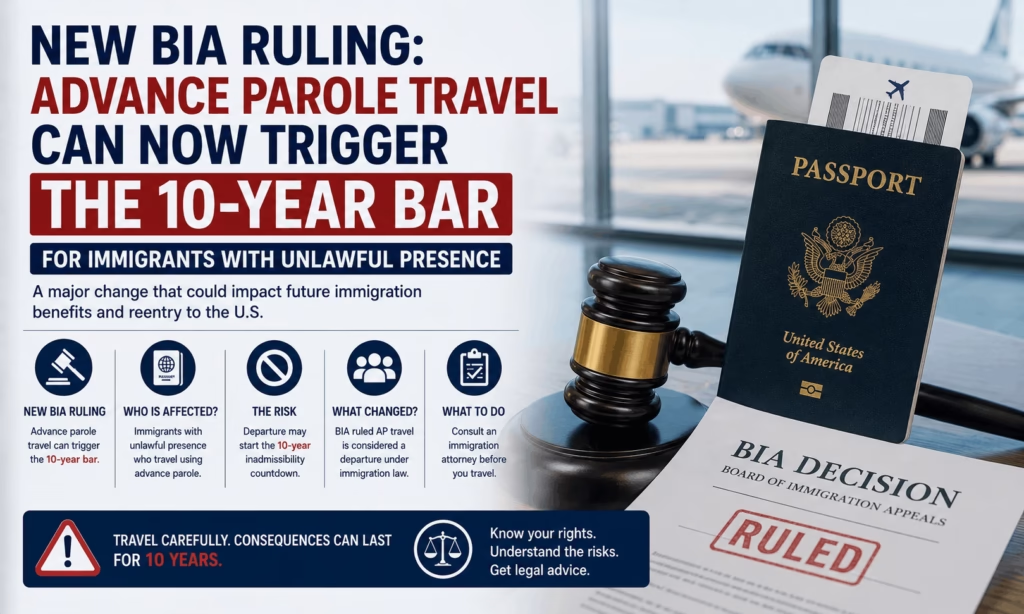
New US Ruling Changes Travel for Immigrants: The Board of Immigration Appeals issued a precedential decision on August 13, 2026 that fundamentally changes the travel calculus for certain immigrants, ruling that leaving the United States under advance parole now counts as a “departure” that can trigger the 10-year bar advance parole ruling under federal immigration law. In Matter of Delcarmen-Lara, the three-member Board overturned a 14-year-old precedent that had specifically protected people who used advance parole for temporary travel abroad from the harsh unlawful-presence penalties that normally apply when someone leaves the country.
The decision directly overturns Matter of Arrabally and Yerrabelly, a 2012 BIA ruling that had told adjustment-of-status applicants, DACA recipients, and others that a trip abroad using advance parole simply did not count as a “departure” for purposes of triggering the three- and ten-year unlawful-presence bars under Section 212(a)(9)(B) of the Immigration and Nationality Act. Immigration attorneys are already warning that anyone considering advance parole travel after this ruling, particularly those who may have already accrued a year or more of unlawful presence before receiving their advance parole document, should not assume the trip is risk-free the way it was understood to be for over a decade. This article breaks down exactly what the BIA ruled, who the decision protects, who now faces new risk, and what steps affected immigrants should take before making any travel plans. We’ll be updating this article monthly as more guidance emerges on how this ruling is being applied in individual cases.
What the BIA Actually Ruled in Matter of Delcarmen-Lara
In Matter of Delcarmen-Lara, 29 I&N Dec. 830 (BIA 2026), the Board of Immigration Appeals held that a departure from the United States under a grant of advance parole is a “departure” for purposes of the unlawful-presence bars found in INA Section 212(a)(9)(B). This is a precedential decision, meaning it is binding on immigration judges and USCIS officers nationwide going forward, not just in the specific case before the Board. The ruling directly and explicitly overrules Matter of Arrabally and Yerrabelly, 25 I&N Dec. 771 (BIA 2012), which had stood as the governing interpretation on this exact question for more than a decade.
The 14-Year-Old Precedent That Just Got Overturned
To understand why this ruling matters, it helps to understand what changed. Since 2012, immigration law treated a trip abroad on advance parole differently from an ordinary departure. Under Arrabally and Yerrabelly, someone who left the United States temporarily using an approved advance parole document, and then returned, was not considered to have made a “departure” in the legal sense that would trigger the three- or ten-year unlawful-presence bars, even if they had previously accrued enough unlawful presence to otherwise qualify for one of those bars. This interpretation gave adjustment-of-status applicants, DACA recipients, and others with pending applications meaningful flexibility to travel internationally, for family emergencies, work obligations, or other reasons, without jeopardizing their ability to eventually obtain lawful status inside the United States.
Matter of Delcarmen-Lara eliminates that protection going forward. Under the new ruling, a departure under advance parole is now treated the same as any other departure for purposes of determining whether the unlawful-presence bars apply.
Social Security Compassionate Allowances List: 14 Conditions Added
SSA Payroll Information Exchange and New SSI Improvement Office: What the Report Actually Changes
Understanding the 3-Year and 10-Year Unlawful Presence Bars
To fully grasp what is at stake, it helps to understand how these bars actually work. Under INA Section 212(a)(9)(B), unlawful presence accumulates while someone remains in the United States without legal status, but critically, the penalty itself does not activate simply from accruing that time. The bar only attaches once the person physically departs the country. Someone who accrues more than 180 days but less than one year of unlawful presence, and then departs, faces a three-year bar preventing their return. Someone who accrues one year or more of unlawful presence, and then departs, faces the more severe ten-year bar. A common misconception is that leaving the country somehow resets an immigration record; in reality, departure after unlawful presence is often exactly what triggers these serious re-entry penalties in the first place.
What Is Advance Parole, and Why Does This Change Matter So Much?
Advance parole is a travel authorization document that allows certain individuals with a pending immigration application, most commonly adjustment-of-status applicants and DACA recipients, to leave the United States and be paroled back in upon return, without automatically abandoning their pending application the way an unauthorized departure normally would. For years, advance parole functioned as a relatively safe travel mechanism precisely because of the Arrabally and Yerrabelly precedent, which treated this specific type of authorized travel as legally distinct from a standard departure for unlawful-presence purposes. With that protection now removed, advance parole remains a valid and important travel mechanism in general, but it no longer automatically shields someone with existing unlawful presence from triggering a multi-year bar simply by using it.
Who Is Protected: The Ruling’s Prospective-Only Application
One of the most important details in the Board’s decision is that it explicitly applies only prospectively. The Board recognized that its new holding represents a significant departure from longstanding precedent that many individuals reasonably relied on for over a decade, and it built protection into the ruling accordingly: people who already traveled abroad under advance parole before August 13, 2026, relying on the old Arrabally and Yerrabelly rule, remain protected under that prior interpretation for those completed trips. The new rule governs decisions about advance parole travel made going forward, not travel that already happened under the old understanding.
Who Is Most at Risk Going Forward
Immigration attorneys have flagged several groups as facing the most direct impact from this ruling. Adjustment-of-status applicants who accrued unlawful presence before their green card application was filed, and who were planning to use advance parole for future travel, now face substantially higher risk if they proceed with that travel without first addressing their unlawful-presence exposure. DACA recipients who accrued unlawful presence prior to receiving DACA status, and who use advance parole for travel such as visiting family abroad or attending to educational or employment matters, similarly face new exposure they did not have before this ruling. The Board itself acknowledged that its decision does not resolve every question about how this prospective rule will be implemented case by case, meaning individuals in ambiguous situations should not assume they know exactly how their specific circumstances will be treated without professional legal guidance.
IRS-ICE Data Sharing Ruling: What Immigrants and Green Card Holders Need to Know
SNAP Soda and Candy Ban by State: Full List, Dates, and Rules for 2026
Social Security Payment August 19, 2026: Who Gets Paid and see birthdate-based schedule (11th-20th → Aug 19; 21st-31st → Aug 26)
The I-601A Waiver: An Existing Path Around the Bar
For people who do face unlawful-presence bar exposure, an existing legal tool remains available and has become more relevant than ever in light of this ruling: the I-601A provisional unlawful presence waiver. This waiver is specifically designed for immediate relatives of US citizens, along with certain other immigrant visa applicants, who are physically present in the United States, at least 17 years old, and subject only to the unlawful-presence bar rather than other independent grounds of inadmissibility. The key structural advantage of the I-601A is that USCIS adjudicates it while the applicant is still inside the United States, before any departure for consular processing takes place, meaning an approved provisional waiver in hand can substantially reduce the uncertainty and risk of an eventual departure, whether that departure happens through advance parole or standard consular processing.
How This Fits Into Broader 2026 Immigration Policy Shifts
This ruling arrives in the context of a series of related developments this year affecting how immigrants navigate departures, adjustments of status, and unlawful-presence exposure. In late May 2026, the Department of Homeland Security walked back an earlier USCIS announcement that had told many green card applicants they would generally need to return to their home countries to complete their process, recasting that policy as case-by-case discretion rather than a blanket requirement. Immigration attorneys at the time noted that even with that walk-back, the underlying ten-year bar under INA Section 212(a)(9)(B)(i)(II) remained a structural risk for long-term visa overstays who later married US citizens and might still need to leave the country for consular processing. The Delcarmen-Lara ruling adds a new, related layer to that same underlying risk, specifically closing off what had been one of the more commonly used, lower-risk travel pathways available to people in exactly this kind of situation.
What to Do If You Are Considering Travel on Advance Parole
Given the significance of this shift, immigration attorneys are advising anyone considering advance parole travel after August 13, 2026 to obtain case-specific legal advice before departing the United States, particularly if there is any possibility unlawful presence was accrued at some point before receiving advance parole status. This means reviewing your specific immigration history, including any period spent in the country without valid status, before assuming a planned trip is safe simply because you hold an approved advance parole document. For those who determine they do have unlawful-presence exposure, exploring whether an I-601A provisional waiver could be filed and approved before any planned departure is now a meaningfully more important step than it was before this ruling.
Timeline: From Arrabally and Yerrabelly to Delcarmen-Lara
| Date | Development |
|---|---|
| 2012 | BIA decides Matter of Arrabally and Yerrabelly, ruling advance parole travel does not trigger unlawful-presence bars |
| May 29, 2026 | DHS walks back a broader USCIS “leave the country” policy for green card adjustment applicants, recasting it as case-by-case discretion |
| August 13, 2026 | BIA issues Matter of Delcarmen-Lara, overturning the 2012 precedent and ruling advance parole departures can trigger the 3- and 10-year bars |
| Ongoing | Advance parole travel completed before August 13, 2026 under the old precedent remains protected |
The 3-Year and 10-Year Unlawful Presence Bars at a Glance
| Bar | Unlawful Presence Accrued | Trigger | Result |
|---|---|---|---|
| 3-year bar | More than 180 days but less than 1 year | Departure from the US | Inadmissible for 3 years |
| 10-year bar | 1 year or more | Departure from the US | Inadmissible for 10 years |
| Available remedy | Either bar | I-601A provisional waiver (before departure) or standard waiver | Can allow re-entry despite the bar, if approved |
Official Resources and Where to Get Help
| Resource | Purpose | Link |
|---|---|---|
| USCIS official site | General immigration forms and case status | uscis.gov |
| USCIS Form I-601A information | Provisional unlawful presence waiver details | uscis.gov/i-601a |
| Executive Office for Immigration Review | Official BIA decisions and case status | justice.gov/eoir |
| Find free or low-cost legal help | Locate immigration legal service providers | justice.gov/eoir/list-pro-bono-legal-service-providers |
| American Immigration Lawyers Association | Find a licensed immigration attorney | ailalawyer.com |
IRS Notice 2026-28: New Paid Family Leave Employer Credit Rules
SNAP Enrollment Drop 2026: Why 5 Million People Lost Benefits?
EB-1 India Visa Bulletin Warning: Category Could Go Unavailable Within Weeks, State Department Says
FAQs
What did the BIA rule in Matter of Delcarmen-Lara?
On August 13, 2026, the Board of Immigration Appeals ruled that leaving the United States under advance parole now counts as a “departure” that can trigger the three- and ten-year unlawful-presence bars under INA Section 212(a)(9)(B), overturning a 2012 precedent that had exempted advance parole travel from this rule.
Does this ruling apply to trips I already took under advance parole?
No. The Board’s decision applies only prospectively, meaning advance parole travel completed before August 13, 2026, under the previous Arrabally and Yerrabelly precedent, remains protected under the old rule.
Who is most affected by this change?
Adjustment-of-status applicants and DACA recipients who accrued unlawful presence before receiving advance parole, and who are planning future travel abroad using that document, face the most direct new risk under this ruling.
What is the difference between the 3-year bar and the 10-year bar?
The 3-year bar applies to someone who accrues more than 180 days but less than one year of unlawful presence before departing the US. The 10-year bar applies to someone who accrues one year or more of unlawful presence before departing.
Is advance parole still safe to use for travel?
Advance parole remains a valid travel mechanism, but it no longer automatically protects someone with existing unlawful presence from triggering a bar simply by using it, the way it did before this ruling. Individual risk now depends on a person’s specific unlawful-presence history.
What is the I-601A waiver, and how does it help?
It is a provisional waiver for the unlawful-presence bar that USCIS adjudicates while the applicant is still inside the United States, before any departure. It is available to immediate relatives of US citizens and certain other immigrant visa applicants who are at least 17 years old and subject only to the unlawful-presence bar.
Should I cancel planned travel on advance parole because of this ruling?
You should get case-specific legal advice before making that decision, since your individual risk depends entirely on your own immigration history, including whether and how much unlawful presence you accrued before receiving advance parole.
How is this ruling connected to the DHS policy changes earlier in 2026?
Both developments touch on the same underlying structural issue: the ten-year unlawful-presence bar under INA Section 212(a)(9)(B)(i)(II) remains a real risk for people with unlawful-presence history who need to leave the United States, whether through standard consular processing or, as this new ruling clarifies, through advance parole travel.
Conclusion
The Board of Immigration Appeals’ decision in Matter of Delcarmen-Lara closes off what had been, for more than a decade, one of the more reliable low-risk travel options for adjustment-of-status applicants and DACA recipients with unlawful-presence history, and it does so with immediate effect for any advance parole departure taken after August 13, 2026. While the ruling’s prospective-only application protects trips already completed under the old rule, anyone weighing future advance parole travel, particularly those who may have accrued a year or more of unlawful presence before receiving their advance parole document, should treat this as a moment to get individualized legal advice and consider whether an I-601A provisional waiver should be pursued before departing, rather than assuming advance parole travel remains as low-risk as it was just weeks ago.
CRS Score Distribution 2026: 5 Trends Shaping the Next Express Entry Draw