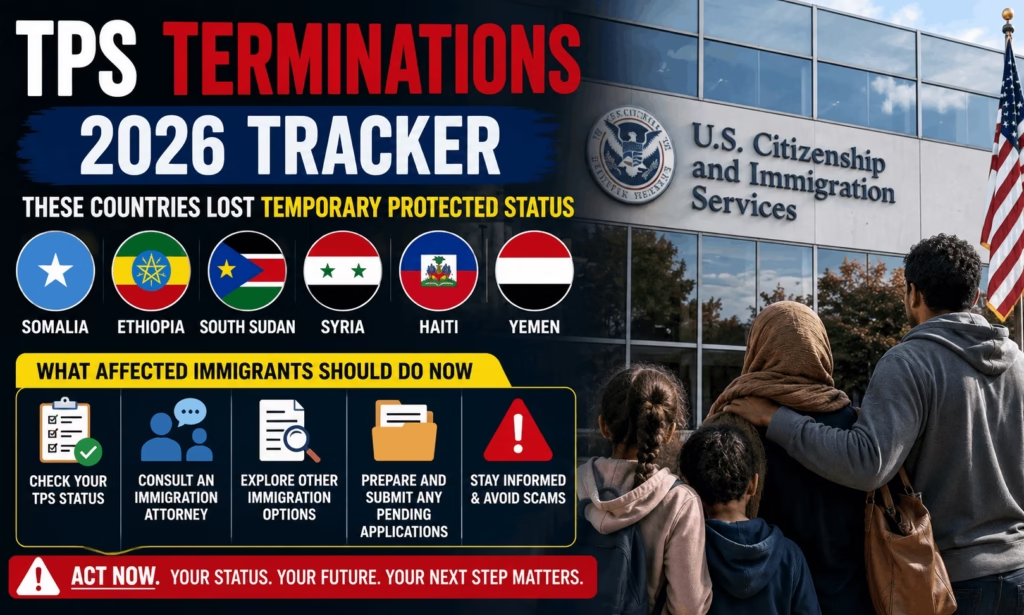
TPS Terminations 2026: On August 18, 2026, a federal judge in Boston lifted the last legal shield protecting Ethiopian TPS holders, making Ethiopia the sixth and final country in this tracker to lose its designation since the Supreme Court’s decision in Mullin v. Doe on June 25, 2026. What started as a single ruling about Haiti and Syria has now cascaded through Yemen, South Sudan, Somalia, and Ethiopia in rapid succession, each falling within days of the appeals court clearing the way.
For the hundreds of thousands of TPS holders from these six countries, this is not an abstract legal story. It is the difference between a valid work permit and an expired one, between legal presence and removability, and for many mixed-status families, between stability and sudden uncertainty. This tracker lays out the exact termination date for every one of the six countries named in this update, the court history behind each ruling, how many people are affected, and what options remain for anyone whose status has now lapsed. We’ll be updating this article monthly as new TPS court rulings and DHS announcements are confirmed.
Latest Update: TPS Termination Status for All Six Countries
Here is the complete, confirmed picture as of this update. Every country listed below has had its TPS designation formally terminated.
| Country | TPS Termination Date | Legal Basis | Approximate Beneficiaries Affected |
|---|---|---|---|
| Yemen | July 20, 2026 | New York federal court lifted its own stay | Several thousand |
| Haiti | July 27, 2026 | Formalized following Mullin v. Doe | Approximately 350,000 |
| Syria | July 27, 2026 | Direct outcome of Mullin v. Doe | Approximately 6,000 |
| South Sudan | August 7, 2026 | First Circuit reversed the lower-court stay | Approximately 232 approved, 73 pending |
| Somalia | August 14, 2026 | Constitutional stay ultimately overturned | Approximately 1,082 approved, 1,383 pending |
| Ethiopia | August 18, 2026 | Federal district court lifted administrative stay | Approximately 5,000 |
What Triggered the Cascade: Mullin v. Doe Explained
To understand why six separate countries lost protection within such a compressed window, everything traces back to one Supreme Court decision. On June 25, 2026, the Supreme Court ruled 6-3 in Mullin v. Doe, a case that combined a Syrian TPS challenge with a parallel Haitian case. The court held that federal courts generally cannot second-guess a Homeland Security Secretary’s decision to end a TPS designation, and separately rejected the argument that Haiti’s termination had been motivated by racial bias.
The ruling did not instantly strip anyone of status. The cases were sent back to district courts to formalize the terminations, a process that typically takes about a month. But the legal effect went far beyond Haiti and Syria. Once the Supreme Court closed off the primary statutory argument TPS holders had been relying on, the Department of Homeland Security cited Mullin in nearly every subsequent filing to argue that the remaining countries’ cases should fall the same way — and, one by one, they did.
September 2026 Refund Payments: All the Real Deposits You Could Actually Get This Month
Service Canada Benefit Payments September 2026 Dates, Amounts and Who Qualifies
Canada FMCSP Study Permit: 2,970 Spots Now Open for French-Speaking Students From 33 Countries
Country-by-Country Timeline: How Each Termination Unfolded
Yemen: The First to Fall Under Mullin
Yemen’s TPS designation ended on July 20, 2026, after a federal court in New York lifted the stay that had been protecting Yemeni beneficiaries. This was the earliest of the six terminations following the Supreme Court ruling, setting the pattern that would repeat across the remaining countries over the following month.
Haiti and Syria: Ground Zero for the Ruling
Haiti and Syria were the two countries directly named in Mullin v. Doe, and both designations ended on the same day: July 27, 2026. Haiti’s termination affects roughly 350,000 people, by far the largest population impacted among the six countries in this tracker. Syria’s termination affects a much smaller group of approximately 6,000 beneficiaries. A federal judge formally lifted the stay on Syria’s termination that same day, closing out the implementation process the Supreme Court had ordered.
South Sudan: A Small Caseload, a Major Precedent
South Sudan’s TPS designation terminated on August 7, 2026, after the First Circuit Court of Appeals reversed the lower-court stay that had been shielding the designation, alongside an identical reversal for Burma (Myanmar) on the same day. Despite the legal significance, South Sudan’s actual caseload was small — roughly 232 approved beneficiaries and 73 pending applicants, according to court filings in the case decided by Judge Patti Saris.
Somalia: The Longest Holdout, With a Constitutional Twist
Somalia’s path to termination was the most legally complicated of the six. A federal judge in Boston, Judge Allison Burroughs, had repeatedly extended stays protecting Somali TPS holders, most notably issuing a fresh stay built around Fifth Amendment due-process and equal-protection claims — a constitutional argument that Mullin v. Doe had explicitly left open, unlike the statutory arguments the ruling had shut down. That stay held for a period even after Ethiopia and South Sudan’s protections collapsed, making Somalia briefly the last country still meaningfully fighting termination in court.
That protection did not last. Somalia’s TPS designation ultimately terminated on August 14, 2026, ending what had been the most closely watched holdout case among the six. The underlying caseload remains small: DHS’s own termination filing counted roughly 1,082 approved Somali TPS holders with another 1,383 applications pending, though a separate government tally citing earlier 2025 data put approved beneficiaries closer to 705 — a reminder that TPS caseload figures can shift depending on when a particular government snapshot was taken.
Ethiopia: The Final Domino
Ethiopia became the sixth and final country in this tracker to lose TPS protection when U.S. District Judge Brian Murphy lifted the administrative stay blocking its termination on August 18, 2026. The lawsuit behind Ethiopia’s protection, filed by the advocacy group African Communities Together, argued the termination violated plaintiffs’ Fifth Amendment equal protection rights and was procedurally flawed. The court’s August 18 order lifted the stay and dismissed most of the case, though it left the plaintiffs’ Equal Protection claim open for continued litigation. Employment authorization documents for Ethiopian TPS beneficiaries, roughly 5,000 people, expired the very next day, August 19, 2026.
Why These Six Countries Matter: The Bigger TPS Picture
It’s worth placing this tracker in context. Temporary Protected Status has historically covered nationals from 17 or more countries at any given time, and the Congressional Research Service estimates roughly 1.3 million people have held TPS status across all designated countries combined. Beyond the six tracked here, the current administration has also terminated TPS for Venezuela (both its 2023 and 2021 designations), Honduras, Nicaragua, Nepal, Afghanistan, and Cameroon over the past year, meaning the vast majority of countries that once had active TPS protection have now lost it.
What remains active, at least for now, includes El Salvador, valid through September 9, 2026; Ukraine and Sudan, both valid through October 19, 2026; and Lebanon, extended through November 27, 2026. None of these currently have a termination notice pending, but a separate policy tied to a one-year cap on TPS work permits under recent tax-and-spending legislation is already shortening how long El Salvador, Ukraine, and Sudan beneficiaries can actually work, regardless of whether their underlying TPS designation itself survives.
Social Security Payment September 2026: Five Confirmed Dates You Need to Know
What Happens to Employment Authorization Documents After Termination
One of the most practical, immediate consequences of a TPS termination is what happens to a beneficiary’s Employment Authorization Document. Once a designation formally terminates, EADs issued under that country’s TPS program with category codes A12 or C19 are no longer valid for employment purposes. Employers are generally required to reverify affected employees using Supplement B to Form I-9 once the termination takes legal effect.
This creates real confusion in mixed-status households, since an EAD card that looks unexpired on its face may already be invalid depending on the litigation timeline behind it. For employees whose cases were paused under a court stay before termination, USCIS instructed employers to note “as per court order” on Form I-9 along with the applicable placeholder date — but once a stay is lifted and a termination becomes final, that placeholder protection ends immediately.
What TPS Holders From These Six Countries Can Do Now
For beneficiaries whose TPS has terminated, a few practical paths and considerations apply, though options vary significantly based on individual immigration history.
How to Check Your Current TPS Status
- Visit the official USCIS Temporary Protected Status webpage and select your country of designation to view the most current termination date and any related litigation updates.
- Check your myUSCIS online account for any formal notices related to your specific case or application.
- Confirm your Employment Authorization Document’s category code and original expiration date, since eligibility rules and any court-ordered extensions depend on those specific details.
- Consult directly with an immigration attorney or an accredited legal service provider, since general news coverage cannot substitute for a review of your individual case history.
Processing Time for Alternative Immigration Options
For TPS holders exploring other paths to remain in the United States, processing times vary enormously depending on the specific pathway. Adjustment of Status applications, asylum claims, and other forms of relief each carry their own separate timelines through USCIS and, where applicable, the immigration courts, and none of these processes are expedited simply because a person’s TPS has terminated. Anyone with a pending or potential asylum claim, a family-based petition, or another form of humanitarian relief should treat the termination date as a deadline to act, not a deadline that resolves itself automatically.
What This Means for Benefits and Payment-Linked Documentation
TPS termination does not, by itself, affect any Social Security number or tax filing history a beneficiary has already established. However, since continued lawful presence and work authorization are what allow many TPS holders to remain employed, a lapsed EAD directly affects a person’s ability to continue receiving a paycheck through their current employer once reverification under Form I-9 fails. Beneficiaries who also receive any public benefits tied to lawful status should confirm their continued eligibility directly with the relevant state or federal agency, since TPS termination can trigger a review of benefit eligibility depending on the specific program.
IRCC Tightens Citizenship by Descent: What the New 1,095-Day Presence Test Rules Mean for Applicants
SSI Address Change Service Enhancements: SSA’s New Fast-Track Process Explained
FAQs
Has TPS actually ended for all six countries — Somalia, Ethiopia, South Sudan, Syria, Haiti, and Yemen?
Yes. As of this update, all six countries listed in this tracker have had their TPS designations formally terminated, with Ethiopia being the most recent on August 18, 2026.
Why did so many countries lose TPS within such a short period?
The Supreme Court’s June 25, 2026 ruling in Mullin v. Doe held that courts generally cannot review a Homeland Security Secretary’s decision to terminate TPS. DHS then cited that ruling in court filings for each of the remaining pending cases, and courts overseeing those cases largely followed the same reasoning in quick succession.
Is my Employment Authorization Document still valid if my country’s TPS has terminated?
Generally, no. EADs issued under a terminated TPS designation with category codes A12 or C19 are no longer valid for employment once the termination formally takes effect, and employers are required to reverify affected employees.
Did Somalia or Ethiopia have a stronger legal case than the other countries?
Somalia’s case was notable for pivoting to Fifth Amendment constitutional claims after the Mullin ruling closed off the primary statutory arguments other countries had relied on. That approach delayed Somalia’s termination longer than most, but it ultimately did not prevent termination on August 14, 2026.
Are any TPS-designated countries still safe from termination?
El Salvador, Ukraine, Sudan, and Lebanon currently have no termination notice pending, though a separate one-year work-permit cap is already limiting how long beneficiaries from El Salvador, Ukraine, and Sudan can work regardless of their designation’s status.
What should I do if my TPS has already terminated?
Check your status directly through the official USCIS TPS webpage for your country, confirm your EAD’s exact category and expiration details, and consult an immigration attorney promptly to review whether any other form of relief, such as asylum or a family-based petition, may apply to your situation.
Can a terminated TPS designation be reinstated?
A terminated designation could theoretically be reinstated only through a new determination by the Secretary of Homeland Security or through further litigation successfully overturning a specific termination, such as the ongoing Equal Protection claim still being litigated in Ethiopia’s case. No reinstatement has occurred for any of the six countries in this tracker as of this update.
How the Litigation Actually Worked: Stays, Reversals, and Court Orders
Understanding why these six countries fell in a specific order requires understanding the mechanics of how TPS litigation has played out since late 2025. In nearly every case, the pattern followed a similar arc: DHS would announce a termination, TPS holders and advocacy groups would sue arguing the decision was procedurally flawed or unconstitutional, and a district court would issue a stay pausing the termination while the lawsuit proceeded. Those stays functioned as placeholder protections, often extended repeatedly through short-term EAD validity notices while litigation continued.
What changed after Mullin v. Doe was not that DHS suddenly won new legal arguments — it was that the Supreme Court eliminated the primary legal theory nearly every stay had been built on. Courts overseeing the remaining cases, including the First Circuit’s reversals affecting Ethiopia and South Sudan, largely concluded that the statutory basis for blocking these terminations no longer held up. Somalia’s case stands out because Judge Burroughs found a narrower path forward through a constitutional claim that Mullin had not directly addressed, buying additional time even though it ultimately did not prevent termination.
Impact on Mixed-Status Families and Communities
Many households affected by these terminations include family members with different immigration statuses under one roof, a pattern especially common among Haitian, Venezuelan, Honduran, and Somali communities. For these families, a few practical realities are worth understanding regardless of which country is involved. An Employment Authorization Document that appears unexpired on its face is not automatically valid once the underlying TPS designation has terminated, and relying on the printed expiration date alone can create serious problems during a workplace reverification. Because USCIS has been updating placeholder extension dates on what advocacy groups describe as a near-weekly basis throughout this litigation wave, checking the agency’s official guidance page directly, rather than trusting a printed card or an older news article, remains the safest way to confirm a specific status.
Community and legal aid organizations serving these populations have also emphasized that TPS termination does not automatically trigger removal proceedings by itself, though it does end the specific legal protection that had been shielding beneficiaries from removal and providing work authorization. Anyone affected should treat the termination date for their country as a firm deadline to seek legal guidance rather than assuming a grace period will follow automatically.
Comparing the Six Terminations by Scale
The population sizes affected by these six terminations vary dramatically, from Haiti’s roughly 350,000 beneficiaries down to South Sudan’s few hundred. This scale difference has shaped both the political attention each case received and the practical urgency for affected communities.
| Country | Relative Population Size | Notable Legal Feature |
|---|---|---|
| Haiti | Largest (approximately 350,000) | Directly named in Mullin v. Doe |
| Syria | Mid-sized (approximately 6,000) | Directly named in Mullin v. Doe |
| Ethiopia | Mid-sized (approximately 5,000) | Equal Protection claim still being litigated |
| Yemen | Smaller | First to terminate after Mullin |
| Somalia | Small (approximately 1,082 approved) | Longest holdout via constitutional claim |
| South Sudan | Smallest (approximately 232 approved) | Decided alongside Burma’s identical reversal |
Official Resources for Checking TPS Status
Always verify current termination dates and case-specific guidance directly through official government and legal aid channels.
| Resource | Purpose | Official Link |
|---|---|---|
| USCIS Temporary Protected Status hub | Official country-by-country TPS status and termination notices | uscis.gov/humanitarian/temporary-protected-status |
| myUSCIS online account (login) | Manage your case, view notices, check application status | my.uscis.gov |
| USCIS Form I-9 Central | Employer guidance on reverification after TPS termination | uscis.gov/i-9-central |
| Federal Register | Official termination notices for each country | federalregister.gov |
| USCIS Contact Center | General phone and online support | uscis.gov/contactcenter |
| Find legal help | Directory of accredited immigration legal service providers | justice.gov/eoir/list-pro-bono-legal-service-providers |
Conclusion
The TPS terminations 2026 tracker for Somalia, Ethiopia, South Sudan, Syria, Haiti, and Yemen tells a story that moved far faster than most observers expected. A single Supreme Court ruling on June 25 became the legal foundation for ending protection for hundreds of thousands of people across six countries within less than two months, with Ethiopia’s termination on August 18 closing out the group. What remains is a shrinking list of designations, El Salvador, Ukraine, Sudan, and Lebanon, that have not yet been targeted but face their own separate pressures from work-permit caps and an administration that has shown little hesitation about pursuing termination once a legal path opens. For anyone directly affected by these six terminations, the practical priority now is the same regardless of which country is involved: confirm your exact status through official USCIS channels, understand what it means for your work authorization, and get individualized legal advice before any documentation lapses further.
SSA Strategic Plan FY2026-2030: New Goals, Wait Times & Service Targets
SSA Ticket to Work Program: How Disability Beneficiaries Can Return to Work Without Losing Benefits
SSDI Payment Dates September 2026: Who Gets Paid and When?
Japan Visa Renewal Fee Increase 2026: New Charges From October Explained