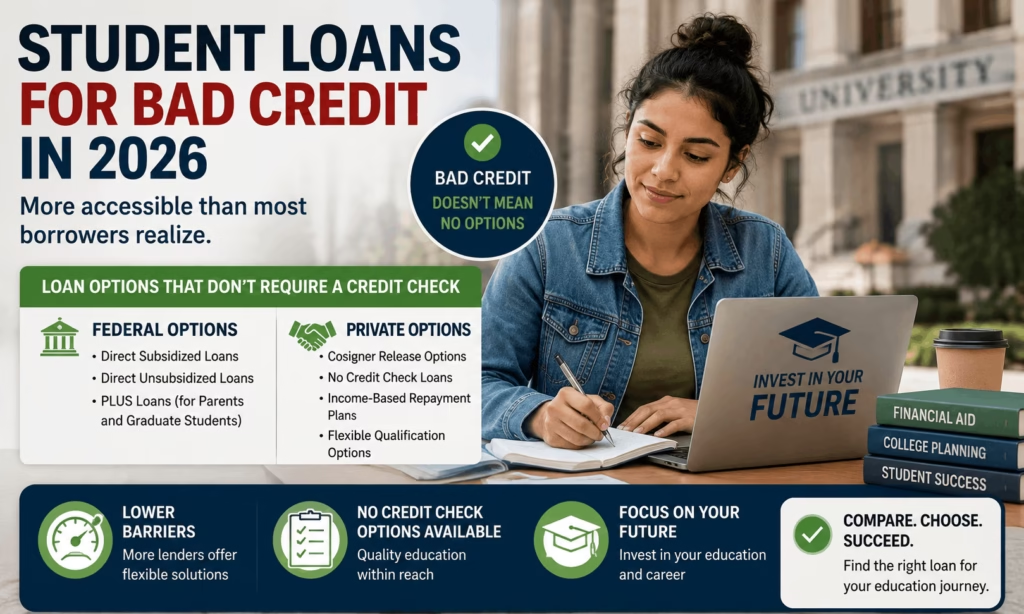
Student Loans for Bad Credit 2026: A poor credit score stops a lot of borrowers before they even start looking, and for student loans, that instinct is usually wrong. The federal student loan system, the one that funds the majority of American college students every year, was deliberately built to ignore credit scores almost entirely. As the 2026-27 academic year gets underway with newly confirmed federal interest rates, undergraduate Direct Loans locked in at 6.52% and graduate loans at 8.07%, following the U.S. Treasury’s May 12, 2026 note auction, the more urgent question for borrowers with damaged credit isn’t whether they qualify. It’s which type of loan to pursue first, and in what order.
That distinction matters more than ever this year. Federal student loan rules changed meaningfully on July 1, 2026, when the Grad PLUS Loan program stopped accepting new borrowers entirely and new annual and lifetime borrowing caps took effect across graduate and parent lending. For students and parents with bad credit trying to figure out how to actually pay for school this fall, understanding exactly which federal programs remain credit-blind, and which private options genuinely exist for lower scores, is the difference between paying manageable interest and getting pushed toward predatory alternatives. We’ll be updating this article monthly as new student loan rate and eligibility data is confirmed.
Latest Update: Student Loan Options for Bad Credit in 2026-27
| Loan Type | Credit Check Required? | 2026-27 Interest Rate | Key Detail |
|---|---|---|---|
| Direct Subsidized Loan | No | 6.52% | Need-based, undergraduate only |
| Direct Unsubsidized Loan (undergrad) | No | 6.52% | No credit or income requirement at all |
| Direct Unsubsidized Loan (graduate) | No | 8.07% | Available to grad/professional students |
| Parent PLUS Loan | Yes, adverse credit history check only | 9.07% | Endorser option available if denied |
| Grad PLUS Loan | Closed to new borrowers as of July 1, 2026 | 9.07% (legacy borrowers only) | Limited 3-year exemption for continuing students |
| Private student loans | Yes, full credit check | Varies, roughly 3% to 15%+ | Usually requires a creditworthy cosigner |
| Origination fee, Direct Loans | N/A | 1.057% | Deducted from disbursement |
| Origination fee, PLUS Loans | N/A | 4.228% | Deducted from disbursement |
Why Federal Student Loans Don’t Actually Check Your Credit Score
This is the single most important fact for anyone searching for student loans for bad credit, and it surprises a lot of first-time borrowers. Direct Subsidized and Direct Unsubsidized Loans, the two loan types that fund the vast majority of undergraduate and graduate borrowing in the United States, have no credit score requirement whatsoever. Your FICO score, your credit history, your income, none of it factors into whether you qualify or what interest rate you’re charged. Every borrower taking out the same loan type in the same academic year pays the exact same fixed rate, regardless of whether they have excellent credit or none at all.
That’s fundamentally different from how private lending works. Federal rates are set once a year through a formula written into the Bipartisan Student Loan Certainty Act of 2013: the 10-year Treasury note’s high yield from the annual May auction, plus a fixed statutory margin that varies by loan type. The May 12, 2026 auction produced a 4.468% yield, which combined with a 2.05% margin for undergraduate loans, a 3.60% margin for graduate loans, and a 4.60% margin for PLUS loans to produce this year’s confirmed rates. Because the formula applies identically to every applicant, a student with a 550 credit score and a student with an 800 credit score pay exactly the same rate on a Direct Loan.
SSA Ticket to Work Program: How Disability Beneficiaries Can Return to Work Without Losing Benefits
SSA Strategic Plan FY2026-2030: New Goals, Wait Times & Service Targets
SSI Address Change Service Enhancements: SSA’s New Fast-Track Process Explained
IRS Confirms Payments of Up to $8,231: Who Qualifies for the EITC in 2026
Where Credit Actually Starts to Matter: PLUS Loans
Federal lending isn’t entirely credit-blind, and this is where borrowers with bad credit need to pay closer attention. Parent PLUS Loans and the now-closed-to-new-borrowers Grad PLUS Loan program do require passing a credit check, though it works differently than a typical private lender’s evaluation. Rather than pulling a full credit score, the Department of Education screens specifically for an adverse credit history, meaning recent bankruptcy, foreclosure, repossession, unpaid collections accounts, a tax lien, wage garnishment, or a Title IV federal aid write-off within the past five years.
If a parent or eligible graduate borrower fails that adverse credit check, they aren’t automatically shut out. They can still qualify by applying with a creditworthy endorser, functionally similar to a cosigner, who agrees to repay the loan if the primary borrower doesn’t. That endorser must remain on the loan for its entire life unless the primary borrower later qualifies to release them. This endorser pathway is one of the most underused options among borrowers who assume a PLUS Loan denial means the end of their federal borrowing options.
What Changed for PLUS Loans on July 1, 2026
Borrowers researching this topic need current information, not outdated guidance, because federal PLUS lending changed substantially this year. Starting July 1, 2026, the Grad PLUS Loan program stopped accepting new borrowers entirely. Graduate and professional students who hadn’t already borrowed under the program in a prior year lost access to it going forward, though a limited exemption allows students who received Grad PLUS funding in 2025-26 and are continuing in the same program to keep borrowing under legacy rules for up to three additional years.
Parent PLUS Loans remain available, but with new restrictions that didn’t exist before this year: a new annual limit of $20,000 per dependent student and an aggregate limit of $65,000 per dependent student now apply to new Parent PLUS borrowers, a meaningful change from the previous system that allowed borrowing up to the full certified cost of attendance minus other aid. For families with bad credit relying on Parent PLUS as a fallback option, these new caps mean some households may need to combine PLUS borrowing with other financing sources rather than covering a full remaining balance through PLUS alone.
Private Student Loans With Bad Credit: What’s Realistic
Private lenders operate entirely differently from the federal system, and this is where a low credit score genuinely creates obstacles. Private student loan rates currently range from roughly 3% for borrowers with excellent credit and a strong cosigner, up past 15% or more for borrowers with weaker credit profiles applying without one. The gap in actual cost is significant: on a $30,000 loan, a top-credit private borrower might pay around $4,920 in total interest over a standard term, while an average-credit borrower on the same loan amount could pay closer to $17,640, more than triple the interest cost for the identical loan size.
For students with bad credit specifically considering private loans, a few realistic strategies exist:
- Apply with a creditworthy cosigner. This remains the single most effective way to access competitive private rates with a damaged personal credit history, since the lender evaluates the cosigner’s credit alongside, or sometimes instead of, the primary borrower’s.
- Check credit union rates before comparing bank lenders. Some credit unions have advertised rates as low as 2.99% for qualified borrowers, occasionally with more flexible underwriting than large national private lenders.
- Exhaust federal borrowing limits first. Because Direct Loans don’t check credit at all, maximizing federal borrowing before turning to any private loan minimizes how much bad-credit-priced debt a student needs to take on.
- Compare multiple private lenders through prequalification tools. Many private lenders offer soft-credit-check prequalification that shows an estimated rate range without affecting your credit score, letting you shop rates before a hard inquiry.
How to Apply for Student Loans With Bad Credit?
For students and families navigating this process, here’s the practical sequence that maximizes access to credit-blind funding before considering options that do factor in credit history.
- Complete the FAFSA first, since this determines eligibility for Direct Subsidized and Unsubsidized Loans, grants, and work-study, none of which require a credit check.
- Accept your full federal Direct Loan eligibility before considering any other borrowing option, since these loans carry no credit requirement and generally the most favorable fixed rates and repayment protections available.
- If additional funding is needed, consider Parent PLUS or remaining Grad PLUS eligibility, understanding that these do involve an adverse credit history check rather than a full credit score evaluation.
- If denied a PLUS Loan, apply with an endorser rather than assuming the denial ends your federal borrowing options.
- Only after exhausting federal options, shop private lenders, comparing prequalified rate estimates across multiple lenders and credit unions.
- Add a cosigner to any private loan application if your personal credit score is limiting your rate, since this consistently produces the largest rate improvement for borrowers with bad credit.
- Complete Entrance Counseling and sign a Master Promissory Note for any federal loan before funds can be disbursed.
IRCC Tightens Citizenship by Descent: What the New 1,095-Day Presence Test Rules Mean for Applicants
September 2026 Refund Payments: All the Real Deposits You Could Actually Get This Month
Social Security Proposals in Congress: What Changes Could Affect Your SSI and SSDI Benefits
Processing Time for Student Loan Applications
Federal Direct Loan processing generally moves quickly once the FAFSA is complete and a school has certified enrollment, often within a few weeks during standard aid cycles, though timing can extend during peak enrollment periods in July and August. PLUS Loan applications involving a credit check typically add a few additional business days for the Department of Education to complete its adverse credit history review. Private loan approval timelines vary significantly by lender, generally ranging from same-day prequalification decisions to one to two weeks for full underwriting and final approval, particularly when a cosigner’s documentation needs separate verification.
What Bad Credit Means for Your Repayment and Payment Schedule
This is a critical distinction borrowers often miss: a low credit score affects your interest rate on private loans and your initial approval on PLUS loans, but it does not change your repayment schedule structure for federal loans. Direct Loan repayment terms, deferment options, and income-driven repayment eligibility, including the newer Repayment Assistance Plan that replaced several previous income-driven options, apply identically regardless of a borrower’s credit history. Interest on unsubsidized federal loans begins accruing from disbursement and capitalizes when a loan enters repayment, while subsidized loans don’t accrue interest while a student remains enrolled at least half-time, a protection that has nothing to do with credit score and everything to do with financial need as determined through the FAFSA.
Federal vs. Private: The True Cost Comparison for Bad Credit Borrowers
Understanding the real dollar difference between these two paths matters enormously for anyone with a damaged credit profile weighing their options.
| Loan Type | 2026-27 Rate | Monthly Payment (on $30,000) | Total Interest Paid |
|---|---|---|---|
| Federal Undergraduate Direct | 6.52% | Approximately $341 | Approximately $10,920 |
| Federal Graduate Unsubsidized | 8.07% | Approximately $368 | Approximately $14,160 |
| Federal Parent/Grad PLUS | 9.07% | Approximately $381 | Approximately $15,720 |
| Private Loan, strong credit + cosigner | ~3% | Approximately $291 | Approximately $4,920 |
| Private Loan, weak/no credit history | ~10%+ | Approximately $397+ | Approximately $17,640+ |
The takeaway is clear: for a borrower with genuinely bad credit and no available cosigner, federal Direct Loans almost always cost less than a private loan priced for weak credit, even though federal rates rose again this year. Private loans only become the cheaper option when a borrower can secure a strong cosigner or has personally rebuilt their credit significantly.
Watch Out for “Guaranteed Approval” Bad Credit Loan Scams
Searching for student loans for bad credit unfortunately puts borrowers directly in the path of predatory advertising, and it’s worth naming the warning signs explicitly. Legitimate lenders, federal or private, never guarantee approval before reviewing an application, and no genuine student loan requires an upfront fee paid before funds are disbursed. Scam operations frequently advertise “guaranteed approval regardless of credit” or “no credit check required” for loans that aren’t federal Direct Loans, since those are the only student loans that genuinely carry no credit requirement by design. Any private lender or third-party company promising guaranteed approval on a credit-checked loan product, combined with pressure to act quickly or provide payment before funding, should be treated as a red flag rather than a legitimate opportunity. When comparing private lenders, stick to established banks, credit unions, and well-known online lenders, and verify any unfamiliar company through the Consumer Financial Protection Bureau’s complaint database before submitting personal or financial information.
TPS Terminations 2026: Complete Tracker for Somalia, Ethiopia, South Sudan, Syria, Haiti, and Yemen
USCIS Ukraine TPS EAD Extension: Work Permits Automatically Extended Through October 19, 2026
BC PNP Entrepreneur Immigration Draw Invites 16 Business Candidates in Latest Round
Building Credit While You Repay Student Loans
For borrowers currently dealing with bad credit, it’s worth understanding that responsible student loan repayment itself becomes one of the more effective tools for credit rebuilding over time. Federal student loan servicers report payment history to all three major credit bureaus, meaning consistent, on-time payments, even modest ones under an income-driven plan, gradually improve a credit profile the same way any other installment loan would. This matters for borrowers who took out a Parent PLUS Loan with an endorser or a private loan with a cosigner, since demonstrating a solid repayment history can eventually support a future application to release that cosigner or endorser from the loan, freeing up their own credit and borrowing capacity in the process.
Borrowers concerned about how a low starting credit score might affect them longer-term should also know that federal loans carry no prepayment penalty, meaning extra payments made during periods of stronger income directly reduce principal and total interest paid, regardless of the credit score a borrower started with when the loan first originated. This is a meaningful structural advantage over many private lending products, where terms and conditions can vary considerably by lender and credit tier.
Official Resources for Student Loans and Credit-Related Questions
Always verify current rates, eligibility, and application status directly through these official sources rather than third-party loan comparison sites.
| Resource | Purpose | Official Link |
|---|---|---|
| Federal Student Aid (login) | Apply for federal loans, manage your account, check status | studentaid.gov |
| FAFSA application | Determine eligibility for federal aid, grants, and loans | studentaid.gov/fafsa |
| Direct PLUS Loan credit check information | Official adverse credit history requirements | studentaid.gov (Direct PLUS Loans page) |
| National Student Loan Data System | Review your current federal loan balances and servicers | studentaid.gov/nslds |
| Annual Credit Report | Free credit report check before applying | annualcreditreport.com |
| Consumer Financial Protection Bureau | Student loan complaint filing and consumer guidance | consumerfinance.gov/consumer-tools/student-loans |
| Federal Register, Direct Loan interest rates | Official confirmed annual rate publication | federalregister.gov |
H-1B Spouse Work Permit at Risk: How Trump’s Latest Move Could Cut Family Incomes in Half
80% to 100% VA Disability: Why the Final Jump Is the Hardest One Veterans Face
FY2027 Government Shutdown Risk: Congress Races the September 30 Funding Cliff
FAQs About Student Loans for Bad Credit
Can you get a student loan with bad credit?
Yes. Direct Subsidized and Unsubsidized federal loans have no credit score requirement at all, making them accessible to virtually any eligible student regardless of credit history. Credit only becomes a factor with PLUS Loans and private lending.
Do federal student loans check your credit score?
Direct Subsidized and Unsubsidized Loans don’t check credit at all. Parent PLUS and Grad PLUS Loans check specifically for an adverse credit history, such as bankruptcy or recent collections, rather than pulling a traditional credit score.
What happens if I’m denied a Parent PLUS Loan due to bad credit?
You can reapply with a creditworthy endorser, who agrees to repay the loan if you don’t, or explore extenuating circumstances documentation with the Department of Education. A denial doesn’t automatically disqualify you from federal borrowing.
Is the Grad PLUS Loan still available in 2026?
No, not for new borrowers. As of July 1, 2026, Grad PLUS Loans are closed to new applicants, though students who borrowed under the program in 2025-26 and are continuing in the same program can keep borrowing under legacy rules for up to three more years.
What’s the current federal student loan interest rate for 2026-27?
For loans disbursed between July 1, 2026 and June 30, 2027, undergraduate Direct Loans carry a fixed 6.52% rate, graduate Unsubsidized Loans carry 8.07%, and Parent PLUS and legacy Grad PLUS loans carry 9.07%.
Can I get a private student loan with no credit history and no cosigner?
It’s difficult but not always impossible. Most private lenders require either an established credit history or a creditworthy cosigner. Borrowers without either typically face significantly higher interest rates or outright denial from many mainstream private lenders.
Does a cosigner help get a lower interest rate on a private student loan?
Yes, substantially. Adding a creditworthy cosigner is generally the single most effective way to lower a private student loan’s interest rate for a borrower with bad or limited personal credit.
Will bad credit affect my federal loan repayment options later?
No. Federal repayment plans, including deferment, forbearance, and income-driven repayment options like the Repayment Assistance Plan, are available based on financial circumstances at the time of repayment, not your credit history at the time of borrowing.
Conclusion
The idea that bad credit locks you out of paying for college is one of the most persistent myths in student financing, and it simply doesn’t hold up against how the federal student loan system actually works. Direct Subsidized and Unsubsidized Loans remain fully accessible regardless of credit history, and even PLUS Loans, the one federal category that does check credit, offer a clear path forward through an endorser when a borrower doesn’t pass the initial screening. With 2026-27 federal rates now confirmed at 6.52% for undergraduates, 8.07% for graduate students, and 9.07% for PLUS borrowers, and Grad PLUS closed to new applicants as of this July, the smartest strategy for anyone with a damaged credit score remains the same one that’s worked for years: max out credit-blind federal borrowing first, and treat private loans, cosigner or not, as the last resort rather than the starting point.
Florida Minimum Wage Reaches $15/Hour: The Final Step of a Six-Year Countdown Arrives September 30
IRS Seize Bank Accounts, Vehicles and Property From Taxpayers Who Ignore This Final Notice
Manitoba EIA Payment and CDB Exemption: What Changes and What Stays Protected in 2026