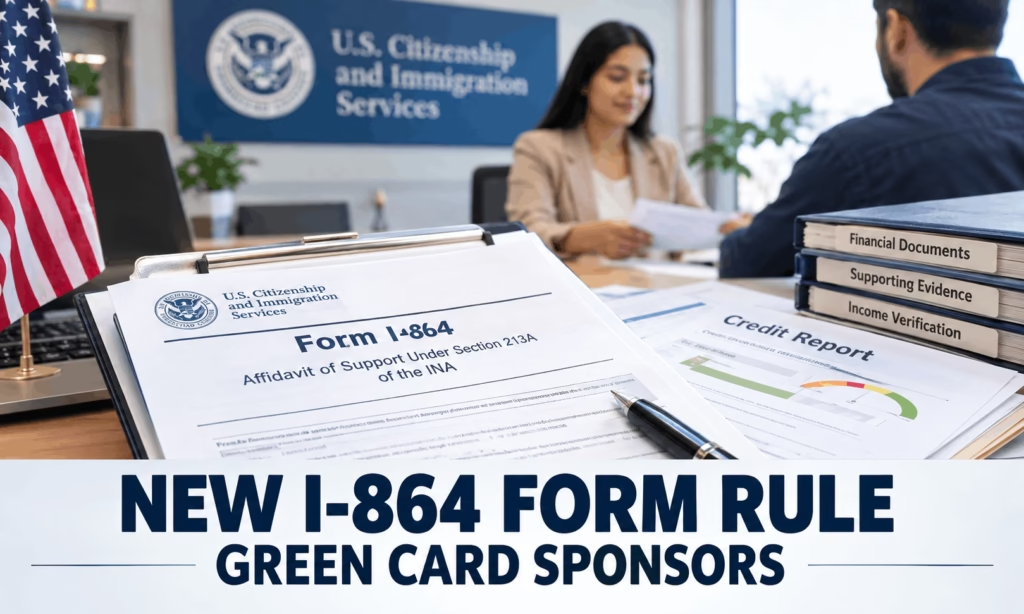
New Form I-864 Edition: USCIS quietly replaced the Affidavit of Support form that every family based green card sponsor must sign, and the rollout has confused thousands of applicants in the middle of active filings. On August 31, 2026, the agency published a new edition of Form I-864, Affidavit of Support Under Section 213A of the INA, dated 08/24/26, and at first announced it would accept nothing else, with no transition window at all. That triggered panic across immigration forums, since many petitioners had already assembled complete packets using the older 10/17/24 edition and were preparing to mail them that same week. We’ll be updating this article monthly as USCIS finalizes its guidance and as a pending lawsuit over the rollout moves through court.
Then USCIS reversed itself. Days after the initial announcement, the agency posted a correction stating it would give sponsors a 30 day grace period, allowing the older 10/17/24 edition to remain valid through September 30, 2026. Beginning October 1, 2026, only the new 08/24/26 edition will be accepted, and any Form I-864 postmarked or submitted electronically on or after that date using the old edition will be rejected. The new form is not a cosmetic update. It adds a consumer reporting authorization that lets USCIS and the State Department pull a sponsor’s credit report, a change that has already prompted a federal lawsuit from the American Immigration Lawyers Association.
Form I-864 Edition and Income Eligibility Checker
Form I-864 Edition and Income Eligibility Checker
Confirm which edition you need for your filing date and check whether your household income meets the 2026 requirement.
This tool applies the official October 1, 2026 edition cutoff and the 2026 HHS poverty guidelines used for Form I-864P. It is an educational estimate only. USCIS makes the final determination on edition acceptance and income sufficiency for each case.
What Changed With Form I-864 on August 31, 2026
Form I-864 is the legally binding contract a sponsor signs promising to financially support an intending immigrant, and it is required in nearly every family based green card case, whether the applicant is adjusting status inside the United States or completing consular processing abroad. On August 31, 2026, USCIS published a revised edition of the form along with updated versions of Form I-864A, the contract used when a household member’s income is combined with the sponsor’s, and Form I-864EZ, the shortened version available to petitioners who qualify.
The most significant substantive change sits in Part 8, the sponsor’s declaration and certification section, on the signature page. By signing the new 08/24/26 edition, a sponsor now authorizes USCIS and the Department of State to request information from one or more consumer reporting agencies, which in practice means the agency can pull a credit report. Prior editions of Form I-864 contained no such authorization. Everything else on the form, including the household size calculation, the income requirements, and the sponsor eligibility rules, remains largely the same as the previous version.
Form I-864 Key Dates and Deadlines
| Date | What Happened or What Takes Effect |
|---|---|
| August 31, 2026 | USCIS publishes the new 08/24/26 edition of Form I-864, I-864A, and I-864EZ, initially with no grace period |
| Shortly after August 31, 2026 | USCIS reverses course and announces a 30 day grace period for the prior 10/17/24 edition |
| September 3, 2026 | The American Immigration Lawyers Association sues USCIS over the abrupt rollout and the credit report requirement |
| September 30, 2026 | Last day USCIS will accept the older 10/17/24 edition of Form I-864 |
| October 1, 2026 | USCIS accepts only the 08/24/26 edition; older editions postmarked or submitted on or after this date are rejected |
Why USCIS Added a Credit Report Authorization to Form I-864
USCIS has said the new consumer reporting authorization is meant to help verify a sponsor’s actual financial circumstances rather than relying solely on tax returns and pay stubs, and to make it harder for so called professional sponsors to repeatedly promise support they cannot realistically provide. The agency has not published a minimum credit score, a specific debt to income threshold, or an automatic denial rule tied to a sponsor’s credit history. High debt, a prior bankruptcy, or a low credit score does not automatically disqualify a sponsor under the guidance released so far, and USCIS has not clarified exactly which elements of a credit report it plans to weigh most heavily.
One practical complication has already surfaced. If a sponsor has placed a credit or security freeze with Equifax, Experian, or TransUnion, USCIS may not be able to access the consumer report data it is authorized to request. USCIS has not announced a blanket requirement that sponsors lift a freeze before filing, but immigration attorneys are widely advising sponsors to check their freeze status and be ready to lift it temporarily if USCIS or the National Visa Center later requests it, since an unanswered request could stall an otherwise complete case.
2027 Social Security Benefits Changes: COLA Increase, Possible Cuts, and New Bills
Stimulus Check 2026: Fact-Checking Every Viral Payment Claim (Tracker)
Trump $5000 Dividend Check: Latest Update on Cost, Eligibility and Payment Date
Which Edition of Form I-864 Should You File Right Now
As of this week, sponsors technically have two acceptable choices. Anyone filing before October 1, 2026 can still use the older 10/17/24 edition during the grace period, though most immigration attorneys are recommending the new 08/24/26 edition regardless, simply to avoid any confusion at the lockbox and to prevent needing to redo the form later in the same case. Anyone filing on or after October 1, 2026 must use the 08/24/26 edition, no exceptions. Confirm the edition date printed at the bottom of each page before mailing anything, since a form prepared in July or August using a saved PDF template may still carry the old edition date even if it looks current.
One detail matters enormously for anyone worried about losing a filing date over the wrong form version. USCIS has clarified that it does not reject Form I-485, Application to Register Permanent Residence or Adjust Status, solely because it was filed together with a previous edition of Form I-864. The edition requirement applies to the Affidavit of Support itself, not automatically to the entire adjustment of status packet, though USCIS may still issue a request for evidence asking for the correct edition before final approval.
2026 Form I-864 Income Requirements Explained
Separate from the edition change, sponsors still must meet the underlying financial requirement written into the Immigration and Nationality Act. Most sponsors must show household income at or above 125 percent of the Federal Poverty Guidelines for their household size, using the updated Form I-864P figures that took effect for Affidavit of Support purposes on March 1, 2026, after a 2.63 percent increase over the 2025 numbers. Active duty members of the U.S. armed forces sponsoring a spouse or child only need to meet the lower 100 percent threshold.
| Household Size | 100% Guideline (Active Duty Military) | 125% Requirement (Most Sponsors) |
|---|---|---|
| 1 | $15,960 | $19,950 |
| 2 | $21,640 | $27,050 |
| 3 | $27,320 | $34,150 |
| 4 | $33,000 | $41,250 |
| 5 | $38,680 | $48,350 |
| 6 | $44,360 | $55,450 |
| 7 | $50,040 | $62,550 |
| 8 | $55,720 | $69,650 |
| Each additional person | +$5,680 | +$7,100 |
Sponsors in Alaska and Hawaii use separate, higher tables. For a household of four, the 125 percent threshold is $51,563 in Alaska and $47,438 in Hawaii. If a sponsor’s income falls short, a joint sponsor who independently meets the full requirement can file a separate Form I-864, or the household can use qualifying assets, generally valued at five times the income shortfall, to close the gap.
How to Apply: Completing and Filing the New Form I-864
Start by downloading a fresh copy of Form I-864 directly from the official USCIS website rather than reusing a previously saved file, since a saved PDF can silently carry the old edition date even after the cutoff. Confirm the edition date reads 08/24/26 at the bottom of every page. Gather the sponsor’s most recent federal tax return or transcript, proof of current employment or income, and evidence of U.S. citizenship or lawful permanent resident status. Calculate the correct household size, which includes the sponsor, their dependents, the intending immigrant, and any other individuals the sponsor has previously sponsored under an active Form I-864. Complete Part 8 carefully, since this is where the new consumer reporting authorization language appears, and sign only after reading it. If a household member’s income is needed to meet the threshold, that person completes Form I-864A separately. File the completed affidavit together with the underlying immigration application, whether that is Form I-485 for adjustment of status or the required documents for consular processing through the National Visa Center.
Processing Time: How Long Affidavit of Support Review Takes
Form I-864 itself is not processed as a standalone application, it is reviewed as part of the broader green card case it accompanies, so there is no separate receipt notice or individual processing clock for the affidavit alone. USCIS officers typically review the Affidavit of Support during the same interview or file review used for the underlying I-485 or immigrant visa application, which commonly takes several months depending on the local field office or embassy workload. If the income documentation is incomplete or the sponsor’s information cannot be verified, expect USCIS or the National Visa Center to issue a request for evidence, which generally adds 60 to 90 days to the timeline while the sponsor gathers and resubmits the missing documents.
SNAP Benefits October 2026 Increase: New Amounts, Eligibility and Calculator
PROMISE Act Social Security Deadline: What the September 17 Trigger Actually Means for Your Benefits
US Russia Sanctions Bill 2026: 100% Tariff Threat to India Explained
What Happens If You File the Old Form I-864 by Mistake
If a Form I-864 using the 10/17/24 edition is postmarked or submitted electronically on or after October 1, 2026, USCIS has stated it will not accept or process it. For a mailed paper filing, that generally means the entire package, or at minimum the affidavit itself, is returned, which can cost weeks of lost time while a corrected form is prepared and resent. For an electronically filed case, the outdated edition may be rejected at intake before it ever reaches an officer for review. The one piece of good news for anyone who already mailed a complete packet using the old edition before the cutoff is that the postmark date controls, not the date USCIS opens the envelope, so a package mailed on September 29 and postmarked that day remains valid even if it physically arrives at the lockbox in October.
The AILA Lawsuit Challenging the New Form I-864 Rollout
On September 3, 2026, the American Immigration Lawyers Association filed suit against USCIS, arguing the agency implemented the new Affidavit of Support requirements, including the credit report authorization, abruptly and without adequate advance notice or a reasonable transition period. The lawsuit asks the court to temporarily block enforcement of the new requirements while the case proceeds. As of this week, a judge has not yet ruled on the request, so the October 1, 2026 cutoff for the old edition remains the operative deadline sponsors should plan around unless and until a court order says otherwise.
How to Protect Your Sponsor’s Credit Information During Filing
Sponsors concerned about the new consumer reporting authorization can take a few practical steps before filing. Check whether a credit or security freeze is currently active with Equifax, Experian, or TransUnion, since a freeze could delay USCIS’s ability to retrieve the requested information if it is ever requested during case review. Keep a folder of income documentation, such as recent pay stubs, tax transcripts, and employer letters, ready to submit quickly if USCIS follows up rather than relying solely on the credit report itself. Read Part 8 of the new form closely before signing, since that section contains the specific authorization language, and ask an immigration attorney to review the completed affidavit if the sponsor’s financial history includes anything unusual, such as a recent bankruptcy or significant outstanding debt.
Common Mistakes Sponsors Make With the New Form I-864
The most frequent error immigration attorneys are seeing right now is sponsors reusing a Form I-864 PDF they had already filled out and saved before August 31, 2026. Because the form was completed in a PDF editor, it can look finished and correct while still carrying the outdated 10/17/24 edition date printed at the bottom of the page, an easy detail to miss when a petitioner is focused on the substantive answers rather than the fine print in the footer. Always download a fresh copy directly from the official USCIS site immediately before filing rather than trusting an older saved version, even one that was completed only a few weeks ago.
A second common mistake involves household size calculations that do not account for previously sponsored immigrants. If a sponsor has an existing, still active Form I-864 obligation from an earlier case, that previously sponsored immigrant typically counts toward the sponsor’s household size on every new affidavit, which raises the income threshold the sponsor must meet. Overlooking this requirement is one of the more common reasons USCIS issues a request for evidence, since the household size on the form ends up smaller than what the sponsor’s actual sponsorship history requires.
A third mistake is submitting Form I-864 without the required tax transcript or return, or submitting only a summary rather than the full return with all schedules attached. USCIS generally wants the most recent federal tax return, either the full return with all schedules or an official IRS transcript, and a printout from tax preparation software without supporting schedules is often insufficient on its own. Pairing the correct edition of the form with complete, properly assembled financial documentation remains the single biggest factor in avoiding delays, regardless of how the credit report authorization ultimately gets used.
FAQs
What is the new Form I-864 edition date for 2026?
The current edition is dated 08/24/26 and was published by USCIS on August 31, 2026.
When will USCIS stop accepting the old Form I-864?
USCIS will only accept the 08/24/26 edition for filings postmarked or submitted electronically on or after October 1, 2026, following a 30 day grace period that allowed the 10/17/24 edition through September 30, 2026.
Does the new Form I-864 really let USCIS check my credit?
Yes. By signing the 08/24/26 edition, the sponsor authorizes USCIS and the Department of State to request information from consumer reporting agencies, though USCIS has not published a minimum credit score or automatic denial threshold.
Will my green card application be rejected if I used the old I-864 with my I-485?
USCIS has stated it does not reject Form I-485 solely because it was filed with a previous edition of Form I-864, though a request for evidence asking for the correct edition may still follow.
What income do I need to sponsor a family member in 2026?
Most sponsors need household income at or above 125 percent of the Federal Poverty Guidelines for their household size, which is $27,050 for a household of two and $41,250 for a household of four in the 48 contiguous states.
Is there a lawsuit against the new Form I-864 requirements?
Yes. The American Immigration Lawyers Association sued USCIS on September 3, 2026, challenging the abrupt rollout and the new credit report authorization, and a court has not yet ruled on the request to block the changes.
Do I need a credit freeze lifted before filing Form I-864?
USCIS has not announced a universal requirement to lift a freeze in advance, but sponsors are advised to check their freeze status with Equifax, Experian, and TransUnion and be prepared to lift it temporarily if requested.
What is the difference between Form I-864 and Form I-864EZ?
Form I-864EZ is a shortened version available only to petitioners sponsoring a single immigrant using income reported on their own most recent tax return, without a joint sponsor or household member contribution, while the full Form I-864 covers every other sponsorship situation.
Can a joint sponsor use the old Form I-864 edition too?
The same edition rules apply to every sponsor and joint sponsor. Anyone filing on or after October 1, 2026 must use the 08/24/26 edition, regardless of whether they are the primary sponsor or a joint sponsor.
How long is a Form I-864 sponsorship obligation valid?
The sponsor’s financial obligation generally continues until the immigrant becomes a U.S. citizen, can be credited with 40 quarters of work history, leaves the United States permanently, or dies, among a few other terminating events defined in the affidavit.
What happens if a sponsor’s income drops after filing Form I-864?
The affidavit is a binding contract at the time it is signed, and a later drop in the sponsor’s income does not remove the legal obligation already created, though it may affect that sponsor’s ability to sponsor additional immigrants in the future without a joint sponsor.
Official Form I-864 Resources and Links
| Resource | Purpose | Link |
|---|---|---|
| USCIS Affidavit of Support page | Download the current Form I-864 edition and read the official alert | uscis.gov/i-864 |
| Form I-864P poverty guidelines | Confirm the exact income requirement for your household size and location | uscis.gov/i-864p |
| USCIS online account login | Check the status of an electronically filed case | myaccount.uscis.gov |
| Case status online | Track a mailed filing using a receipt number | egov.uscis.gov/casestatus |
| National Visa Center | Submit Form I-864 for consular processing cases | travel.state.gov |
Conclusion
The new Form I-864 rollout has been messier than most USCIS form updates, moving from a zero grace period announcement to a 30 day reprieve within days, while a federal lawsuit over the new credit report authorization remains unresolved. For sponsors and petitioners, the practical takeaway is simpler than the headlines suggest. File using the 08/24/26 edition, confirm the printed edition date before mailing anything, make sure your household income meets the applicable 125 percent or 100 percent threshold, and check your credit freeze status ahead of time so a routine verification request does not stall an otherwise strong case. The October 1, 2026 deadline for the old edition stands unless a court intervenes, so treat that date as firm while continuing to watch for updates as the AILA lawsuit develops.
Medicaid Work Requirements 2026: New Rule Rollout, State Start Dates and Who Is Exempt
ABLE Account Eligibility 2026: Who Qualifies Now, New Age Limit and Calculator
$354 Canada Disability Benefit September 2026: Full dates, Eligibility & Calculator