Colorado SNAP Junk Food Ban Status: When Colorado became the first Democratic-led state to win federal approval for a SNAP food restriction, it looked like the “junk food ban” movement had gone bipartisan. Under the plan, families using the Supplemental Nutrition Assistance Program (SNAP, once known as food stamps) would no longer be able to buy soda and other sugary drinks with their benefits. Governor Jared Polis had backed the idea for years, the U.S. Department of Agriculture (USDA) approved it in August 2025, and the state announced rollout dates. Yet in November 2026, a Colorado shopper can still put a can of soda on an EBT card.
That outcome is the result of two separate roadblocks. The first was local. Colorado’s State Board of Human Services, which must adopt the rule before the state can enforce it, heard strong opposition, repeatedly delayed its vote, and never approved the policy. The second was federal. On June 22, 2026, a federal court in Washington, D.C. vacated USDA’s approval of Colorado’s waiver, along with approvals for four other states, ruling that the department had overstepped its legal authority. USDA is appealing, but for now the Colorado waiver is not in force.
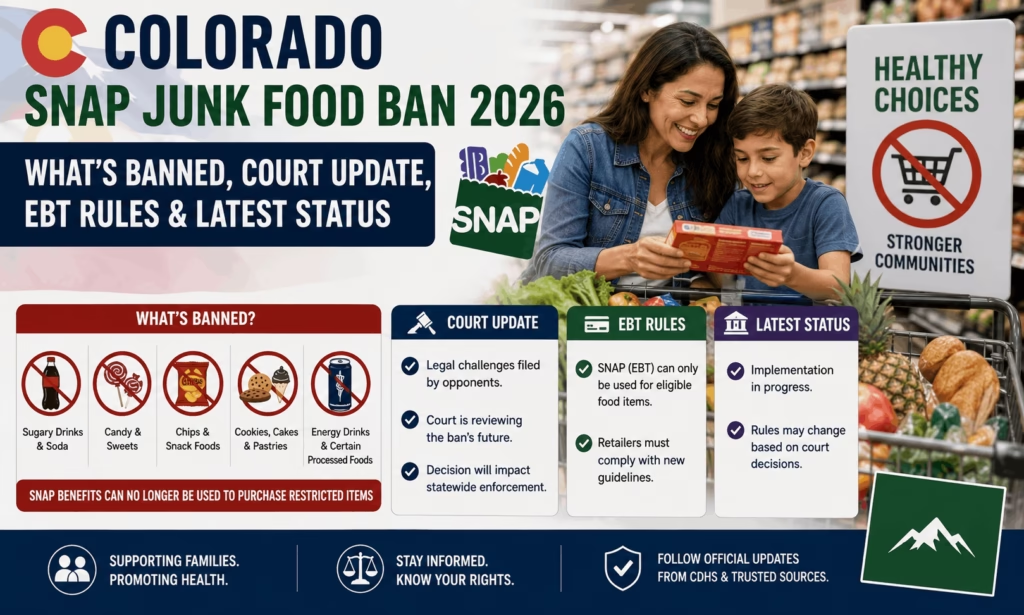
Colorado SNAP Junk Food Ban 2026
This article on SNAP Junk Food Ban covers what Colorado planned, how the plan unraveled, what the court actually decided, what the situation is today, and what could happen next. It also corrects a common confusion: some third-party websites still describe Colorado’s restriction as if it were active. It is not. Key facts are matched to official or primary sources in the table near the end of the article (SNAP Junk Food Ban).
- Colorado’s SNAP soda restriction is not in effect.
- A federal court vacated USDA’s approval on June 22, 2026, in Aragon et al. v. Rollins et al.
- Colorado’s own board never adopted the rule, and the state said in April 2026 that it would not implement it.
- USDA appealed on August 20, 2026. The appeal is pending, and filing it does not revive the waiver.
What Colorado Planned?
Colorado’s proposal, called the SNAP Healthy Choice Waiver, was narrower than many other states’ plans. It focused on soft drinks, which reporting described as sweetened beverages with at least 5 grams of sweetener per 12 ounces. Unlike Oklahoma, Nebraska or Louisiana, Colorado did not target candy or energy drinks in its approved waiver. Under the state’s own materials, beverages made of at least 50 percent natural fruit or vegetable juice by volume were to stay eligible.
The state also said the rule applied only to purchases made in Colorado. Its FAQ stated that restrictions do not follow a cardholder into other states, since SNAP transactions follow the rules of the state where the purchase happens. Households would still have been free to buy restricted drinks with cash.
Colorado’s request also had a second part. According to Colorado reporting, USDA asked the state to split its application into pieces. It approved the sweetened-drink portion, while a request involving hot foods was left without a decision.
The stated goal was public health. State officials and supporters said cutting sweetened drinks from SNAP would encourage healthier choices and support the state’s health goals. More than 600,000 Coloradans rely on SNAP each month, so even a drinks-only rule would have touched a large number of households.
Timeline: How the Plan Unraveled?
| Date | Event |
| Aug. 1, 2025 | Colorado Department of Human Services (CDHS) submits its waiver request to USDA |
| Aug. 4, 2025 | USDA approves Colorado’s waiver, making it the first Democratic-led state approved |
| Jan. 2026 | CDHS announces rollout details and information sessions; start dates cited at the time included March 1 and April 30, 2026 |
| Feb. 6, 2026 | State Board of Human Services hears public testimony and advances the rule toward a second reading |
| Mar. 6, 2026 | Board votes 8–1 to delay its decision until April 3 |
| Mar. 11, 2026 | Aragon v. Rollins is filed in federal court in D.C. |
| Apr. 3, 2026 | The item is dropped from the board’s agenda, and CDHS says Colorado will not implement the rule |
| June 22, 2026 | Federal court vacates USDA’s approval of Colorado’s waiver and four others |
| Aug. 20, 2026 | USDA files notice of appeal with the D.C. Circuit |
| Nov. 3, 2026 | USDA’s table still lists Colorado as vacated, with no start date |
Why the state board mattered?
In Colorado, a federal waiver alone was not enough. CDHS needed the State Board of Human Services to adopt a rule. At the first hearing, SNAP recipients, health care professionals, retailers and anti-hunger advocates testified, and many opposed the proposal. Groups such as Hunger Free Colorado argued that the policy would add stigma, confuse shoppers and reduce the dignity and flexibility of SNAP. After two hearings and the pending lawsuit, the board’s vote was postponed, and the matter was taken off its April 3 agenda.
At one stage CDHS also said that, under board procedure, it had until August 7, 2026 to bring a rule package forward for a final vote. That deadline became moot once the court acted in June.
The Court Ruling: Aragon v. Rollins
The case
The lawsuit was filed on March 11, 2026 in the U.S. District Court for the District of Columbia by five SNAP recipients from Colorado, Iowa, Nebraska, Tennessee and West Virginia. They sued USDA and Secretary Brooke Rollins. Colorado’s plaintiff, Nieves Aragon, has Type 1 diabetes and argued that small cans of soda are a fast, dependable way for her to bring her blood sugar up. Law groups including the National Center for Law and Economic Justice (NCLEJ) represented the plaintiffs.
The plaintiffs raised two central arguments:
- USDA had no statutory authority to approve state waivers that narrow the federal definition of eligible food.
- USDA failed to follow required public notice procedures under the Administrative Procedure Act.
The decision
On June 22, 2026, Judge Amy Berman Jackson ruled for the plaintiffs. She held that USDA lacked authority to approve the five challenged state pilot projects. The court vacated USDA’s approval for each and ordered that implementation may not proceed. Reporting on the opinion also noted that the judge found USDA’s “no significant impact” conclusion to be at odds with the administrative record.
“Vacated” matters. It means the approval itself is void. It is not merely paused, and it is not something the state has withdrawn. A restriction can come back only if USDA issues a new, valid approval or a higher court reverses the ruling.
Cash App $15M Settlement Payments: Who Qualifies, How Much?
Estate Tax Exemption 2026: $15 Million Limit, $19,000 Gift Tax Rule and the New 2027 IRS Numbers
The scope
The ruling applies to the five states in the case. USDA’s own table notes that the waivers for Colorado, Iowa, Tennessee, West Virginia and Nebraska were vacated. Other states with approved waivers, such as Oklahoma, Texas, Florida and Indiana, were not covered and continue to enforce theirs.
The federal response
Rollins publicly criticized the ruling, calling the judge “activist” and saying SNAP is for food, not “sugar bombs.” USDA filed its notice of appeal to the U.S. Court of Appeals for the D.C. Circuit on August 20, 2026. Legal commentators have noted that filing an appeal does not itself reinstate the programs. The five waivers stay blocked unless the ruling is stayed or reversed.
SNAP Junk Food Ban Status
- Soda, candy and other sweetened items remain eligible with SNAP in Colorado. A SNAP Junk Food Ban guide updated this month confirms shoppers can still buy them and explains that the June 2026 ruling placed the proposed restriction on hold.
- USDA’s official table shows Colorado with the court order language in place of a start date.
- No reapplication from Colorado appears in USDA’s table. Nebraska, by contrast, refiled and now has a December 1, 2026 date listed.
- CDHS’s waiver page has carried public information, and a version of the page indexed in search results says the department is discontinuing its implementation effort because federal policy currently prohibits states from piloting such restrictions. Pages can change, so check the live page before relying on that wording.
A word of caution about misinformation: at least one popular SNAP Junk Food Ban guide has described Colorado as having soft drink restrictions “in place starting in October 2026.” That reflects the old USDA target date and does not match USDA’s current table or the court order. Always verify against USDA and CDHS.
What the Ruling Means for Colorado Families?
Shopping. Nothing changes at the register. Your EBT card should work for sodas and other eligible drinks just as before.
Benefits and eligibility. The case was about which items SNAP can buy, not who qualifies or how much households receive. Benefit amounts and eligibility rules are separate from the waiver fight.
Payment timing. Colorado loads SNAP benefits between the 1st and 10th of each month, so November 2026 benefits arrive between November 1 and November 10. Third-party guides disagree on whether your exact day is set by your case number or Social Security number, so confirm your date on your benefit notice or in the PEAK portal. If your balance looks wrong, the EBT customer service number listed for Colorado is 1-888-328-2656, and your county human services office can help.
Retailers. Colorado retailers do not need to block soda under this waiver. Retailers elsewhere in the country are dealing with new requirements as other states begin their restrictions, but Colorado’s stores are not affected unless the situation changes.
What Could Happen Next?
- The D.C. Circuit appeal. If the appeals court reverses, USDA’s approval could be revived. Even then, Colorado would still need to decide whether to move forward, and its State Board would still need to adopt a rule.
- A new federal approval process. USDA has begun using a Federal Register notice process for at least one affected state, Nebraska. Colorado could follow that path, but nothing in USDA’s table shows it has asked.
- Policy changes in Colorado. Governor Polis has long supported removing soda from SNAP, so the idea could return in a different form. The strong public opposition seen in 2026 suggests any new attempt would face scrutiny.
- Federal legislation. Proposals in Congress, such as the Healthy SNAP Act, would set national limits regardless of state waivers.
Colorado Compared With Other States
Colorado is part of a wider story. USDA lists approved waivers in 23 states. Eight states had restrictions at the register by the autumn, including Indiana, Utah, Idaho, Oklahoma, Louisiana, Texas, Florida and Arkansas. Montana, North Dakota, South Carolina and Virginia began on November 1, 2026. Colorado, Iowa, Tennessee and West Virginia are listed as vacated, while Nebraska has a new December 1, 2026 date. Colorado stands out because it is the one case where the state’s own board stopped the policy before the courts did.
Official and Primary Sources
| Topic | Source | Link |
| All state waivers (updated Nov. 3, 2026) | USDA Food and Nutrition Administration | CLICK HERE |
| Colorado waiver on USDA site | USDA FNA | CLICK HERE |
| Colorado Healthy Choice Waiver page | Colorado Dept. of Human Services | CLICK HERE |
| Colorado waiver request (Aug. 1, 2025) | USDA FNS | CLICK HERE |
| Governor’s statement on federal approval | Colorado Governor’s Office | CLICK HERE |
| Court opinion, Aragon v. Rollins | FindLaw (court text) | CLICK HERE |
| Case summary and docket details | Civil Rights Litigation Clearinghouse | CLICK HERE |
| Federal court blocks Colorado plan | Colorado Sun via States Newsroom | CLICK HERE |
| Ruling coverage | CNN | CLICK HERE |
| Colorado will not implement rule (Apr. 3) | KJCT/KKTV | CLICK HERE |
| Board delays vote | KOAA | CLICK HERE |
| Community opposition and pause | Hunger Free Colorado | CLICK HERE |
| What Colorado shoppers can buy now | Community Food Share | CLICK HERE |
| Nationwide expansion and appeal context | FoodNavigator | CLICK HERE |
SNAP Junk Food – Frequently Asked Questions
Is the Colorado SNAP soda ban in effect?
No. A federal court vacated USDA’s approval on June 22, 2026, and Colorado’s State Board of Human Services never adopted the rule.
What exactly did Colorado SNAP Junk Food ban plan to restrict?
Soft drinks, described as sweetened beverages with at least 5 grams of sweetener per 12 ounces. Candy was not part of Colorado’s approved waiver.
Would juice have been banned?
No. Beverages with at least 50 percent natural fruit or vegetable juice by volume were to remain eligible under the state’s materials.
When was the ban supposed to start?
Dates changed over time. Early state materials gave March 1, 2026, other reporting cited April 30, 2026, and USDA’s table later showed October 30, 2026. None took effect.
Who approved Colorado’s waiver, and when?
USDA approved it on August 4, 2025, after the state’s August 1, 2025 request.
Why did the state board not approve it?
The board heard strong opposition at public hearings, delayed its vote, and the item was removed from its April 3 agenda. CDHS then said the state would not implement the rule.
What is Aragon v. Rollins?
The federal lawsuit, No. 1:26-cv-00861, filed March 11, 2026 by SNAP recipients from five states, challenging USDA’s approval of food restriction waivers.
Has USDA appealed?
Yes. The appeal was filed with the D.C. Circuit on August 20, 2026 and is pending.