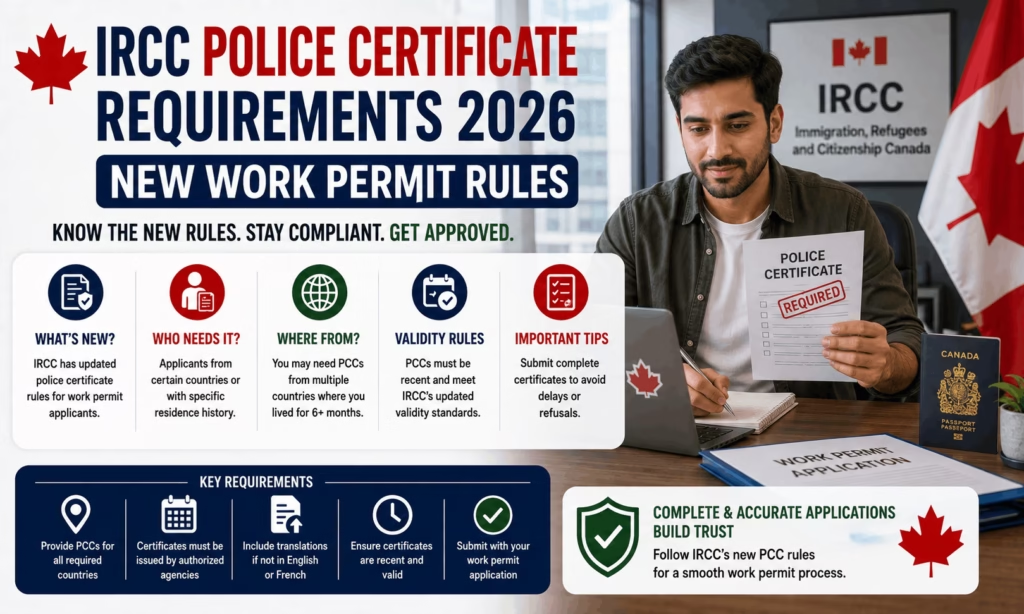
IRCC Police Certificate Requirements 2026: Immigration, Refugees and Citizenship Canada (IRCC) has rolled out important clarifications to its police certificate requirements, and every work permit applicant planning to apply through International Experience Canada (IEC) or other work permit streams needs to understand these changes before submitting their file. The updated instructions, published on June 17, 2026, tighten how the six-month validity window for a police certificate is calculated, close a loophole around applicants who have lived in more than one country, and clarify how the rule applies to U.S. citizens and permanent residents. Because a police certificate is one of the most common reasons work permit applications get delayed or returned as incomplete, understanding exactly when your certificate must be issued, from which country, and in what format, can make the difference between a smooth approval and months of lost time. This guide walks through the new IRCC police certificate rules, who they affect, and the exact steps to stay compliant.
A police certificate (also called a police clearance certificate or police check) is an official document confirming whether an applicant has a criminal record in a specific country or region. IRCC uses this document to assess admissibility to Canada under the Immigration and Refugee Protection Act, since applicants with certain criminal records may be found inadmissible and refused a work permit. Requirements differ across immigration programs: Express Entry candidates generally have a window after entering the pool to submit certificates, while IEC candidates must typically submit at least one police certificate at the same time as their work permit application. With the 2026 update, IRCC has made the timing rules far more precise, meaning applicants can no longer rely on outdated certificates or ambiguous interpretations of “recent enough.” We’ll be updating this article monthly to reflect any further IRCC policy changes.
What Changed: The New IRCC Police Certificate Rules for 2026
On June 17, 2026, IRCC published updated instructions clarifying police certificate requirements, primarily affecting International Experience Canada (IEC) work permit applicants, though the underlying admissibility principles apply broadly across work permit categories. The key changes include:
- The six-month validity window is now tied to the date IRCC receives your application. Previously, the instructions mentioned a six-month rule but did not clearly state the reference point. Now it is explicit: your police certificate for your current country of residence must be issued within six months before IRCC receives your work permit application.
- New clarity for applicants who lived in multiple countries. If you lived in another country for six consecutive months or longer since turning 18, your certificate from that country must have been issued after the last time you lived there, not simply within any six-month window.
- The rule now explicitly applies to U.S. citizens and permanent residents applying for an IEC-specific work permit through a Recognized Organization (RO), as well as to applicants from countries that don’t normally require an upfront certificate but are asked for one by an immigration officer during review.
- U.S. citizens and permanent residents who have only ever lived in the United States are generally not required to submit a police certificate upfront.
These clarifications are designed to remove ambiguity that previously led to inconsistent decisions and avoidable application delays.
Who Needs a Police Certificate for a Canadian Work Permit?
You may need to submit one or more police certificates if you are applying for:
- A work permit under International Experience Canada (IEC), including Working Holiday, Young Professionals, and International Co-op categories
- A work permit where you previously declared a criminal record on a related application, such as an eTA, study permit, or prior work permit
- Permanent residence through Express Entry or other economic immigration programs
- Canadian citizenship, for applicants aged 18 and over, or those resuming citizenship after giving it up
In most IEC cases, a certificate is required for any country or territory where you lived for six or more consecutive months in a row since turning 18. You do not need a certificate for any period before you turned 18, and certificates are generally required from your country of citizenship and your current country of residence, whichever applies to your situation.
Missouri SNAP Food Ban Delayed: What’s Banned & Latest Status
Hawaii SNAP Soda Ban Delayed to 2027: What Will Be Banned & Status
Florida SNAP Junk Food Ban 2026: What’s Banned, Court Update, EBT Rules & Latest Status
Nevada SNAP Food Ban: What’s Banned & Start Date Explained
The Six-Month Rule Explained in Detail
The most significant update in 2026 concerns timing. Under the clarified instructions:
- If you are currently living in a country, your police certificate must be issued within six months before IRCC receives your work permit application, not six months before you submit it from your end, but six months before it lands in IRCC’s system.
- If you previously lived in another country for six months or more since turning 18, your certificate from that country must be issued after your last period of residence there, even if that was several years ago.
- This clarification also applies to applicants who are asked for a certificate by an immigration officer during processing, even if their country doesn’t normally require one upfront.
If your existing certificate is close to expiring under this six-month window, the safest approach is to request a new one rather than risk submitting an outdated document, since IRCC officers can request an updated certificate at any point during processing if they believe the one on file is no longer current.
Format, Translation and Upload Requirements
IRCC has specific technical requirements for how police certificates must be submitted:
- If your certificate is not issued in English or French, you must submit the original document along with a certified translation.
- IRCC’s online application portal typically provides only one upload field for police certificates. If you need to submit certificates from multiple countries, you must merge all scanned copies into a single PDF file before uploading.
- Submit a scanned copy of the original certificate, not a photograph or screenshot, to avoid processing delays.
- If your certificate does not include a document number, enter “N/A” in the relevant field on your application rather than leaving it blank.
25 States Sue Trump Administration Over New Tariffs on Trading Partners
How to Obtain a Police Certificate
The exact process for getting a police certificate depends on the country involved, since each government sets its own procedure:
- In most countries, you must contact the local police authority or a designated government agency directly to request a certificate.
- Some countries, including certain jurisdictions like Hong Kong and Mexico, do not allow applicants to request a certificate independently. In these cases, you first need a formal request letter from the Canadian government, which IRCC will issue as part of your application process.
- Processing times for police certificates vary significantly by country, so applicants are strongly encouraged to start the request process early, well before their intended work permit submission date, to avoid last-minute delays.
- Fingerprinting for a police certificate is a separate process from providing biometrics (fingerprints and photo) for your IRCC application, and the two should not be confused.
Program-by-Program Timing Requirements
Different IRCC immigration streams have different windows for submitting a police certificate. Here is a comparison based on the latest published guidance:
| Program | When You Must Submit a Police Certificate |
|---|---|
| International Experience Canada (IEC) | In most cases, submitted with your work permit application, generally within 20 days of accepting your Invitation to Apply |
| Express Entry (Permanent Residence) | Typically required within 60 to 90 days of entering the pool, depending on current IRCC guidance |
| Canadian Citizenship (Grant) | Required for applicants 18 years and older, or those resuming citizenship |
| Other Work Permits (declared criminal record) | Required if a criminal record was declared on an eTA, study permit, or prior application |
| Validity window for current country of residence (2026 update) | Must be issued within 6 months before IRCC receives the application |
| Validity window for a previously lived-in country | Must be issued after your last period of residence in that country |
Canada Grocery Rebate 2026 Full Schedule: Confirmed Payment Dates, Amounts & Status Check!
Key Highlights: What’s New in the 2026 Police Certificate Update
| Date of official clarification | June 17, 2026 |
| Programs primarily affected | International Experience Canada (IEC), with broader admissibility relevance |
| Main change | Six-month validity window now explicitly tied to IRCC’s application receipt date |
| New coverage | Rule now applies to U.S. citizens/PRs applying through a Recognized Organization |
| Multiple-country rule | Certificate must be issued after the last period of residence in that country |
| Upload limit | One file field; multiple certificates must be merged into a single PDF |
| Translation requirement | Certified translation required if certificate isn’t in English or French |
| Who is generally exempt | U.S. citizens/PRs who have only lived in the United States |
Common Mistakes That Delay Work Permit Applications
- Submitting an outdated certificate that falls outside the six-month window by the time IRCC processes the file
- Forgetting a country where you lived for six months or more since turning 18, even years in the past
- Uploading multiple separate files instead of merging certificates into one PDF as required
- Skipping certified translation for a certificate issued in a language other than English or French
- Waiting too long to request a certificate from a country with a lengthy issuance process, causing the certificate to expire before the application is even submitted
- Assuming U.S. citizens never need a certificate, when in fact this only applies if the U.S. is the only country they’ve lived in since turning 18
Why This Matters: Admissibility and Work Permit Approval
IRCC uses police certificates specifically to determine whether an applicant is admissible to Canada under the Immigration and Refugee Protection Act. Applicants with a criminal record that triggers inadmissibility may be refused a work permit, regardless of how strong the rest of their application is. This is why accuracy and timing matter so much: an expired, mismatched, or missing certificate doesn’t just cause a delay, it can result in your application being returned as incomplete, forcing you to restart the process and potentially lose your place in a competitive IEC pool or miss a program intake deadline.
Tips to Avoid Police Certificate Delays
- Map your residence history first. Before applying, list every country or territory where you’ve lived for six consecutive months or longer since turning 18. Missing even one location is one of the most common causes of an incomplete application.
- Request certificates from slow-processing countries first. Some jurisdictions can take weeks or months to issue a police certificate, so prioritize those requests as soon as you decide to apply for a Canadian work permit.
- Track the six-month clock carefully. Since the window is now measured from the date IRCC receives your application, not the date you submit it from your end, build in a buffer of a few extra weeks to account for processing on IRCC’s side.
- Keep digital and physical copies organized. Scan every certificate at high resolution as soon as you receive it, and store both the original document and its certified translation (if needed) together.
- Confirm the correct issuing authority. IRCC only accepts certificates issued by the relevant police or government authority in your country of residence or citizenship; certificates from private background-check companies are generally not accepted.
- Double-check formatting before uploading. Merge multiple certificates into a single, correctly ordered PDF, and make sure file sizes meet IRCC’s upload limits to avoid a rejected submission.
Official IRCC Resources and Links
| Resource | Purpose |
|---|---|
| How to Get a Police Certificate | Country-by-country instructions for obtaining a certificate |
| When to Submit a Police Certificate | Program-specific timing requirements |
| Police Certificates Overview | General eligibility and submission rules |
| IEC Work Permit Application Guide | Full IEC application steps, including document checklist |
| IRCC Account Sign In / Registration | Create an account, apply online, and pay fees |
| Check Application Status | Track your work permit application |
| IRCC Call Centre | 1-888-242-2100 (within Canada) or 1-613-944-4000 (outside Canada) |
FAQs
How recent does a police certificate need to be for a Canadian work permit in 2026?
For your current country of residence, it must be issued within six months before IRCC receives your work permit application. For a country you lived in previously, it must be issued after your last period of residence there.
Do U.S. citizens need a police certificate for an IEC work permit?
Generally no, if the United States is the only country they have lived in since turning 18. However, if they lived elsewhere for six months or more, a certificate from that country is required.
What happens if my police certificate expires before IRCC processes my application?
IRCC officers can request an updated certificate at any point during processing. It is safer to apply for a new one if your existing certificate is close to the six-month cutoff.
Can I upload multiple police certificates separately on the IRCC portal?
No. Most IRCC application portals provide only one upload field for police certificates, so multiple certificates must be merged into a single PDF before submission.
Do I need a police certificate for a country I lived in before turning 18?
No. IRCC does not require police certificates for any period of residence before you turned 18.
What if my country doesn’t allow me to request a police certificate directly?
Countries like Hong Kong and Mexico require a formal request letter from the Canadian government before issuing a certificate. IRCC provides instructions for this during your application process.
Is a police certificate the same as biometrics?
No. A police certificate is a document from a police or government authority confirming your criminal record status, while biometrics (fingerprints and photo) are collected separately as part of your IRCC application.
Does a criminal record automatically disqualify me from getting a work permit?
Not automatically, but certain criminal records can make an applicant inadmissible to Canada under immigration law. Each case is assessed individually by an IRCC officer.
Conclusion
The 2026 update to IRCC police certificate requirements brings much-needed clarity for work permit applicants, particularly those applying through International Experience Canada. The most important takeaway is timing: your certificate for your current country of residence must fall within a six-month window before IRCC receives your application, and certificates from previously lived-in countries must be issued after your last period of residence there. Given how much processing times can vary by country, and how strictly IRCC now enforces these validity windows, applicants should start gathering their police certificates as early as possible in the application process. Always verify the latest requirements directly on canada.ca, since IRCC continues to refine its instructions as application volumes and program rules evolve throughout 2026.
How to Request Urgent Processing of a Canadian Citizenship Certificate: Eligibility, Documents and Fast-Track Steps
State-by-State SNAP Food Ban 2026: What’s Banned, Status Update
Arkansas SNAP Junk Food Ban 2026: What’s Banned, Court Update, EBT Rules & Latest Status
Canada Immigration Absorption Index 2026: What the Numbers Show