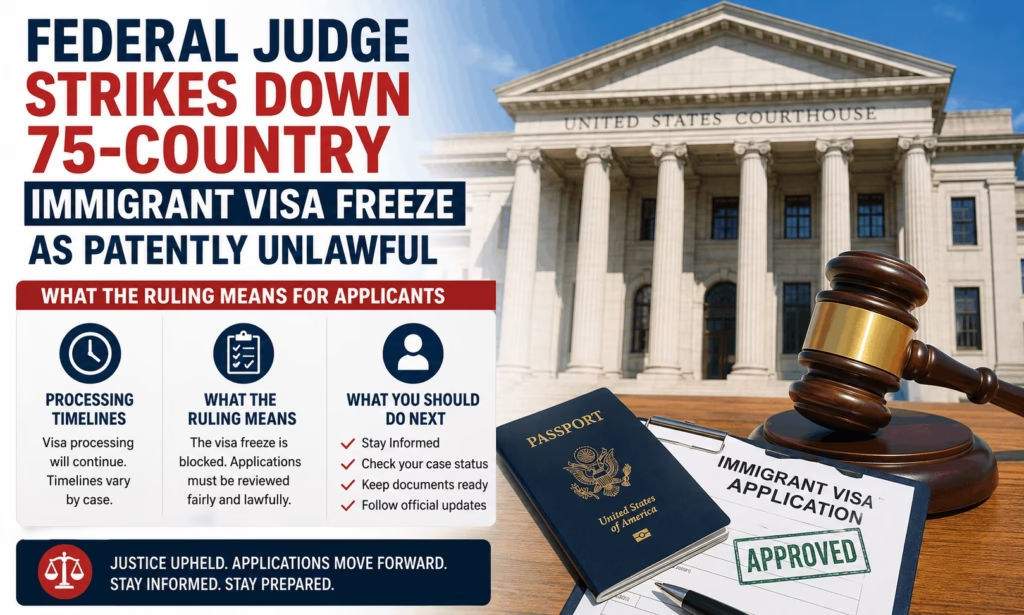
75-Country Immigrant Visa Freeze Overturned: A federal judge in Manhattan struck down the Trump administration’s suspension of immigrant visas for applicants from 75 countries on Friday, August 21, 2026, ruling the policy patently unlawful and finding it exceeded the statutory authority of Secretary of State Marco Rubio. U.S. District Judge Jeannette Vargas of the Southern District of New York wrote that the policy, which categorically prohibited the issuance of immigrant visas based purely on an applicant’s nationality, represented a direct abrogation of the statutory scheme Congress built into federal immigration law. We’ll be updating this article monthly, so check back here for the latest developments as the case moves toward its next stage and as the State Department decides whether to appeal.
For families who had been separated for months, spouses waiting to reunite with a partner already living in the United States, and employers whose sponsored workers had their green card processes frozen indefinitely, this ruling arrives as the most significant legal setback yet to one piece of the administration’s broader immigration enforcement agenda. The freeze, announced by the State Department in January 2026, had suspended immigrant visa processing for nationals of 75 countries stretching across Latin America, the Balkans, South Asia, and Africa, effectively halting the legal pathway to permanent residence for hundreds of thousands of applicants who had already been approved through the standard petition process and were simply waiting for their final consular interview and visa issuance.
What the 75-Country Immigrant Visa Freeze Actually Did?
The policy at the center of this ruling was announced by the State Department on January 14, 2026, and it suspended the issuance of immigrant visas, the category covering permanent residence rather than temporary travel, to applicants from 75 designated countries. Unlike President Trump’s separate travel ban covering 39 countries, which restricts entry into the United States broadly, this specific freeze targeted the immigrant visa process itself, meaning it did not affect nonimmigrant visas such as tourist or student visas, but instead blocked the specific legal pathway used by people joining family members already living in the U.S. or moving to the country to take up permanent employment.
The State Department’s stated justification centered on a claim that immigrants from the listed countries, which included nations like Afghanistan, Brazil, Egypt, Pakistan, Bangladesh, Colombia, Uruguay, Bosnia, Albania, and Somalia, took welfare benefits from the American public at what the department characterized as unacceptable rates. This rationale relied on the federal “public charge” concept, a long-standing part of immigration law that allows a consular officer to deny a visa if an applicant is likely to become primarily dependent on government assistance.
Key Facts and Ruling Highlights
| Detail | Information |
|---|---|
| Policy struck down | State Department suspension of immigrant visas for 75 countries |
| Policy announced | January 14, 2026 |
| Ruling issued | Friday, August 21, 2026 |
| Presiding judge | U.S. District Judge Jeannette Vargas, Southern District of New York |
| Court’s characterization of the policy | “Patently unlawful” |
| Legal basis for the ruling | Violated the Immigration and Nationality Act and exceeded the Secretary of State’s statutory authority |
| Case name | CLINIC v. Rubio |
| Lead plaintiffs | Catholic Legal Immigration Network (CLINIC) and African Communities Together |
| Defendants | Secretary of State Marco Rubio and the U.S. Department of State |
| Visa types affected by the original freeze | Immigrant (permanent residence) visas only, not tourist or student visas |
| Deadline for both sides to propose next steps | September 11, 2026 |
| Right to appeal | Yes, the administration retains the option to appeal the ruling |
| Related but separate policy still in effect | Trump’s 39-country travel and entry ban |
Why the Judge Called the Policy “Patently Unlawful”?
At the heart of Judge Vargas’s ruling is a specific legal distinction between how the “public charge” determination is supposed to work under federal immigration law versus how the State Department actually implemented this policy in practice. Congress built a five-factor individualized test into the Immigration and Nationality Act for evaluating whether a specific visa applicant is likely to become a public charge, requiring consular officers to weigh each applicant’s own age, health, family status, assets and financial resources, and education and skills before making that determination.
Judge Vargas found that the State Department’s actual guidance abandoned that individualized approach entirely. According to a cable Secretary Rubio sent to every diplomatic and consular post worldwide, which was entered into the case record, officers were directed to refuse immigrant visa applications from nationals of the 75 designated countries regardless of that individual applicant’s actual financial circumstances, effectively substituting a blanket, nationality-based bar for the case-by-case evaluation the statute requires. In her written opinion, Vargas stated that this categorical approach, prohibiting visa issuance based purely on an applicant’s country of origin, represented a direct abrogation of the statutory scheme Congress established, since the law explicitly stripped the Secretary of State of authority over how individual consular officers adjudicate immigrant visa applications.
The ruling also specifically noted that the ban affected only immigrant visas, covering people seeking permanent residence in the U.S. through family sponsorship or employment, and had no bearing on nonimmigrant visa categories like tourism or study.
Hawaii TDI 2026: New Weekly Benefit Rate, Eligibility & Payment Rules
The Legal Battle That Led to This Ruling
The lawsuit challenging this policy was filed in early February 2026 in the U.S. District Court for the Southern District of New York, brought by a coalition that included the Catholic Legal Immigration Network, commonly known as CLINIC, and African Communities Together, along with individual immigrant visa applicants and U.S. citizens who had been sponsoring family members from the affected countries. The plaintiffs argued that the policy unlawfully rewrote settled U.S. immigration law and discriminated against applicants on the basis of nationality and race, describing it as eviscerating decades of established legal precedent governing how visa eligibility determinations are supposed to be made.
In defending the policy, the administration’s legal team pointed to a 2018 U.S. Supreme Court decision that had upheld the third version of President Trump’s first-term travel ban, a ruling that similarly involved restrictions tied to specific countries, most of them majority-Muslim nations. Judge Vargas rejected that comparison directly in her opinion, explaining that the earlier Supreme Court case turned on the president’s separate constitutional and statutory authority to decide who may enter the United States at the border, whereas this case involved a fundamentally different legal question, whether an immigrant visa may be issued to an already-vetted, already-approved applicant at all.
What Happens Next in This Case
Judge Vargas’s ruling does not immediately close out the litigation. She gave both the plaintiffs and the Trump administration until September 11, 2026 to propose how the remaining parts of the case should be resolved, meaning further court proceedings, and potentially additional written orders clarifying the practical scope and implementation of this ruling, are still expected in the weeks ahead. The Trump administration retains the option to appeal Judge Vargas’s decision to the U.S. Court of Appeals for the Second Circuit, and as of this ruling, the administration had not yet publicly indicated whether it intends to pursue that appeal.
It is also important for affected applicants to understand precisely what this ruling does and does not change. The decision specifically reverses visa denials that were based solely on this particular nationality-based policy, but it does not automatically resolve or eliminate the separate, individualized public charge evaluation that remains a standard, lawful part of every immigrant visa application under the Immigration and Nationality Act. In other words, the ruling restores the requirement that consular officers evaluate each applicant’s actual financial circumstances individually, rather than eliminating public charge considerations from the immigrant visa process altogether.
What This Means for Immigrant Visa Processing Going Forward?
For the hundreds of thousands of applicants from the 75 designated countries whose immigrant visa cases had been frozen or denied under this policy since January 2026, this ruling represents a legal pathway back toward normal processing, though the practical, day-to-day implementation of that restart will depend heavily on how the State Department responds to the court’s order in the weeks following the decision. Applicants whose cases were specifically denied based on this nationality-based policy may now be entitled to have those denials reversed and their applications reconsidered under the standard, individualized public charge evaluation process the law actually requires.
Given the scale of the original freeze, spanning countries across Latin America, including Brazil, Colombia, and Uruguay, Balkan nations such as Bosnia and Albania, South Asian countries including Pakistan and Bangladesh, and numerous nations across Africa, resuming full processing at the volume the freeze had suppressed is likely to take meaningful time even with the legal obstacle now removed. Consular posts that had paused interview scheduling or final visa issuance for these applicant populations will need to work through any accumulated backlog, and the exact timeline for individual applicants to see their specific case move forward will likely vary considerably depending on their consular post, the stage their application had reached before the freeze took effect, and how quickly the State Department issues updated internal guidance implementing the court’s order.
$1,636 ODSP and Canada Disability Benefit Now Stack Fully in Ontario, No Clawback on Either Payment
$4427 EITC Payment: How to Know If You Qualify and When Will You Get It?
What Affected Applicants Should Do Now?
For anyone whose immigrant visa application was denied, delayed, or frozen because of this specific 75-country policy, immigration attorneys and the advocacy organizations behind this lawsuit generally recommend a few concrete steps in the immediate aftermath of the ruling. Reviewing any denial notice received since January 2026 to determine whether it specifically cited this nationality-based public charge policy as the basis for refusal is an important first step, since that documentation may become relevant to requesting reconsideration once the State Department issues implementation guidance.
Staying in contact with the National Visa Center or the specific consular post handling an individual case remains important, since updated processing guidance following a court ruling of this kind typically flows through official State Department channels rather than being something individual applicants can influence directly. Applicants working with an immigration attorney or a sponsoring family member should coordinate with that legal representation to monitor for official State Department announcements specifically addressing how previously affected cases will be handled following this decision, since the practical mechanics of reopening or reconsidering paused cases will depend on forthcoming agency guidance rather than being automatic the moment the ruling was issued.
Immigrant Visa Processing Timelines Following the Ruling
Understanding realistic timing expectations matters considerably for applicants trying to plan around this development. Even under normal circumstances, immigrant visa processing involves multiple sequential stages, including an approved petition, National Visa Center document collection, a scheduled consular interview, and final visa issuance, each of which can take weeks to months to complete depending on the specific visa category and consular post involved. For applicants whose cases were frozen under the now-overturned policy, the practical restart of that processing pipeline will likely require the State Department to first issue internal guidance to consular posts worldwide clarifying how officers should now evaluate previously affected applications, a step that has not yet occurred as of this ruling and that has no officially announced timeline.
Applicants should also bear in mind that the possibility of an appeal by the Trump administration introduces some uncertainty into how quickly and how completely normal processing actually resumes, since an appeal, if filed, could potentially affect the practical implementation timeline even though the underlying district court ruling remains in effect while any appeal is pending, absent a specific stay being granted by a higher court.
Reaction From Advocacy Groups and Legal Organizations
The organizations that brought this lawsuit framed the ruling in personal terms, emphasizing the real-world family separations the policy had caused. Anna Gallagher, executive director of the Catholic Legal Immigration Network, said the suspension of lawful visa processing across 75 countries had separated spouses, parents, and children who were simply following the legal immigration process, describing the ruling as affirming both the rule of law and the value of keeping families together. Diana Konate, Deputy Executive Director for Policy and Advocacy at African Communities Together, characterized the decision as a tremendous victory for the rule of law.
The ruling arrives against the backdrop of a broader pattern of legal challenges to various pieces of the Trump administration’s immigration enforcement agenda throughout 2026, with rights groups and legal advocacy organizations continuing to argue that several of these overlapping restrictions raise due process concerns and disproportionately affect immigrants from specific regions and ethnic backgrounds. This particular ruling is separate from, though related in spirit to, an earlier decision in 2026 that struck down related USCIS policies affecting nationals of the 39 countries covered by Trump’s separate travel and entry ban, along with a blanket halt on asylum decisions that had been implemented at USCIS.
Official Resources and Links
| Resource | Purpose | Link |
|---|---|---|
| U.S. Department of State, immigrant visa information | Official guidance on immigrant visa categories and processing | https://travel.state.gov/content/travel/en/us-visas/immigrate.html |
| National Visa Center case status | Check the status of a pending immigrant visa case | https://travel.state.gov/content/travel/en/us-visas/immigrate/national-visa-center.html |
| Catholic Legal Immigration Network (CLINIC) | Legal resources and updates on this case | https://cliniclegal.org |
| African Communities Together | Advocacy resources and case updates | https://africans.us |
| USCIS case status online | Check the status of an underlying immigrant petition | https://egov.uscis.gov/casestatus/landing.do |
| Federal court filings for CLINIC v. Rubio | Read the court’s decision and case background | https://www.courtlistener.com |
Trump Halts 50 Percent Tariffs Canada: What the Last Minute Deal With Ottawa Means
Green Card Rule Changes: New Public Charge Test to Assess Age, Health, Family Status and Finances
FAQs
What was the 75-country immigrant visa freeze?
It was a State Department policy announced on January 14, 2026 that suspended the issuance of immigrant visas, covering permanent residence through family sponsorship or employment, to applicants from 75 designated countries, citing concerns about applicants becoming a public charge.
Why did the judge rule the policy unlawful?
Judge Jeannette Vargas found that the policy improperly applied a blanket, nationality-based bar rather than the individualized, five-factor public charge evaluation that federal immigration law actually requires consular officers to conduct for each applicant.
Does this ruling affect tourist or student visas?
No. The overturned policy applied specifically to immigrant visas for permanent residence and did not affect nonimmigrant visa categories such as tourist or student visas.
Can the Trump administration appeal this ruling?
Yes, the administration retains the right to appeal Judge Vargas’s decision to the U.S. Court of Appeals for the Second Circuit, and as of this ruling had not publicly announced whether it intends to do so.
Which countries were affected by the now-overturned visa freeze?
The policy affected nationals of 75 countries, including Brazil, Colombia, Uruguay, Bosnia, Albania, Pakistan, Bangladesh, Afghanistan, Egypt, and Somalia, spanning Latin America, the Balkans, South Asia, and Africa.
When will immigrant visa processing fully resume for affected countries?
There is no officially announced timeline yet. The State Department will need to issue updated guidance to consular posts worldwide, and both sides in the case have until September 11, 2026 to propose next steps to the court.
People Also Ask
What is a public charge in US immigration law? A public charge is a legal term referring to a noncitizen determined likely to become primarily dependent on government assistance for support, and federal law requires consular officers to evaluate this using a five-factor individualized test covering age, health, family status, financial resources, and education and skills.
Is the 75-country visa freeze the same as Trump’s travel ban? No. The travel ban is a separate policy restricting physical entry into the United States for nationals of 39 countries, while the now-overturned visa freeze specifically blocked the issuance of immigrant visas for permanent residence to applicants from 75 different countries.
What is the Immigration and Nationality Act? The Immigration and Nationality Act is the primary federal statute governing U.S. immigration law, including the rules for how visas are issued, who is eligible for various immigration categories, and the specific factors consular officers must weigh when evaluating an applicant.
Who filed the lawsuit against the 75-country visa freeze? The lawsuit, formally known as CLINIC v. Rubio, was filed by the Catholic Legal Immigration Network and African Communities Together, along with individual immigrant visa applicants and U.S. citizens sponsoring family members from the affected countries.
Does this ruling mean everyone denied under the policy will automatically get their visa? Not automatically. The ruling reverses visa denials based solely on this specific nationality-based policy, but each applicant’s case will still need to go through the standard, lawful individualized public charge evaluation the Immigration and Nationality Act requires.
Conclusion
Judge Jeannette Vargas’s ruling striking down the 75-country immigrant visa freeze as patently unlawful marks one of the most significant legal defeats yet for the Trump administration’s broader immigration enforcement agenda, restoring the individualized, statutorily required evaluation process for hundreds of thousands of immigrant visa applicants whose family reunification and employment-based cases had been frozen since January 2026. With both sides due back before the court by September 11, 2026 to propose next steps, and with the administration retaining the option to appeal, significant uncertainty remains about exactly how quickly normal processing resumes for applicants from the affected countries. As the State Department responds to this ruling and as the case continues moving through the courts, this article will be updated every month with the latest confirmed developments.
Employment Insurance (EI) 2026 Rule Changes: What Every Canadian Worker Needs to Know
Empire State Child Credit 2026: $1,000 Per Child Under 4, Full Eligibility & Payment Guide