
CalWORKs Payments September 2026: More than 350,000 California families receiving CalWORKs cash aid are heading into September working with the same Maximum Aid Payment structure that’s been in place since the state’s 5% grant increase took effect back on July 1, 2025, and understanding exactly when that money actually lands each month remains one of the most frequently misunderstood parts of the entire program. Unlike CalFresh, California’s food assistance program, which spreads deposits across the first ten days of the month based on a household’s case number, CalWORKs cash aid compresses into just the first three or four days of the month, a compressed schedule that catches a lot of families off guard, especially those receiving both benefits and expecting them to arrive on the same day.
That distinction matters enormously for budgeting. With California’s average CalWORKs grant sitting at roughly $999 per month across all family sizes and income levels for the current fiscal year, and the state’s 2026-27 budget proposing $7.2 billion in total program funding, a modest 1% increase over the current year, knowing your exact deposit date isn’t a minor convenience, it’s central to managing rent, utilities, and other fixed monthly costs that don’t wait for a benefit to post. We’ll be updating this article monthly as new CalWORKs payment and grant amount information is confirmed.
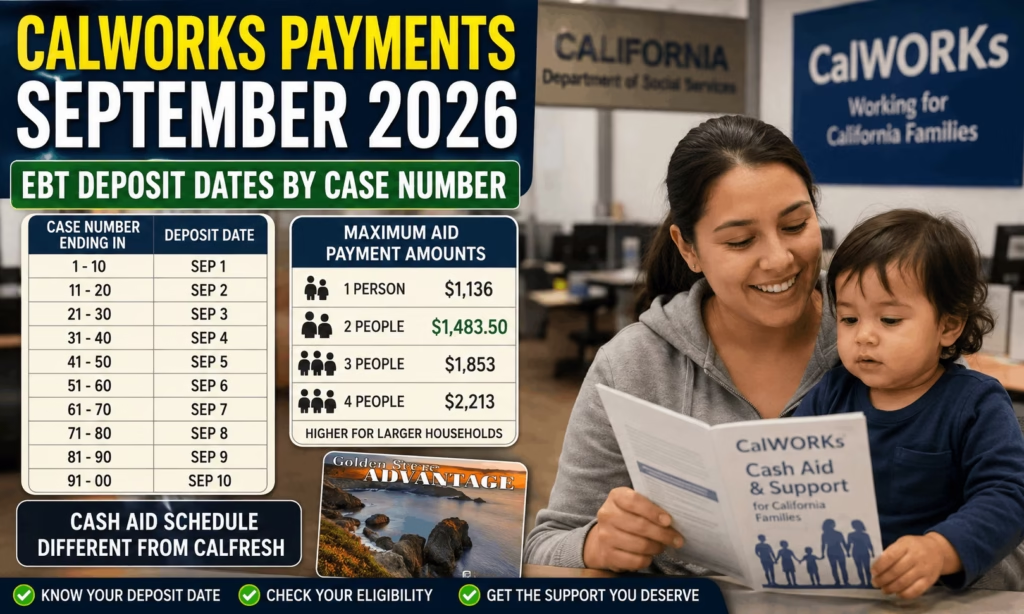
Latest Update: CalWORKs Payments September 2026
| Detail | Information |
|---|---|
| CalWORKs deposit window | 1st through 4th of the month |
| Deposit method | Based on last digit of case number |
| Most recent Maximum Aid Payment increase | 5%, effective July 1, 2025 |
| Average CalWORKs grant (all family sizes) | Approximately $999/month |
| 2026-27 proposed CalWORKs funding | $7.2 billion total funds |
| CalWORKs cases (2026-27 estimate) | Approximately 360,137 |
| Lifetime aid limit for adults | 60 months |
| Administering agency | California Department of Social Services (CDSS) |
| Regional variation | High-cost counties (LA, SF) pay ~5% more than inland counties |
How the CalWORKs September 2026 Payment Schedule Actually Works
This is the single most searched, and most misunderstood, detail about California’s cash assistance program. CalWORKs benefits load onto a recipient’s EBT card during a compressed, four-day window at the very start of each month, determined by the last digit of your case number, not your birthday, your county, or when you were originally approved.
| Last Digit of Case Number | September 2026 Deposit Date |
|---|---|
| 1, 2, or 3 | September 1, 2026 |
| 4, 5, or 6 | September 2, 2026 |
| 7, 8, or 9 | September 3, 2026 |
| 0 | September 4, 2026 |
This schedule stays fixed month to month; if your case number ends in 5, your deposit lands on the 2nd every single month unless that date falls on a weekend or federal holiday, in which case the deposit typically moves to the preceding business day. Since September 1, 2026 falls on a regular weekday this year, no adjustment applies to this month’s schedule.
SSA Ticket to Work Program: How Disability Beneficiaries Can Return to Work Without Losing Benefits
SSA Strategic Plan FY2026-2030: New Goals, Wait Times & Service Targets
SSI Address Change Service Enhancements: SSA’s New Fast-Track Process Explained
IRS Confirms Payments of Up to $8,231: Who Qualifies for the EITC in 2026
Why CalWORKs and CalFresh Deposit on Different Days
Confusion between these two programs is extremely common, and it’s worth explaining clearly since many California households receive both simultaneously. CalFresh, the state’s SNAP-equivalent food assistance program, spreads deposits across a full ten-day window, from the 1st through the 10th of each month, using the same last-digit case number logic but applied across all ten possible digits individually rather than grouped into three-day bands. CalWORKs, by contrast, compresses its entire caseload into just the first three or four days, grouping multiple case-number endings into the same deposit date.
The practical result: a household receiving both benefits will typically see two separate deposits on two different dates within the same month, one for CalWORKs cash aid landing within the first four days, and a separate CalFresh deposit landing on whichever specific day between the 1st and 10th corresponds to their individual case number digit. This is exactly why so many recipients report confusion when their “food stamps” and their “cash aid” don’t arrive together, even though both benefits load onto the same physical EBT card.
Current CalWORKs Maximum Aid Payment Amounts
California’s CalWORKs grant amount depends on your assistance unit (AU) size, meaning the number of CalWORKs-eligible people in your household, not necessarily everyone living under the same roof. Grant amounts are also adjusted based on whether a household qualifies for the Exempt or Non-Exempt Maximum Aid Payment tier, and whether the household lives in a high-cost region.
| Assistance Unit Size | Exempt MAP | Non-Exempt MAP |
|---|---|---|
| 1 | $809 | $734 |
| 2 | $1,039 | $930 |
| 3 | $1,314 | $1,175 |
| 4 | $1,579 | $1,416 |
| 5 | $1,850 | $1,659 |
| 6 | $2,123 | $1,902 |
| 7 | $2,395 | $2,145 |
| 8 | $2,669 | $2,389 |
| 9 | $2,939 | $2,631 |
| 10 or more | $3,215 | $2,876 |
The Exempt MAP applies to households where the assistance unit includes an unaided, non-needy caretaker relative, essentially a relative caring for a child but not themselves receiving aid. Every other configuration receives the Non-Exempt MAP. It’s worth noting these figures represent the maximum a household can receive with zero countable income; most CalWORKs households have at least some income, which reduces the actual grant amount they receive below these ceiling figures.
How Regional Cost-of-Living Affects Your Grant
California doesn’t pay every county the same amount for an identical family size. Families in higher-cost coastal counties, including Los Angeles and San Francisco, receive grants roughly 5% higher than comparable families in lower-cost inland counties like Fresno or Shasta. This regional adjustment reflects the real difference in housing and living costs across the state, though it means two families of identical size and income can receive noticeably different monthly amounts depending purely on which county administers their case.
Why CalWORKs Grants Increased in Recent Years
Understanding the origin of the current Maximum Aid Payment levels helps explain why they’ve moved as much as they have over the past few years. California law includes an automatic trigger mechanism: when sufficient revenue growth accumulates in the state’s Child Poverty and Family Supplemental Support Subaccount, funded through a portion of state sales tax and vehicle license fee revenue realigned back in 1991, that growth automatically triggers a CalWORKs grant increase. A separate, larger boost came from a temporary 10% General Fund grant increase originally implemented in October 2022, which the legislature later made permanent by removing its scheduled end date in 2023. The most recent major increase, a full 5% bump, took effect July 1, 2025, bringing the current MAP levels shown in the table above into effect.
How to Apply for CalWORKs: Step-by-Step
For California families considering an application, the process runs through several standard stages.
- Confirm basic eligibility, which generally requires having a child in the household (or being pregnant), meeting income and asset limits, and being a California resident.
- Submit an application through BenefitsCal.com, in person at your county social services office, or by phone.
- Complete an intake interview with a county eligibility worker, who will review your income, assets, and household composition.
- Provide required documentation, including identification, proof of income, housing costs, and immigration status documentation where applicable.
- Receive your Notice of Action, which confirms your approved grant amount, assistance unit size, and your assigned case number, the key to determining your deposit date going forward.
- Set up your EBT card and check your deposit schedule using the last digit of your case number against the table above.
IRCC Tightens Citizenship by Descent: What the New 1,095-Day Presence Test Rules Mean for Applicants
September 2026 Refund Payments: All the Real Deposits You Could Actually Get This Month
Social Security Proposals in Congress: What Changes Could Affect Your SSI and SSDI Benefits
Processing Time for CalWORKs Applications
California counties are generally required to process a complete CalWORKs application within 45 days from the date of application, though many counties process straightforward cases considerably faster. Applicants who qualify for expedited services due to urgent financial need, such as having little to no income and facing imminent eviction or utility shutoff, may receive a faster initial payment, sometimes within days rather than weeks, though the full ongoing grant determination still follows the standard eligibility review process.
CalWORKs Payment Schedule: What Happens After Your First Deposit
New CalWORKs recipients often see an irregular first payment, since counties frequently issue a prorated amount covering only the remaining days of the month from approval through month’s end, before switching to the standard full monthly grant on the regular deposit schedule described above. After that first prorated payment, your deposit date locks into the case-number-based schedule and remains consistent every month going forward, unless your case number itself changes, which happens rarely and typically only if your case transfers between counties.
CalWORKs Eligibility Requirements
Beyond the payment schedule itself, understanding who actually qualifies for CalWORKs helps explain why grant amounts vary so much between households. To be eligible, a family generally needs to include at least one child under 18, or a pregnant individual with no other children, and meet the program’s income and asset limits. California’s asset limits for CalWORKs are considerably more generous than many other states’ cash assistance programs, allowing households to retain a vehicle and a modest amount of savings without losing eligibility, a deliberate policy choice aimed at helping families avoid depleting their limited resources before they can access support.
Income limits vary by assistance unit size and are evaluated against both gross and net income tests, with the program using specific income disregards that allow working families to keep a meaningful portion of their earnings without losing their entire grant. This is part of why CalWORKs functions less like an all-or-nothing benefit and more like a sliding-scale supplement, a working parent with modest earnings can still qualify for a reduced grant that fills the gap between their wages and their family’s basic needs, rather than losing eligibility the moment they find employment.
Welfare-to-Work Requirements and Supportive Services
CalWORKs isn’t simply a cash payment program, it’s structured around a Welfare-to-Work requirement that most adult recipients must participate in as a condition of continued eligibility. This typically includes activities like job search, vocational training, adult basic education, or subsidized employment, with the county assigning specific hourly requirements based on the recipient’s circumstances and the assistance unit’s composition. Recipients who are pregnant, caring for a child under one year old, or who meet certain other exemption criteria may be excused from these requirements for a defined period.
To support families navigating these requirements, CalWORKs recipients are typically also eligible for a bundle of supportive services beyond the cash grant itself, including subsidized child care, which removes one of the biggest practical barriers to employment for single parents; transportation assistance to cover the cost of getting to work, training, or required appointments; and in some cases, ancillary expenses like work-related clothing or tools. Recipients are also generally eligible for Medi-Cal, California’s Medicaid program, providing health coverage for the entire family alongside the cash assistance itself, and most CalWORKs households also qualify for CalFresh food benefits, which is exactly why understanding both programs’ different deposit schedules matters so much for day-to-day budgeting.
What Happens When You Reach the Lifetime Limit
The 60-month lifetime limit for adult CalWORKs recipients is one of the more consequential rules in the program, and it’s worth understanding exactly how it works in practice. The clock generally only counts months in which an adult actually received aid as part of the assistance unit, and certain months can be excluded from the count under specific circumstances, including periods of significant hardship recognized by the state. Once an adult reaches their 60-month limit, they’re generally no longer eligible to receive their own portion of the grant, but eligible children in the household can continue receiving their portion of the benefit under what’s called a child-only case, meaning the family doesn’t necessarily lose all assistance even after an adult’s time-limited eligibility ends. Families approaching this limit are strongly encouraged to speak with their county caseworker well in advance, since transitioning to a child-only case involves its own eligibility review and can affect the total grant amount the household receives going forward.
What supportive services come with CalWORKs besides the cash grant? Most recipients also qualify for subsidized child care, transportation assistance, Medi-Cal health coverage, and CalFresh food benefits, alongside Welfare-to-Work program participation that includes job search, training, and education support.
What happens to my CalWORKs case after I reach the 60-month lifetime limit? Adults generally stop receiving their own portion of the grant once they reach 60 cumulative months of aid, but eligible children in the household can continue receiving assistance as a child-only case, which involves its own separate eligibility review.
Official Resources for CalWORKs Applicants and Recipients
Always verify your specific grant amount and deposit schedule directly through these official California state channels.
| Resource | Purpose | Official Link |
|---|---|---|
| BenefitsCal | Apply for CalWORKs, check case status, manage your account | benefitscal.com |
| California Department of Social Services | Official CalWORKs program information | cdss.ca.gov/calworks |
| EBT customer service | Check balance and deposit history | 1-877-328-9677 |
| California EBT portal | Manage your EBT card online | ebt.ca.gov |
| Find your county social services office | Local application and case management | cdss.ca.gov/county-offices |
| CalWORKs Maximum Aid Payment tables | Official current grant amounts by AU size | cdss.ca.gov (MAP levels) |
| Report EBT fraud | Report suspicious activity on your account | 1-877-328-9677 |
TPS Terminations 2026: Complete Tracker for Somalia, Ethiopia, South Sudan, Syria, Haiti, and Yemen
USCIS Ukraine TPS EAD Extension: Work Permits Automatically Extended Through October 19, 2026
BC PNP Entrepreneur Immigration Draw Invites 16 Business Candidates in Latest Round
FAQs About CalWORKs Payments September 2026
When will my CalWORKs payment arrive in September 2026?
It depends on the last digit of your case number. Case numbers ending in 1, 2, or 3 receive their deposit September 1; those ending in 4, 5, or 6 receive it September 2; those ending in 7, 8, or 9 receive it September 3; and case numbers ending in 0 receive their deposit September 4.
Why did my CalWORKs and CalFresh benefits arrive on different days?
These are separate programs with different deposit schedules. CalWORKs cash aid deposits within the first three or four days of the month, while CalFresh spreads deposits across a full ten-day window based on the same last-digit case number logic applied individually rather than in grouped bands.
What is the current maximum CalWORKs grant for a family of three?
As of the current Maximum Aid Payment levels in effect since July 1, 2025, a family of three (assistance unit size 3) qualifies for up to $1,314 under the Exempt MAP or $1,175 under the Non-Exempt MAP, depending on household configuration.
How long can a family receive CalWORKs benefits?
Adults face a lifetime limit of 60 months of aided CalWORKs assistance, though children in the household can continue receiving their portion of the grant even after an adult reaches the lifetime limit, under what’s known as a child-only case.
Why do families in Los Angeles get a higher CalWORKs grant than families in Fresno?
California adjusts Maximum Aid Payment levels regionally to reflect cost-of-living differences. Higher-cost coastal counties like Los Angeles and San Francisco receive grants roughly 5% higher than lower-cost inland counties.
How long does it take to get approved for CalWORKs?
California counties are required to process a complete application within 45 days, though households facing urgent financial hardship may qualify for expedited processing and a faster initial payment.
Does CalWORKs count as income for CalFresh eligibility?
Yes, in most cases. Households receiving CalWORKs typically see their CalFresh allotment adjusted to reflect the cash aid as countable income, which is why an increase in a household’s CalWORKs grant can sometimes result in a corresponding decrease in their CalFresh benefit amount.
What happens to my CalWORKs payment if the 1st falls on a weekend?
If your scheduled deposit date falls on a weekend or federal holiday, the deposit typically moves to the preceding business day. For September 2026, no adjustment is needed since September 1 falls on a regular weekday.
Conclusion
The CalWORKs payments September 2026 schedule follows the same compressed, four-day deposit window California families have relied on for years, with your exact date determined entirely by the last digit of your case number rather than any factor tied to CalFresh, your birthday, or your county. With the current Maximum Aid Payment levels reflecting last year’s 5% increase and the state’s 2026-27 budget proposing modest additional funding growth, understanding both your deposit timing and your actual grant amount, adjusted for your assistance unit size, region, and income, remains essential for planning around rent and other fixed monthly costs. If your deposit doesn’t arrive on your expected date after accounting for weekends and holidays, contacting your county caseworker or checking your balance through BenefitsCal directly remains the fastest way to resolve any confusion.
H-1B Spouse Work Permit at Risk: How Trump’s Latest Move Could Cut Family Incomes in Half
80% to 100% VA Disability: Why the Final Jump Is the Hardest One Veterans Face
FY2027 Government Shutdown Risk: Congress Races the September 30 Funding Cliff
Florida Minimum Wage Reaches $15/Hour: The Final Step of a Six-Year Countdown Arrives September 30
IRS Seize Bank Accounts, Vehicles and Property From Taxpayers Who Ignore This Final Notice
Manitoba EIA Payment and CDB Exemption: What Changes and What Stays Protected in 2026