Canada Immigration New Rules 2026: Canada’s immigration system just moved again, and this time the biggest shift is not about who gets in, it is about how long people are waiting once they apply. Immigration, Refugees and Citizenship Canada updated its temporary residence processing estimates on August 19, and the numbers show wait times lengthening in nearly every major category, from super visa applications to work permits filed from Pakistan and Nigeria. At the same time, the department confirmed it has already finalized more than 1.2 million temporary residence applications in the first five months of the year, with roughly 404,000 still sitting in the queue as of the end of May. Layered on top of these processing delays is a fresh set of rule changes affecting study permits, post-graduation work permits, spousal open work permits, and co-op placements, several of which took effect as recently as April 1. We’ll be updating this article monthly as IRCC releases new processing figures and confirms further details on pending proposals.
For anyone currently holding a study permit, a work permit, or planning to sponsor a spouse, this is not a one-time policy update, it is a continuing pattern. The 2026 study permit target has already been cut to 408,000, a 7 percent reduction from last year, and the number of applications provinces can accept under the attestation letter system now sits at 309,670 nationwide. Meanwhile, graduate students in select programs just gained new flexibility, even as thousands of other applicants face longer waits and stricter financial and language requirements. Understanding exactly which rule applies to which group, and what has genuinely changed versus what remains unchanged from 2025, is now essential for anyone navigating the Canadian immigration system this year.
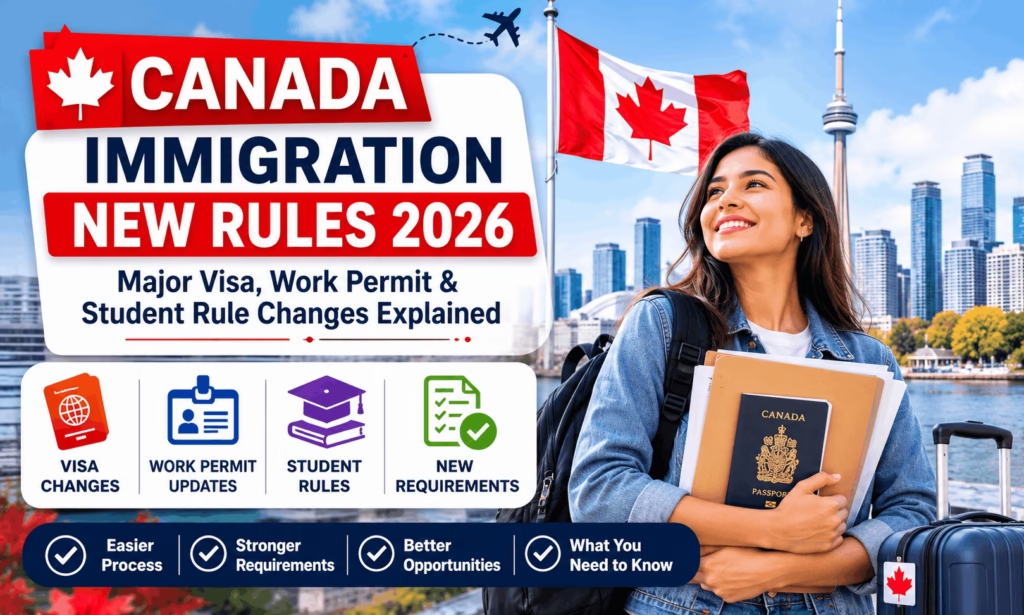
Key Highlights: Canada Immigration New Rules 2026
| Change | Detail | Effective Date |
|---|---|---|
| Study permit issuance target | 408,000 permits, down 7 percent from 437,000 in 2025 | 2026 calendar year |
| PAL and TAL application cap | 309,670 application spaces nationwide, split by province | 2026 calendar year |
| Graduate student exemption | Master’s and doctoral students at public institutions no longer need a PAL or TAL | Since January 1, 2026 |
| Co-op work permit requirement removed | Students no longer need a separate work permit for required co-ops, internships, and practicums | Since April 1, 2026 |
| PGWP field of study list | Frozen for 2026, no new additions or removals this year | Ongoing through 2026 |
| Spousal open work permits | Limited to partners of master’s, doctoral, and select professional degree students | Ongoing |
| Dependent children open work permits | No longer issued for family members of most temporary residents | Ongoing |
| Proof of funds for single applicant | 22,895 dollars, plus tuition and travel costs | Since September 1, 2025 |
| Latest IRCC processing update | Released August 19, 2026 | Next update expected August 26, 2026 |
| Work permit extensions | Averaging roughly 15 months as of mid-2026 | Ongoing |
| Express Entry permanent residence | Roughly 6 to 8 months | Ongoing |
Study Permit Rules: What Actually Changed For 2026
The most talked about shift heading into this year was the reduction in the national study permit target. IRCC confirmed in late 2025 that it plans to issue 408,000 study permits in 2026, down from a 437,000 target the year before, continuing a multi-year effort to bring temporary resident numbers closer to what the department considers sustainable for housing and public services.
Underneath that headline figure sits a separate and more technical number, the Provincial Attestation Letter and Territorial Attestation Letter cap, which controls how many new study permit applications provinces are allowed to approve for processing in the first place. For 2026, that cap sits at 309,670 spaces nationwide, distributed among provinces and territories roughly according to population, with each province deciding how it hands out its own share.
The one genuine expansion inside an otherwise tighter system is the graduate student exemption. As of January 1, 2026, students applying for master’s or doctoral programs at public designated learning institutions no longer need to submit a PAL or TAL at all. This removes both a paperwork step and, in many cases, a deposit requirement that previously added cost and delay to graduate applications. K-12 students, qualifying exchange students, and a handful of other priority categories remain similarly exempt.
Financial requirements have also stayed elevated. Since September 1, 2025, a single applicant outside Quebec must show 22,895 dollars in available funds, on top of first-year tuition and travel costs, a level that has not eased going into 2026 despite the lower overall study permit target.
$1250 New Jersey Child Tax Credit: State Budget Delivers 25% Boost for Families With Young Children
H-1B Fraud Investigation Texas: Paxton Targets Nearly 30 Ghost Office Firms
Post-Graduation Work Permit: The Freeze And What It Means
The Post-Graduation Work Permit remains one of the most closely watched pathways in the entire system, since it is often the bridge between studying in Canada and eventually qualifying for permanent residence.
For 2026, IRCC froze the list of eligible fields of study, meaning the same list that took effect after last year’s revisions, when 119 new fields became eligible and 178 were removed, stays in place with no further changes this year. Students enrolled in non-degree programs, meaning college diplomas and certificates rather than university degrees, must still confirm their program’s Classification of Instructional Programs code appears on the current eligible list before applying, since this requirement applies to any study permit submitted on or after November 1, 2024. Degree graduates from bachelor’s, master’s, and doctoral programs remain exempt from this field-of-study restriction and continue to qualify regardless of subject area.
Two other requirements introduced in 2024 remain fully in force this year. Language ability now matters directly for eligibility, with bachelor’s, master’s, and doctoral graduates needing Canadian Language Benchmark or Niveaux de compétence linguistique canadiens level 7 across all four abilities, while most college and non-university graduates need level 5. Permit length continues to match program length up to a three-year maximum, and master’s graduates whose program ran at least eight months but under two years can still receive the full three-year permit, a rule that has stayed unchanged since it took effect in February 2024.
In June 2026, IRCC also issued updated compliance guidance clarifying PGWP eligibility for non-credit programs of study, which the department describes as a clarification rather than a new rule, though it has already led some affected students to appeal refusals under the revised interpretation.
Work Placements And Co-op Programs: A Rare Simplification
Not every change this year has tightened the system. As of April 1, 2026, post-secondary international students no longer need a separate co-op work permit to take part in student work placements that are a required part of their program, including co-ops, internships, and practicums. This was the first change to take effect from a broader package of proposed amendments IRCC announced the same day, with additional proposals covering expanded work authorization for PGWP applicants and foreign apprentices still sitting in the consultation phase.
The department has also floated allowing students to keep working while they wait for a decision on a study permit extension or a PGWP application, a change that would directly address one of the most common gaps students currently fall into during processing delays, though this proposal has not yet been finalized.
Students continue to be permitted to work up to 24 hours per week off campus during academic terms, with unlimited hours typically allowed during scheduled breaks, a policy that has remained stable through the broader tightening seen elsewhere in the system.
Spousal And Family Open Work Permits: Who Still Qualifies
Family based open work permits have narrowed considerably compared to prior years. Spousal open work permits are now generally reserved for partners of international students enrolled in master’s, doctoral, or certain professional degree programs, rather than being broadly available to spouses of any study permit holder. Dependent children of most temporary residents are no longer eligible for open work permits at all, a change that has directly affected household income planning for many families who previously relied on a second working adult while one parent studied or worked in Canada.
These restrictions sit alongside separate changes on the employer side, where 2026 has brought stricter compliance requirements for temporary foreign worker employers and continued caps on Labour Market Impact Assessments in several sectors, part of a broader effort to align work permit issuance more closely with genuine labour market need rather than general demand.
IRCC Processing Times: The Latest August 2026 Update
Processing times are where the practical impact of these policy shifts is showing up most clearly right now. IRCC’s August 19 update, compared against the August 12 figures, showed increases across almost every temporary residence category. United States super visa applications and Pakistan-based visitor visa applications both lengthened by at least two weeks, while Nigeria’s study permit processing time rose by one additional week with no improvement recorded elsewhere in that category. The one clear bright spot was a five-week reduction in work permit processing for Pakistan-based applicants, continuing a volatile pattern where individual country queues have swung sharply from one update to the next.
Zooming out to the broader picture for mid-2026, typical processing windows now look like this: Express Entry permanent residence applications are taking roughly 6 to 8 months, study permits filed from inside Canada are running close to 8 weeks, PR card renewals submitted online average about 28 days, and work permit extensions have stretched to roughly 15 months on average, a category that has drawn particular criticism from applicants caught in status limbo while waiting for a decision.
IRCC updates weekly categories, including visitor visas, study permits, work permits, and PR cards, roughly every seven days, with the next release expected around August 26, 2026. Monthly categories, including citizenship, permanent residency, and family sponsorship, follow a slower update cycle and were last refreshed on August 10.
Application Fees And Processing Schedule
| Application Type | Typical Current Processing Time | Notes |
|---|---|---|
| Study permit, filed inside Canada | Approximately 8 weeks | Faster for Student Direct Stream where applicable |
| Study permit, filed outside Canada | Varies significantly by country | Nigeria and Pakistan currently among the slower queues |
| Work permit extension | Approximately 15 months | Longest average wait among common categories |
| Work permit, new, inside Canada | Improved in recent updates | Check current weekly figures before applying |
| Post-Graduation Work Permit | Processed after study completion confirmation | Must apply within 180 days of program completion confirmation |
| Express Entry permanent residence | Roughly 6 to 8 months | Meets IRCC’s standard service target in most streams |
| PR card renewal, online | Approximately 28 days | Faster than paper-based renewal |
| Spousal sponsorship, inland | Approximately 12 months | Outland sponsorship runs closer to 14 months |
| Visitor visa, outside Canada | 30 to 90 days depending on country | Varies widely by visa office workload |
How To Apply Under The New Rules
Applying correctly under the current framework starts with confirming which category actually applies to your situation, since a mismatch between the rules used in 2025 and the rules now in force is one of the most common reasons for delay or refusal this year.
For a new study permit, applicants outside the exempt graduate categories must first secure a Provincial or Territorial Attestation Letter from the province or territory where they plan to study, since without this document IRCC will not process most new study permit applications under the current cap. Once the PAL or TAL is issued, applicants submit their study permit application online through their IRCC secure account, along with proof of acceptance from a designated learning institution, proof of funds meeting the current threshold, and required biometrics.
For a Post-Graduation Work Permit, graduates must apply within 180 days of receiving official confirmation that they have completed their program, and should confirm in advance that their specific program appears on the current PGWP-eligible field of study list if it is a non-degree credential. Language test results must be valid at the time of application, since an expired result can result in refusal even if the applicant genuinely meets the underlying benchmark.
For a spousal open work permit, applicants should confirm their partner’s program qualifies under the narrowed eligibility rules before applying, since submitting under outdated 2025 assumptions is now a common cause of unnecessary refusals.
How To Check Your Application Status
IRCC provides a secure online account portal where most applicants can track real time status updates for study permits, work permits, and permanent residence applications, including document requests, biometrics confirmation, and final decisions. For general processing time estimates before applying, the department’s online processing times tool allows applicants to check current country-specific and category-specific timelines, which are updated weekly for temporary residence categories and monthly for permanent residence and citizenship categories.
Applicants whose processing time significantly exceeds the posted estimate, generally considered to be more than 50 percent beyond the published timeline, can contact IRCC directly through the department’s webform or request GCMS notes for a more detailed look at where their file currently stands.
Official Resources And Application Links
| Resource | Purpose | Official Link |
|---|---|---|
| IRCC Secure Account | Apply and track study, work, and PR applications | canada.ca/en/immigration-refugees-citizenship |
| Check Processing Times | View current wait times by category and country | canada.ca/en/immigration-refugees-citizenship/services/application/check-processing-times.html |
| Study Permit Application | Apply for a new or extended study permit | canada.ca/en/immigration-refugees-citizenship/services/study-canada.html |
| Post-Graduation Work Permit | Apply after completing an eligible program | canada.ca/en/immigration-refugees-citizenship/services/work-canada/permit/post-graduation.html |
| PGWP Eligible Fields Of Study | Confirm your program’s CIP code eligibility | canada.ca/en/immigration-refugees-citizenship/services/study-canada/study-permit/prepare/eligible-fields-study.html |
| Express Entry Profile | Create or manage a permanent residence profile | canada.ca/en/immigration-refugees-citizenship/services/immigrate-canada/express-entry.html |
| Provincial Attestation Letter Info | Confirm provincial study permit quota rules | canada.ca/en/immigration-refugees-citizenship/services/study-canada/study-permit/provincial-attestation-letter.html |
What Has Not Changed
Amid all the new restrictions, several long-standing rules remain exactly as they were. The core eligibility framework for a PGWP, meaning graduation from an eligible Designated Learning Institution program of at least eight months and application within 180 days of program completion, has not changed for 2026. The 24 hour per week off-campus work allowance for students during academic terms also remains unchanged, as does the general structure of Express Entry, which continues to operate on its standard 6 month service target for most applicants who receive an invitation to apply.
Conclusion
Canada’s immigration system in 2026 is best understood as two things happening at once. On one side, the government has narrowed several pathways that were previously wide open, cutting the study permit target, tightening PGWP eligibility around field of study and language, and restricting spousal and dependent open work permits to a smaller group of applicants. On the other side, processing times have simply grown longer across most categories, with work permit extensions now averaging around 15 months and several country-specific queues lengthening again in the most recent August update. The one meaningful simplification, the removal of the separate co-op work permit requirement as of April 1, shows the door has not closed entirely, even as most other changes point toward a more selective and slower system overall. Anyone currently applying, or planning to apply, should confirm their specific category against IRCC’s current published rules rather than relying on last year’s requirements, since the gap between 2025 and 2026 policy has already caught a meaningful number of applicants off guard.
Empire State Child Credit 2026: $1,000 Per Child Under 4, Full Eligibility & Payment Guide
Frequently Asked Questions
What are Canada’s newest immigration rules for 2026?
The newest changes include a reduced study permit target of 408,000, a graduate student exemption from provincial attestation letters starting January 1, removal of the separate co-op work permit requirement starting April 1, and continued restrictions on spousal and dependent open work permits.
Do master’s students still need a study permit cap letter in 2026?
No. Master’s and doctoral students applying to public designated learning institutions have been exempt from the Provincial or Territorial Attestation Letter requirement since January 1, 2026.
How long does a Canadian work permit extension take in 2026?
Work permit extensions are currently averaging roughly 15 months, though this varies by country of application and can change from one weekly IRCC update to the next.
Can international students still get a spousal open work permit?
Spousal open work permits are now generally limited to partners of students enrolled in master’s, doctoral, or certain professional degree programs, rather than being available to spouses of most study permit holders as in previous years.
Do I still need a co-op work permit for my internship in 2026?
No. As of April 1, 2026, post-secondary international students no longer need a separate work permit to take part in required co-op placements, internships, or practicums that are part of their program.
How much money do I need to show for a Canadian study permit?
A single applicant outside Quebec must currently show 22,895 dollars in available funds, in addition to covering first-year tuition and travel costs, a threshold that has been in effect since September 1, 2025.
People Also Ask
Why are Canada work permit processing times so long right now?
Processing times have lengthened due to a combination of high application volumes, country-specific backlogs, and broader policy adjustments, with work permit extensions currently averaging around 15 months and several country queues increasing again in the latest weekly update.
Is Canada still accepting international students in 2026?
Yes. Canada plans to issue 408,000 study permits in 2026, though this is a 7 percent reduction from the 437,000 target set the previous year, and provinces now operate under a stricter attestation letter cap.
What happens if my study permit or PGWP application takes longer than expected?
Applicants can check their real time status through their IRCC secure account, compare their wait against the department’s published processing time estimates, and contact IRCC directly if their case has significantly exceeded the posted timeline.
Can dependent children get an open work permit in Canada in 2026?
Generally no. Dependent children of most temporary residents are no longer eligible for open work permits under the current rules, a shift from broader eligibility in earlier years.
Will Canada’s PGWP eligible fields of study list change again in 2026?
No new changes are planned for 2026, since IRCC froze the list following the revisions made in 2025, though the department can still update it in future years based on labour market needs.