Canada Citizenship Proof Rules 2026: Canada’s citizenship certificate system is under fresh scrutiny this month, and anyone applying for proof of Canadian citizenship needs to know why. Immigration, Refugees and Citizenship Canada (IRCC) has kept its tightened CIT 0014 document checklist in place after revising it in mid June 2026, and the agency’s own numbers confirm the backlog has kept climbing rather than shrinking. Newly released IRCC data shows the department issued 28,940 citizenship certificates between January and May 2026, while roughly 82,000 applications were still sitting in the queue as of the most recent count, up sharply from 70,400 in May and 56,000 in April. For families applying through citizenship by descent under Bill C-3, this is no longer a routine paperwork exercise. It is a documentation test, and getting it wrong can mean months of extra delay.
We’ll be updating this article monthly so readers always have the latest requirements. The core change driving all of this is one new sentence IRCC added to the official Document Checklist for a Citizenship Certificate: an application cannot be supported solely by third-party records. That single line has ended the practice of relying on Ancestry or FamilySearch printouts as standalone proof of a Canadian family line, and it followed a period in which the department quietly ordered a batch of already-approved certificates returned for review. Processing times have also stretched from about five months in 2025 to somewhere between 12 and 19 months in 2026, depending on the applicant’s location and the complexity of their family chain. Below is a complete, plain-language breakdown of what has changed, which documents IRCC now accepts, and how to build an application that will not get flagged.
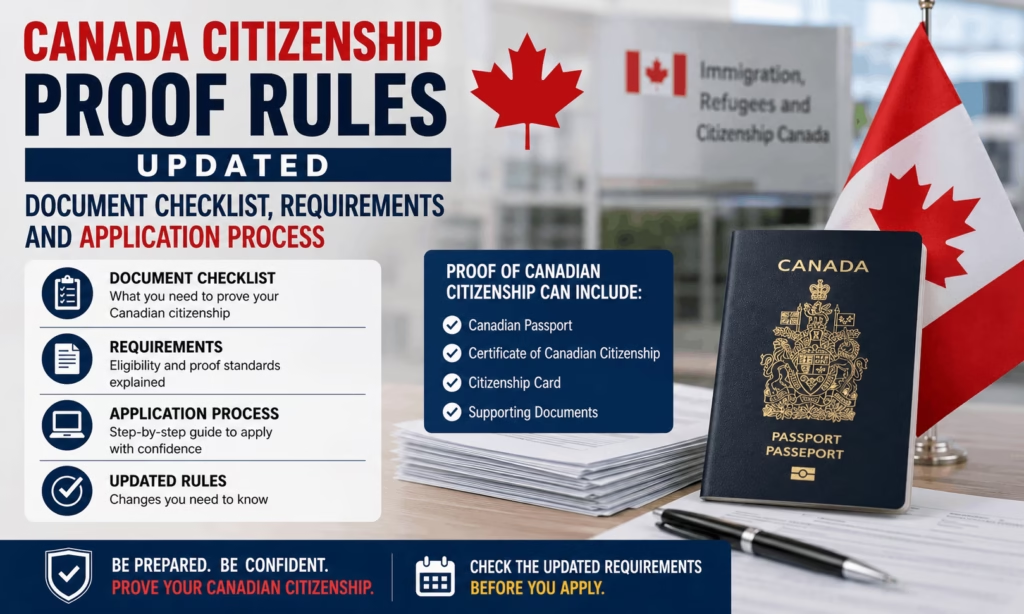
What Changed in the Canada Citizenship Proof Rules
The revised CIT 0014 checklist, updated in mid June 2026, is the clearest signal yet that IRCC wants stronger, government-issued evidence behind every citizenship by descent claim. The department’s own wording now states that applications cannot be supported solely by third-party records, meaning genealogy website printouts can support a file but can never be the only evidence in it. This applies across the board, but it lands hardest on applicants tracing their Canadian citizenship through a parent or grandparent who was born decades ago, when record-keeping varied widely between provinces and countries.
Alongside the checklist update, IRCC confirmed it had temporarily paused finalization of some new citizenship by descent applications while it reviewed how a number of recent approvals were processed. A separate wave of letters, signed by the Registrar of Canadian Citizenship, asked some recipients of newly issued certificates, many of them living in the United States, to return their documents pending a file review. IRCC has since walked part of that back: a number of affected applicants received revalidation letters confirming their certificates remain valid and will not be cancelled. Throughout this process, IRCC has repeatedly stated that anyone caught up in a review is still considered a Canadian citizen. What is under review is the certificate as a physical proof document, not the person’s underlying legal status.
Key Highlights: Dates You Need to Know
| Date | Development |
|---|---|
| November 20, 2025 | Bill C-3 receives Royal Assent, removing the first-generation limit on citizenship by descent |
| December 15, 2025 | Bill C-3 comes into force |
| March 9, 2026 | IRCC formalizes online citizenship testing as the default method for applicants aged 18 to 54 |
| April 2026 | Government filing fee for a citizenship certificate confirmed at CAD 75 per person |
| May 15, 2026 | New completeness check rules ease acceptance for applicants applying from outside Canada and the United States |
| June 13 to 15, 2026 | Registrar issues surrender notices for a portion of roughly 4,075 recently approved Bill C-3 certificates |
| June 16 to 18, 2026 | Revised CIT 0014 checklist released; IRCC pauses finalization of some descent applications |
| June 19, 2026 | Revalidation letters begin going out to affected certificate holders |
| July 21, 2026 | IRCC publishes updated processing data showing 82,000 pending applications |
Who Is Affected by the New Documentation Standard
The tightened rules apply most directly to people filing under citizenship by descent, particularly what IRCC internally treats as Scenario 3 of the CIT 0014 checklist, where an applicant is claiming citizenship through a parent or grandparent rather than presenting their own Canadian birth certificate. It also affects anyone whose original family records were lost, destroyed, or never digitized by the country where the birth, marriage, or death took place.
It does not mean genealogy research is worthless. Ancestry and FamilySearch records can still support a file as supplementary evidence. What changed is that they can no longer stand alone as the only proof linking one generation to the next. Every generation in the family chain now needs at least one document from an original source authority, meaning the civil registry, vital statistics office, or provincial or territorial archive that actually created and holds the record, rather than a private platform that has simply copied or indexed it.
Direct Express Card Transition to Fifth Third Bank: What 3.6 Million Cardholders Need to Know
Federal Fuel Excise Tax Suspension: Ford Pushes Carney to Extend Relief Past Labour Day
USCIS Restored Power To Deny Without RFE: Here Is What Policy Alert PA-2026-05 Actually Changes
Documents IRCC Currently Accepts
IRCC continues to accept a defined set of primary documents for proof of citizenship applications, and understanding this list before you submit is the single best way to avoid a delay.
Primary documents accepted:
- Provincial or territorial birth certificates issued by an official Canadian registry
- Foreign birth certificates that clearly show the parent-child relationship
- Existing Canadian citizenship or naturalization certificates
- Registration of Birth Abroad or retention certificates
- Other government-issued documents that directly confirm a citizenship lineage
If an original document cannot be obtained, IRCC now expects applicants to take the following steps rather than substituting a genealogy printout:
- Request an official letter of no record from the registry or archive that would have issued the missing document
- Submit secondary evidence such as hospital birth records, baptismal certificates, or historical census entries
- Provide a written, dated account of the specific efforts made to locate the original record
Applicants claiming citizenship for a child born after December 2025 should also be ready to provide physical presence evidence tied to the 1,095-day residency requirement introduced under Bill C-3, since this rule now applies to certain descent claims going forward.
Step-by-Step: How to Apply for a Canadian Citizenship Certificate
- Confirm your eligibility. Most people born outside Canada before December 15, 2025 to a Canadian parent are already citizens under the amended law; a certificate simply proves it.
- Gather your documents using the CIT 0014 checklist, prioritizing original source authority records for every generation in your chain.
- Complete the correct application form. Most applicants use form CIT 0001; requirements can differ slightly depending on whether you are applying from inside Canada, the United States, or another country.
- Pay the government filing fee, which stands at CAD 75 per applicant.
- Submit certified copies, not originals, unless IRCC specifically requests originals for verification.
- Track your application status online and respond promptly if IRCC requests additional evidence, since delayed responses add further months to an already long queue.
- Keep your documents in order after approval. Recent surrender-letter cases show IRCC can request a file review even after a certificate has been issued.
Applicants filing from outside Canada and the United States benefit from a streamlined completeness check introduced in May 2026: an application only needs required signatures, proof of payment, compliant photographs, and a completed form to be accepted into processing, with supporting documents requested later at an officer’s discretion rather than triggering an outright rejection.
Processing Times and Backlog: The Numbers Behind the Rules
The documentation tightening did not happen in isolation. It coincides with a backlog that has grown every month this year. IRCC’s own figures show 82,000 pending proof of citizenship applications as of the latest count, compared with 70,400 in May and 56,000 in April, a rise driven largely by the surge in Bill C-3 descent claims. Processing times have stretched accordingly, moving from roughly five months in 2025 to a range that immigration practitioners now describe as 12 to 19 months, with applications filed earlier in 2026 generally tracking toward the longer end of that window.
For applicants, the practical takeaway is straightforward: a complete, well-sourced application filed correctly the first time is now far more valuable than a fast but thin one, since a request for additional evidence can add several more months to an already lengthy wait.
Official Government and Regulatory Resources
| Resource | Purpose | Official Link |
|---|---|---|
| Canada.ca Citizenship Certificate page | Current official rules and eligibility | canada.ca/en/immigration-refugees-citizenship/services/canadian-citizenship/proof-citizenship-certificate.html |
| CIT 0001 Application Form | Application for a citizenship certificate | canada.ca/en/immigration-refugees-citizenship/services/application/application-forms-guides/application-proof-citizenship-adults.html |
| CIT 0014 Document Checklist | Official required-documents checklist | canada.ca/en/immigration-refugees-citizenship/services/application/application-forms-guides/document-checklist-proof-citizenship.html |
| IRCC Secure Account (Login/Registration) | Create an account and submit applications online | account.cic.gc.ca |
| Application Status Check | Track your citizenship certificate application | canada.ca/en/immigration-refugees-citizenship/services/application/check-status.html |
| IRCC Processing Times Tool | Estimated current processing times by application type | canada.ca/en/immigration-refugees-citizenship/services/application/check-processing-times.html |
| Bill C-3 Information Page | Background on the citizenship by descent amendments | canada.ca/en/immigration-refugees-citizenship/campaigns/citizenship-act-amendments.html |
IEEPA Tariff Refund Process: How Businesses Are Claiming Their Share of $166 Billion
$5000 CRA Data Breach Settlement 2026: Who Qualifies and How to Claim
$2000 Tariff Dividend August 2026: Is It Still Coming? Full Fact-Check Update
FAQs
Is a genealogy website printout like Ancestry or FamilySearch still accepted by IRCC?
It can support your application as supplementary evidence, but under the updated rules it cannot be the only document proving a link between generations. You need at least one official record from the original source authority for each generation in your family chain.
What is an original source authority?
It is the actual government office, civil registry, or archive that created and holds a record, such as a provincial vital statistics office, rather than a private website that has copied or indexed that record.
How long does a Canadian citizenship certificate application take in 2026?
Current estimates range from about 12 to 19 months, up from roughly five months in 2025, largely because of the sharp rise in citizenship by descent applications following Bill C-3.
I already received my citizenship certificate. Can IRCC still ask for it back?
In a limited number of recent cases tied to citizenship by descent, IRCC did ask some certificate holders to return their documents for a file review. Affected individuals remain Canadian citizens throughout the review, and many have since received letters confirming their certificates will not be cancelled.
Do I need a lawyer or immigration consultant to apply?
No, self-represented applicants can and do apply successfully. However, because the documentation standard has tightened, applicants with complex or multigenerational family chains may benefit from professional help assembling original source records before submission.
What happens if I cannot find an original birth or marriage record?
Request a formal letter of no record from the relevant registry, then submit secondary evidence such as hospital records, baptismal certificates, or census documents, along with a written account of the efforts you made to locate the original.
Does Bill C-3 still apply if I was born before December 2025?
Yes. Bill C-3 removed the first-generation limit that previously blocked many people from claiming citizenship through a Canadian parent or grandparent, and most people born abroad before the law came into force are already citizens by operation of law. A certificate simply provides formal proof of that status.
Is there a fee to apply for a citizenship certificate?
Yes, the government filing fee is CAD 75 per applicant, in addition to the cost of obtaining certified copies of supporting records, which typically run between CAD 25 and 50 each depending on the issuing province or country.
Conclusion
The Canada citizenship proof rules in place right now put document quality ahead of document quantity. IRCC has made clear that a citizenship by descent application built on genealogy printouts alone will not pass its updated checklist, and the backlog data shows the cost of getting it wrong: tens of thousands of applicants are already waiting well over a year for a decision. Anyone applying should start by pulling official records from original source authorities for every generation in their family chain, use a letter of no record wherever a document genuinely does not exist, and check their application status regularly through IRCC’s official channels. The rules can keep evolving as the Bill C-3 review process plays out, so applicants are better served checking the official government links above before submitting rather than relying on older guidance.
2027 VA Disability COLA Increase: How Much Could Benefits Rise Under the Latest Projection
50% US Tariffs on Canadian Goods: Full List and What Changes
Borrower Defense Student Loans: How to Apply for a Full Discharge?