Searches for Free Money From the USA Government spike every year, and this year brings a genuine policy change worth knowing about before you apply. The Supplemental Nutrition Assistance Program has updated its work-requirement rules for 2026, and the exemption that used to protect parents of children up to age 18 from work requirements now only applies if a parent’s youngest child is under 14. That single change affects how many parents qualify for food assistance without meeting additional work or job-training requirements, and it is exactly the kind of real, verifiable update that separates legitimate government aid programs from the scam pitches that dominate search results for this topic.
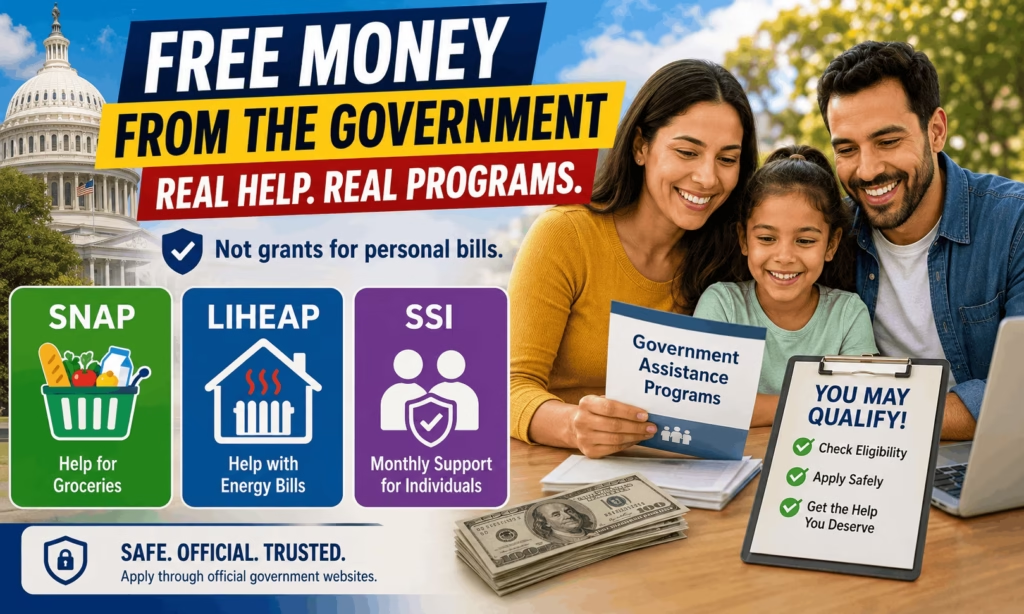
That distinction matters because most of what circulates online under the phrase free government money is not government money at all. There is no federal program that hands out cash grants to individuals simply for paying bills, and any website, text message, or social media ad claiming otherwise is almost always a scam designed to collect an upfront fee or personal information. What does exist is a wide network of real federal and state programs, including food ‘assistance, energy bill help, cash assistance for families, disability payments, and education grants, all of which are free to apply for directly through official government websites. We’ll be updating this article monthly as program rules, income limits, and eligibility thresholds change, so check back for the latest details before you apply.
Key Highlights: Real Government Assistance Programs in 2026
| Program | What It Provides | Who Typically Qualifies |
|---|---|---|
| SNAP (food assistance) | Monthly benefits on an EBT card for groceries | Households up to 130% of federal poverty level federally, higher in some states |
| Medicaid | Free or low-cost health coverage | Adults up to 138% FPL in the roughly 40 expansion states and DC |
| LIHEAP | Help paying heating and cooling bills | Income-based, varies by state, often tied to federal poverty level or state median income |
| TANF | Cash assistance for families with children | Low-income families with children, subject to a 60-month lifetime federal cap |
| WIC | Food packages for pregnant women and young children | Pregnant women, new mothers, and children under 5, up to 185% FPL |
| SSI | Monthly cash payments | Individuals who are 65 or older, blind, or disabled with limited income and resources |
| Section 8 / Housing Choice Voucher | Rental assistance | Based on area median income, administered by local public housing agencies |
| Federal Pell Grant | Money for college that does not need to be repaid | Undergraduate students with financial need, based on FAFSA results |
| Earned Income Tax Credit (EITC) | Refundable tax credit at filing time | Low-to-moderate income workers, amount depends on income and number of children |
Understanding What Free Government Money Actually Means
The phrase free government money is technically accurate for a specific set of programs, but it does not mean what many online ads imply. Legitimate government assistance falls into two broad categories. The first is need-based benefit programs like SNAP, Medicaid, LIHEAP, and TANF, which provide ongoing support for food, healthcare, energy costs, or basic living expenses to households that meet income and resource limits. The second is one-time or targeted funding like Pell Grants for college students or refundable tax credits like the Earned Income Tax Credit, which return money to eligible taxpayers at filing time.
None of these programs require an application fee, and none of them are administered through a private website that promises fast approval or guaranteed cash for a processing charge. According to consumer guidance from federal benefit navigators, legitimate government programs are always free to apply for, and any site asking for payment to unlock a grant or benefit application should be treated as a red flag rather than a shortcut.
SNAP Food Assistance: The 2026 Work Requirement Change
SNAP remains the most widely used federal assistance program, and it saw a meaningful rule change heading into 2026. Historically, parents with children under 18 were exempt from SNAP’s standard work requirements, which otherwise require able-bodied adults without dependents to work or participate in job training for a minimum number of hours each month to keep receiving benefits. Under the updated 2026 rules, that parental exemption now only applies if a parent’s youngest child is under 14, meaning parents of teenagers between 14 and 17 may now need to meet work requirements that did not previously apply to them.
Federal income limits for SNAP are updated annually and currently cover the period from October 1, 2025, through September 30, 2026. Most states use 130 percent of the federal poverty level as the baseline gross income limit, though many states have adopted broad-based categorical eligibility, which allows them to raise that threshold for households that also qualify for certain TANF-funded services. Applicants should also know that SNAP benefit calculations are based on current monthly income rather than income from the prior year, which means someone who just lost a job can often qualify quickly even if the previous year’s earnings would have disqualified them.
Social Security $200 Monthly Increase 2027: Which Seniors Qualify for the Biggest Raise?
H-1B 60-Day Grace Period Elimination: What US Visa Workers Should Know
450,000 Borrowers Student Debt Erased: How to Check If You Qualify?
LIHEAP: Help With Heating and Cooling Bills
The Low Income Home Energy Assistance Program, known as LIHEAP, sends funding directly toward a household’s utility bills rather than as a cash payment to the individual. Depending on the state, LIHEAP can cover a portion of heating costs in winter, cooling costs in summer, and in some cases emergency assistance for households facing imminent shutoff of utility service. Because LIHEAP is federally funded but state-administered, benefit amounts and specific eligibility rules vary considerably, with colder-climate states generally offering larger heating assistance grants than warmer states.
One detail many applicants miss is that approval for LIHEAP can also increase SNAP benefits in many states. A LIHEAP approval often unlocks what is called the SNAP Standard Utility Allowance, which raises the shelter deduction used in the SNAP benefit calculation, meaning households that qualify for both programs frequently see a higher food benefit simply by applying for energy assistance first.
TANF Cash Assistance: What It Covers and Its Limits
Temporary Assistance for Needy Families, created under the 1996 welfare reform law, provides direct cash assistance to low-income families with children, along with support services such as job training and child care assistance in many states. Unlike SNAP, which is a federal entitlement program with nationally consistent rules, TANF operates through fixed block grants sent to each state, and states have broad discretion over how they structure benefit amounts, work requirements, and eligibility rules within federal guidelines.
The most important limit to understand is the 60-month federal lifetime cap on TANF cash assistance, which restricts most adults to a maximum of five years of benefits over their lifetime, though some states apply shorter limits or offer exemptions for specific circumstances. Applicants who qualify for both SNAP and TANF are generally encouraged to apply for both at the same time, since many state benefit offices can screen for multiple programs, including LIHEAP and Medicaid, during a single office visit or online application.
Medicaid, WIC, and SSI: Health, Nutrition, and Disability Support
Medicaid remains one of the largest sources of free healthcare coverage available to low-income Americans, with eligibility for adults extending to 138 percent of the federal poverty level in the roughly 40 states and the District of Columbia that have adopted Medicaid expansion. In the states that have not expanded Medicaid, eligibility rules for adults without children remain considerably stricter, which is why checking state-specific rules directly is essential before assuming disqualification.
The Special Supplemental Nutrition Program for Women, Infants, and Children, or WIC, provides food packages, nutrition education, and breastfeeding support to pregnant women, new mothers, and children under age 5, with income eligibility generally set at 185 percent of the federal poverty level nationwide. Supplemental Security Income, or SSI, provides monthly cash payments to people who are 65 or older, blind, or have a qualifying disability and meet strict income and resource limits. SSI recipients are frequently automatically eligible for SNAP and Medicaid without needing to complete a separate income test for those programs.
Housing Assistance and Free Money for College
Housing costs remain one of the largest financial burdens for low-income households, and the Section 8 Housing Choice Voucher program helps cover rent in privately owned housing for eligible families, seniors, and people with disabilities. Section 8 eligibility is based on area median income rather than a flat national threshold, and vouchers are administered through local public housing agencies, which is why waitlists and availability can vary significantly by city and county.
For students, the Federal Pell Grant remains the largest source of grant funding that does not require repayment for undergraduate education. Eligibility is determined through the Free Application for Federal Student Aid, commonly known as the FAFSA, and the amount awarded depends on financial need, cost of attendance, and enrollment status. Unlike student loans, Pell Grant funds never need to be paid back as long as a student meets the program’s continued enrollment and eligibility requirements.
The Earned Income Tax Credit: Free Money Through Your Tax Return
For many working households, the single largest one-time source of free government money comes not from a benefits office but from the tax return itself. The Earned Income Tax Credit is a refundable federal tax credit available to low-to-moderate income workers, meaning eligible filers can receive money back even if they owe little or no federal income tax. The credit amount depends on income, filing status, and the number of qualifying children in the household, and it is claimed directly on a federal tax return rather than through a separate application.
Millions of eligible taxpayers fail to claim the EITC every year, often because they assume they do not qualify or are unaware the credit exists. Using free tax filing resources through the IRS, rather than paid tax preparation services that may charge fees against the refund, ensures eligible filers keep the full value of the credit rather than losing part of it to preparation costs.
How to Apply for Government Assistance the Right Way
The safest and most direct path to applying for any of these programs is through official federal or state government websites, most of which end in a .gov domain rather than a commercial site. Benefits.gov operates as a centralized federal screening tool that can identify which programs a household likely qualifies for based on income, family size, and location, without charging any fee or requiring payment information. Many state and local benefit offices can also process applications for multiple programs, such as SNAP, TANF, LIHEAP, and Medicaid, during a single visit or through one combined online application.
Anyone applying should gather basic documentation in advance, including identification, proof of income, Social Security numbers for household members, proof of residency, and recent utility or rent bills, since most applications will request this information regardless of which specific program is being pursued. If a household is denied benefits, most programs allow an appeal, and free legal aid organizations in many states can assist with that process at no cost.
Weekly Jobless Claims Report: 199,000 Filings Signal Labor Market Cooling
Federal Employee RIF Rules 2026: What the New OPM Regulations Actually Change
IRS Releases New Details on the Saver’s Match Program: Up to $1,000 for Your Retirement Account
IRS SSA Advanced Leave Suspension: What Federal Employees Need to Know
How to Spot a Free Government Money Scam
Because the phrase free government money attracts so much search traffic, it has also become a common target for scammers. The clearest warning sign is any request for payment, whether framed as a processing fee, an application fee, or a fee to unlock grant listings, since legitimate government benefit programs never charge a fee to apply. Scam operations frequently use urgency, claiming a limited-time grant opportunity or guaranteed approval, tactics that real government agencies do not use since benefit eligibility depends entirely on documented income and household circumstances rather than timing.
Another common red flag is any offer of a personal grant to pay off credit card debt, cover a mortgage, or fund general personal expenses, since no federal program provides unrestricted cash grants of that kind to individuals outside of the specific, need-based programs described above. Verifying any offer directly through Benefits.gov, USA.gov, or a program’s official federal agency website before providing any personal or financial information remains the most reliable way to avoid falling victim to this type of scam.
Official Government Resources for Applying and Checking Eligibility
| Resource | Purpose | Official Link |
|---|---|---|
| Benefits.gov | Federal benefit screening tool covering all major programs | https://www.benefits.gov |
| USA.gov Government Benefits | General guidance on federal assistance programs | https://www.usa.gov/benefits |
| USDA Food and Nutrition Service (SNAP) | SNAP eligibility rules and state application links | https://www.fns.usda.gov/snap |
| Medicaid.gov | State-by-state Medicaid eligibility and application | https://www.medicaid.gov |
| LIHEAP (Administration for Children and Families) | State LIHEAP program contacts and eligibility | https://www.acf.hhs.gov/ocs/liheap |
| Social Security Administration (SSI) | SSI eligibility, application, and status check | https://www.ssa.gov/ssi |
| HUD Housing Choice Voucher Program | Section 8 information and local housing agency lookup | https://www.hud.gov/topics/housing_choice_voucher_program_section_8 |
| Federal Student Aid (Pell Grants) | FAFSA application and Pell Grant eligibility | https://studentaid.gov |
| IRS Earned Income Tax Credit | EITC eligibility and free filing resources | https://www.irs.gov/credits-deductions/individuals/earned-income-tax-credit-eitc |
| 211 Helpline | Free local referral service for assistance programs | https://www.211.org |
Conclusion
Real financial help from the government exists in the USA, but it looks different from what most free government money ads promise. Programs like SNAP, LIHEAP, TANF, Medicaid, SSI, Section 8, Pell Grants, and the Earned Income Tax Credit all provide genuine, need-based support, and every one of them is free to apply for directly through official government channels. The safest strategy for anyone searching for this kind of assistance is to start with a trusted federal screening tool like Benefits.gov, apply for every program a household may qualify for at the same time where possible, and treat any offer that asks for a fee or promises guaranteed personal cash grants as a scam rather than an opportunity.
Service Canada Benefit Payments August 2026 Dates, Amounts and Who Qualifies
Government Shutdown Stopgap Spending Bill: Senate Passes Funding Patch Through December 11
USPS Operational Restructuring: Latest Updates on Cash Crisis and Network Overhaul
FAQs
Is free money from the government actually real?
Yes, in the sense that real federal and state programs like SNAP, LIHEAP, TANF, Medicaid, SSI, Pell Grants, and the Earned Income Tax Credit provide genuine financial assistance with no repayment required. However, there is no program that hands unrestricted cash grants to individuals simply for personal expenses, and any offer claiming otherwise is typically a scam.
Do I have to pay a fee to apply for government assistance programs?
No. Legitimate government benefit and grant programs never charge an application fee. Any website or offer requesting payment to process a government grant application should be treated as a scam.
What changed with SNAP work requirements in 2026?
The parental exemption from SNAP work requirements now applies only if a parent’s youngest child is under 14, a narrower exemption than the previous rule, which covered parents of children up to age 18.
Can I qualify for more than one government assistance program at once?
Yes. Many programs are designed to work together. Receiving SNAP, TANF, LIHEAP, WIC, Medicaid, and housing assistance simultaneously is common, and qualifying for one program, such as SSI, can automatically qualify a household for others, like SNAP or Medicaid, without a separate income test.
How do I know if a government grant offer is a scam?
Warning signs include requests for upfront payment, promises of guaranteed approval, pressure to act immediately, and offers of unrestricted personal cash grants unrelated to a specific, documented need. Verifying any offer directly through an official .gov website before responding is the safest approach.
Where can I check what government benefits I qualify for?
Benefits.gov offers a free federal screening tool that identifies likely eligibility across major programs based on income, household size, and location, without requiring any payment or personal financial account information.
Is the Earned Income Tax Credit the same as a government grant?
No, though it functions similarly in providing money with no repayment required. The EITC is a refundable tax credit claimed directly on a federal tax return rather than through a separate grant application, and eligibility depends on earned income, filing status, and number of qualifying children.