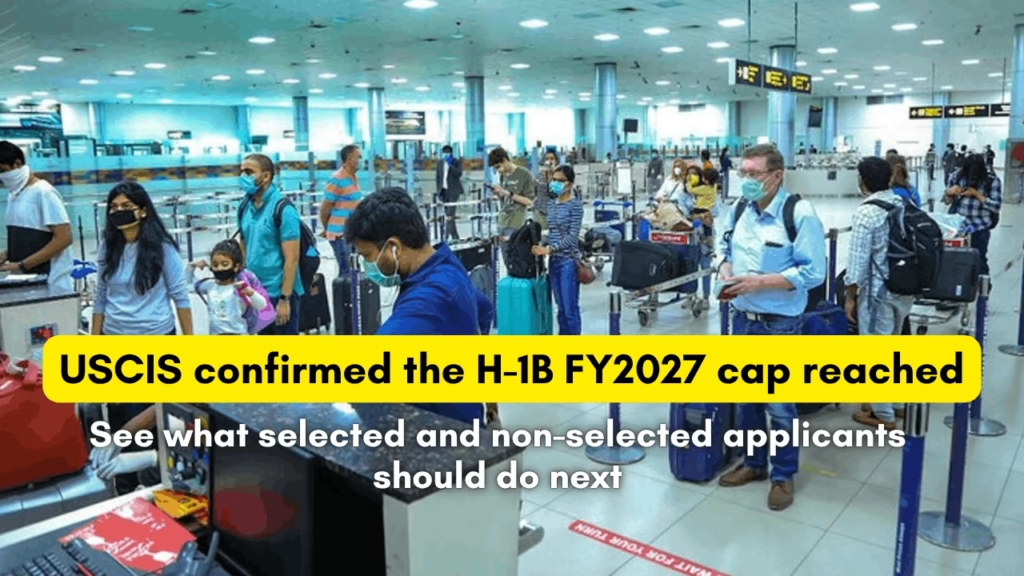
H-1B FY2027 Cap Reached: U.S. Citizenship and Immigration Services confirmed on July 17, 2026 that the H-1B FY2027 cap reached its full congressionally mandated allocation, receiving enough approved petitions to fill all 65,000 regular cap slots and the 20,000 advanced degree exemption, commonly known as the master’s cap, for a combined total of 85,000 visas. With the cap now met, USCIS will not run any additional registration rounds for fiscal year 2027, officially closing out a cap season that looked meaningfully different from any before it.
This was the first H-1B cap cycle run entirely under a new wage-weighted selection system, replacing the flat, random lottery USCIS had used for years, and it played out alongside a disputed $100,000 fee tied to a presidential proclamation that remains the subject of active litigation. Total registrations also dropped sharply, with USCIS confirming 211,600 properly submitted registrations for unique beneficiaries, down roughly 38 percent from 343,981 the year before. This article walks through exactly how the FY2027 cap season unfolded, what the new selection rules actually changed, and what both selected and non-selected applicants should do now that the cap has closed. We’ll be updating this article monthly as litigation over the $100,000 fee develops and as USCIS releases guidance for the FY2028 cycle.
What USCIS Confirmed?
USCIS announced that it had received a sufficient number of approved petitions to meet the FY2027 H-1B numerical allocations, meaning the agency will not select any additional registrations this cycle. This confirmation came after USCIS had already completed its initial registration selection process back on March 31, 2026, notifying petitioners with selected beneficiaries that they were eligible to file cap-subject petitions. The July announcement essentially closes the loop, confirming that enough of those selected registrations converted into approved petitions to fully use up the available cap numbers, eliminating any possibility of a second selection round for FY2027.
Timeline: How the FY2027 H-1B Cap Season Unfolded
| Date | Milestone |
|---|---|
| September 19, 2025 | Presidential Proclamation on Restriction on Entry of Certain Nonimmigrant Workers issued, introducing the $100,000 fee condition |
| March 4 to March 19, 2026 | Initial electronic registration period, $215 fee per registration |
| March 31, 2026 | USCIS confirms enough registrations received to reach the FY2027 cap; selected petitioners notified |
| April 1, 2026 | Cap-subject petition filing window opens for selected beneficiaries |
| July 17, 2026 | USCIS confirms enough approved petitions received; FY2027 cap season officially closes with no second lottery round |
| October 26, 2026 (expected) | Briefing on the government’s appeal over the $100,000 fee expected to conclude |
The New Wage-Weighted Selection Process Explained
For the first time, FY2027 registrations were selected under a wage-weighted system rather than the traditional flat lottery, following a final rule published by the Department of Homeland Security. Under the old system, every properly submitted registration had an equal, random chance of selection regardless of the offered salary. Under the new system, registrants are assigned extra entries into the selection pool based on the wage level tied to their offered salary, calculated using Occupational Employment and Wage Statistics data, meaning higher-paid, higher-skilled positions received a statistically better chance of being selected than lower-wage registrations. Employers were also required for the first time to include evidence supporting the basis of the wage level selected during registration, with USCIS warning that failure to comply could result in rejection, a request for evidence, or denial of the resulting petition.
2027 COLA Increase for VA Disability: How Much Could Benefits Rise Under the Latest Projection
Registration Numbers Drop 38 Percent: Why Fewer Employers Applied
One of the most striking figures from this cap season is the sharp decline in total registration volume. USCIS confirmed 211,600 properly submitted registrations for unique beneficiaries in FY2027, down from 343,981 the year before, a drop of approximately 38 percent. While USCIS has not published an official explanation for the decline, immigration attorneys have pointed to a combination of factors likely at play: the new wage-weighted system discouraging registrations for lower-wage positions that would now have reduced odds of selection, and the disputed $100,000 fee adding significant new cost uncertainty for employers considering whether to register candidates at all, particularly for roles that might ultimately require consular processing rather than a straightforward change of status.
The $100,000 H-1B Fee: What It Actually Requires
Under the September 19, 2025 Presidential Proclamation, Restriction on Entry of Certain Nonimmigrant Workers, certain H-1B petitions filed at or after 12:01 a.m. Eastern on September 21, 2025 must be accompanied by an additional $100,000 payment as a condition of eligibility for approval. Importantly, this fee does not apply universally to every H-1B petition. According to USCIS guidance, the fee specifically applies when a petition cannot be approved as an in-country change of status and can only be approved through consular notification instead, a scenario that commonly arises for candidates changing from F-1 student status or L-1 intracompany transferee status into H-1B status, since a status change filed and approved entirely within the US may not trigger the fee the same way.
Employers can seek a national interest exception to avoid the fee, but as of the most recent reporting, no national interest exceptions are known to have been granted, including in compelling circumstances such as healthcare workers planning to work in medically underserved areas of the United States. To help employers manage payment of this substantial fee, the US Department of Treasury also approved an increase in the daily credit card transaction limit for H-1B registrations and petitions, raising it from $24,999.99 to $99,999.99 per day.
Ongoing Litigation Over the $100,000 Fee
The $100,000 fee remains contested in active litigation. The First Circuit Court of Appeals denied a motion to stay the fee, meaning it has remained in effect while the underlying legal challenge continues. USCIS has acknowledged this ruling and issued formal guidance while the case proceeds, and the agency has said it is working on next steps, indicating that if the current order is ever lifted, it aims to resume fee collection procedures accordingly. Briefing on the merits of the government’s appeal is expected to conclude around October 26, 2026, meaning employers and beneficiaries should expect continued uncertainty around this fee at least through the fall of 2026.
What Happens Next If Your Registration Was Selected
If your registration was selected during the initial FY2027 selection process, and your employer successfully filed and received an approved H-1B cap-subject petition, no further action is required for the cap process itself, though you should confirm the status of your specific petition, including whether the $100,000 fee applied to your case, directly with your employer or immigration counsel. Petitioners had at least 90 days from April 1, 2026 to file petitions for selected beneficiaries, and USCIS petitioner accounts display registration and case status directly, allowing you to confirm your specific standing without waiting for separate correspondence.
Social Security Spousal Benefit Rule Almost Everyone Gets Wrong, and What It Actually Costs
Canada 50% Tariff 2026: Full List of Products That Could See Price Hikes
What Happens Next If Your Registration Was Not Selected
If your registration was not selected, or your petition was not filed within the required window, your options for fiscal year 2027 under the standard H-1B cap process are now closed, since USCIS will not conduct any additional selection rounds this cycle. That does not mean every path forward is closed, however. Several cap-exempt pathways remain available regardless of the annual cap. Petitions filed by institutions of higher education, nonprofit research organizations, or governmental research organizations are cap-exempt regardless of the specific role, since the exemption applies to the employer type rather than the position. Concurrent cap-exempt employment is also available for individuals who were already counted against a prior year’s cap. Existing H-1B holders can still pursue a change of employer, amendment, or extension petition without needing a new cap allocation. Finally, candidates who do not qualify under any H-1B pathway for this cycle may want to evaluate alternative visa categories, including O-1 for individuals with extraordinary ability, L-1 for intracompany transferees, TN for eligible Canadian and Mexican professionals, or E-3 specifically for Australian nationals, depending on individual eligibility.
Cap-Exempt and Alternative Pathways at a Glance
| Pathway | Who It’s For |
|---|---|
| Higher education, nonprofit, or government research employer | Cap-exempt regardless of the specific role or beneficiary |
| Concurrent cap-exempt employment | Individuals already counted against a prior year’s H-1B cap |
| Change of employer, amendment, or extension | Existing H-1B holders needing to change jobs or extend status |
| O-1 visa | Individuals with extraordinary ability in their field |
| L-1 visa | Intracompany transferees from a related overseas entity |
| TN visa | Eligible Canadian and Mexican professionals under USMCA |
| E-3 visa | Australian nationals in specialty occupations |
Looking Ahead to FY2028
USCIS has not yet announced exact dates for the FY2028 initial registration period. Based on the registration pattern observed from FY2025 through FY2027, the window is generally expected to open in early March, though prospective petitioners should rely on official USCIS announcements rather than assuming this year’s exact dates will repeat. Employers planning ahead should also monitor the ongoing litigation over the $100,000 fee, since its outcome could materially affect cost planning for the next cap cycle.
Official Resources and Where to Check Your Status
| Resource | Purpose | Link |
|---|---|---|
| USCIS H-1B Cap Season page | Official registration dates, requirements, and updates | uscis.gov/working-in-the-united-states/temporary-workers/h-1b-specialty-occupations/h-1b-cap-season |
| USCIS online account | Check your registration and petition status | my.uscis.gov |
| H-1B Electronic Registration Process | Official registration process details | uscis.gov/h-1b-registration |
| Presidential Proclamation guidance | Official details on the $100,000 fee requirement | uscis.gov (H-1B Specialty Occupations page) |
| USCIS newsroom alerts | Track official cap season announcements | uscis.gov/newsroom/alerts |
OAS Payment Increase August 2026: Confirmed Amounts, Payment Date, and the Annual GIS Reset !
Weekly Jobless Claims Report: 199,000 Filings Signal Labor Market Cooling
Fast-Track Deportation Ruling: Could It Affect Indian Immigrants?
FAQs
Has the H-1B FY2027 cap been reached?
Yes. USCIS confirmed on July 17, 2026 that it received enough approved petitions to meet the full FY2027 cap of 65,000 regular slots plus the 20,000 master’s cap exemption, closing the cap season with no additional selection rounds.
Will there be a second H-1B lottery round for FY2027?
No. USCIS has confirmed there will be no additional registration or selection rounds for fiscal year 2027, since the cap has already been fully met through the initial selection process.
What is the new wage-weighted H-1B selection process?
Instead of a flat, random lottery, FY2027 registrations were selected using a system that gives extra entries to registrants offering higher wages, based on official wage level data, meaning higher-paid positions had a statistically better chance of selection than in previous years.
Does the $100,000 H-1B fee apply to every petition?
No. It specifically applies to petitions that cannot be approved as an in-country change of status and can only be approved through consular notification, unless the employer has obtained a national interest exception, which has not yet been granted in any known case.
What should I do if my H-1B registration was not selected for FY2027?
Consider cap-exempt options such as employment with a higher education institution or nonprofit research organization, concurrent cap-exempt employment, or alternative visa categories like O-1, L-1, TN, or E-3, depending on your specific eligibility.
When will FY2028 H-1B registration open?
USCIS has not announced exact dates yet. Based on the pattern from FY2025 through FY2027, the registration period is generally expected to open in early March 2027, though applicants should confirm official dates once USCIS announces them.
Is the $100,000 H-1B fee still being challenged in court?
Yes. The First Circuit Court of Appeals denied a motion to stay the fee, and the government’s appeal on the merits is expected to conclude briefing around October 26, 2026, meaning the fee remains in effect while litigation continues.
Why did H-1B registration numbers drop this year?
USCIS has not given an official explanation, but immigration attorneys point to the new wage-weighted selection system discouraging lower-wage registrations, along with cost uncertainty from the disputed $100,000 fee, as likely contributing factors behind the roughly 38 percent drop in total registrations.
Conclusion
The confirmation that the H-1B FY2027 cap reached its full allocation on July 17, 2026 closes out a genuinely transformed cap season, marked by the first-ever wage-weighted selection process, a sharp 38 percent drop in total registrations, and continued uncertainty around the disputed $100,000 fee tied to consular-processed petitions. With no second lottery round available this cycle, applicants who were not selected should now focus on cap-exempt pathways or alternative visa categories rather than waiting on further FY2027 selection activity, while keeping an eye on both the ongoing fee litigation and USCIS’s eventual announcement of FY2028 registration dates.
Federal Employee RIF Rules 2026: What the New OPM Regulations Actually Change
IRS Releases New Details on the Saver’s Match Program: Up to $1,000 for Your Retirement Account
IRS SSA Advanced Leave Suspension: What Federal Employees Need to Know
Small Personal Loans for Bad Credit USA: Direct Lenders With Same-Day Approval and Funding