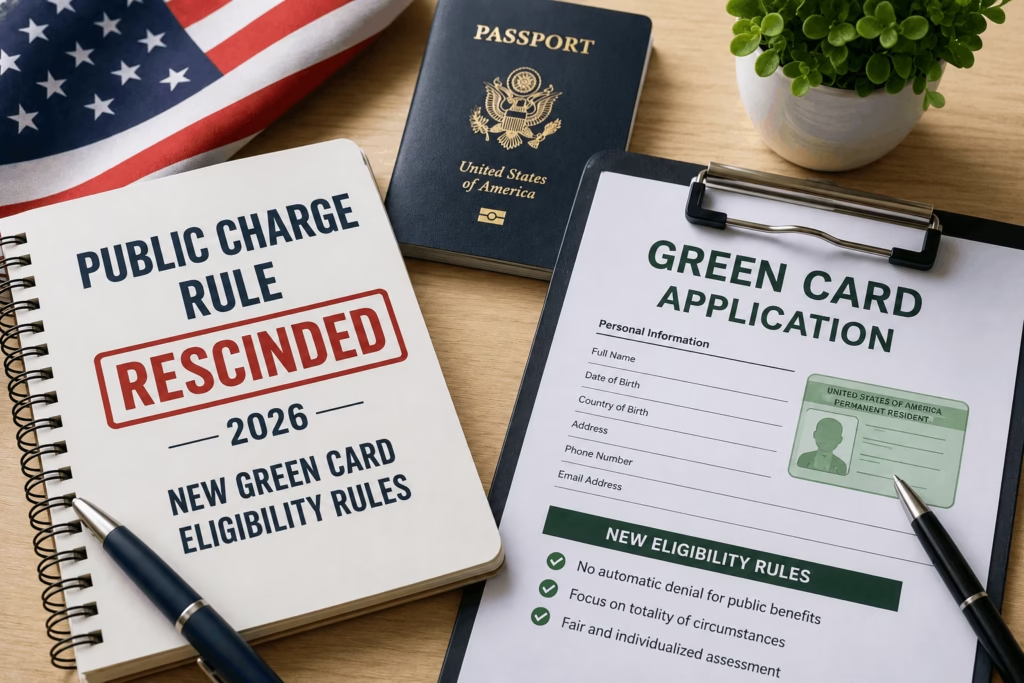
Public Charge Rule Rescinded 2026: The Department of Homeland Security has officially rescinded the 2022 public charge regulation, and starting September 18, 2026, immigration officers will once again be able to weigh a green card applicant’s use of Medicaid, SNAP and housing assistance when deciding whether to approve or deny an application. DHS published the final rule on July 16, 2026, ending the narrower, Biden-era framework that had limited public charge reviews to cash assistance programs and long-term institutional care since December 2022. Under the new public charge rule 2026, USCIS officers gain much broader discretion to look at an applicant’s full financial picture, including means-tested benefits that had been off the table for nearly four years.
This is not a minor technical update buried in the Federal Register. It directly affects anyone currently applying, or planning to apply, for a green card through adjustment of status, an immigrant visa at a U.S. consulate, or admission at a port of entry. Families who have leaned on Medicaid, food assistance or housing help while waiting on a pending case now have a hard deadline to understand before it arrives. We’ll be updating this article monthly as USCIS releases its revised Policy Manual guidance and the new Form I-485 ahead of the September 18 effective date. The short version for anyone with a case in progress: what counts against you, and when, depends heavily on the date you file, so the next several weeks matter more than usual.
Public Charge Rule Rescinded 2026 Key Highlights
| Item | Detail |
|---|---|
| Rule announced | July 16, 2026, published as a DHS final rule |
| Effective date | September 18, 2026 |
| Rule being rescinded | The 2022 DHS public charge regulation |
| What the 2022 rule allowed to count | Cash assistance only (SSI, TANF, state general assistance) and long-term institutionalization at government expense |
| What counts under the new rule | Cash assistance plus means-tested benefits such as SNAP, most Medicaid, and housing assistance including Section 8 and public housing |
| Who is affected | Green card (adjustment of status) applicants, immigrant visa applicants, and applicants for admission at a port of entry |
| Who is exempt | Refugees, asylees, VAWA self-petitioners, T and U visa applicants, and most current lawful permanent residents |
| Form update | USCIS will issue a revised Form I-485; older editions filed on or after September 18, 2026 will be rejected |
| Transition protection | Benefits received before September 18, 2026 are generally not held against applicants |
| Filing date rule | Applications postmarked or e-filed before September 18, 2026 are reviewed under the current 2022 framework |
| Related policy | Department of State visa pause affecting people from 75 countries took effect January 21, 2026, citing public charge concerns |
Latest Update: What DHS Actually Announced
DHS placed its final rule on public inspection on July 16, 2026, formally rescinding the public charge regulation that had governed green card decisions since it took effect in December 2022. USCIS confirmed the change in a newsroom statement, framing the rescission as a return to the discretion Congress intended officers to have under the Immigration and Nationality Act. A USCIS spokesperson described the move as protecting American taxpayers from subsidizing immigrants who might become dependent on public benefits, language that echoes the agency’s position during the first Trump administration’s earlier attempt at a similar expansion in 2019.
The practical mechanics are straightforward, even if the policy shift is significant. The rescission itself does not create a brand-new rule to replace the old one. Instead, it removes the 2022 regulation’s limits and reopens the door for USCIS officers to apply a broader, case-by-case totality-of-circumstances test drawn from the statute and reinforced by DHS’s new rulemaking. That means officers can once again consider factors such as age, health, family status, education, assets and resources, and prior or current use of designated public benefits, similar in structure to the 2019 rule that a federal court vacated in March 2021.
The rule takes effect on September 18, 2026, giving applicants, attorneys and community organizations roughly two months of lead time. USCIS has said it will publish a revised Form I-485, Application to Register Permanent Residence or Adjust Status, tied to the new standard, and has warned that older editions submitted on or after the effective date will not be accepted. As of this writing, USCIS has not yet released its updated Policy Manual guidance explaining exactly how officers should weigh each factor, which is the detail immigration attorneys are watching most closely, since the gap between the old rule disappearing and the new guidance arriving is where the most uncertainty sits for pending cases.
Federal Funds Rate 3.62% Today: Mortgage and Credit Card Impact
Social Security Spousal Benefit Rule Almost Everyone Gets Wrong, and What It Actually Costs
Canada 50% Tariff 2026: Full List of Products That Could See Price Hikes
What Is the Public Charge Rule, in Plain Terms
The public charge ground of inadmissibility has existed in U.S. immigration law for more than a century. Under Section 212(a)(4) of the Immigration and Nationality Act, a person can be denied a visa, admission or a green card if immigration officials determine they are likely to become primarily dependent on the government for support. The rule does not apply to everyone equally. It generally applies to people seeking a green card through adjustment of status inside the United States, people applying for an immigrant visa at a consulate abroad, and people seeking admission at a border or airport. It does not apply to U.S. citizens, most current green card holders, refugees, asylum seekers, VAWA self-petitioners, and holders of certain humanitarian visas such as T and U visas for trafficking and crime victims.
Over the past decade, the definition of what counts as being a public charge has changed several times depending on which administration is in office. The 1999 field guidance under the Clinton administration limited the test to cash assistance for income maintenance and long-term institutional care, explicitly stating that noncash benefits like SNAP, non-long-term Medicaid, and housing assistance would not count. In 2019, the first Trump administration expanded that definition significantly to include a much wider set of benefits. That 2019 rule was vacated by a federal court in March 2021 and formally replaced by the narrower 2022 DHS regulation, which restored the Clinton-era, cash-only approach. The rule now being rescinded is that same 2022 regulation, and its removal effectively swings the pendulum back toward the broader 2019-style standard.
What Benefits Now Count Against Applicants
This is the change families are asking about most directly. Under the outgoing 2022 rule, only three categories mattered: Supplemental Security Income, Temporary Assistance for Needy Families, and state or local general assistance cash programs, along with government-funded long-term institutional care. Medicaid, SNAP, housing assistance, WIC, CHIP and subsidized school meals carried no weight at all in a public charge determination.
Starting September 18, 2026, that list expands substantially. Officers will be able to consider receipt of any means-tested public benefit, a term that generally covers government programs with an income eligibility limit. That includes SNAP, most forms of Medicaid, and housing assistance such as Section 8 vouchers and public housing. It does not mean automatic denial. DHS and immigration attorneys tracking the rollout have been consistent on this point: benefit use is one factor considered within the totality of an applicant’s circumstances, not a standalone disqualifier. An officer weighing a case will still look at the applicant’s age, health, family size, education, work history, and financial resources alongside any benefit use.
There are also carve-outs that families should know about. Emergency Medicaid, Medicaid used by children under 21, and Medicaid received during or shortly after pregnancy are generally excluded from the analysis, mirroring exceptions that existed under the 2019 rule. DHS has also indicated that benefits received before the September 18, 2026 effective date will generally not be held against an applicant, creating a transition period meant to avoid penalizing people for relying on programs that were legally available to them under the current rule. If a spouse or U.S. citizen child in the household receives benefits, that use is not automatically attributed to the applicant, though attorneys note it can still color an officer’s broader view of household self-sufficiency in mixed-status cases.
Who Is Affected by the New Public Charge Rule
The rule reaches a specific set of applicants, and understanding whether you fall into one of these categories matters more than general anxiety about the headline. People filing Form I-485 to adjust status to a green card from inside the United States are directly affected, as are people applying for an immigrant visa through a U.S. consulate abroad and people seeking admission to the country at a port of entry. Certain nonimmigrant visa holders applying to extend or change their status can also be subject to a public charge review, depending on the visa category.
Several groups remain outside the rule entirely. Refugees and asylees are exempt because their admission is based on humanitarian protection rather than the standard immigrant visa process. VAWA self-petitioners, and T and U visa applicants and holders, who are victims of trafficking or certain crimes, are also excluded, reflecting long-standing congressional intent to avoid discouraging vulnerable individuals from seeking protection or cooperating with law enforcement. Most people who already hold a green card are not subject to a new public charge review simply because the rule changed, since the test generally applies at the point of admission or status adjustment, not to permanent residents already living in the country. Naturalization applicants seeking U.S. citizenship are also not evaluated under the public charge standard.
How the Filing Date Determines Which Rule Applies
The single most important detail for anyone with a pending or upcoming application is timing. Applications postmarked or submitted electronically before September 18, 2026 will generally continue to be evaluated under the current 2022 framework, meaning only cash assistance and institutionalization can count against the applicant. Applications filed on or after September 18, 2026 will be reviewed under the new, broader standard, using the revised Form I-485 that USCIS is preparing to release.
This creates a genuine incentive for people who are eligible and ready to file before the deadline to do so, particularly if their household has used Medicaid, SNAP or housing assistance and they want that use evaluated under the narrower current rule rather than the incoming broader one. Immigration attorneys are cautioning, however, that rushing an incomplete or poorly documented application to beat the deadline can backfire, since errors or missing evidence create their own delays and complications regardless of which public charge standard eventually applies. Anyone unsure whether their timeline allows for a complete, accurate filing before September 18 should talk to a qualified immigration attorney or an accredited nonprofit legal service provider rather than guessing.
Public Charge Bonds Are Also Changing
A less publicized piece of the rule affects public charge bonds, a mechanism USCIS can use in rare cases to allow an otherwise inadmissible applicant to proceed by posting a bond guaranteeing the government will be reimbursed if the person later becomes a public charge. Under the new rule, a bond posted on or after the September 18, 2026 effective date is considered breached if the bonded individual receives means-tested public benefits before death, permanent departure from the United States, or naturalization. That is a notably broader trigger than what applied under the outgoing 2022 framework, and it raises the practical stakes for the small number of cases where a public charge bond becomes part of the process.
How This Fits Into the Broader Immigration Policy Picture
The public charge rescission is not happening in isolation. In January 2026, the Department of State separately paused visa issuance for individuals from 75 countries, citing public charge concerns, a blanket measure that applies without the kind of individualized review the DHS rule uses. Immigration advocacy groups have raised concerns that the combination of a broader public charge standard and the visa pause could discourage eligible immigrant families from using benefits like Medicaid or SNAP for citizen children in their household, even in situations where the law does not actually penalize them for it, a phenomenon researchers have documented as a chilling effect during the 2019 rule’s brief period in force.
Legal challenges are also a live possibility. The 2019 version of this rule spent roughly a year working through federal courts before eventually being vacated, and immigration law organizations tracking the 2026 rescission have signaled they expect similar litigation. For now, though, the rule stands as finalized, with the September 18, 2026 effective date intact unless a court intervenes before then.
Fast-Track Deportation Ruling: Could It Affect Indian Immigrants?
2027 COLA Increase for VA Disability: How Much Could Benefits Rise Under the Latest Projection
Official Resources for the Public Charge Rule 2026
| Resource | What It’s For | Official Link |
|---|---|---|
| USCIS public charge rescission announcement | Official DHS and USCIS rule announcement | uscis.gov/newsroom/news-releases |
| Form I-485 (Adjustment of Status) | Current and updated application form and instructions | uscis.gov/i-485 |
| USCIS Policy Manual, Public Charge | Detailed officer guidance once updated | uscis.gov/policy-manual |
| USCIS case status check | Track a pending green card application | egov.uscis.gov/casestatus |
| Federal Register final rule text | Full legal text of the rescission rule | federalregister.gov |
FAQs About the Public Charge Rule 2026
When does the new public charge rule take effect?
September 18, 2026. Applications filed before that date are reviewed under the current 2022 framework, which only considers cash assistance and long-term institutionalization.
What benefits will count against green card applicants after September 18, 2026?
Cash assistance programs continue to count, along with SNAP, most Medicaid, and housing assistance such as Section 8 vouchers and public housing. Emergency Medicaid, Medicaid for children under 21, and pregnancy-related Medicaid are generally excluded.
Will using Medicaid automatically get my green card denied?
No. Benefit use is one factor considered within the totality of an applicant’s circumstances, alongside age, health, education, work history and financial resources. It does not result in an automatic denial.
Does this rule apply to refugees or asylees?
No. Refugees, asylees, VAWA self-petitioners, and T and U visa applicants are exempt from the public charge ground of inadmissibility.
Will benefits I received before September 18, 2026 be held against me?
DHS has indicated that benefits received before the effective date are generally not counted, creating a transition period for benefits used under the current rule.
Do I need to use a new form to apply for a green card?
Yes, eventually. USCIS will publish a revised Form I-485 tied to the new standard, and older editions filed on or after September 18, 2026 will not be accepted.
People Also Ask
Is the public charge rule the same as the 2019 Trump rule? It is similar in structure and broader scope, but it is a new rulemaking rather than a reinstatement of the exact 2019 regulation, which was vacated by a federal court in March 2021.
Does public charge apply to U.S. citizens? No. The public charge ground of inadmissibility only applies to noncitizens applying for a visa, admission, or adjustment of status. It does not apply to U.S. citizens or naturalization applicants.
What happens if my spouse or child receives public benefits? Benefits received by a spouse or U.S. citizen child are not automatically attributed to the applicant, though officers may still consider the household’s overall financial picture in mixed-status families.
Can I still apply for a green card if I currently receive SNAP or Medicaid? Yes. Receiving these benefits does not disqualify you from applying. It becomes one factor an officer may weigh under the new rule if the benefit is received on or after September 18, 2026.
How do I know if the old or new public charge rule applies to my case? The filing date controls. If your Form I-485 or immigrant visa application is postmarked or submitted electronically before September 18, 2026, the current 2022 framework applies. Filings on or after that date fall under the new, broader standard.
Conclusion
The rescission of the 2022 public charge rule marks one of the more consequential immigration policy shifts of 2026, expanding what USCIS officers can weigh when deciding green card and visa cases starting September 18, 2026. For families currently receiving Medicaid, SNAP or housing assistance, the change is significant but not automatically disqualifying, and the filing date of an application remains the single biggest factor in determining which standard applies. With USCIS still expected to release detailed Policy Manual guidance and a revised Form I-485 before the effective date, the coming weeks are the most important window for anyone with a pending or planned application to get accurate, individualized advice rather than relying on general headlines. Anyone with questions about a specific case should consult a licensed immigration attorney or an accredited nonprofit legal services organization before the September 18, 2026 deadline arrives.
H-1B FY2027 Cap Reached: What Happens Next for Applicants?
Social Security Payment August 12, 2026: Who Gets Paid Today and When Is Your Next Check?