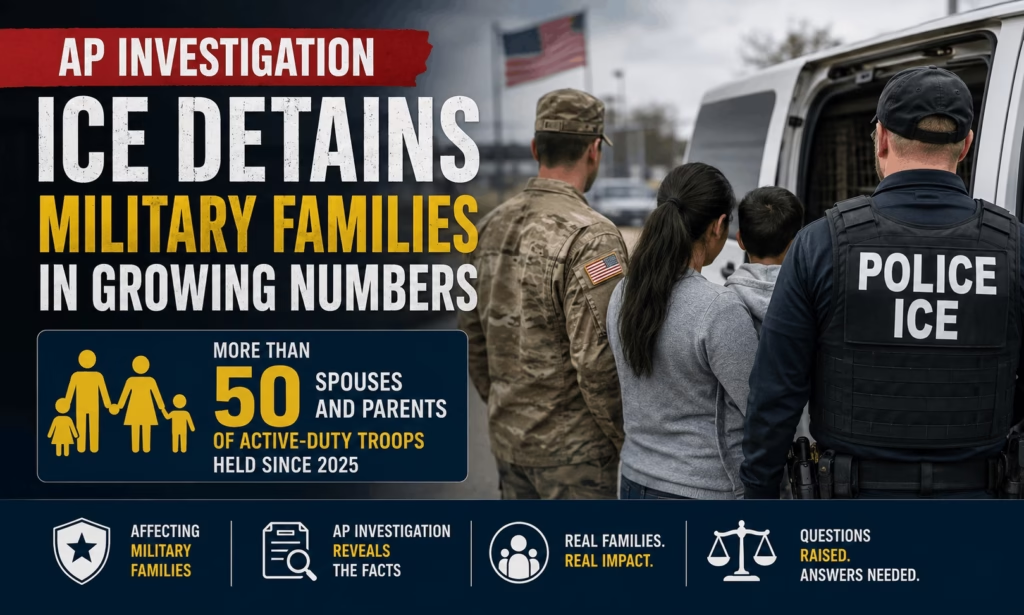
ICE Detained Military Families: An Associated Press investigation published this month has produced the first known accounting of a pattern that military families and immigration attorneys have been describing anecdotally for months. According to AP reporters Jack Brook, Safiyah Riddle, and Aaron Kessler, more than 50 parents and spouses of active-duty U.S. service members have been detained by immigration authorities since President Trump began his second term in January 2025, with at least six already deported, one who self-deported, and at least eight immediate family members of active-duty troops still sitting in federal immigration custody at the time AP completed its review.
The finding matters because these detentions cut directly against a bipartisan understanding that has generally shielded immediate family members of U.S. service members from deportation for decades, a protection built on the recognition that military readiness and family stability are closely linked. AP’s reporting makes clear this is not a formal policy reversal announced through a press release, but rather the practical result of the administration rolling back specific immigration protections for military families while pursuing a broader mass deportation agenda, with no single government agency tracking these cases as a distinct category before AP’s own reporting pieced the numbers together. We’ll be updating this article monthly as AP and other outlets continue reporting on this story and as any policy or legal changes develop.
What the AP Investigation Found?
The numbers at the center of AP’s reporting, published August 5, 2026, represent what the news organization describes as the first known accounting of this specific pattern, since the federal government does not itself track detentions of active-duty military family members as a distinct data category. AP’s review found more than 50 parents and spouses of active-duty service members detained since January 20, 2025, with outcomes ranging from ongoing detention to formal deportation.
| AP Investigation Finding | Figure |
|---|---|
| Parents and spouses of active-duty troops detained since January 2025 | More than 50 |
| Confirmed deportations among this group | At least 6 |
| Self-deportations among this group | At least 1 |
| Immediate family members still in federal custody at time of review | At least 8 |
| Publication date of AP investigation | August 5, 2026 |
Canada 50% Tariff 2026: Full List of Products That Could See Price Hikes
Why Is SNAP Enrollment Falling in 2026? Key Reasons Behind the Decline in SNAP Participation
Social Security Compassionate Allowances List: 14 Conditions Added
The Separate DHS Data on Veterans and Their Families
While the Department of Homeland Security told AP it does not maintain data specifically on active-duty troops’ family members, the agency has released a related figure covering military veterans and their immediate families, who separately qualify for certain immigration benefits. In a letter to several Democratic senators, DHS disclosed that between January 20, 2025 and January 26, 2026, immigration authorities detained 125 military veterans, placed 34 of them into formal removal proceedings, and arrested more than 150 immediate family members connected to veterans.
| DHS Disclosed Data (Veterans and Their Families) | Figure |
|---|---|
| Period covered | January 20, 2025 to January 26, 2026 |
| Military veterans detained | 125 |
| Veterans placed into removal proceedings | 34 |
| Immediate family members of veterans arrested | More than 150 |
Individual Cases Documented in the Reporting
AP’s investigation and related coverage from other outlets have documented specific cases that illustrate how these detentions have unfolded in practice. Army Staff Sergeant Alexis Jaramillo’s wife, Maisa Lopes Eliaser, a Brazilian national, was being held at the South Louisiana ICE Processing Center in Basile, Louisiana as of early August 2026, with Jaramillo photographed visiting her there on August 2. In a separate case reported by CBS News, Marine Corps veteran Adrian Clouatre’s wife Paola was detained during what was meant to be a green card application appointment, leaving Clouatre to care for their two young children, including a three-month-old still breastfeeding, on his own.
Another case involved Anh Dung Cong Tran, known as Tony, a 56-year-old man who came to the United States in 1990 through a program for children of American military personnel born in Vietnam, and whose own father and son both served in the U.S. military. Tran was deported in July 2026 after living in the United States for decades with regular immigration check-ins. In an earlier case that drew Coast Guard confirmation, the spouse of an active-duty Coast Guardsman was detained by Homeland Security Investigations agents directly on the government housing area of Naval Air Station Key West, while the family was in the process of moving onto the base.
Congressional Response to Military Family Detentions
The detentions have prompted a formal congressional investigation. Senator Mark Kelly of Arizona, joined by Senators Elizabeth Warren, Tammy Duckworth, and Dick Durbin, along with several House members including Representatives Chrissy Houlahan, Maggie Goodlander, and Delia Ramirez, opened an inquiry into what they characterized as the administration’s treatment of non-citizen service members, veterans, and military families. More than 60 total members of Congress joined the effort. Kelly specifically cited his own meeting with Maria Pelaez, the mother of an active-duty U.S. Marine, who was detained by ICE in Arizona and, according to Kelly’s office, remained in custody even after a judge granted her bond.
Lawmakers involved in the inquiry have also raised a separate concern beyond the detentions themselves, suggesting that information military families voluntarily provided to the federal government through routine service member paperwork may now be informing enforcement actions against those same families.
Why Military Families Were Historically Protected
For decades, immigration enforcement in the United States operated under a general, bipartisan understanding that immediate family members of active-duty service members and veterans warranted particular caution before detention or deportation, reflecting concern that destabilizing a service member’s family life could directly affect military readiness, morale, and retention. Mechanisms such as Military Parole in Place have specifically allowed certain undocumented family members of service members to remain in the country and pursue legal status without leaving, in recognition of the unique circumstances military families face.
AP’s reporting and testimony gathered by congressional investigators indicate this deference has eroded significantly under current enforcement priorities. Immigration law experts quoted in AP’s reporting noted that the very federal agency historically tasked with helping military family members obtain legal status has, according to internal government memos reviewed by reporters, begun referring some of these same family members for deportation instead.
FTC Refund 2026: Millions of Americans May Be Owed Money and Most Don’t Know It
What Military Families Facing This Situation Can Do
Immigration attorneys working with military families generally recommend documenting a family member’s connection to an active-duty service member as thoroughly as possible well before any interaction with immigration authorities, including marriage certificates, military dependent identification, and any prior Military Parole in Place applications or approvals. Legal advocates also stress that any family member with a pending or upcoming appointment tied to their immigration status, including green card interviews or benefit registration appointments on a military installation, should consult an immigration attorney beforehand given the documented cases of detentions occurring during precisely these kinds of routine appointments.
Service members themselves have limited formal tools available if a spouse or parent is detained, though congressional offices, including those involved in the ongoing investigation, have in some cases intervened directly on behalf of affected constituents, as seen in Senator Kelly’s engagement with the Pelaez case.
Official Resources for Military Families
| Resource | Purpose | Link |
|---|---|---|
| USCIS, Military Parole in Place | Official information on parole in place for military family members | https://www.uscis.gov/military/military-parole-in-place |
| ICE Online Detainee Locator | Search for a detained family member’s custody location | https://locator.ice.gov |
| Military OneSource | Free support and referral services for military families | https://www.militaryonesource.mil |
| American Immigration Lawyers Association, Find an Attorney | Locate immigration legal counsel | https://www.aila.org/practice/find-lawyer |
FAQs
How many military family members has ICE detained under the current administration?
An Associated Press investigation published August 5, 2026 found more than 50 parents and spouses of active-duty U.S. service members have been detained since January 2025, with at least six deported, one self-deported, and at least eight still in federal custody at the time of the review.
Are family members of military veterans also being detained?
Yes. Separately from the active-duty family figures, the Department of Homeland Security disclosed to Congress that 125 military veterans were detained between January 2025 and January 2026, with 34 placed into removal proceedings, and more than 150 immediate family members of veterans arrested during the same period.
Does having a spouse in the U.S. military protect someone from deportation?
Historically, immediate family members of active-duty service members and veterans received particular caution from immigration enforcement under longstanding bipartisan practice, including mechanisms like Military Parole in Place. However, AP’s investigation and congressional testimony indicate this deference has significantly eroded under current enforcement priorities.
What is Military Parole in Place?
Military Parole in Place is a USCIS process that allows certain undocumented immediate family members of active-duty service members, veterans, and some enlistees to remain in the United States and pursue a path to legal status without needing to leave the country first.
Why does the government not have exact numbers on these detentions?
The Department of Homeland Security told AP reporters it does not track detentions of active-duty military family members as a distinct data category, which is why AP describes its investigation as the first known accounting of this specific pattern, compiled through individual case reporting rather than an existing government dataset.
Has Congress taken any formal action on this issue?
Yes. Senator Mark Kelly and several Senate and House colleagues opened a formal investigation into the administration’s arrest, detention, and deportation practices affecting non-citizen service members, veterans, and military families, with more than 60 members of Congress ultimately joining the effort.
What should a military family do if a spouse or parent is detained by ICE?
Immigration attorneys generally recommend contacting an immigration lawyer immediately, using the ICE Online Detainee Locator to confirm custody location, and reaching out to the affected service member’s chain of command and, if needed, their congressional representative’s office, which has intervened directly in at least one documented case.
Conclusion
The Associated Press investigation has, for the first time, put a concrete number on a pattern that military families, immigration attorneys, and members of Congress had been describing case by case for much of the past year, more than 50 parents and spouses of active-duty troops detained, with real consequences already playing out in deportations and prolonged family separations. With a formal congressional investigation now underway and individual cases like Maisa Lopes Eliaser’s and Maria Pelaez’s continuing to unfold, this remains an active and evolving story rather than a settled one. We’ll be updating this article monthly as AP’s reporting continues, as the congressional investigation produces findings, and as individual cases reach resolution.
Student Loans and FAFSA 2026: Urgent changes every student needs to know
ACA Subsidy Cliff 2026: What Is It, Who Is Affected and Why Health Insurance Costs Are Rising
2027 HSA Contribution Limits Announced: IRS Confirms $4,500 and $9,000 Caps